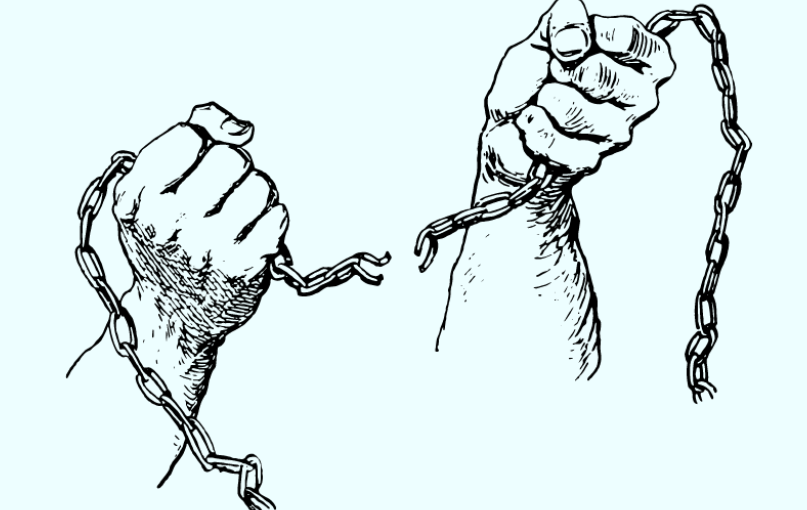
The Torah portion Miketz, Gen 41:1 – 44:17, tells of Joseph’s amazing journey from incarceration to second in command in Pharaoh’s court. This is a good time to reflect on incarceration and Judaism: the needs of Jews who are incarcerated as well as the responsibility of Jews in- and outside to address related issues. In addition, the holiday of Chanukah is calling us to consider our dedications, so this might be a good time to dedicate, as capacity allows, our time, energy, and financial resources to carceral issues.
In addition, a specific request to aid an incarcerated Jew who has been active in speaking up on his own and others’ rights, and experiencing retaliation in response. Please check out this recent essay from Ronald W. Clark Jr. —
Chapter 34 of Genesis begins with a woman going to visit neighbors. It is one of very few instances in Genesis — maybe the only one? — of an apparently friendly, non-transactional interaction with folks of the surrounding culture. And one of the few instances in Genesis in which a woman has any agency. This episode is part of the Torah portion Vayishlach (Gen 32:4-36:43). The commentary is inspired by Joni Mitchell and “The Last Waltz,” concert and film, as well as Dinah’s story
CONTENT WARNING: What follows is mostly about music and crossing boundaries of various kinds in contemporary society. But Dinah’s story cannot be separated from disturbing underlying topics, including misogyny, racism, and sexual violence.
UPDATED afternoon of 12/5/25: mostly edits to correct typos and awkward grammar; some new phrasing in the Joni Mitchell, Now and Then section and a few new paragraphs at the end. Apologies for any confusion… still thinking.
Existing in Public
In Genesis 34:1, Dinah, “went out [teitzei] to see the women of the land.” The single verse relating this scene describes Dinah as “daughter of Leah, whom she had borne to Jacob.” (More below on Dinah and her going out, and a little about her parents.)
This “going out” is the only verb attributed to Dinah and the only time that other women are mentioned in Chapter 34. One verb. One verse of agency. And no voice.
The text itself does not criticize Dinah for going out or denigrate the women she went to visit. But the consequences of this one woman exercising agency and existing in public for the space of one verse are dramatic and dire. This reverberates in so many aspects of US society today, and in history, where simply existing in public is understood by some as provocation:
walking or driving while Black;
being queer in public;
living with brown skin or other signs of “possible immigrant” status;
being “too Jewish” or Jewish in the “wrong place” or the “wrong” kind of Jewish;
playing sports without identifying strongly with one gender;
existing as a transgender person;
expressing support for Palestine;
appearing in any way that resists authoritarianism;
what we used to call “doing your own thing” among folks strongly committed to some other way of being.
At various points in US history, whatever white people performed on stage or dance floor was eventually accepted as mainstream, while “Black music” was/is continually viewed as dangerous and in need of policing by white nationalism:
Jazz. Here in Germany it become something worse than a virus. We was all of us damn fleas, us Negroes and Jews and low-life hoodlums, set on playing that vulgar racket, seducing sweet blond kids into corruption and sex. It wasn’t music, it wasn’t a fad. It was a plague sent out by the dread black hordes, engineered by the Jews. Us Negroes, see, we was only half to blame – we just can’t help it. Savages just got a natural feel for filthy rhythms, no self-control to speak of. But the Jews, brother, now they cooked up this jungle music on purpose. All part of their master plan to weaken Aryan youth, corrupt its janes, dilute its bloodlines.
…we was officially degenerate.
…And poor damn Jews, clubbed to a pulp in the streets, their shopfronts smashed up, their axes ripped from their hands. Hell. When that old ivory-tickler Volker Schramm denounced his manager Martin Miller as a false Aryan, we know Berlin wasn’t Berlin no more. It had been a damn savage decade.
–Sid, Black musician narrator, in Esi Edyugan’s Half-Blood Blues: A Novel Picador, 2011 p.78-79
In a somewhat similar vein, women’s and queer people’s existence continues to be viewed as dangerous in many quarters and in need of policing by cishet men and white nationalists.
Joni Mitchell, Then and Now
With US Thanksgiving, I am often reminded of “The Last Waltz” as a film and soundtrack, both of which have been important parts of my world for decades. And, most years, I re-discover how angry I still am at the film’s treatment of Joni Mitchell as an artist and human being. It is only in the last 10 or 15 years, that I’ve learned just how much of the film’s presentation was NOT what the original concert offered; instead, Martin Scorsese chose, and popular attitudes to women permitted, deliberate manipulation of concert footage in ways that denigrate Mitchell and every woman, in- and beyond the arts.
I wrote the above piece a few years ago, in a week associated with a different part of the Torah, and on the heels of Mitchell’s surprise appearance at Newport that year (2022). I recently updated some of this post’s language for clarity and to add a few new links.
This year (2025), I had the opportunity to attend a tribute to “The Last Waltz” at a music venue just outside of Chicago. In many ways it was a great concert and a terrific experience. However, unless I misunderstood his meandering words, the musician-emcee called Joni Mitchell a tramp while introducing “Coyote.” I think he believed he was being funny, and maybe he meant to illustrate double-standards that existed then and still operate. But I was mostly struck with how hard the world can still — after 50 years! — push back when many people are just trying to exist, live their life, and engage their art.
Defending and Celebrating “Going Out”
We only get his one verse, in the midst of such a wildly disturbing story, that tells of Dinah’s going out. And we don’t learn much, if anything, about the rest of the family engaging with local culture or making friends. Is the Torah trying to tell us how dangerous it is to be going out into the surrounding culture? If so, when did that emphasis come into the telling? And what might we learn by focusing on the importance of going out and what we miss if we fear it or are attacked for doing so?
UPDATE 12/5 afternoon, four paragraphs and image added here:
When Esau and Jacob meet, after decades apart, the Torah text includes dots above the word va-yishakeihu [and he kissed him] in Genesis 33:4: “Esau ran to meet him; he embraced him, flung himself upon his neck, and kissed him. And they wept.”
Va-yishakeihu with dots (Gen 33:4)
For centuries, Jewish teaching has used these dots to suggest that the text be read in opposition to its straightforward meaning: instead of kissing Jacob, Esau was insincere in his greeting or perhaps trying to bite or otherwise do Jacob harm. (Find the text and commentary at Sefaria.)
As part of the deliberate demonization of Esau, unsupported by the Torah itself, this dotted reading is one of my least favorite aspects of Torah commentary. It seems very like Scorsese’s use of interview footage to completely alter how viewers are introduced to Joni Mitchell. And all too resonant with dangerous propaganda through the ages. However, the dots also offer a powerful example of how Jewish tradition has always found a way to read with some skepticism, even change the text where warranted.
Jacob went out; Leah went out; Dinah went out. Maybe we, too, can go out into Torah readings that put us in better touch with our families, our neighbors, and the world at large. Where Torah has been weaponized, we can learn to acknowledge harm and promote better readings. And where our culture, in- and outside of Judaism, has tricked us into thinking the worst of others, maybe we can work to undo the propaganda.
NOTES
Dinah Went Out
Prior to Genesis 34, Dinah is previously mentioned only at her birth and naming (Gen 30:21). Dinah, daughter of Leah and Jacob, has no voice of her own in the text, and we never hear from Leah or any other women of Jacob’s household or the town regarding her fate. Instead, men act on and about Dinah: She is an object — of lust or love, depending on translation/interpretation — for the prince, who is seen lurking here in R. Crumb’s illustration —
Then Dinah is the object of various decisions and actions by the prince, his father, other men of the local town, and her own father and brothers. Over the centuries, Dinah’s “going out” has been variously interpreted as
involving herself — for better or worse, depending on the commentary’s perspectives and biases — in the existing culture;
spying on the women of the land;
showing off her wealth;
seeking women’s companionship in a non-romantic sense;
checking out the women as potential romantic partners;
seeking inappropriate attention, with some teachers insisting that a woman seeking any attention at all is inappropriate (and potentially dangerous);
acting forward, as Leah’s going out to meet Jacob (Gen 30:16) is often characterized, with the implication that women must be restrained;
simply moving through the world, which the text itself does not condemn, perhaps akin to Jacob’s going out to find his way (Gen 28:10).
**Alt Text: graphic frame for Gen 34:1-2 shows Dinah visiting congenially with a few women in what appears to be a public square, while the prince looks on from behind a nearby building column. R. Crumb’s Illustrated Book of Genesis uses Robert Alter’s 1996 translation: “And Dinah, Leah’s daughter, whom she had borne to Jacob, went out to see some of the daughters of the land. And Shechem, the son of Hamor the Hivite, prince of the Land, saw her…”
Commentary on Dinah’s Story
Rashi (11th Century CE France) notices that Leah previously “went out” (Gen 30:16): “like mother, like daughter.” Rashi adds a note about the need for men to subdue wives from public activity.
Ibn Ezra (12th Century CE Spain) says: AND DINAH WENT OUT. Of her own accord — as in: She did not ask her parents’ permission.
Ramban (13th Century CE Spain) says “bat Leah” is links Dinah to Simeon and Levi, who are also children of Leah and so are moved to avenge her [due to perceived defilement]
The Torah: A Women’s Commentary (CCAR Press, 2008) notes that Jephthah’s daughter “went out to meet him,” using the same yud-tzadei-aleph verb (Judges 11:34) with horrible consequences. That volume has more on Dinah. See also “The Debasement of Dinah” and “A Story that Biblical Authors Keep Revising” Dinah and Schechem” at TheTorah.com.
Some relatively contemporary notes on Dinah. While some people treat Anita Diamant’s novel, The Red Tent (St. Martin’s Press, 1997), as midrash, the author herself says it is historical fiction.
Note also that Leah goes on to live with Jacob on “the land,” while Rachel seems strongly linked to her family’s original home, “back there,” and dies on the road giving birth to the only child born in “the land.” (More on these aspects of the story found in this older post.)
Notes on “subdue it/her”
Rashi and Genesis Rabbah to Gen 34:1
Rashi cites Genesis Rabbah (4th Century, Talmudic Israel), which uses Gen 34:1 as proof text for why men should subdue their wives: Gen 1:28 tells humans to “…fill the earth and subdue it/her[mil’u et ha-‘aretzv’khivshuha…].” The Hebrew verb construction v’khivshuha uses the feminine direct object ha [it/her] to match the feminine noun ‘aretz. Commentary plays on that grammatical feature to read “subdue her [the woman],” rather than the more common “subdue it [the earth],” bringing Gen 34:1-3 as explanation: “the man subdues his wife so she should not go out in public, as any woman who goes out in public will ultimately falter.” Implication is that Dinah “faltered” by allowing herself to come in contact with Shekhem (Gen 34:2); depending on reading of va-y’aneiha, this means either that Dinah allowed herself to be “humbled” by consensual association with Shekhem or that she made herself vulnerable to physical attack or social violation by “going out,” i.e, simply being a woman in public space.
This is not a particularly polished post, but more of a set of musings or food for thought.
Leaving
There is a lot of talk about leaving, voluntary and through forced exile, in Genesis
Exile from Eden (Gen 3:24)
Cain’s exile (Gen 4:16)
God limits the span human life (Gen 6:4)
Flood leavings
— Noah, Naamah, and all leave earth for the ark (Gen 7:2)
— Raven sent out (Gen 8:7)
— Dove sent out (Gen 8:8)
— Noah/Naamah and all leave ark (8:16)
Scattering from Babel (Gen 11:9)
Terah and family leave Ur (Gen 11:31)
Abraham is told to leave [Lekh Lekha] (Gen 12:l)
The departure of Gen 12:1 — “from your land, from your kindred, and from your father’s house” — is sometimes treated as a single, decisive leaving for the Genesis story. And it is a key element in the story. But leaving, voluntary and forced, continues throughout the Genesis story.
This is a thorough but not exhaustive list of goings:
Abraham and Sarah leave for, and then from, Mitzrayim (Gen 12:10, 13:1)
Abraham’s and Lot’s families part (Gen 13:10)
— Lot’s folks settle near Sodom (Gen 13:13)
— Abraham and Sarah move-tent to Oaks of Mamre (Gen 14:1)
— War-related movements (Gen 14)
Hagar runs away and returns (Gen 16:6)
Some of Lot’s family leave Sodom (Gen 19:17)
Abraham and Sarah sojourn in Gerar (Gen 20)
Hagar and Ishmael are exiled (Gen 21:15)
Eliezer goes “back” to get Isaac a wife (Gen 24:1)
Rebecca leaves her family’s home to marry Isaac (Gen 24:58-59)
Ishmael and Isaac have, meanwhile, both settled near Beer Lahai Roi (Gen 25)
Rebecca “goes to inquire” (Gen 25:22)
Rebecca and Isaac sojourn in Gerar (Gen 26)
Jacob goes “back” to Rebecca’s family to marry (Gen 28:5)
Back There
The Lekh Lekha departure of Gen 12:1 is often read as thorough and decisive. Several rituals and some covenantal language suggest a serious break with the past is intended:
the dramatic, one-time Covenant of the Pieces (Gen 15),
the name changes for Abraham and Sarah (from Abram and Sarai, Gen 17),
the on-going covenant of circumcision commandment (Gen 17) for those with penises and, presumably, their families.
In the portion, Chayei Sarah, however, Abraham sends to his people back home to find a wife for Isaac (Gen 24); later, Jacob spends two decades in the old country, marrying two women from his grandparents’ kindred, with most of the children born outside “the land” (Gen 29ff)…
Chayei Sarah contains a lot of “There=שם “
Abraham is old and telling the elder servant of his household to go “to my country, and to my kindred (or: the land of my birth) to get a wife for my son Isaac” (Gen 24:1-2). The servant (later identified as Eliezer) asks what to do, should he find a potential wife who doesn’t consent to return with him: Should he bring Isaac back…
אֶל־הָאָרֶץ אֲשֶׁר־יָצָאתָ מִשָּׁם׃ …to the land from which you came? (Gen 24:5)
פֶּן־תָּשִׁיב אֶת־בְּנִי שָׁמָּה On no account take my son back there (Gen 24:6)
וְלָקַחְתָּ אִשָּׁה לִבְנִי מִשָּׁם …get a wife for my son from there (Gen 24:7)
לֹא תָשֵׁב שָׁמָּה …do not take my son back there (Gen 24:8)
In contrast to Gertrude Stein’s “no there there,” there is a lot of “there”–שם — here.
Commentators across centuries have explored many “there” details: Did Abraham intend a specific place? Specific kin? Why not encourage marriage with neighbor families? Was the union meant to seal some kind of family reconciliation? One of the most salient answers, for present purposes, stresses basic there-ness:
Abraham was sent away from his country, kindred and father’s house, so that he should have no further contact with them and be a stranger in a foreign clime…Similarly, his son must not marry [a Canaanite]. For this reason he was called Abraham the Hebrew, “that all the world was on one side and he on the other” (ivri means in Hebrew “a person from the other side” usually taken as a reference to Abraham’s origins in Mesopotamia — on the other side of the river). –Nehama Leibowitz, New Studies in Breishit,, p. 220
Belonging
Abraham is ivri, from there. As in “not from here.” A key experience that his descendants will repeat — in Mitzrayim, in the wilderness, in later exile. At this point in Genesis, Abraham and his family are becoming separate. That separateness will play an important role in the Exodus and, later, Babylonian Captivity. Meanwhile, though, after Rebecca comes “from there” to marry Isaac and raise their sons, the situation will be reversed for the next generation, with Jacob finding his wives and fathering children in the land where, according to Leibowitz and so many others, God intended there should be “no further contact.”
This portion mentions Abraham’s “seed” and how that seed is connected to a future in a “land I will show you”? In the Haftarah for the portion Lekh Lekha, two weeks back, we learned that covenant and seed are connected through God’s friendship — or “beloved” relationship — to Abraham (Isaiah 41:8). In this way, the future is being crafted through a visioning process that involves leaving, mourning, leaning still toward “back there,” and seeking to belong in a new place.
A few related questions to consider:
Where, if anywhere, does Abraham belong? Does belonging involve purchase? vision?
What does this mean for our own belonging?
How much of what’s “back there” is essential to our life today? How much needs to be left?
Additional questions: How do specific attributes of a neighborhood, current or “back there,” influence our choice of where to dwell? What is our responsibility, if any, to a neighborhood in which we no longer reside?
Akara
Sarah, Rebecca, and later Rachel are all called “akara,” a relatively rare word in the Torah. It is often translated as “barren” but also related to uprooting and, in later Hebrew, to “essential.”
Here is a presentation from a few years back on this word and what it might mean for understanding all the leaving and uprooting in Genesis: “Rachel and Joseph: Rooting, Uprooting, and the Essence of Judaism” at the Global Shavuot Teach-In 5784 Torah of Freedom for All.
The full-slide version includes graphical elements (no illustrations, just decorative and organizational graphics.)
Imagery of Abraham as “God’s friend” offers a path for exploring relationship with the divine, linking themes of Lekh Lekha (Genesis 12:1-17:27) and its prophetic reading (Isaiah 40:27-41:16) to later Jewish text and post-collapse struggle (touched on in last week’s post, Where Now?“).
Avraham Ohavi [My friend, lover, beloved]
The expression “Avraham ohavi” is found in Isaiah 41:8:
But you, Israel, My servant, Jacob, whom I have chosen, Seed of Abraham My friend — Revised JPS via Sefaria; more translations/notes
This verse is part of the haftarah for Lekh Lekha. The same expression is also found in Sefer Yetzirah [Book of Creation, or Book of Formation] where “Abraham, God’s friend” is linked to covenant and seed, as in Isaiah, and also to mystical/meditative connection with the divine:
The radical assertion of Sefer Yetzirah is that the divine-human relationship created via the meditative/magical practices of the Book of Creation is worthy of the language of covenant.
…God loves Abraham because Abraham learns how to play with creative magic and contemplation the way God does.
It is Abraham’s engagement with the cosmic mystery that God admires and rewards. Just as Sefer Yetzirah redefines the Temple as the cosmos, it redefines covenant as the development of cosmic consciousness. This covenant extends, by implication, to the reader of teh text, who now has also conducted the ritual of letter combination and world-temple visualization. The conclusion of the book, by implication, grants covenant to the one who has just read and practiced it. –Rabbi Jill Hammer, Return to the Place: The Magic, Meditation, and Mystery of Sefer Yetzirah (Ben Yehuda Press, 2020), p.261
Before Abraham turns up in the final verse, Sefer Yetzirah does not feature narrative characters. Water, breath, fire, Hebrew letters, Wisdom, and God-YHVH act or are acted upon. Aspects, or rulers of, space, time, and living bodies are identified — called in one section “Dragon,” “Wheel,” and “Heart,” which sound like possible character names — but action and object are not clearly delineated. In fact, R’ Hammer cites Karen Barad’s theory of agential realism, suggesting that all involved in Sefer Yetzirah are intra-actors.
So, what is Abraham — or any narrative character at all — doing at the close of Sefer Yetzirah?
R’ Hammer explores the choice of Abraham — rather than, e.g., Moses or Solomon — as “exemplar who ends the story.” She suggests that Abraham, as a spiritual forebear of Christians and Muslims as well as Jews, sets the book “beyond tribe”; in addition, Abraham’s biblical story centers individual, rather than collective or institutional, relationship to God (p.257). Moreover: “Abraham becomes the reader, the seeker, the adept who follows in God’s footsteps” and “opens the elemental channels, the paths of Wisdom. God’s friend becomes a creator, a worker of the life-force” (p.256, p.262).
Post-Collapse Relationship Building
“Facing Collapse Together” study group — with Rabbi Jessica Rosenberg, Derekh Travers, and Dean Spade — offered lots of food for thought. I was particularly struck by R’ Jessica’s teaching about the Jewish calendar recognizing institutional collapse with Tisha B’Av and then moving into smaller, shakier relationships through the high holidays and Sukkot.
The study group led me to the “Calendar Notes for a Summer of Collapse” series of ponderings. R’ Jessica also offered a vision of “Spiral Time in Collapse,” concluding:
…every day, trying to live, choosing our stories for the sake of protecting and cherishing life, choosing each other, protecting and cherishing each other. To be in as honest and specific a story of the past, and living into as clear a vision of the future as we can, together. — R’ Jessica Rosenberg, “Spiral Time in Collapse” Dvar for Erev Rosh Hashana 5786, World to Come Twin Cities
Now, I am stumbling through what it means to read Torah in collapse, struggling to find what is fresh and nourishing in this still-new year, amid so much that is old, exhausted, and painful.
R’ Hammer’s approach to Abraham and Sefer Yetzirah offers heartening possibilities: Maybe we can read Torah this year in ways that build on our smaller, shakier relationships — within or apart from our collapsed/ing institutions; maybe we can emulate the creative energy of Abraham in Sefer Yetzirah, walking and co-creating with the divine without denying imperfection and brokenness around us; maybe we can lean into covenant born of friendship.
See also “Planting Trees, Stretching Glitter” about the eshel in parashat Vayera (Gen. 18:1-22:24) and the need to pause between big, dramatic moments in Torah/life.
Sefer Yetzirah 6:7
Some versions of Sefer Yetzirah close the final chapter before verse 7, ending with Abraham and covenant but not the friend imagery. (See earliest extant version at Sefaria and earliest recoverable text at Open Siddur.)
Here are two versions which include verse 7:
כשהבין אברהם אבינו וצר וצרף …נגלה עליו ” עשאו אוהבו
And when Abraham our father understood transformed and transmuted… God appeared to him and made him God’s friend —Sefer Yetzirah 6:7, Rabbi Jill Hammer translation
כשבא אברהם אבינו ע”ה הביט וראה והבין … נגלה עליו אדון הכל יתברך…
וקראו אברהם אוהבי
When the patriarch Abraham comprehended the great truism, revolved it in his mind…the Lord of the Universe appeared to him…and called him his friend —Sefer Yetzirah 6:7, Gra Version, Kalisch (1877) translation
And when Abraham, our father, may he rest in peace, looked, saw, understood…Immediately there was revealed to him the Master of all, may His name be blessed forever…
and He called him ‘Abraham, My beloved’ —Sefer Yetzirah, 6:7, Gra Version, Kaplan (1997) translation
R’ Hammer uses the third-person “ohavo” in Hebrew, while the Gra version uses the first-person “ohavi.” Hammer and Kalisch use English third-person: “God’s friend”/”his friend.” Kaplan makes the reference to Isaiah explicit, using quotation marks and the first person: “My beloved.” (Kalisch and Kaplan translations at Sefaria; Hammer, Return to the Place, p.256).
Sefaria’s English translations offer no variety; other options, to suggest some different flavors, include Mia amato (Esperanto), qui m’aimait or mon ami (French), meines Freundes (German), and haver (Yiddish). BibleHub (Christian site) presents 38 translations into English, mostly relying on “my friend”:
28 opt for “Abraham, my friend”
2 use “my friend Abraham”
2 use “Abraham, My lover” (1898 Young’s Literal and Literal Standard Version)
1 version (1995) chooses “Abraham, my dear friend”
3 use “beloved / beloued” (Coverdale 1535, Bishop 1568, Julia E Smith 1876)
1 uses “whom I have loved” (Brenton’s 1844 translation of Greek Septuagint*)
1 uses “friend, whom I have strengthened” (1933 Lamsa translation from Aramaic**, incorporating the expression “strengthened” [וּמַתְקֵיף לֵיהּ / וַיְחַזְּקֵהוּ] from verse 7)
*Greek: σπέρμα Ἀβραὰμ ὃν ἠγάπησα. See JPS commentary below.
** Aramaic uses “r’chimi” [זַרְעֵהּ דְאַבְרָהָם רְחִימִי]; Jastrow dictionary says r’chem = “beloved, friend, lovable.” The final phrase seems to incorporate an expression from verse 7 — “strengthened with nails” [וּמַתְקֵיף לֵיהּ בְמַסְמְרִין / וַיְחַזְּקֵהוּ בְמַסְמְרִים] — which Rashi explains refers to how nails reference Shem, a blacksmith who made nails and bars for the Ark: “Shem strengthened Abraham to cleave to the Holy One, blessed be He, and not to move.”
“Seed of Abraham My Friend. Hebrew ‘ohavi; literally, “Who loves Me.” Ibn Ezra stressed the active force of the verb and distinguished it sharply from the passive sense (“who is loved by Me”); cf. Avot de-Rabbi Natan, B, 43). A reversal or softening of this theological point occurs in the Septuagint, where a relative clause is used (“whom I have loved”). 2 Chronicles 20:7 speaks of the land given to the “descendants of Abraham,” God’s “friend.” These variations reflect ongoing theological considerations and applications. The tradition of God’s love for Abraham occurs in the Septuagint a Isa 51:2, but not in the Masoretic tradition. God’s love for Israel occurs in Isa 43:4.” — The JPS Bible Commentary: Haftarot, 2002. Michael Fishbane. Commentary on verse 41:8, p.21
Sotah 31a:7
The Gemara asks: And with regard to Abraham himself, from where do we derive that he acted out of a sense of love? As it is written: “The offspring of Abraham who loved Me” (Isaiah 41:8).
Tractate Kallah Rabbati 8:1
ברייתא
ר׳ מאיר אומר כל העוסק בתורה לשמה זוכה לדברים הרבה ולא עוד אלא שכל העולם כלו כדאי הוא לו. נקרא ריע [אהוב] אוהב את המקום אוהב אה הבריות.
BARAITHA. R. Meir said: Whoever occupies himself with the Torah for its own sake merits many things; nay more, the whole world is beholden to him. He is called friend, *Cf. Isa. 41, 8, where it is used of Abraham. beloved, *Cf. Prov. 8, 17, I love them that love me. a lover of the All-present and a lover of his fellow-creatures, one who gladdens *Cf. Judg. 9, 13, [wine] which cheereth God and man. The Torah is compared by the Rabbis to wine. the All-present and his fellow-creatures.
Presentation title page: “Matir Asurim: Introduction to the Jewish Care Network for Incarcerated People,” Yom Kippur 5785 — Virginia Avniel Spatz. + Tzedek Chicago logo
Some of us have been worshiping together for much of the day. Others may be joining from another context. Either way, I hope this hour will bring focus to one way we can engage in teshuvah/repair for the coming year. The basic concept for this session is that I was asked to share a little about my volunteer work with the organization, Matir Asurim: The Jewish Care Network for Incarcerated People, and bring some text to link that work with Yom Kippur.
Overview, Basics, and Contacts
[SLIDE 2]. The planned shape of the session is:
Basics and contact information for myself and the organization Matir Asurim
Text exploration: Genesis 44
Matir Asurim Guiding Principles
Back to Genesis 44
Thoughts for Yom Kippur and into 5785
So, let’s get started with some basics
[SLIDE 3] Matir Asurim — “One Who Frees Captives”
Who We Are: “We are a collection of Chaplains, Rabbis, Cantors, Kohanot/Hebrew Priestesses, advocates, activists, volunteers, loved ones of incarcerated people, and people with direct experience of incarceration. We are an all volunteer group who began meeting in 2021. We live and work across Turtle Island, in territories, cities, and rural settings of the US and Canada.”
I’ve been volunteering with Matir Asurim for close to two years,
producing the monthly e-newsletter,
serving as a penpal/chevruta partner with an incarcerated Jew,
helping to create resources for readers who are incarcerated,
helping craft materials for outside readers around incarceration,
producing some additional programming,
and working on organizational infrastructure.
We’ll get into some more specifics a bit later. Meanwhile, some contacts:
[Summary] Joseph is 12th of 13 siblings in the family of Jacob, Rachel, Leah, Bilhah, and Zilpah. In his youth, he was the favorite of his father, Jacob, and an annoyance to the rest of the family. So, Joseph’s brothers attempt to get rid of him. Their scheming takes an odd turn, however, and, although his family does not know it, Joseph becomes a powerful government leader in Mitzrayim, second in command to Pharaoh.
When famine strikes in Canaan, Jacob sends the brothers down to Mitzrayim, where grain is plentiful, to beg food. Joseph, still unrecognized by his brothers, treats the brothers to a feast at the palace and grants the requested supplies.
Joseph also orchestrates a criminal charge against the youngest brother – thus creating a situation in which the older siblings can again harm a younger brother, or they can act to avoid such harm.
Genesis 44 starts as the brothers leave the palace with the supplies.
[SLIDE 5] Genesis 44 Revised (2023) Jewish Publication Society translation, via Sefaria
1) Then he [Joseph] instructed his house steward as follows, “Fill the men’s bags with food, as much as they can carry, and put each one’s money in the mouth of his bag.
2) Put my silver goblet in the mouth of the bag of the youngest one, together with his money for the rations.” And he did as Joseph told him.
3) With the first light of morning, the men were sent off with their pack animals.
4) They had just left the city and had not gone far, when Joseph said to his house steward, “Up, go after those men! And when you overtake them, say to them, ‘Why did you repay good with evil?”…
[The house steward follows Joseph’s orders, going after the brothers and accusing them of stealing the goblet.]
12) He searched, beginning with the oldest and ending with the youngest; and the goblet turned up in Benjamin’s bag.
13) At this they rent their clothes. Each reloaded his pack animal, and they returned to the city.
[SLIDE 6] (Genesis 44 cont.)
14) When Judah and his brothers reentered the house of Joseph, who was still there, they threw themselves on the ground before him.
15) Joseph said to them, “What is this deed that you have done? Do you not know that a man like me practices divination?”
16) Judah replied, “What can we say to my lord? How can we plead, how can we prove our innocence? God has uncovered the crime of your servants. Here we are, then, slaves of my lord, the rest of us as much as the one in whose possession the goblet was found.”
17) But [Joseph] replied, “Far be it from me to act thus! Only the man in whose possession the goblet was found shall be my slave; the rest of you go back in peace to your father.”
18) Then Judah went up to him and said, “Please, my lord, let your servant appeal to my lord, and do not be impatient with your servant, you who are the equal of Pharaoh. [Link to bilingual English/Hebrew at Mechon-Mamre]
pray let your servant speak a word in the ears of my lord,
יְדַבֶּר־נָא עַבְדְּךָ דָבָר בְּאׇזְנֵי אֲדֹנִי
and do not let your anger flare up against your servant,
וְאַל־יִחַר אַפְּךָ בְּעַבְדֶּךָ
for you are like Pharaoh!
כִּי כָמוֹךָ כְּפַרְעֹה׃
va’yigash eilav…
This expression, va’yigash eilavis, is worth considering. It comes up in midrash about this Torah story and it appears in Maimonides vocabulary discussion.
Jewish Teachers Discuss “Approaching”
[SLIDE 8] This is a small portion from Maimonides Guide for the Perplexed. Part 1 has many chapters focusing on Hebrew vocabulary.
BTW, I highly recommend checking out Maimonides’ vocabulary chapters, if you can. Sefaria offers free bilingual text with live links to the Tanakh verses mentioned, and I find it a worthwhile exercise to spend some time with the words Maimonides discusses.
Part 1, Chapter 18 is about three similar words: Karov, Naga, and Nagash
קרוב – נגוע – נגוש
Maimonides writes:
“THE three words karab, “to come near,” naga‘, “to touch,” and nagash, “to approach,” sometimes signify “contact” or “nearness in space,” sometimes the approach of man’s knowledge to an object, as if it resembled the physical approach of one body to another.”
He gives examples of each usage, including Gen 44:18: “…And Judah drew near (va-yiggash) unto him”
While we pursue the exchange between Judah and Joseph, it’s worth keeping this expression and the Hebrew vocabulary in mind, more generally: What does it mean to be near to another person in terms of physical space and knowledge of another?
A number of teachers over the centuries have derived lessons from Genesis 44:18. Here are two…
[SLIDE 9] va’yigash eilav yehudah…
It is asked: Judah and Joseph are already in the same room. So, why does the text tell us that Judah vayigash, “drew near” or “came in contact”?
One answer: Jacob ben Asher says:
The last letters of these three words — vayigaSH eilaV yehudaH,shin-vav-hey — spell “shaveh, שָׁוֶה [equal].” Judah’s step forward changes the dynamic, allowing the brothers to speak directly, as equals.
Another answer: The 18th Century teacher, Or Hachayim, from Morocco, cites Prov 27:19: “As face answers to face in water, So does one person’s heart to another”
Building on his teaching, we can see Judah’s step forward as an attempt to create a face-to-face encounter. This was a struggle for Judah, to step across apparent cultural differences and the gap in their positions. The result, ultimately, was reconciliation between the brothers.
This principle of seeking face-to-face interaction can be useful for the season of teshuvah to consider when taking steps in interpersonal reconciliation.
It is also a guiding principle for Matir Asurim as an organization.
Matir Asurim Guiding Concepts
[SLIDE 10] Panim-el-Panim, seeking face-to-face approach, is a guiding principle of Matir Asurim: “Seeking ‘face-to-face’ interactions, despite difference, distance and bars; approaching one another as equals and striving to work in genuine relationship.”
This shapes our penpal relationships, our creation of resources for those who are behind bars, as well as any advocacy on legislation or change of practices, regulations, and conditions inside.
Matir Asurim seeks to provide resources that reflect realities in carceral facilities which often include circumstances that contradict assumptions in much Jewish teaching
reciting prayers or reading Torah right next to toilets;
reciting daily prayers upon waking, which might not align with shacharit, morning prayers, at all;
figuring out how to create community in isolation, when so much of Jewish life assumes access to community (not exclusively an incarceration issue, but a BIG challenge for Jew who are incarcerated)
There are enormous challenges to organizing across bars, and we know that people inside are counting on those of us on the outside to organize and advocate where they cannot.
Still, it’s crucial to take our lead from incarcerated people and those who have experienced incarceration.
All people are created in the image of the Divine.
We all carry a spark of divine goodness as well as the capacity for creative action and transformation.
Teshuva [repentance/return]:
We believe in human resilience and transformation, in our ability to make amends after experiencing and/or perpetrating harm.
We practice this relationally as conflict arises within our organizing, and also strive to create a world that uplifts restorative accountability processes rather than punishment.
Refua Shleima [Complete Healing]:
We work towards collective healing and wholeness, striving to restore balanced relationships within the broader interconnected web of creation and to heal the traumatic effects of white supremacy, colonization, and other systems of oppression that affect our minds and bodies.
Learning from every person:
Learning from every person requires honoring the contributions and voices of people who have been systemically silenced, including through incarceration. In our conversations, we strive to hold awareness around differences in identity and power dynamics.
Kol Yisrael Aravim Zeh Bazeh
[All Jews Are Responsible, One to the Other]/Communal Responsibility:
“All Yisrael is responsible, one for the other.” Jews have many universalist obligations, but we also have a special duty to other Jews.
A little more on this last principle —
[SLIDE 12] Kol Yisrael Aravim Zeh Bazeh
Matir Asurim works with non-Jewish individuals and organizations on issues, trying to address needs of folks who are incarcerated and returning from incarceration in both the US and Canada.
Many non-Jewish groups are larger and better equipped to cope with more general issues, such as solitary confinement and the death penalty. We are also trying to link up with other affected groups regarding what is often called “religious diet.”
But we also focus on specifically Jewish needs: Trying to ensure that incarcerated Jews and those exploring Judaism have access to penpals and spiritual resources. In some carceral facilities, Jews are still offered a Christian bible and told to “ignore the end.” Trying to supply more appropriate resources is one goal. We also seek to fill requests for obtaining a tallit or tefillin – often an issue for those who are not recognized by Aleph (the biggest Jewish organization working in prisons, which provides resources for some Jews but not all).
[SLIDE 13] At a more basic level, we seek to increase awareness in Jewish communities that Jews DO experience incarceration and that we cannot treat incarceration as something that happens to other people.
This awareness also leads, in turn, to more general concerns about incarceration and the toll it takes on individuals, families, and society….
And that takes us back to Maimonides’ idea that “coming near” can be a matter of knowledge as much as one of physical nearness.
Back to “Coming Near”
[SLIDE 14] Back to Genesis 44
[Summary] Judah approaches Joseph and relates the brothers’ previous visit to Mitzrayim for food rations, when Joseph insisted that they return with their youngest brother. Judah includes in his tale the fiction, from years earlier, of a brother killed by a beast and their father’s real grief over the loss. Judah says that incarcerating Benjamin would increase Jacob’s pain and so offers himself as captive instead. At this point, Joseph can no longer restrain himself, clears the room of everyone except his brothers, weeps loudly, and reveals himself.
Gen 45:4-5 – Fox (Schocken) translation:
Then Yosef said to his brothers: I am Yosef. Is my father still alive?
But his brothers were not able to answer him,
for they were terrified before him.
Yosef said to his brothers:
Pray come close to me! [geshu-na eilai גְּשׁוּ־נָא אֵלַי]
They came close. [va’yigashu וַיִּגָּשׁוּ]
He said: I am Yosef your brother, whom you sold into Egypt.
This time, the same verb, nagash, that we saw in Gen 44:18 is used by Joseph to invite approach, and the brother comply. Joseph invites the brothers to hear a truth they previously did not know even though they did know they had a part in causing harm.
In the Torah, Joseph will go on to explain that it’s all good, because even though the brothers meant ill, God meant to put Joseph where he ends up. Still we can consider this verse and what it means for the brothers to hear from Joseph about his direct experience. They come close and learn something they did not know but MUST if they are to understand Joseph’s life and their own roles in the wider world which also includes incarceration as a regular part of its function.
There are ways we all can learn more about the role incarceration plays in our history and our society now and how it impacts individuals and families.
We can opt to get closer to individuals who are or have been incarcerated.
We can also opt to approach through general learning.
[SLIDE 15] They came close: approaching as a matter of knowledge
Explore the complex, interrelated stories of racism, enslavement, and incarceration; of colonialism, displacement and destruction
Learn about the over-representation of Indigenous people in US and Canadian carceral systems
Learn about the Incentive System in the Canadian carceral system
Learn about the Exception Clause in the 13th Amendment to the US Constitution
Learn about the “Auburn system” of incarceration, which predates the US Civil War and the 13th Amendment. We have a video and transcript coming soon about Freeman’s Challenge — and I recommend the book….
One of the things that Robin Bernstein, author of Freeman’s Challenge, says she was trying to do with her book is to stop letting the North off the hook in terms of responsibility for our carceral state. Many of us associate exploiting prisoners for profit with the US South and Reconstruction. But her book describes a prison for profit system that pre-dates the Civil War and originates in the North….
For me, learning about the Auburn system, which originated in upstate New York, was a real shift in my thinking. So, coming on that verse, Gen 45:5 — where Joseph says, “I am the one you sold into imprisonment,” really rings new.
More details on some of the topics above, and some related Jewish texts, are available on Matir Asurim’s Resources page — originally prepared for Passover, but also more widely applicable. For more on Freman’s Challenge, visit this page.
by what can we show ourselves innocent? וּמַה־נִּצְטַדָּק
God has found out your servants’ crime! הָאֱלֹהִים מָצָא אֶת־עֲוֺן עֲבָדֶיךָ
Here we are, servants to my lord, הִנֶּנּוּ עֲבָדִים לַאדֹנִי
so we, גַּם־אֲנַחְנוּ
so the one in whose hand the goblet was found. גַּם אֲשֶׁר־נִמְצָא הַגָּבִיעַ בְּיָדוֹ
[SLIDE 17] When Joseph orchestrates the threatened punishment of Benjamin alone, Judah says “God has found out your servants’ crime!” – ha-elohim, matza et-avon avdeikha
He then repeats the same verb, to find [mem-tzadei-aleph], and offers this poetic statement of collective responsibility:
Many teachers note that Judah seems to be acknowledging the brothers’ long-ago crime. And that verb, mem-tzadei-aleph, finding, might point us to things we might find we are complicit in, like living in a carceral state that relies on ideas of “public safety” leading to people being locked up and tortured.
Judah’s statement — “so we, so the one in whose hand the goblet was found” or “the rest of us as much as he in whose possession the goblet was found” points to an understanding of collective responsibility not unlike what we recite throughout Yom Kippur — when one of us commits a crime, we, all of us, who permitted the conditions that lead to crime, are the ones who sinned.
What name of God is an anchor for you through this period of ever-growing mourning? A recent study session* asked participants to focus on this question, based on text from Psalm 16:8:
Shiviti YHVH l’negeditamid
“I am every mindful of the divine presence”
or “Divine presence is in front of me always”
Participants shared many names — Shekhinah [indwelling presence], Ruach Ha-olam [spirit/breath of all], Ein Sof [without end], “Matir Asurim — the one who releases the bound,” HaTzur (the Rock)….All that came to mind for me was: “Eikha?! [How?!]” —
guide me in Your true way and teach me, for You are God, my deliverer; it is You I look to at all times.
Later, I was reminded of another text, one which relates in a round about way to the Joseph story — from the current Torah reading cycle — and to my own confusions these days….
Joseph and “Your Own Pit”
Proverbs 5:15-17 says:
15) Drink water from your own cistern [bor-kha], Running water from your own well.
16) Your springs will gush forth
In streams in the public squares.
17) They will be yours alone, Others having no part with you
This image from Proverbs echoes language in the Joseph story: His brothers “took him and cast him into the pit [ha-bor]. The pit was empty; there was no water in it” (Gen 37:22).
Commentary on the Proverbs passage links water to Torah and describes an empty pit as a new learner:
R. Akiva says: It is written: “Drink waters from your pit.” A pit, in the beginning, is unable to supply a drop of water of its own, containing, as it does, only what is put into it. So, a Torah scholar, in the beginning, has learned and reviewed only what their teacher has taught them.
“and flowing waters from your well”: Just as a well flows living waters from all of its sides, so, disciples come and learn from the “flowing” Torah scholar. And thus is it written: “Your fountains will spread abroad.” Words of Torah are compared to water. Just as water is life for the world, so, words of Torah, as it is written (Proverbs 4:22) — Sifrei Devarim 48:5
I am sure there is commentary linking this passage to the Joseph story….
…if anyone knows, please advise. Otherwise, I’ll look it up and update….
At the time of this incident, Joseph was young, still what we now call a teenager. And his behavior to his family does seem, at least on the surface, quite immature. So, it is tempting to view him as without Torah yet.
But, many young people have absorbed Torah in all sorts of ways. And different commentary, based on the expression “ben zekunim” (Gen 37:3), says that Jacob had been teaching Joseph “Torah of Exile,” learned from Shem and Eber. (More here.) So, what I’m thinking THIS WEEK — who knows what is to come — is that maybe Joseph did not yet have his own Torah.
And that leads me, as very little in this world does not, to Star Trek.
“I fly the ship”
I am still catching up on Star Trek: Strange New Worlds and recently saw Season Two, Episode 4, “The Lotus Eaters” (originally aired: July 6, 2023). In this episode, the whole Enterprise crew has lost their memories (but not skills), and the ship’s pilot is trying to remind herself of her role.
I’ve shared this to start at 46 seconds in —
WARNING: The only real violence in the last 3 minutes of this clip is to, and from, some space rocks. But the first 45 seconds are very violent and, on their own, add little to the scene with the pilot. So, view with that caution in mind, please.
When Ortegas yells at the ship’s computer — which she does not recognize, due to the odd memory losses, and so addresses as “miss” and “ma’am” — I was right there with her: “Stop the rocks!”
“Yes, ma’am, please, right now: Stop the rocks!” seems very close to what I’m yelling at civic leaders, at Jewish communities, at the universe, at God. All day. Every day.
So, I was immensely moved by her gradual realization that she might be able to do something to improve the situation, for herself and others: “I’m Erica Ortegas, and I fly the ship!”
Earlier in the episode, Ortegas is not pleased to lose a very rare opportunity for an away mission… with its chance to wear a spiffy fur-like hat in the local culture’s style. Her annoyance is presented mostly as a question of boredom. But don’t we all ask ourselves why we don’t get to be on the fun mission instead of stuck with work based on choices we made long ago? or maybe based on how others view us and our skills? I really resonated with her frustration when told she was needed on the ship instead.
I hope Ortegas gets her away mission (although some do point out the perils of being a red-shirt in such circumstance). But I also loved watching her figure out that she could, indeed, do something other than yell about the rocks.
“I am… and I…”
On ordinary days, it can be a struggle to figure out what we can contribute to the world at any moment, however small and unworthy or huge and daunting it may seem. On days when space rocks are bombarding the ship and no one seems in charge… those are the days when all I seem able to manage is a cry of Eikha!?
Some days the answer is: well, I can empty the dishwasher or clean the bathroom. Or, I can answer this letter from a friend or send a gift for the neighbor’s new baby. Some days the answer is: I can assist a colleague in an important electoral campaign, or I can join a protest, or I can share news that seems crucial but ignored. And sometimes, the answer might be: I can sit right here until I figure out what it might mean to “plot a course” for myself and others.
And that brings me back to Psalm 25: Let me know. Teach me. Show me. Guide me.
It is painful to sit with the uncertainty while a crisis unfolds. But maybe sometimes getting to one’s own Torah means staying with the question: “I am Virginia Spatz, and I ask ‘How?!'”
In the Book of Genesis, Rachel steals the teraphim that were her father’s (31:19). Meanwhile, Laban accuses Jacob of stealing “my gods [elohai]”; Jacob responds, speaking of “elohekha” [your gods], using Laban’s term; and a tent-by-tent search is conducted (Gen 31:30-33). Rachel and the teraphim then re-appear in Gen 31:34-35. Why “elohim” when it’s Jacob and Laban, and teraphim only when Rachel is around?
…The word “teraphim” is used three times in Rachel’s presence, and then never again in the Torah. In the prophetic books, there are a dozen more mentions of teraphim (Judges, Samuel, Kings, Ezekiel, Hosea, and Zechariah). “Elohim” is grammatically plural and means both (plural) gods or judges and (singular) name of God of Israel….
Many would attribute the shift in language to different source texts. Perhaps, though, vocabulary change indicates fundamental differences in experience. Genesis itself doesn’t tell us what the elohim/teraphim meant to any of the individuals or the households involved. But, we do find a few clues in the text.
Two relationships
After the search fails, Jacob and Laban do not again mention the elohai, which remain abstract, another element in a larger argument over possessions and twenty years of grievances. There is intensity between Jacob and Laban, but other family members recede into the men’s power struggle: Women and children become inanimate or invisible, while households gods seem to disappear. One moment, Jacob is declaring theft of elohim worthy of death-penalty; the next, they’re well and truly forgotten.
Meanwhile, whatever the teraphim were to anyone else, they do seem important to Rachel. She had no idea, when they were leaving home, that Jacob would later make a death-pronouncement about the theft. But she does seem willing to take substantial risk in stealing them. And her method of keeping them hidden is tied to her own body and “the ways of women.” Rachel’s life seems intimately attached to these teraphim.
Maybe, the switch of vocabulary indicates that Rachel relates to the teraphim differently than her (male) kin folk.
Two word-scenes
For Jacob and Laban the household gods seem abstract, maybe a little like this set of featureless, static images —
“Why have you stolen my gods?” Image: a monochrome set of featureless human-shape models — the pose-able kind artists use to aid in sculpture or sketching — with the words “why have you stolen my gods [לָמָּה גָנַבְתָּ, אֶת-אֱלֹהָי]” in Hebrew across them. Artist dummy images are public domain, via Pixabay.
When Rachel’s around, though, the household gods seem more animated and personal, maybe a little like this set of images with real, lifelike features and sense of movement —
“And he didn’t find the teraphim.” Image: two more monochrome artist’s models, this time in animated poses, around an ancient Canaanite figure, with the words “and he didn’t find the teraphim [וְלֹא מָצָא אֶת-הַתְּרָפִים]” superimposed. Canaanite image from LookandLearn.com. Dummy images are public domain, no attribution from Pixabay.
The vocabulary switch strikes me as something like the shifts from panel to panel in Bill Watterston’s “Calvin & Hobbes.” When Calvin was with Hobbes, Hobbes was an animated companion; but when another human entered the picture, Hobbes was an ordinary, inanimate stuffed toy. I am not suggesting teraphim are anything like stuffed animals to Rachel or anyone else in the story. Just fascinated by a sort of parallel shift in scene from one of animated connection to one of subject-object.
There is no “man” or “woman” in the early part of Genesis, even after “the human” is created (twice). The first Torah portion, Breishit (Gen 1:1-6:8), read this week as the cycle begins again for the new year, gives two versions of humanity’s genesis. Neither one includes the word “ish” at the outset:
We are introduced to the earthling or the human in 1:26-27, and told ha-adam is in God’s image and male [zachar] and female [nekevah]. (Here are a few additional notes and translations for comparison.)
God crafts ha-adam from ha-adamah [“the earth” or maybe “arable land”] in Gen 2:7 (and ha-adam gets singular masculine grammar treatment).
We do not see the word “ish [man]” until after isha [woman] is created and recognized by ha-adam as “bone of my bone and flesh of my flesh” (Gen 2:23). Subsequently, we read of ha-adam and ha-isha or ishto, usually translated as “the man” and “the woman” or “his wife [literally: his woman].”
Just prior to this, God introduces the human to all the other creates that have been created, but —
…no fitting helper was found.
Gen 2:20
There was no helper appropriate, or corresponding or opposite, [k’negdo] to the human — what the King James Version called a “help-meet.”
Not sure the Genesis text actually supports this reading, but this week I am seeing Elton John as “ezer k’negdo” for Lil Nas X.
…There has been a great deal written, ancient and current and in between, about what these verses might imply about gender and about relationships of various kinds. And there are so many layers of gender and sexuality to be explored in discussing Lil Nas X or Elton John or Dolly Parton. But it’s almost Shabbat, and that’s not my area of expertise/primary experience, and this is meant to be just a short thought…
One of Me
Recently Lil Nas X released “One of Me.” It’s an important work on its own (full lyrics), and it’s important that Elton John is featured on the song. In addition, the two of them appear together in a video advertisement. (Usually my inclination is to suspect advertisers of capitalizing on pain, but in this case I applaud Uber Eats for providing this urgently needed creative space, whatever their motives. Video “One of Me” for Uber Eats.)
Watching the elder (b. 1947) stand so publicly with the younger (b. 1999) has an enormous power. (Especially for someone raised in a home where “shush” was the only permitted, and the most polite, thing to say about Elton John’s sexuality, and anyone who remembers when the public was not kind to him.)
Without making any claims as to how the actual individuals involved — Montero Lamar Hill and Reginald Dwight or their public alter egos — feel about this, I see Elton John as ezer k’negdo, that corresponding-helper, for Lil Nas X, an elder appearing “opposite” in a way that allows the younger to appear more clearly as himself…to the world at large, if not to himself. Seems especially poignant in relation to a song about how so many want him to be something else.
Could something like that be meant when ha-adam says —
At last! This time! Bone of my bone and flesh of my flesh”
Gen 2:23
after first seeing ha-isha?
Not sure the text supports this, but also not sure in this instance how much I care about being exact: Is is possible that we all have the power to serve as ezer k’negdo to others? to use our own selves in positive ways to help others see themselves more fully?
Elton John in a Lil Nas X cowboy get up and Lil Nas X in Elton’s feathers. More than that would be very hard to describe. But if requested, I’ll search out a video description.
Full official video from Lil Nas X below
not going to try to provide a video description, but if requested will try to find one
Charity associated with this album — Central Alabama Alliance Resource & Advocacy Center — if you click through from the YouTube link there is a matching grant.
Sacredness is a tricky concept, made more complicated when a single place or story, concept or ritual is prominent in more than one belief system. Throughout history, conflict around sacred visions has led to much violence. An example is unfolding today in the U.S. capital.
For months now, the District has been home to an informal memorial to individuals killed by police, as well as related artwork and signage in support of Black Lives Matter. Names and pictures of those lost had been posted with loving care over the last five months, and many thousands made pilgrimages, some regularly, over the months.
The weekend of Nov. 13-16, protesters with the #MillionMAGAMarch and related demonstrations destroyed the memorial, while actively disparaging those it honors. This was accomplished with the acquiescence, and sometimes assistance, of DC’s Metropolitan Police Department (MPD). And this destruction, and MPD’s participation, has been met with silence on the part of DC leaders….and, so far, most of our faith communities as well.
The memorial is under reconstruction….meanwhile, here is (STILL DRAFT) background of the fence, pictures of what happened over Nov. 13-16, and a call to attention and action.
Conflict over sacred space appears in the story of Abraham, in the Hebrew Bible, seeking a tomb for his deceased wife, Sarah (Gen 23:1ff). The spot he chooses is “Me’arat Ha-machpelah.” Me’arah is a cave (or den). The root — כפל [kaphal] — in Hebrew means “fold” or “double.” Traditional etymology suggests that the cave’s name reflects the burying of couples (Biblically, Sarah and Abraham; Isaac and Rebecca; Jacob and Leah, with Rachel buried elsewhere; Talmud and later text includes Adam and Eve) or that it was composed of two chambers, either side-by-side or an upper and a lower. The doubling, or folding, also appears in other aspects of this story and sheds some light on the BLM memorial conflict.
In the process of negotiating, Abraham declares himself “גר־וְתוֹשב [ger-v’toshav] — “stranger” and “resident” — which is a kind of folding in this one individual’s status. Likewise, DC folks might be residents, on the one hand, and simultaneously strangers in public spaces where we are excluded from full representation; some visitors here for the MAGA events, on the other hand, might be strangers in DC neighborhoods, while simultaneously appearing to feel at home, even proprietary, in public spaces.
Abraham negotiates to purchase the cave and the surrounding land and trees. Eventually, the field and cave are confirmed as Abraham’s, “from the children of Heth.” This transfer results in a kind of double identity: It’s Abraham’s and it’s former Hittite property. A similar pattern shows up in many layers at BLM Plaza: On one level, it’s part of the L’Enfant plan for the U.S. government seat and it’s Anacostan/Piscataway land. On another, it’s District property and a response to the White House. It’s both a mayoral action and the people’s response to that action. The horizontal stripes are part of a DC flag and remnants of an equal sign, simultaneously a city-sanctioned design and a reminder of the guerilla “DEFUND THE POLICE” briefly equated with “BLACK LIVES MATTER.” (“BLACK LIVES MATTER = DEFUND THE POLICE,” lasted a single day before the city repainted.)
Another “doubling” can be seen in the dual nature of the historical Machpelah site (in the city of Hebron): known simultaneously as “Tomb of the Patriarchs” and as “Ibrahimi Mosque,” the site is recognized as sacred to both Jews and Muslims. In a somewhat similar vein, we see several “doublings” of meaning for BLM Plaza and Memorial Fence.
The yellow paint has one meaning for the movement for Black lives and another for DC’s mayor; trying to honor both at once results in serious conflict and insult to one vision or the other: On the one hand, consider again how the predominantly white Nov. 7 celebration was experienced as erasure by BLM supporters; on the other hand, protesters have faced months of police violence, suggesting that the mayor’s vision for BLM Plaza must be something quite different from BLM-led action.
Mayor Bowser has been sued for allowing a “cult for secular humanism” by plaintiffs who argue that the BLM Plaza “equates to endorsing a religion.” Brought by a small group, the suit represents a larger movement, in- and outside of DC, believing the yellow paint a provocation for those who “Back the Blue.” Other “Back the Blue” supporters declare no value in the lives memorialized on the fence, seek to actively erase anything associated with them, and join the current president in treating Black Lives Matter as “terrorists.” They are actively trying to reclaim the space for their vision of the United States.
Abraham negotiates in front of a gathering at the city’s gate. Do we have a “city gate” for considering the BLM Plaza conflict?
Abraham never has to argue for Sarah’s humanity. What does it say about DC and the nation, if we are silent while memorials are dismantled amid calls of “time to take out the trash”?
PS — this was written (and I thought, posted) a few days back; must have failed to hit “publish.” Sorry for delay.
Some thoughts and resources for exploring the Torah portion Vayechi — also spelled Vaychi and Vayhi — Genesis 47:28 – 50:26, the final reading in the book of Genesis. This is part of a series of weekly “gathering sources” posts, collecting previous material on the weekly Torah portion, most originally part of a 2010 series called “Opening the Book.”










 "A Song Every Day"