“When do we eat?” is often identified as the fifth question at the Passover seder, after the prescribed four about dipping and reclining, bitter herbs and unleavened bread. Just as often, in my experience, people are asking about two Hebrew words that look identical in English transliteration: ‘oved‘ meaning ‘slave’ and ‘oved‘ in the phrase “Arami oved avi,” from Deuteronomy 26:5.
The Hebrew words for “slave,” “work,” and “worship” or “service” all have the same root. (More on “oved with an ayin” in a future post). But I have never heard anyone question the meaning of “avadim hayinu…” which appears near the start of the Passover telling: “We were slaves, and now we’re free.”
Note the letter ayin at the start of the word “avadim [slaves].”
“Avadim hayinu“
The Deuteronomy verse, “Arami oved avi…” is another story. The ‘oved‘ with an aleph lends itself to several relatively straightforward translations as well as a traditional homelitical reading based on the biblical character most commonly identified with Aram.
Note the letter “aleph” at the start of “…oved… [lost, perished, fugitive,…].”
“Arami oved avi“
For discussion of “Who is Arami?” and “What does it mean to be oved?” in the Deuteronomy setting and in the Passover Haggadah, see “Ki Tavo: A Path to Follow.” Here, just to explore Hebrew vocabulary a bit more, is a little background on the word ‘oved‘ (with an aleph) itself.
‘oved‘ with an aleph
Forms of ‘oved‘ (with an aleph) appear frequently in biblical text. Here are a few instances, along with some translations.
Jeremiah 9:11 —
מִי-הָאִישׁ הֶחָכָם וְיָבֵן אֶת-זֹאת
וַאֲשֶׁר דִּבֶּר פִּי-יְהוָה אֵלָיו וְיַגִּדָהּ;
עַל-מָה אָבְדָה
הָאָרֶץ, נִצְּתָה כַמִּדְבָּר מִבְּלִי עֹבֵר.
Who is the wise man, that he may understand this?
And who is he to whom the mouth of the LORD hath spoken,
that he may declare it?
Wherefore is the land perished and laid waste
like a wilderness, so that none passeth through?
— JPS 1917 translation
…Why is the land in ruins…
— JPS 1999
Micah 7:2 —
אָבַד
חָסִיד מִן הָאָרֶץ,
וְיָשָׁר בָּאָדָם אָיִן:
The godly man is perished out of the earth,
and the upright among men is no more
— JPS 1917
The pious are vanished from the land
— JPS 1999
Psalms 9:7 —
אָבַד
זִכְרָם הֵמָּה
…their very memorial is perished.
— JPS 1917
…their very names are lost.
— JPS 1999 with note: “meaning of Hebrew uncertain”
Ezekiel 12:22 —
בֶּן-אָדָם, מָה-הַמָּשָׁל הַזֶּה לָכֶם,
עַל-אַדְמַת יִשְׂרָאֵל, לֵאמֹר:
יַאַרְכוּ, הַיָּמִים, וְאָבַד,
כָּל-חָזוֹן.
‘Son of man, what is that proverb
that ye have in the land of Israel, saying:
The days are prolonged,
and every vision faileth?
— JPS 1917
…every vision comes to naught“?
— JPS 1999
One more point of comparison, just because Temple Micah’s Hebrew poetry group encountered this modern Hebrew instance — over studies during the Shabbat of Passover — and noted how ‘obed‘ with an aleph and ‘obed‘ with an ayin sound alike to most English-speaking, and to some Hebrew-speaking, ears.
Yehuda Amichai’s “Shir Ha-Chut La-Machut [Poem of the Needle for the Thread]” has not been published in English translation. Our group rendered this line from the poem as “Only in the day, you are lost in the light,” or “Only in the daylight, are you lost.” (We struggled with the expression “b’yom ha-ohr.”)
And, finally, here are several versions of Deuteronomy 26:5 —
וְעָנִיתָ וְאָמַרְתָּ לִפְנֵי יְהוָה אֱלֹהֶיךָ,
אֲרַמִּי אֹבֵד אָבִי,
וַיֵּרֶד מִצְרַיְמָה,
וַיָּגָר שָׁם בִּמְתֵי מְעָט; וַיְהִי-שָׁם,
לְגוֹי גָּדוֹל עָצוּם וָרָב.
And thou shalt speak and say before the LORD thy God:
‘A wandering Aramean was my father,
and he went down into Egypt,
and sojourned there, few in number;
and he became there a nation, great, mighty, and populous.
— JPS 1917
…’My father was a fugitive Aramean…’
— JPS 1999
‘An Aramean Astray my Ancestor”
— Everett Fox translation, 1995
posted on this sixth day of the Omer 5777, with this prayer:
“In remembrance of the Exodus from Egypt, we pray that you release all whose bodies and spirits remain captive and enable us to extend Your outstretched arm in the process of liberation.” (see Ritual Well)
As we approach the high holidays, grass shows up in two haftarah readings. What do these verses tell us in this season of repentance and return? I am pondering. Meanwhile, a recent yahrzeit called to mind the sweetness of grass as well as its transient nature. Does that, too, carry a message for the high holidays?
We learn on Shabbat Nachamu, the Sabbath of Comfort that follows the lowest point in the Jewish calendar, that “all flesh is grass,” and that “grass withers, the flower fades; but the word of our God stands forever” (Isaiah 40:6-8). Three weeks later, on Shabbat Shoftim, we are told “Mortals fare like grass” (Isaiah 51:12). (Full verses and Hebrew below)
Learning to Witness
My father, Delmar G. Spatz — called just plain ‘Spatz’ by most adults, including my mom — was raised in northern Wisconsin. He moved to Chicago after his Army Air Corps service during World Ward Two; he’d been stationed in England but still taught us to sing “How Ya Gonna Keep ’em Down on the Farm (After They’ve Seen Paree).” Spatz met Bette, a native of Chicago. They married in 1951 and settled on the city’s West Side. He died in 1976, the summer I was 16.
The hole my dad left has taken many shapes over the decades. This is his 40th yahrzeit. And it appears to me this year that his death – and his life – form a hollow that creates a lens.
A few weeks ago, my older sister, Martha, and I had the opportunity to discuss some of what he taught us to see. She told me how, in 1968, he walked her out to see the tanks, deployed a few blocks from our apartment in the wake of Martin Luther King’s murder and the subsequent unrest. Later that year, during the Democratic National Convention, Dad sent Martha and a friend downtown to the Prudential Building – then the tallest place around – so they could see without direct risk to themselves what was happening between police and protesters in Grant Park.
That was the year Martha turned 14. I guess my younger siblings, Amy and Bob, and I were considered too young for these particular field trips.
But learning to be a witness was a major part of our education in all the years we had with Dad. He especially emphasized noticing people and circumstances that regularly went unrecognized.
It took me a long time to realize that my classmates were not being taught see the same way my dad wanted us to see. It might take me another 40 years to explore just how the lenses crafted by my dad’s lessons worked – and continue to work – in my life.
Meanwhile, though – in the way each yahrzeit seems to bring its own new facet of blessing – this year I recall another aspect of that lens. I remember Dad teaching me to notice how the strongest blades of grass, when pulled gently from the ground, would yield a hidden, moist taste treat. He helped me recognize that the greenish-white part of a watermelon, the stuff closest to the rind – that so many people toss away – is often the sweetest. And together, on many a horridly hot summer day, we witnessed how sitting absolutely still could call up a breeze more cooling than anything produced by a fan, electric or paper.
— these reflections were shared with Temple Micah on August 20, 2016.
Hark! says one: ‘Proclaim!’ Another says: ‘What shall I proclaim?’
‘All flesh is grass, and its goodness is as the flower of the field;
The grass withers, the flower fades;
because the breath of the LORD blows upon it–surely the people is grass.
The grass withers, the flower fades; but the word of our God stands forever.’
— Isaiah 40:6-8, in Haftarah Va’etchanan
אָנֹכִי אָנֹכִי הוּא, מְנַחֶמְכֶם; מִי-אַתְּ וַתִּירְאִי מֵאֱנוֹשׁ יָמוּת, וּמִבֶּן-אָדָם חָצִיר יִנָּתֵן.
I, even I, am He who comforts you: who are you, that you fear Man who must die, Mortals who fare like grass… — Isaiah 51:12, in Haftarah Shoftim
Hebrew text from Mechon-Mamre.org,
Translation adapated from “Old JPS” and Sefaria.org BACK
Chapter 21 of Deuteronomy (Shoftim: Deut 16:18-21:9) tells the Israelites what to do, upon entering the land, “if a corpse be found..the identity of the slayer not being known.” This is the elaborate ritual involving the Red Heifer in which the elders of the nearest town must be prepared to declare, “Our hands did not shed this blood…”
It turns out that this is not so simple, according to commentary across the centuries. First of all, many point out, neglect and indifference are sins and not easy ones to disavow.
Abraham Joshua Heschel taught, in the middle of the 20th Century:
“Few are guilty, but all are responsible.” (See The Prophets, and Essays on Moral Grandeur and Spiritual Audacity, Essays edited by Susannah Heschel)
Ibn Ezra, the 12th Century Spanish commentator, writes that elders in Red Heifer cases have some responsibility for the fact of sinfulness was present in their town, without which the crimes could not have occurred.
Samson Raphael Hirsch, a 19th Century commentator, hypothesized that the only case where a body would be left out in the open, in apparent mocking defiance of public officials, would be if town officials had sent a hungry traveling stranger on his way without food and so he resorted to highway robbery. In this case, Hirsch says, the slayer is guiltless and the blameworthy ones are the officials who failed to exercise Jewish communal duty.
Child Trauma
With this background in mind, here is information from the DC Children’s Law Center on factors contributing to child trauma:
One in four District of Columbia school-age children lives in poverty – which is defined as living on less than $24,000 for a family of four.
Over 4000 public school students were homeless in the 2013-2014 school year.
Adult incarceration is higher among DC residents than anywhere else in the country, leaving many children without one or more of their parents.
In DC, forty percent of high school students reported hearing or seeing violence in the previous year. This is far higher in some neighborhoods where gunshots and violent crime are constants.
A friend who ran two day camps in Southeast housing projects this summer had to help children cope with shootings in both locations. Heartbreaking, but not unusual occurrences there. She also returned to her office, after letting camp out early one day, to find a bullet hole in her window and a bullet lodged in the wall behind her desk.
Other friends are coping as we speak this morning (Temple Micah, August 22) with the aftermath of two juveniles shooting at one another on Tuesday, resulting in serious injuries to both boys and the death of the younger one’s mother. I witnessed the shooting death of a 21-year-old in another neighborhood on the same day, as did many people who were on that street, just going about their business, or inside the church while Amari Jenkins was shot outside.
A number of children witnessed the aftermath of both incidents. I know little about the third shooting of that same day. (All readers are encouraged to #SayThisName for each individual lost to homicide in DC; news stories about the high murder rate in DC and other US cities abound.)
A guest on the Education Town Hall, a weekly radio program I help organize, spoke on August 20 of how an annual back-to-school picnic he arranges now provides children with first-aid kits. Why would that be a back-to-school supply? Because, he says, these kids live in a war zone, and we need to acknowledge it.
Blameworthy Elders?
The history and sociology of how this reality developed is too complex for this dvar Torah. But I think the Torah portion is asking us to consider our communal responsibility for helping children cope with situations that endanger them, lest we become as blameworthy as the elders in Hirsch’s hypothetical town.
Early childhood trauma affects the way the brain develops, and trauma in older children makes it difficult, if not impossible, for students to learn, often appearing in attention and behavioral problems in the classroom. The eventual result, according experts, is that trauma is transmitted, through further violence in many cases, if young people are not helped to transform it.
Taking positive action is important in recovering from the helplessness of a traumatic event, according to psychologists. I continue to seek ways to turn the energy of the tragedy I witnessed into something healing. Several possible courses of action, to help us take positive steps amidst this chaos, are shared here “Prayer, Advocacy, and #RippleEffect.”
Murder Pollutes
Returning to the Red Heifer…
The Plaut commentary focuses on the practicality of the ritual, suggesting that it would attract so much attention as to enhance a sense of communal responsibility and help ensure that the murderer is apprehended.
The 15th Century Portuguese commentator, Abarbanel, said the shock value of the ritual would prevent people from forgetting the murder and keep alive the search for the offender.
However, the Mishnah (redacted around 200 CE) reports that the Red Heifer ritual had already ceased when crimes of murder multiplied to such a degree that the ritual was no longer feasible. I didn’t have the heart to read what Sanhedrin says about this (Babylonian Talmud, Sanhedrin 27b and forward), and I cannot imagine what the ancient Rabbis would make of DC and other major US cities today.
But it’s clear that we need some new approaches. And I’ve been thinking about that double “tzedek” in this week’s “Tzedek, tzedek tirdof” [“Justice, Justice you shall pursue] (Deut 16:20).
Toward a New Approach
“Justice, justice you shall pursue”
Efforts like the #RippleEffect Campaign and Playing for Change Day are no expiation for murder, of course, and they’re no substitute for direct, head-on, immediate action in pursuit of justice. But we’re not all in a position to effectively take up that work —
The direct approach accounts for only the first “justice” in “justice, justice you shall pursue.” I suggest that the second “justice” calls for something completely different.
“Justice, justice you shall pursue”
Maybe a large public ritual PFC Day — one based on music, not blood — can capture a 21st Century world’s attention, to inspire some introspection and improvements, launch some creative energy and community building.
One of the reasons given for setting up judges at all the gates — at the start of this week’s Torah portion — is to ensure that justice enters into daily life in every location, a little like those ripples of kindness beginning from a variety of centers.
I also know that those of us facing the constant stress and grief of life today in some parts of the District — and what I experience is minor compared to what many others face — need the joy and release and uplifting power of music now more than ever.
Sometimes I image that music is the conduit the prophet Amos had in mind when he said that justice should roll down — or “well up” — like waters (Amos 5:24; see also below). Like water, music can exert its power with flexibility, perhaps in torrents or flood, perhaps through softer means, carrying us great distances, operating in ways we easily sense, and in ways below the surface and beyond our control that help bring transformation.
Stains and Ripples
The ritual of the Red Heifer warned the People that shrugging or hoping someone else would step up was not an option, reminded the elders that the conditions of their town could leave innocent blood on their hands.
This portion tells us that murdered blood pollutes the land and requires atonement.
I have watched a young man’s blood power-washed off concrete, and I can tell you the stain is still there.
We’re going to need some serious creative collective strength to address all the stains from all the murders in this town — and all the youth left to deal with what their elders should be managing.
Power washing doesn’t work.
Force doesn’t work.
More blood won’t work.
We need a new approach. For, now —
…Let there be songs to fill the air
Ripple in still water
When there is no pebble tossed
Nor wind to blow
Reach out your hand if your cup be empty
If your cup is full may it be again
Let it be known there is a fountain
That was not made by the hands of men
— Robert Hunter (Grateful Dead, 1970)
NOTE: Amos, Water, and Justice
I confess that I largely know the quote “until justice rolls down like waters, and righteousness like a might stream,” from its use by Martin Luther King and, consequently, in Maya Lin’s Civil Rights Memorial.
How fascinating and disconcerting, in this context, then, to be reminded just now of what Amos says about music —
Amos 5:כא שָׂנֵאתִי מָאַסְתִּי, חַגֵּיכֶם; וְלֹא אָרִיחַ, בְּעַצְּרֹתֵיכֶם. 21 I hate, I despise your feasts, and I will take no delight in your solemn assemblies.
כב כִּי אִם-תַּעֲלוּ-לִי עֹלוֹת וּמִנְחֹתֵיכֶם, לֹא אֶרְצֶה; וְשֶׁלֶם מְרִיאֵיכֶם, לֹא אַבִּיט. 22 Yea, though ye offer me burnt-offerings and your meal-offerings, I will not accept them; neither will I regard the peace-offerings of your fat beasts.
כג הָסֵר מֵעָלַי, הֲמוֹן שִׁרֶיךָ; וְזִמְרַת נְבָלֶיךָ, לֹא אֶשְׁמָע. 23 Take thou away from Me the noise of thy songs; and let Me not hear the melody of thy psalteries.
כד וְיִגַּל כַּמַּיִם, מִשְׁפָּט; וּצְדָקָה, כְּנַחַל אֵיתָן. 24 But let justice well up as waters, and righteousness as a mighty stream.
“Every 28 hours across America a black person is killed by security guard, police officer or some other executive of the state,” Georgetown University professor Michael Eric Dyson said on the recent “Face the Nation,” adding that President Obama needs to use his “unique position” to explain the rage emanating from Ferguson, MO:
[Obama needs to explain] to white people whose white privilege in one sense obscures from them what it means that their children can walk home every day and be safe. They’re not fearful of the fact that somebody will kill their child who goes to get some ice tea and some candy from a store.”
— Michael Eric Dyson on August 17 Face the Nation
The Torah portion known as “Eikev [heel]” calls us to consider whether we might be, however inadvertently, tugging on the heel of a brother. And Mishkan T’filah‘s adaptation of words taken from this portion demands that we avoid making “gods of own comfort or power.”
Meanwhile, the Torah portion known as “Eikev [heel]” calls us to consider whether we might be, however inadvertently, tugging on the heel of a brother. And Mishkan T’filah‘s adaptation of words taken from this portion demands that we avoid making “gods of own comfort or power.”
If we turn from Sinai
The portion Eikev (Deuteronomy 7:12 – 11:25) includes verses that make up the second full paragraph of the Shema. These words, Deuteronomy 11:13-21, are included within tefillin as well. This passage, therefore, appears several times in many prayerbooks. But it’s far less prominent in, or missing entirely from, some liberal prayerbooks.It’s easy to see why a passage that speaks of reward and punishment as a direct result of the People’s actions was omitted or diminished in Reform Prayerbooks. (See, e.g., Richard Sarason on the Three Paragraphs of the Shema.) But Mishkan T’filah (URJ, 2007) includes, as an alternative reading, a thematic paraphrase of the Shema’s second paragraph.
The reading — by Richard Levy, a member of the editorial committee for the prayerbook and an author of many contemporary liturgical pieces — can be found on page two of these Mishkan T’filah sample pages:
… But if we turn from Sinai’s words and serve only what is common and profane, making gods of our own comfort or power, then the holiness of life will contract for us; our world will grow inhospitable.
Let us therefore lace these words into our passion and our intellect, and bind them as a sign upon our hands and eyes…. — from Mishkan T’filah, p.67 and p.235
Levy’s is one of a number of approaches to this paragraph that take what theologian Judith Plaskow calls “a more naturalistic” view, focusing on the need to avoid thinking that “we can trample on or transcend the constraints of nature.”
The passage also seems to capture what another theologian, Elliott Dorff, calls the insistence that God is ultimately just. He points out that the ancient Rabbis had trouble with the way reward and punishment are described in this portion. Still, he says, they included this passage as a central part of the prayers because of their “deep faith in the ultimate justice of God as the metaphysical backdrop and support for human acts of justice.”
The story of Ruth, read on the holiday of Shavuot – the time of the giving of Torah — centers around a “redeemer”: a “redeemer” in the financial sense, a male relative to retrieve the land holdings of a widow; and a “redeemer” in broader understandings, encompassing messianic hopes and God as ultimate Redeemer of Israel. And the story of Ruth itself is a powerful redeemer in its own right.
Ruth is one in a line of women – including Lot’s daughters (Gen 19:30-38) and Judah’s daughter-in-law Tamar (Gen 38) – who use their sexuality, one of the few powers women could employ in the world of these ancient texts, to accomplish crucial goals for themselves, their families, and all Israel. Boaz is one in a line of men – including Lot and Judah – who are seduced by younger women as part of larger schemes in which the men function chiefly as seed-providing tools.
Lot and his unnamed daughters flee Sodom as it is destroyed. According to some commentary, Lot knew that only a few cities, including their own, had been destroyed; his daughters, however, feared that they were the last people on earth. In an effort to continue the human race, each, in turn, plies their father with drink and then seduces him in order to conceive. Lot, in a drunken sleep throughout both incidents, is “not aware of her lying down or her getting up” (Gen. 19:33, 35).
We’re told that the sons of Lot’s daughters become progenitors of the Moabite and Ammonite peoples. Israel is later forbidden from allowing these peoples into their congregation, for reasons linked to these peoples’ behavior and not to their conception. (Deut. 23:4; rabbinic tradition later determines that only men of these peoples were banned). But the Genesis story moves on before we learn anything about the lives of Lot and his daughters post-seduction. top
Tamar dresses as a prostitute and seduces her father-in-law after he delays in giving his third son to her in leverite marriage. Judah has thus prevented her from conceiving a child to support her in life; denied his own son (her first husband) the chance for an heir, and, in some understandings, a rebirth of his soul; and added another obstacle in the birth of the child who was to become – and some say Tamar knew would become – an ancestor of the Davidic dynasty.
Tamar is veiled, and Judah does not recognize her during the time he is intimate with her. Later, when Tamar is pregnant and on trial for sexual misconduct, she sends out Judah’s wrap, staff, and signet – which he’d given her as pledge in lieu of her “prostitute’s fee.” Only at that point does he recognize the woman with whom he fathered a child. He takes that opportunity to say, “she is right” (Gen. 38:26). top Continue reading Shavuot: Forward, Eyes Wide Open
“Remember what your God YHVH did to Miriam on the journey after you left Egypt.” — Deuteronomy/Devarim 24:9 — What is this personal remembrance doing in the midst of a portion which consists largely of commandment after commandment? And what might it tell us, in these days leading up to the high holidays, about memory and return ([teshuvah])? Continue reading Remember Miriam: Process & Patience in Parashat Ki Teitzei
The Torah portion Ki Tavo closes with a wonderfully disorienting perspective, as the reading cycle prepares to leave the Israelites on the banks of the Jordan, while we, as readers, prepare for the new year. Who experienced what in the desert years? Who is about to enter the Promised Land, with instructions for bringing the first fruits? And who is in the exact same spot reached each year at this point, wondering about the meaning of the journey and what chance there is for moving forward? Continue reading Hearts, Eyes and Ears: Ki Tavo Prayer Links
Abraham Joshua Heschel’s challenge to explore the “soul” of words in our prayers (see last week’s post) suggests consideration of “zakhor [remember],” which occurs several times in the portion Ki Teitzei:
Remember [zakhor] what HASHEM, your God, did to Miriam on the way, when you were leaving Egypt. — Deut./Devarim 24:9
You shall not pervert the judgment of a proselyte or orphan, and you shall not take the garment of a widow as a pledge. You shall remember [v’zakharta] that you were a slave in Egypt, and HASHEM, you God, redeemed you from there; therefore I command you to do this thing. — Deut./Devarim 24:17-18
Remember [zakhor] what Amelek did to you on the way when you were leaving Egypt….wipe out the memory [zekher and/or: zakhor] …you shall not forget! — Deut./Devarim 25:17
— all translations from Stone Chumash*
“We must learn how to study the inner life of the words that fill the world of our prayerbook,” Abraham Joshua Heschel told fellow rabbis in 1953. “A word has a soul, and we must learn how to attain insight into its life….We forgot how to find the way to the word, how to be on intimate terms with a few passages in the prayerbook. Familiar with all the words, we are intimate with none.”
In that spirit, I believe parashat Shoftim [judges] calls out for us to get a little more intimate with at least one word:
— Tzedek — as in “Tzedek, tzedek tirdof… [Justice, justice you shall pursue…]” (Deut./Devarim 16:20).
The words tzedek [“justice” or “righteousness”] and tzadikim [“just” or “righteous” folk] feature frequently in the siddur and in the Book of Psalms, including a number of psalms recited regularly as part of the liturgy. Perhaps a few examples will provide insights into the soul of “tzedek.” Continue reading Justice: God’s Promise or Ours? (Shoftim Prayer Links)
In this portion, Moses presents the People with a jumble of sentiments — from sweeping promises to dire threats — which found their way into prominent roles in our prayers. And, while biblical context often has little to do with the use the siddur makes of the bible’s language, our prayers do reflect this portion’s tangled relationship between the People, God and others. Continue reading You Can’t Spend What You Ain’t Got: Eikev Prayer Links





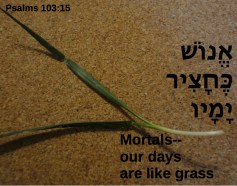 Meanwhile, though – in the way each yahrzeit seems to bring its own new facet of blessing – this year I recall another aspect of that lens. I remember Dad teaching me to notice how the strongest blades of grass, when pulled gently from the ground, would yield a hidden, moist taste treat. He helped me recognize that the greenish-white part of a watermelon, the stuff closest to the rind – that so many people toss away – is often the sweetest. And together, on many a horridly hot summer day, we witnessed how sitting absolutely still could call up a breeze more cooling than anything produced by a fan, electric or paper.




 "A Song Every Day"