Chanukah and the Five Powers

Exploring Babylon Chapter 10

This week in the Jewish calendar (mid-December 2017), we meet the major foreign powers with which ancient Judaism struggled:

  • In the Torah-reading cycle, Joseph is already in Mitzrayim, setting the stage for the whole clan of Yisrael to move, and eventually become enslaved, there.
  • Chanukah (in 2017: 12/12-12/20), reminds us of events in the Seleucid (“Syrian-Greek“) Empire.
  • The haftarah for Shabbat Chanukah, from Zechariah, is set just after the Babylonian Captivity, during Persian rule.
  • In addition, the game of dreidel is sometimes explained with reference to Roman soldiers, and other aspects of the holiday relate to this later empire.

Mitzrayim, Greece, Babylon, Persia, and Rome. That’s a lot of foreign powers converging on any one week.

And there are aspects of Chanukah that tend to equate or conflate oppressors and different experiences of exile. For example, all five of the foreign powers show up in one of the post popular Chanukah songs, based on the 13th Century piyyut, “Ma’oz Tzur.” (More on this soon.) So, there’s an impulse, on the one hand, to roll all the opponents into one enormous, amorphous threat to scrappy, little Yisrael. On the other hand, there’s a tradition of aiming to universalize the Chanukah story, making it into everyman’s battle against tyranny everywhere. Insights can be gleaned by comparing and combining the foreign powers that turn up together this week. But it’s worth examining each of these empires, and its particular arc through Jewish history and thought, to see what light it sheds — on its own and in conjunction with the others.

Doing a thorough exploration is an enormous job, but perhaps we can start where we are, on this day of the third candle of Chanukah.

One Candle: Mikeitz (Mitzrayim)

Mitzrayim has a lot to say about exile and the challenges of a non-homogeneous society, in this week’s Torah portion (Mikeitz, Gen 41:1 – 44:17) alone:

  • Joseph’s precarious status and employment situation, here taking an upswing (Gen 41:41-46) after slavery, a rise to power and fall into incarceration (and, before the pharaoh who doesn’t know Joseph and enslaves all his descendants);
  • New clothes for a new position;
  • A new, foreign name for Joseph;
  • A new, foreign spouse, read alternatively as Asenath joining Yisrael or as Joseph’s acceptance into Mitzrayimite society;
  • Names for Joseph’s children that reflect experience in exile; and
  • Food issues.

Joseph, “the Hebrews,” and the Mitrayimites each eat separately, “because it was abhorrent to the Mitrayimites [כִּי־תוֹעֵבָ֥ה הִ֖וא לְמִצְרָֽיִם]” (Gen 43:32). What was abhorrent? The possibilities are many, including, from various commentators: extremely different customs and manners , snobbery on the part of the Mitzrayimites, and religious taboo (one theory: Mitrayimites revered animals, like the cow, while Hebrews ate beef).

Two Candles: Mikeitz and Chanukah

The story of the Maccabees is multi-layered, and many scholars point to the twin layers of internal strife within Yisrael and the precipitating Greek pressure:

The power the Greeks sought and the threat they posed was not just military, and so it could not be resolved by military means alone; their threat was as much to the identity, faith, and practice of the Jews. What is more, the threat came not just from the Greeks but from the Jews themselves, many of whom, according to the sources, had opted voluntarily to assimilate or gave in rather than resist Greek orders….
— Gila Sacks, “Creating Light Each Day ” (2013)
from JOFA’s Shema Bekolah [hear her voice] series

This dynamic has never yet ceased to be relevant to Jewish communities, in- or outside Israel. When this candle’s light is burned side-by-side with the one from Mikeitz, the combine light raises a host of new questions about Joseph’s story.

Three Candles: Mikeitz, Chanukah, and Zechariah

The Haftarah for Shabbat Chanukah is Zechariah 2:14-4:7. The first eight chapters of Zechariah’s prophecy are dated to 520-518 BCE, during the reign of Darius I of Persia. This is just after the conquest of Babylon, when Judeans were permitted to return and rebuild in Jerusalem. Work on the Temple had stalled “when the leadership refused to allow local population to join in the labor…, and this group interfered with the building down to the second year of Darius 1” (M. Fishbane, JPS Haftarah Commentary. Philadelphia: Jewish Publication Society, 2002, p.163).

Zechariah’s prophecy, which includes several visions, supports a leadership duo for the effort ahead: Joshua ben Jehozadak, heir to the priesthood, and Zerubbabel ben Sheathiel, royal heir. Chapter 4 relates a vision in which Zechariah is shown a complex candelabra of seven lamps, “with a bowl on top of it,” and an olive tree on each side. The prophet asks for the meaning of this, and the angel responds in verses 4:6-14 — beginning with “prologue” (4:6-7) and then interpreting the lamps and trees.

In between, the prophecy includes a comforting declaration: “Zerubbabel’s hands have founded this House and Zerubbabel’s hands shall complete it….Does anyone scorn a day of small beginnings?” (4:9-10).

All of this is part of God’s promise to return from exile along with the people (Zech 1). And the JPS commentary also includes a midrash around the word “gullah [bowl],” that is at the head of the candelabrum (Zech 4:2). One of the themes of Zechariah is that God is at the “head,” but God and the people are united in both “exile (golah)” and “redemption (ge’ulah).”

That’s one aspect of Zechariah, taken on its own. And it can surely lend further light the whole topic of foreign powers. But the Chanukah haftarah stops at what Fishbane called “prologue” above:

Then he explained to me as follows: “This is the word of the LORD to Zerubbabel: Not by might, nor by power, but by My spirit—said the LORD of Hosts.
וַיַּעַן וַיֹּאמֶר אֵלַי, לֵאמֹר, זֶה דְּבַר-יְהוָה, אֶל-זְרֻבָּבֶל לֵאמֹר
לֹא בְחַיִל, וְלֹא בְכֹחַ–כִּי אִם-בְּרוּחִי, אָמַר יְהוָה צְבָאוֹת:

Whoever you are, O great mountain in the path of Zerubbabel, turn into level ground!
For he shall produce that excellent stone; it shall be greeted with shouts of ‘Beautiful! Beautiful!’”
מִי-אַתָּה הַר-הַגָּדוֹל לִפְנֵי זְרֻבָּבֶל, לְמִישֹׁר;
וְהוֹצִיא, אֶת-הָאֶבֶן הָרֹאשָׁה–תְּשֻׁאוֹת, חֵן חֵן לָהּ
— Zechariah 4:6-7

In doing so, Fishbane says, the Rabbis not only emphasize that Zerubbabel’s success will be through God’s spirit alone but “transformed the text into a divine warning. Groups wishing to ‘force the end’ through military might, or support projects promising restoration of the Temple, are given divine notice of the futility of their plans” (p.165).

It’s this appearance of Zechariah that shows up this week, with Mikeitz and the story of Chanukah. And taken together, the three candles shed a different light.


NOTES
Note 1:
To avoid confusion, I’m using “Yisrael,” as both the name given to Jacob after his divine wrestling match (Gen 32:22-32) and the name of the ancient people, as distinguished from the contemporary nation of “Israel.” I also use “Mitzrayim” to similarly distinguish biblical land/culture from any historical location. For the sake of simplicity, I’m leaving as is “Greece,” “Babylon,” “Persia,” and “Rome.” 
TOP

Dick Gregory and Rabbis Under Rome

Exploring Babylon Chapter 9.2

Dick Gregory’s Bible Tales with Commentary offers insights on the Joseph Story, begun in last week’s Torah portion, Vayeishev (Gen 37:1 – 40:23).

His remarks begin with notes on dreamers and dreaming:

Joseph found out it’s dangerous to be a dreamer. Just like Joseph’s brothers, society today has three ways of dealing with dreamers. Kill the dreamer. Throw the dreamer in jail (the contemporary “cisterns” in our society). Or sell the dreamer into slavery; purchase the dream with foundation grants or government deals, until the dreamer becomes enslaved to controlling financial or governmental interests. Society tries to buy off the dream and lull the dreamer to sleep. It’s called a “lull-a-buy.”
Dick Gregory’s Bible Tales, p.70 (full citation below)

Gregory (1932-2017) goes on to say, in his 1974 publication, that this country used all three tactics on Dr. Martin Luther King, Jr., adding: “Dreamers can be killed. Dreams live on.”

Gregory then suggests: “Maybe Joseph was a Black cat. That would certainly explain his taste in clothes and the wild colors he wore.” He relates Joseph’s experience with Potiphar’s wife (Gen 39) to the many Black men in this country “falsely accused of making advances to white women” (Bible Tales, p.72).

Regarding the final story in Vayeishev, Joseph’s incarceration and interpretation of dreams for fellow inmates (Gen 40), Gregory writes:

The butler in the Joseph story symbolizes America’s treatment of Black folks. The butler used Joseph’s talent as an interpreter of dreams and he promised to tell Pharaoh about Joseph. As soon as the butler got himself comfortably back in Pharaoh’s palace, he forgot about his word to Joseph.

America was built on the sweat, toil, and talent of Black folks. But when the work was done and the talent utilized, America quickly forgot its debt to Blacks. Black folks helped lay down the railroad tracks, but they could only work as porters after the trains started running. Black slaves picked the cotton, but the garment industry belonged to white folks.
Bible Tales, p.73

Gregory’s commentary struck me as very like the commentary of the Rabbis under Roman rule. One famous example is this teaching of Gamaliel, son of Judah (Gamaliel III):

Be wary in your dealings with the ruling power, for they only befriend a man when it serves their needs. When it is to their advantage, they appear as friends, but they do not stand by a person in his hour of need.
Pirkei Avot 2:3

Torah of Exile, Again

The previous episode discussed the “Torah of Exile” and the Academy of Shem and Eber, offering lessons on keeping the faith when the surrounding culture seems alien, even hostile. The above-quoted passages from Gregory’s Bible Tales fit this curriculum in two importantly different ways.

First, dreams and dreamers. People from many communities — in 1974 and today — can relate to Gregory’s characterization of a system that tries to buy dreams in order to squash them. So, his comments on this comprise one kind of “Torah of Exile,” comfort and instruction for exiles.

…Let’s note, before continuing, that an individual might feel exiled around one aspect of life (gender or sexual orientation, for example) while feeling integrated into the surrounding community in other ways….

Second, the butler who “symbolizes America’s treatment of Black folks.” Gregory’s notes on the butler story are more specific to a particular form of exile. It’s not that people outside the Black community cannot relate to being used. But those of us who don’t directly experience what he is describing must pause and be sure to really hear what is said about an experience we don’t share. This is a second kind of “The Torah of Exile”: discomfort and instruction for those who are in relative safety with regard to a particular form of exile.

We should all, of course, seek to learn from many sources. We need all the ancient and contemporary wisdom we can find, and all that’s in between, to help us understand our own exilic circumstances and those of our neighbors. It’s essential, though, that we stay clear on the two kinds of Torah of Exile and be careful to learn about others’ suffering without mistaking it for our own.

Gregory_BibleTales
Dick Gregory’s Bible Tales with Commentary, James R. McGraw, ed.
NY: Stein and Day, 1974

This volume, by the way, is very funny and oddly current.
TOP

Torah of Exile

Exploring Babylon Chapter 9.1

Jacob studied “the Torah of exile” in his younger years, and that helped sustain him during his time with Laban. Joseph, in turn, uses this “Torah of exile” during his decades in Egypt. This idea, based on an odd expression in Gen 37:3, opens up all sorts of possibilities for #ExploringBabylon.

The Family Business

This week’s Torah portion (Vayeishev, Gen 37:1 – 40:23) begins with an odd expression that has engendered a variety of commentary:

כִּי-בֶן-זְקֻנִים
ki-ben-zakunim
— from Gen 37:3

Ben zakunim” is usually translated as something like “child of his old age.” But this failed to satisfy many readers over the centuries, because Joseph is, after all, not the youngest child. Another reading takes zaken (“old”) as a contraction of “זה שקנה הכמה [one who acquired wisdom]” and so identifies Joseph as wise or as one who learned from wise elders: Jacob taught Joseph what he learned in “the Academy of Shem and Eber” (Rashi quoting Onkelos).

The idea of the Academy of Shem and Eber, sometimes two separate “academies,” appears in a number of midrashim. This student essay explains that the academy is used as an explanation for periods of time when someone seems to disappear from the narrative: When Isaac disappears from the text, following the Akedah, he was learning from these elders (Gen. Rabbah 56:11). Fourteen missing years in Jacob’s chronology are attributed to the academy (Babylonian Talmud, Megilla 17a). In addition, when Rebecca went to “inquire of God” about her agitated twins (Gen 25:22), she is said to be visiting the Academy of Shem (Gen. Rabbah 45:10).

These midrashim reflect the Rabbinical propensity to see Torah learning as a useful and desired occupation — the family business, in a way — and even an eternal reward: Shem and Eber join Abraham, Isaac, Moses, and Aaron in the Beit Midrash of the world to come (Shir ha-Shirm Rabbah 6:2), open to all who learn Torah in this world. But there’s another thread here in that Shem and Eber have something specific to teach.

Academy for Exiles

Shem lived through the Flood and the conditions that preceded it. Eber had lived among those who built the Tower of Babel. The lessons they learned in these difficult circumstances, the “Academy” reasoning goes, helped Jacob and Joseph survive, and not assimilate, during their periods of exile.

In addition, Klahr notes in “The First Beit Midrash,” lessons from Shem and Eber helped Isaac “derive the inspiration to remain a committed Jew after he was almost killed for the sake of God.”

Centuries of Jews have faced similar challenges, and many individuals in tough circumstances, in which faith seems irrelevant or too hard, have found themselves, with Rebecca, asking: “Why am I thus!?”

The importance of the Yeshivah of Shem and Eber lies not in its historical accuracy, but rather in its representation of a culture in which one can maintain a relationship with God despite its difficulty….God did not simply appear to the Bible’s heroes. They were not born with deep strength and conviction; rather, the forefathers [and mothers] worked hard to develop their faith. They went to seek advice from those who knew more than they. They spent time contemplating God and life’s meaning.
— “The First Beit Midrash”

To take a different sort of example, consider the role of the Highlander Folk School in mid-20th Century U.S. history.

Academy for Today

Many of us were raised with some version of “Rosa was tired” as the narrative behind the Montgomery Bus Boycott. This makes it sound as though Mrs. Parks was a non-entity, calmly tolerating segregation until one day she just snapped, and that the boycott somehow just materialized after that. The real story, of course, is that the boycott was years in the planning by many people, including Mrs. Parks.

Moreover, before making her stand, so to speak, Mrs. Parks was active with the NAACP and attended the Highlander Folk School, where she made connections and developed resources that helped launch a huge part of the Civil Rights Movement.

For a little background, listen to Studs Terkel talk in 1973 with Rosa Parks and Myles Horton, founder of Highlander, about some of learning and work involved.

(BTW, be sure to check out the existing Studs Terkel Archive, see what’s new for 2018, and learn about WFMT’s call for support.)

What did Shem and Eber teach that we can use for #ExploringBabylon? What do we need for today’s “Academy for Exiles”?

Notes

Benjamin, the last born, is also a child of Jacob’s “old age” — and so this phrase would not explain why Jacob loved Joseph more than his youngest. Some commentators suggest that perhaps Rachel’s death giving birth to Benjamin made it hard for Jacob to relate to his youngest son. Others say that Jacob was already in “old age” when Joseph was born, and that father and son developed a strong bond before Benjamin was born. But these lines of reasoning did not satisfy many readers over the centuries, so other ways of reading “ben-zakunim were suggested. (Not tracking down the citations, sorry, as this is pretty far off-topic.)
TOP

Miriam Pearl Klahr, then a sophomore at Stern College, wrote “The First Beit Midrash: The Yeshiva of Shem and Eber,” for a 2014 edition of Kol Hamevaser, The Jewish Thought Magazine of the Yeshiva University Student Body.

This blog actively avoids choosing non-egalitarian sources for basic Jewish background or for default learning resources. But that practice is not meant to discount learning from any quarter. I found this a powerful and useful essay, and I appreciate the author’s careful attention to citing sources so we can all learn further from them. I definitely recommend checking out the whole article.
BACK

The Babylon Road

Exploring Babylon Chapter 8.1

The biblical Rachel, the last matriarch to join and add to the clan that becomes Israel, is tied to the east in several ways — all leading, ultimately, to Babylon.

Children of Two Lands

Rachel is introduced just after Jacob arrives in the “land of the Easterners [אַרְצָה בְנֵי-קֶדֶם]” (Genesis 29:1, last week’s Torah portion: Vayetze, Gen 28:10-32:3).

The construct “בְנֵי-קֶדֶם, bnei-kedem” — sometimes translated as “people (or children) of the east,” sometimes, “Kedemites” — does not appear anywhere else in the Torah, although it shows up ten times later in the Tanakh (Concordance Even-Shoshan). Many Torah translations leave the expression without comment (cf. Alter, Fox, URJ, Women of Reform Judaism, Gefen Onkelos); the Stone Chumash simply points out that Ur Kasdim and Haran, places associated with Abraham’s family, are east from Canaan.

Some commentators note that eastward is the direction Abraham sent the children of Ketura, whom he married after Sarah’s death (Gen 25:6). The word “kedem” itself means “past,” as well as “east.”

Previous #ExploringBabylon chapters discussed two themes, repeated through much of Genesis:

  • Ur Kasdim and Haran as “Back Home” for the family of Terah;
  • the descendants of Sarah and Abraham as perpetually “from there.”

Both themes appear in Jacob’s story, and both appear, in two quite different ways, in the stories of Leah and Rachel.

Two Sisters

Jacob is urged, separately by Rebecca and Isaac, to leave Canaan, with both parents saying that he should seek out Rebecca’s brother and find a wife from the uncle’s household (“back home”). Isaac echoes Abraham’s earlier words, insisting his son should find a wife “from there [מִשָּׁם].”

In their instructions to Jacob, Rebecca calls her old home “Haran,” while Isaac calls the place “Paddan-Aram.” Jacob goes to Paddan-Aram (Gen 28:5), going out from Beer-Sheva toward Haran (Gen 28:10). Where he arrives, however, is “artzah bnei-kedem.”

Jacob’s grandparents and parents retained a sense of “from there,” while leaving “back home” behind: Sarah and Abraham left there, as did Rebecca. But Jacob’s trajectory is different: He will live decades among the people of kedem. So, even though the plain meaning of arriving “artzah bnei-kedem” is reaching the “east country” or “land of the Easterners” (as JPS has it above), Jacob has also, in a sense, traveled toward his family’s past. And Rachel’s introduction links her to this land in a way that Leah’s does not.

Jacob arrives in the land of the Easterners, where he sees a well and flocks of sheep and then meets locals who tell him his cousin Rachel is on the way. Rachel, whose name means “ewe,” is intricately woven into this landscape and the household of Laban, where she is seen and heard taking an active role.

Leah, in contrast, is not introduced until 29:16 and then only as Laban’s older daughter with tender, or weak, eyes; she is not linked to the land in any way and does not interact with Laban, except as the passive object of his machinations.

Two Stories

The sisters jointly declare themselves “as outsiders” [כִּי מְכָרָנוּ] in Laban’s household, when Jacob proposes leaving (Gen 31:14-16). The Torah: A Woman’s Commentary adds:

By acknowledging their outsider status in the household, Leah and Rachel prepare themselves to journey to an unknown land. They distinguish themselves from their father, citing the egregious manner in which he married them off and then denied them their due.
— Rachel Havrelock’s commentary to Vayetze

But this doesn’t pan out in the same way for both sisters.

Eventually, although we learn nothing about the later stage of her life, Leah does settle with Jacob and the extended family in Canaan; she is buried at Machpelah with Sarah and Abraham, Rebecca and Isaac, and, finally, Jacob (Gen 49:31). We also learn that Dinah, “the daughter whom Leah had borne to Jacob, went out to visit the daughters of the land” (Gen 34:1); this troubling episode is beyond the scope of this project, but it does seem relevant that Leah and Dinah are thus linked, not to the old land but to the new.

Rachel, in contrast, seems to have stronger relationships to the old land and to the old family. She steals the terafim (הַתְּרָפִים [idols, household gods]) from her father’s house (Gen 31:34), which many commentators link to inheritance or clan leadership — although there is great variety in interpreting the meaning of her act. Moreover, when Laban comes in search of his property, Leah is again a cipher in his presence, but Rachel is seen and heard responding to her father.

However the theft is interpreted, Rachel’s act exhibits strong opinions about her native culture and her place in it. She does not simply move on. And she doesn’t simply move into the new land, either, as her story unfolds in this week’s Torah portion (Vayishlach, Gen 32:4-36:43).

Two Bookends

We’ll explore Rachel’s appearance in the Book of Jeremiah more thoroughly later, but it seems important to mention here the second bookend for her story: We saw above how the landscape appeared prior to Rachel’s gradually coming into view as part of it (Genesis Chapter 29). In Jeremiah 31:15, her cry is heard “wailing, bitter weeping,” before we are told that it is Rachel weeping.

Rachel is tied strongly to the land of her birth; she doesn’t leave it easily or have an opportunity to live in the new land, even as she gives birth to the only child of Jacob, tribe of Israel, born there.

And Rachel died, and was buried on the road to Ephrath (Gen 35:19). Why did Jacob see fit to bury Rachel on the road to Ephrath [and not in the cave of Machpelah*]? Because our father Jacob foresaw that they who were to be exiled would pass by way of Ephrath. Therefore he buried her there, so that she might beseech mercy for them. Referring to this, Scripture says, “A voice is heard in Ramah, lamentation, and bitter weeping. Rachel is weeping for her children” (Jer. 31:15).
— Sefer Ha-Aggadah 50:87, based on Genesis Rabbah 82:10

*Footnote provided by Sefer Ha-Aggadah: Ramah, near where Jacob buried Rachel, lay north of Jerusalem in the path of the exiles driven toward Babylon. Hebron is south of Jerusalem, and the patriarchs and matriarchs buried there in the cave of Machpelah were out of the way of the exiles going northeast to Babylon.

In this way — and in others we’ll explore soon — the bookends of Rachel’s life and death link her to the Babylon of the past and future and to the precarious nature of Israel’s future on the land.

Jacob’s Dream and What’s Ours

Exploring Babylon Chapter 7.2

In the previous episode of #ExploringBabylon, I shared a pair of midrashim about Jacob’s Dream (Gen 28:12) from Midrash Tanchuma-Yelammedenu Vayetze 2. In Dream “Version #2,” God blames Jacob’s lack of faith, evidenced by his failure to ascend the ladder, for future oppression of Israel by Babylon, Persia, Greece, and Rome:

…since you did not have faith, your descendants will be oppressed by these four kingdoms with imposts, taxes on their crops, and poll-tax.
— Tanchuma Vayetze 2 cont. (Berman, p.186; full citation in previous post)

Version #2 concludes with a promise that the people will be saved due to the practice of pe’ah [corners], i.e., not harvesting one’s fields entirely, but leaving the corners for the poor (Lev 19:9-10, 23:22). Chapter 7.1 noted a few questions that this raises about the relationship between oppression and taxes, on the one hand, and faith, on the other. Here are further thoughts.

Let’s begin with the commandment of pe’ah, and travel backward through the midrashic territory.

Removing Wealth

1) Pe’ah, we learned, may be compared to withholding tax: “One does not even own one’s income until one has separated out the portion for the poor,” like “taxes that are withheld from income; it never really was yours anyway” (Jeffrey Spitzer, “Pe’ah: The Corners of Our Fields“). The mitzvah of pe’ah, and the associated attitude toward one’s earnings, is what will save the people from annihilation, according to Dream Version #2.

Biblical and rabbinic text focus a great deal on what individuals owe to the community, particularly to the most vulnerable — and pe’ah is just one of many related mitzvot that we might understand, following Spitzer, as akin to taxation for the public good. But ancient “taxation,” in ancient Jewish views, was something else.

2) The oppression, suffered under four kingdoms in Dream Version #2, encompasses “imposts, taxes on their crops, and poll-tax.” These taxes remove wealth from the local community for the needs of empire — be it Babylon, Persia, Greece, or Rome. Removing wealth from subject populations served to support the empire while also reducing the chance of rebellion in the provinces.

Such taxes, imposed from outside, were not viewed in Jewish tradition as commonweal-supporting. In addition, some ancient taxes were specifically designed to be punitive, such as poll-taxes on Jews in the wake of the 1st Century CE rebellion; diverting taxes from the Temple in Jerusalem to instead finance a temple for Jupiter in Rome was seen (and intended) as a particular affront.

3) In Dream Version #2, God announces that the kind of tax-oppression Jews experienced, as subjects of four foreign empires, can be explained by Jacob’s lack of faith and failure to ascend the ladder.

We don’t get Jacob’s side of the story. But we have a small clue in the text that follows the dream. When Jacob awakens, he makes a vow using an “if-then” construction:

And Jacob vowed a vow, saying: ‘If God will be with me, and will keep me in this way that I go, and will give me bread to eat, and raiment to put on, so that I come back to my father’s house in peace, then shall the LORD be my God…and of all that Thou shalt give me I will surely give the tenth unto Thee.’
— Gen 28:20-22

Most commentators read this, as discussed in “Jacob’s Contract with God,” as conditional only “in the way any contract or agreement is conditional” or as another form of affirming the covenantal relationship God has just announced. But I hear something else.

What’s Ours

Jacob, on the road to Haran, has just lost his home and any mundane sense of security. He hopes the sojourn will be temporary but does not yet know for sure and is not assured of future success, or even of shelter ahead. God’s promise is amazing, but Jacob sins by not grasping it.

“For all this they sinned still, and believed not in His wondrous works” (Psalm 78:32), we read in Dream Version #2. “Jacob” has shifted from a patriarch alone on the road to his national persona, which includes us.

We know from later text and tradition that the covenant God established with Abraham and Sarah, with Isaac and Rebecca, now reiterated with Jacob, obligates us to sharing resources in the ways outlined above, the mitzvah of pe’ah being a prime example. We are meant to acknowledge, all the time, in our thought and in our economic behavior that whatever we have is by the grace of God and not because we’re somehow entitled.

But Jacob, in his vow, sounds very like most of us most of the time: willing enough to give tzedakah, or otherwise contribute to the community, only after our own financial security is assured. This is a luxury denied to many.

And we have a great deal of work to do, as individuals, as communities, and on the national scale in the U.S., to examine what is ours and re-think how “our” stuff is distributed. This holiday of Thanksgiving calls those of us who are not of indigenous descent to carefully examine “ours” in the context of this land and its bounty. We must also look, nationally, at what is “ours” in the context of labor stolen from millions of enslaved people.

This is what I hear in Jacob’s dream. What about you?


“POLL TAX”
When I first encountered the midrash about poll-taxes, I confess my first thought was this was some kind of anachronistic reference to voting rights. For anyone else who may be confused….

“Poll,” meaning “head,” is used in two common, inter-related ways: Poll-taxes, since ancient times, are levied per person, as opposed to taxes on crops (income) or property, and imposed for a variety of reasons; history has seen a number of poll-taxes specifically aimed at Jewish communities. Poll is also used in voting contexts, where each “head” has a say in an election.

These two uses collide in the United States, where poll-taxes — in the sense of taxes on an individual, rather than on income or property — were used as a barrier to the polling place. The 24th Amendment made such use on the federal level unconstitutional in 1964, and subsequent rulings outlawed their use in state elections. Prior to that, poll taxes were used to prevent many people, primarily black citizens of the South, from exercising the right to vote.
BACK

Babylon, Taxes, and Thanksgiving

Exploring Babylon Chapter 7.1

Jacob heads back “there,” home of his mother’s and his grandparents’ people, in this week’s Torah portion, Vayetze (Gen 28:10-32:3; for more on “there“). But a great deal happens in the few verses between his leaving Beer Sheva and his arrival in Haran, and some of it sheds light for #ExploringBabylon.

In flight, after stealing his brother’s blessing (last week’s portion), Jacob pauses for the night:

וַיַּחֲלֹם, וְהִנֵּה סֻלָּם מֻצָּב אַרְצָה, וְרֹאשׁוֹ, מַגִּיעַ הַשָּׁמָיְמָה; וְהִנֵּה מַלְאֲכֵי אֱלֹהִים, עֹלִים וְיֹרְדִים בּוֹ
And he dreamed, and behold a ladder set up on the earth, and the top of it reached to heaven; and behold the angels of God ascending and descending on it.
— Gen 28:12 (Old JPS translation)

This dream, particularly its image of angels first ascending and then descending, has been the source of many tales and lessons. One such commentary, from Midrash Tanchuma (c. 500-800 CE), involves Babylon and taxes, and leads us to consider what Judaism demands regarding economic justice.

The Four Exiles

Earlier in #ExploringBabylon, we encountered two midrashim reading four exiles, or foreign dominations, into biblical text without apparent connection to exile: The first involved the earliest stages of Creation, Gen 1:2 (see “Babylon and the Beginning“); the second, the Binding of Isaac, Gen 22:13 (see “Entangled and Free“). Midrash Tanchuma Vayetze 2 uses a similar trope.

As in the previous examples, national exile is nowhere explicit in the biblical text, but an anxious uncertainty in the story provides a link. Here, Jacob’s precarious, liminal situation and God’s dream promise to “keep you wherever you go and bring you back into this land” (Gen 28:15), is linked to Israel’s national fate.

Two versions of dream commentary contain small variations that make for big midrashic differences. (The translations below are from Midrash Tanchuma-Yelammedenu, by Samuel A. Berman. Hoboken, NJ: Ktav, 1996).

Ascent and Descent

In version #1 of the dream midrash, God shows Jacob four specific angels:

  • the guardian angel of Babylon ascending seventy rungs of the ladder and descending,
  • the guardian angel of Media ascending fifty-two rungs of the ladder and descending,
  • the guardian angel of Greece ascending one hundred [I’ve also seen 180] rungs of the ladder and descending, and
  • the guardian angel of Edom ascending the ladder

Tanchuma Vayetze 2 (Berman, p.185)

Jacob could not see an end to this fourth angel’s ascent and so “cried out in terror: Perhaps Edom will never be compelled to descend.” God’s response is described with a combination of verses from the Tanakh:

Therefore fear thou not, O Jacob My servant, saith the LORD; neither be dismayed, O Israel; for, lo, I will save thee from afar, and thy seed from the land of their captivity; and Jacob shall again be quiet and at ease, and none shall make him afraid.

Though thou make thy nest as high as the eagle, and though thou set it among the stars, I will bring thee down from thence, saith the LORD.
— Jer 30:10, Obad 4

Here, as in the Creation (Gen 1:2) and the Akedah (Gen 22:13) midrashim, three of the four exiles/dominations are complete. The final domination persists: the “wicked empire,” rule of Teman (an Edomite clan), and Edom, in the Creation, Akedah, and Dream midrashim, respectively, all ways of referring to Rome. In the earlier midrashim, oppression will end with a messianic spirit (Creation story) and the ram’s horn (Akedah). Here, Roman rule seems endless, and Jacob despairs.

This version stops with Jacob’s despair and God’s assurance.

Faith and Taxes

In Version #2, “R. Berechiah, in the name of R. Helbo, and R. Simeon the son of Yosinah, maintained” that Jacob sees the fourth angel descend and God then asks Jacob why he does not ascend.

Whereupon our patriarch Jacob became distressed and asked: Shall I too be forced to descend, just as these are? The Holy One, blessed be He, responded: If you ascend, you will not be required to descend. Nevertheless, he did not ascend, for his faith was not sufficiently strong.
— Tanchuma Vayetze 2 cont. (Berman, pp.185-186)

R. Simeon ben Yosinah adds an interpretation of Ps 78:32, “For all this they sinned still, and believed not in His wondrous works,” to make Jacob’s failure more explicit:

The Holy One, blessed be He, said to Jacob: If you had ascended and trusted Me, you would never have been compelled to descend, but since you did not have faith, your descendants will be oppressed by these four kingdoms with imposts, taxes on their crops, and poll-tax.
— Tanchuma Vayetze 2 cont. (Berman, p.186)

Similarly to the midrashim on Gen 1:2 and 22:13, Version #2 has Jacob cry out: “Will this oppression continue forever?”

As in Version #1 above, God’s response is taken from Jer 30:10. Here, however, a second verse(30:11) is used to explain in detail how Jacob will survive while other nations perish. The key involves economic justice:

That is to say, “I will make an end of all the nations” (Jer 30:11) that reap their fields completely, but since the people of Israel do not reap their fields completely, “of thee I will not make an end.”
— Tanchuma Vayetze 2 cont. (Berman, p.186)


Economic Justice

The “people of Israel do not reap completely” refers to the mitzvah of “corners [pe’ah],” found in Leviticus:

And when ye reap the harvest of your land, thou shalt not wholly reap the corner of thy field, neither shalt thou gather the gleaning of thy harvest.
And thou shalt not glean thy vineyard, neither shalt thou gather the fallen fruit of thy vineyard; thou shalt leave them for the poor and for the stranger: I am the LORD your God.
— Lev 19:9-10; also Lev 23:22

The declaration that “corners” has “no prescribed measure” — that is, no upper limit — opens Mishnah tractate Pe’ah. Importance of this mishnah (Pe’ah 1:1) is stressed by its inclusion as a passage for daily study in many prayerbooks.

Jeffrey Spitzer, of American Hebrew Academy (Greesboro, NC), provides an overview of the mitzvah and its contemporary applications, for My Jewish Learning. He suggests equating pe’ah with withholding tax:

One does not even own one’s income until one has separated out the portion for the poor; one holds them briefly in trust for the poor. The challenge is to consider one’s tzedakah like the taxes that are withheld from income; it never really was yours anyway.
— Spitzer, “Pe’ah: The Corners of Our Fields

This withholding model helps explain the link between Jacob’s dream, as portrayed in this midrash, and ancient Israel’s national economic behavior. The upcoming Thanksgiving holiday in the U.S., and the economics of “Black Friday,” make this a particularly good time to consider what R. Simeon ben Yosinah meant us to learn from Jacob’s dream. More on this in chapter 7.2 of #ExploringBabylon. Meanwhile —

Questions to Consider

(1) What is the relationship between the midrash’s claim that Jacob lacks faith and the vow he makes when he awakens?

Consider what Jacob tells God the morning after the dream:

And Jacob vowed a vow, saying: ‘If God will be with me, and will keep me in this way that I go, and will give me bread to eat, and raiment to put on, so that I come back to my father’s house in peace, then shall the LORD be my God, and this stone, which I have set up for a pillar, shall be God’s house; and of all that Thou shalt give me I will surely give the tenth unto Thee.’
— Gen 28:20-22

Deuteronomy 10:18 says that God “loves the stranger, giving him food and raiment,” and some commentators say Jacob was asking no more than this. But, might it be that Jacob is showing a lack of faith by demanding the equivalent of income to which he is not (yet) entitled?

(2) How does the concept of pe’ah at the close of midrash version #2 relate to the particular kind of oppression the people experience?

(3) What can we learn from R. Simeon ben Yosinah’s labeling of taxes as oppression?

Notes

Of related interest: See this article on ancient taxation. Note how often taxes, especially those imposed by foreign powers, are discussed in the Talmud and other ancient records (including Christian Gospels). More on Rome and ancient Israel.


Sulam
Or perhaps a stairway. The Hebrew word “sulam” סֻלָּם is a one of those words used only once in the Tanakh (“hapax legomenon“), so determining exact meaning is a challenge.
TOP


Edom
The Book of Obadiah (21 verses in its entirety) is introduced as “the vision of Obadiah…concerning Edom.” Obadiah is dated to the period leading to Babylonian Captivity, during which it seems that Edom switched alliances. Centuries later, when the Roman, and then the Byzantine, Empire ruled the entire region — until mid-7th Century CE — “Edom” came to stand in for this seemingly endless outside force.
BACK


Jeremiah 30:11
“For I am with thee, saith the LORD, to save thee; for I will make a full end of all the nations whither I have scattered thee, but I will not make a full end of thee; for I will correct thee in measure, and will not utterly destroy thee.”
— Jer 30:11

Tanchuma Vayetzei’s third teaching about Jacob’s ladder concludes with an explanation of this “correct thee in measure” phrase:

I will punish you, O Israel, in this world in order to cleanse you of your iniquities for the sake of the world-to-come. Hence it is said: And he dreamed.
— Tanchuma Vayetzei 2

RETURN

Babylon: Further Adventures #1

Exploring Babylon: Chapter 6.1.1

Discussing text from this week’s Torah portion (Toldot, Genesis 25:19-28:9), I quoted yesterday comments about “The Isaac Complex” from Israel in Exile (Albertz). I noted my surprise at the author’s declaration that a particular verse “makes sense only” in a very specific historical context. I even created a little homage to the mouse’s “long tale” in Alice’s Adventures in Wonderland, to help explain my befuddlement and lead into my plea for comments about this on-going #ExploringBabylon series.
tale

Today, thanks to Woodstock Theological Library at Georgetown University, and their open-stacks policy, I was finally able to do some more relevant reading. Among the interesting and useful things I encountered was a response to Israel in Exile in the 2012 volume, By the Irrigation Canals of Babylon.

More on “Only”

Ralph W. Klein’s essay, “Israel in Exile after Thirty Years,” begins from the perspective of his own similarly titled work. In discussing Albertz’s book, Klein includes a substantial passage on use of the same word that had caught my notice: “only.”

Klein points out that Albertz dates biblical material based on a small number of passages and “how well they seem to fit a specific historical context, or even the claim that they only fit that context.” The first of Klein’s six examples is the one I quoted yesterday, Gen 26:1-5, about God’s command to Isaac not to go down to Egypt (Albertz, p.249). Klein continues:

In every one of these six cases, I can easily imagine other circumstances that may have been the context for these words. The condemnation of the voluntary migration to Egypt in Jeremiah is explicitly condemned for other reasons than the one labeled “only” by Albertz. Ezekiel’s condemnation of the false prophets of salvation in 13:9 fits easily, in my judgment, into his activity before the fall of Jerusalem 60 years earlier than Albertz allows. Albertz dates Gen 12:1-3 confidently to the mid-sixth century, but I remember a time when Hans Walter Wolff dated it with equal confidence to the tenth century.
— Klein, “Israel in Exile after Thirty Years,” p.15


More on Exile

NOTE: I had looked for reviews of Albertz’s Israel in Exile, and expected to find additional work building on his, but clearly I was not looking in the right places. Delighted to find at least one scholar objecting to his “only” and the otherwise decisive nature of his compositional theories. Hoping to find more.

Klein’s essay goes on to stress that engaging with aspects of Israel in Exile is mean to further conversation on the work of Albertz, “from whom we all have learned so much.” Klein encouraged the Exile group within the Society of Biblical Literature to “debate which biblical voices speak to and from the biblical exile, and when we think they do so.”

He also added, in a footnote:

I recognize that other participants in this consultation want to widen the discussion to deal with the issues of landlessness or the migration of peoples at different points in Israel’s history. These are legitimate theological and historical questions. My essay, however, has sought to define what is meant by the exile in the more narrow sense of the sixth century B.C.E.
Klein, p.19

And a cursory review of SBL happenings and publications suggests that focus following this paper was, indeed, on the wider “migration” themes, rather than defining exile.
Klein Exile

Ralph W. Klein is now Christ Seminary-Seminex Professor Emeritus of Old Testament, Lutheran School of Theology at Chicago. In addition to Israel in Exile: A Theological Interpretation (Minneapolis: Fortress Press, 1979), he has a lengthy list of publications (scroll down).

“Israel in Exile after Thirty Years,” is the opening essay IN By the Irrigation Canals of Babylon: Approaches to the Study of the Exile (John J. Ahn and Jill Middlemas, eds. NY: T&T Clark, 2012).

Babylon and Adventures in Bibleland

Exploring Babylon: Chapter 6.1

The last episode, Chapter 5.2, touched on ways the Torah stresses that Abraham comes from “there,” so he and his family remain apart from their neighbors. This week’s portion opens with a reminder that Rebecca is daughter of “Bethuel the Aramean of Paddan-arm, sister of Laban the Aramean” (Gen 25:20). Much has been made, midrashically, over the centuries of this emphasis. For the purposes of #ExploringBabylon, the key factor is still her origin “there.”

There and the Land

“There” — at Gen 25:20 (above) and when Jacob is sent off to Haran in Paddan-aram (27:43, 28:2-5) — brackets this portion. In between, “the land” is mentioned many times (26:1, etc.), along with the more unusual “lands” (26:3-4).

#ExploringBabylon will eventually venture into “the land,” with the help of teachers who can provide useful perspectives. At this point, the path detailed in Israel in Exile (Albertz 2003) leads in another direction.

Albertz describes much of Genesis as an “Exilic Patriarchal History,” meant to meet the needs of “an age when Israel was no longer a ‘great nation’ and no longer dwelt within secure borders” (p.250). In this context, the bulk of Isaac’s story (Genesis Chapter 26), has a particular goal:

The Isaac Complex recorded how the second patriarch, an alien in Philistia, rose with God’s help and blessing (Gen 26:12, 28, 29) from an endangered fugitive to a respected covenant partner of the Philistines. It suited admirably the conception of RPH1, who therefore elaborated it to make it the second pillar of his work.
Albertz, p.261

A footnote adds that “The Isaac Complex…may date from the end of the eight century, when Hezekiah claimed hegemony over the Philistine cities…” PH is “Patriarchal History (exilic edition),” and RPH1 is “redactor of the first exilic edition of PH.” Israel in Exile modifies “the classical Documentary Hypothesis,” with these more finely distinguished documents.

Albertz, as noted in previous posts, has been Professor of Old Testament at University of Muenster (Germany) since 1995, previously at universities of Siegen and Heidelberg. He describes Israel in Exile as a “new attempt at a comprehensive presentation of the exilic period.” Others call it a masterpiece of biblical and historical scholarship, and it is referenced by many (mostly Christian) scholars.

He concurs with an earlier scholar, Erhard Blum (Die Komposition der Vätergeschichte [Patriarchal History]), in declaring that God’s directive to Isaac to “stay” and “reside” in the land (26:1-5) represents a particular historical mind-set:

[YHVH’s] strange command to Isaac not to go down to Egypt despite the famine but to stay in Palestine instead makes sense only against the background of a time when there were large-scale migrations to Egypt that presented a survival problem for the Judeans in Palestine. The first time this situation obtained was during the exile (Jer 41:16-43:7).
— Albertz, p.249

Perhaps “makes sense only” lost something in translation. Still, this entire path — and its very decisiveness — raises a host of questions for this blog. (But see also “Further Adventures #1,” for a scholarly response to this “only.”)

“Either the well was very deep,
or she fell very slowly,
for she had plenty of time as she went down
to look about her and to wonder
what was going to happen next.”
Alice in Wonderland, Chapter 1


Rabbit Holes

Most of this #ExploringBabylon series has defaulted to the “pay no attention to the fingers behind the keyboard” style of writing encouraged in the author’s school years: share a mix of views from others, post only materials and ideas checked out with a few sources first, add personal notes largely for full-disclosure of possible prejudice, and keep things focused on the topic, not the author. But it’s time for a change, at least temporarily.

I started this series with some structure in mind and some initial research behind me. I intended to post, around the topics of Babylon and Exile, as I learned. Encountering so much new material at each step, however, meant struggling to decide which of many intriguing directions to take. I have tried to stay focused on the overall topics of oppression and exile. But there’s a fine and jagged line between something that is useful background for this project and something that is interesting – maybe even powerful Torah – but not really the point. And then there’s my tendency to meander.

….Deciding what might be useful or interesting to anyone but me is kind of a shot in the dark. I’m grateful to those who’ve already been in touch, and I hope others will chime in, via comments or by email (songeveryday at gmail), sharing your own expertise and resource suggestions as well as questions or topics you’d like to see addressed. Some just plain, “yes, I’m reading” notes would be helpful to me, as well….

As some readers of this blog already know, I have no credentials and little formal training in bible studies. I will be enlisting expert help and welcome all suggestions, resources, and tips. Meanwhile, a tale:

tale.jpg

If the history of biblical interpretation teaches us anything, it is that there have always been many interpretations of a biblical text And, as literary theory has shown, the interpretation will depend on who is doing the interpreting and for what purpose….

…The issue is not what the text means, but who controls its interpretation; who sets the agenda, who makes the rules, who confirms the validity of the results.
— Adele Berlin, “Literary Approaches to Biblical Literature,” p.64
IN The Hebrew Bible: New Insights and Scholarship

I find the souped-up Documentary Hypothesis a rabbit hole all its own. And just trying to understand the goals and premises of different branches of bible-related academia leads down an entirely different hole.

And a Looking Glass

In an effort to understand contemporary arguments about multiplicity of bible interpretation, I looked into some of the history. And I was surprised to learn that Catholicism employed a fourfold interpretive method that pre-dates the “PaRDeS” framework by several hundred years and probably influenced the quintessentially Jewish idea. I’ve also been surprised by apparent segregation, even within the academic world, between Christian and Jewish scholars and was struck by this note, opening the Jewish Studies in the Twenty-First Century series:

Meanwhile the fact that the Bible plays a significant role in several quite different communities forces those studying it (at least to the extent that they interact) to think about how it is treated in each tradition.
— preface, The Hebrew Bible: New Insights and Scholarship (2008)

All of which makes it difficult to figure out where #ExploringBabylon needs to go.

…I am seeking comments about how Jewish this series should be and how it should be Jewish. This is partly a question of background and interests readers share, or don’t. It’s also a question of how to approach the specific topic of Babylon, which is one that has been influenced so strongly by Christianity. Finally, it’s an issue of how best to tackle the goal of this project — seeking out new perspectives that will help Jews interact with challenges in- and outside Jewish communities — given that neither our history nor our future is independent of the wider culture.


Four-fold Interpretation

Venerable Bede (d. 735) and Rhabanus Maurus (d. 856) both taught fourfold approaches: literal, allegorical, anagogical (mystical, “upward”), and tropological (moral). Catechism adds:
“The Letter speaks of deeds; Allegory to faith;
The Moral how to act; Anagogy our destiny.”

Bahya ben Asher (1250-1340) introduced four interpretive paths:
1) the way of the Peshaṭ (plain sense)
2) the way of the Midrash (metaphorical, “to search”)
3) the way of Reason (exegesis),
4) the way of the Kabbalah (mystical).

The Zohar, published by Moses de Leon (1240-1305?) and credited to Shimon bar Yohai (2nd Century), includes these four:
1) Peshat
2) Remez (allegorical, “hint”)
3) Drash
4) Sod (secret, esoteric)

See Jewish Encyclopedia and Four Senses of Scripture (Catholicism). Several sources, including Jewish Encyclopedia note that Jewish scholars of Medieval Spain would have known the Catholic methods. See also James Kugel. How to Read the Bible: A Guide to Scripture Then and Now (NY: Free Press, 2007).
BACK

Rivers Dark

The sense of “from there” is complicated for the descendants of Abraham and Sarah, and there are several powerful ways in which “there” becomes part of their identity and remains an important force, even when not there.

Paul Kriwaczek (Babylon) points out that, unlike so many ancient cities and civilizations that are known only to scholars, Babylon “is still readily remembered for its pagan greatness” (p.168). He adds that this is primarily due to Jewish tradition:

To devout Christians, Babylon would always be the whore…To Rastafarians…she is the ultimate symbol of everything oppresses and crushes black people….To the world of Islam…the name of Babylon meant almost nothing….

Thus is was left to the Jews to keep the multi-faceted reality of the ancient centre of civilization alive in western cultural consciousness, waiting for the time when a new spirit of enquiry would lead European explorers to investigate…
Kriwaczek, pp.169-170

And, in honor of the first yahrzeit of Leonard Cohen (9/21/1934-11/9/2016)–

Be the truth unsaid
And the blessing gone,
If I forget
My Babylon.
— Leonard Cohen
By the Rivers Dark

BACK

The Language of There

Exploring Babylon: Chapter 5.2

“When I make a word do a lot of work like that,” said Humpty Dumpty,
“I always pay it extra.”

— Alice Through the Looking-Glass, Lewis Carroll (1871, chapter 6)

A few weeks ago, #ExploringBabylon looked at “them” who traveled with Terah from southern Babylon to northern Mesopotamia and a little of what “back there” meant for Abraham. In this week’s portion, we return with the elder servant (later identified as Eliezer) to what Abraham calls “my kindred” or “my birthplace.”

שָּׁם

Abraham is old and telling the elder servant of his household to go
אֶל-אַרְצִי וְאֶל-מוֹלַדְתִּי
“to my country, and to my kindred [or: the land of my birth”]
to get a wife for my son Isaac” (Gen 24:1-2). The servant (later identified as Eliezer) asks what to do, should he find a potential wife who doesn’t consent to return with him: Should he bring Isaac back…

Genesis 24:5
אֶל-הָאָרֶץ אֲשֶׁר-יָצָאתָ מִשָּׁם
…to the land from which you came?

24:6
פֶּן-תָּשִׁיב אֶת-בְּנִי שָׁמָּה
On no account take my son back there

24:7
וְלָקַחְתָּ אִשָּׁה לִבְנִי, מִשָּׁם
…get a wife for my son from there

24:8
לֹא תָשֵׁב שָׁמָּה
…do not take my son back there

In contrast to Gertrude Stein’s “no there there,” there is a lot of “there” here:

  • שָּׁם = “there”
  • שָׁמָּה = “to there” (ending hey makes a locative form)
  • מִשָּׁם = “from there” (beginning mem adds the preposition)

Commentators across the centuries have explored many “there” details: Did Abraham intend a specific place? Specific kin? Why did the servant later say he’d been sent to Abraham’s “father’s house and family” (Gen 24:38)? Why not encourage marriage with neighbor families? Was the union meant to seal some kind of family reconciliation? One of the most salient answers, for this blog’s purpose, stresses basic there-ness:

Abraham was sent away from his country, kindred and father’s house, so that he should have no further contact with them and be a stranger in a foreign clime…Similarly, his son must not marry [a Canaanite]. For this reason he was called Abraham the Hebrew, “that all the world was on one side and he on the other” (ivri means in Hebrew “a person from the other side” usually taken as a reference to Abraham’s origins in Mesopotamia — on the other side of the river).
— Nehama Leibowitz, New Studies in Breishit, p. 220

Abraham is ivri, from there. As in “not from here.” A key experience that his descendants will repeat — in Egypt, in the wilderness, in later exile. At this point in Genesis, Abraham and his family are becoming separate. That separateness will later help the people survive in Babylonian Captivity.

But this seems to be as much work as “there” is willing to do at the moment, regardless of how well paid.

Babylon fist

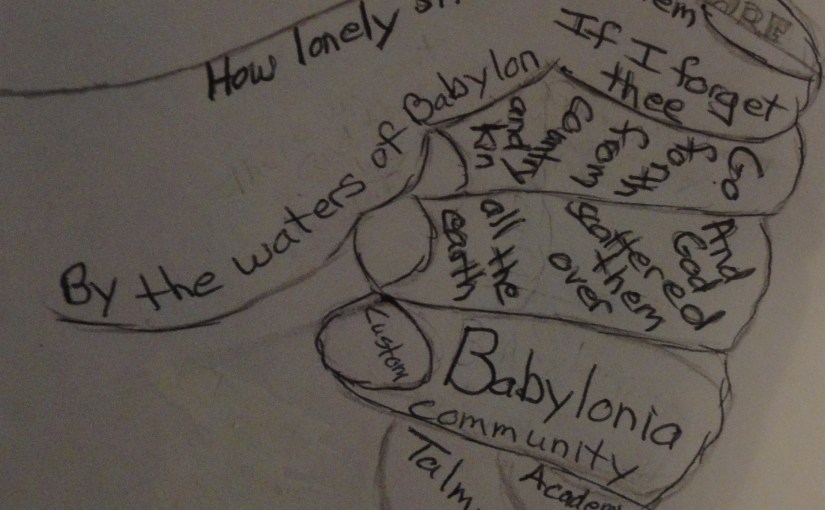
This is a palm-map illustrating the #ExploringBabylon journey. We’re just not there yet.
(Think the Little Prince and the boa constrictor digesting an elephant.)

Language

Finally, the Rabbinic stories about Babylonian Captivity being in some sense “back home” for people of Abraham, included an important message about the language of “there”: “R. Hanina said: comment that ‘The Holy One exiled them to Babylonia because the language is akin to the language of the Torah.’ To underscore this, a footnote of sorts:

The very success of Jews in adapting to life in a foreign environment poses problems for the would-be compiler of a Jewish sourcebook. Greek was the dominant language of Diasporan Jews and their personal names were mainly Greek or Latin…
The Jews Among the Greeks and Romans: A Diasporan Sourcebook, Margaret H. Williams (Baltimore, MD: Johns Hopkins, 1998), pp. xi-xii

Babylon: Back Home

Updated with additional Moon-cult link and previously missing footnotes.

Exploring Babylon: Chapter 3:2

The Torah doesn’t tell us much about the background of Abraham and Sarah, except that they leave it. We learn later, though, that their family maintains ties with the folk “back home.” And that on-going relationship has a lot to do, both logistically and thematically, with the larger theme of Israel’s relationship to Babylon.

Two of the few details we get about Abraham and Sarah involve departures:

  • Together with Abraham’s father, Terah, and “them,” Abraham and Sarah “departed from Ur of the Chaldees, to go into the land of Canaan; and they came unto Haran, and dwelt there” (Gen 11:31).
  • At Haran, God tells Abraham to go forth; he goes, with Sarah and his family group: “…they departed to go to the land of Canaan, and they came to the land of Canaan” (Gen 12:1, 4).

The departure of Gen 12:1 — “from your land, from your kindred, and from your father’s house” — is often read as thorough and decisive. Later covenantal language, which includes a name change for Abraham and Sarah (from the original Abram and Sarai) and the ritual of circumcision to separate those in- from those outside (Gen 17), suggests that a serious break with the past is intended. Later, however, Abraham sends to his people back home to find a wife for his son Isaac (Gen 24), and Jacob spends two decades in the old country, marrying two women from his grandparents’ kindred (Gen 29ff).

Over the millenia, a variety of teachings have been gleaned from connections of the Patriarchs and Matriarchs with folks “back home.” There is much food for thought and study there in #ExploringBabylon. Here, to begin, are two points of note.

Babylonian Time Travel

From the land of Palestine in the First Century CE, Rabbi Yohanan ben Zakkai taught:

R. Yohanan ben Zakkai used to say: Why should Israel have been exiled to Babylon more than to any of the other lands? Because Abraham’s family came from there. By what parable may the matter be explained? By the one of a woman who was unfaithful to her husband. Where is he likely to send her? Back to the house of her father.
— Bialik & Ravnitsky, The Book of Legends: Sefer Ha-Aggadah 149-150:18 (full citation)
[based on Tosefta Baba Kama 7:3]

R. Yohanan’s teaching merges the Babylon of Captivity, which was roughly 700 years before his time, with the “back home” of Abraham, which the rabbis of the Talmud placed at some 1500 years earlier. Without more context, it’s hard to tell what else the teaching meant to say about Abraham’s place of origin, but it does seem to confirm the idea of an on-going relationship between Israel and “back home.” Perhaps it’s a largely negative one, but there is some kind of relationship.

Two hundred years later, the older teaching is amended:

R. Hanina said: The Holy One exiled them to Babylonia because the language is akin to the language of the Torah. R. Yohanan said: Because He thus sent Israel back to their mother’s house. As when a man grows angry at his wife, where does he send her? Back to her mother’s house. Ulla said [God sent them to Babylonia] so that they might eat dates and occupy themselves with Torah.
The Book of Legends: Sefer Ha-Aggadah 380:25
[based on B. Pes 87b-88a]

Ulla, who traveled between the Talmud academies of Palestine and those of Babylonia, adds a third time period to the merged Babylon concept: It’s Abraham’s original home, it’s the place of Captivity, and it’s a contemporary place where the speaker has witnessed Jews thriving in body and soul. R. Yohanan’s teaching is still there, but it’s book-ended with entirely positive comments about Babylon as the time travel expands.

In addition to merging time periods, both teachings rely on some merging of geographical locations.

Mesopotamia

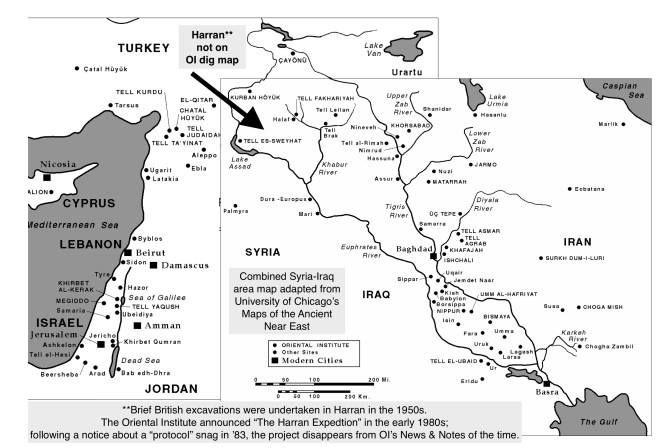
In Genesis (cited above), the places specifically linked to Abraham and Sarah are called Ur Kasdim [אוּר כַּשְׂדִּים] and Haran [חָרָן]. Scholars — of history, archaeology, and bible studies — today identify these biblical locations with the historical cities of Ur, west of the Euphrates River in the southernmost area of Mesopotamia, and Harran, between the Euphrates and Tigris rivers in the northernmost section of Mesopotamia.

Babylon, which Genesis never identifies directly with Terah or descendants, is also between the rivers, south of Harran and north of Ur. In Jewish discourse, however, “Babylon” sometimes means the city, but can also mean the wider Babylonia or whole region of Mesopotamia.

Iraq_Syria_CombinedMap
more info: https://oi.uchicago.edu/research/computer-laboratory/oriental-institute-map-series

As #ExploringBabylon continues, we’ll return to the relationship of Israel to Mesopotamia — in geography, history, and imagination. One of the key elements in that relationship involves the “old” religion. And this topic is linked to the two towns associated with Terah and family.

The Torah text itself does not explain why Terah left Ur or why Abraham is told to leave Haran; nor does the Torah give any reason for God’s choice to engage with Abraham. Commentary generally equate the journey with distancing from older practices and beliefs, particularly in the towns of Ur and Haran. Midrash often fills the white space with stories about Abraham (and, sometimes, Sarah, to whom he was already wed) taking steps toward monotheism before God said “go forth,” while other family members faltered. For example:

Influenced by Abram and his circle, Terah and other members of the family also felt an inner urge — yet not sufficiently strong or clear — in the spiritual direction toward which Abram was set with all his heart and soul. But they did not succeed in overcoming completely the attraction of idol worship and were unable to abandon the world of paganism; they did, in truth, set out on the journey, but stopped in the middle of the away.

Throughout his life, [Terah] did not find the strength to continue his journey and reach the goal that he originally had in mind under his son’s influence. Although he had made an effort to get away from the centre of the moon-cult in Ur of the Chaldees, yet when he came to another city dedicated to this worship — to Haran — he did not succeed in freeing himself from the spell of idolatry, and stayed there.
— Umberto Cassuto, A Commentary on the Book of Genesis Part Two: From Noah to Abraham (Jerusalem: The Magnes Press, 1964; Hebrew, first published 1949), p.281, 283

For more on the moon-cult of Sin, an archaeology background page.


“And Them”

Rabbi and biblical scholar Umberto Cassuto (1883-1951) was eager to provide alternative readings to those promulgated under the Documentary Hypothesis in the mid-20th Century. As part of that effort, he goes to great pains to elaborate on the phrase “[וַיֵּצְאוּ אִתָּם] they went out, with them” (Gen 11:31) in relation to Terah and his traveling party. He also looks at inconsistent references to Abraham’s “country” and “kindred.” (See From Noah to Abraham (full citation).)

While Cassuto is arguing against assigning various passages to the different Documents (not a central concern of this blog), his detailed analysis adds texture to the picture of “back home” for Abraham and Sarah. And that is useful for #Exploring Babylon.

Home and Also Home
Casutto points out that “birth-place” did not mean the same thing for a nomadic people that it means to more settled folk. After further discussion of the references to Abraham’s “country and kindred,” he concludes:

Thus there is no contradiction at all between the passages that indicate Ur of the Chaldees as the original home of Abram and those that afterwards refer to the land of Haran as his native land.
— Cassuto, p.274

This declaration speaks charmingly to all of us who distinguish between “original hometown,” on the one hand, and “longtime home,” on the other. Neither is less “native.” But he goes on to use his analysis to bring some further depth to the landscape Genesis 11ff.

Cassuto suggests that perhaps Terah’s family had originated in Haran and traveled to Ur at some point:

Accordingly, the migration to Haran mentioned in v.31 [11:31] really marks the return of the family to its original home. The fact that Ur and Haran were the chief centres of the cult of the moon-god Sin, and consequently were linked together by firm and permanent ties, serves to explain the movements from one to the other.
— Cassuto, p.275

BACK