Matot: Heavy Tongue, or the House of Cards theory of bible study

I want to begin by acknowledging my teacher, Max Ticktin z”l, for whom the period of shloshim is coming to a close and whose connections to Temple Micah are more varied and interesting than I knew before he died. Max taught me — and others in several generations — a lot about who is and is not an enemy, of ourselves personally and of the People Israel.

Dvar torah on parashat Matot, Temple Micah 7/30/16

These remarks focus on the story of vengeance, Numbers 30:1ff. This is an odd and troubling story in many ways. I chose to study it, in part because I worry about the consequences of failing to examine the uglier parts of our tradition, and in part because its very oddness makes it interesting.

A few odd things

One odd thing is that we are told Pinchas was the priest of the campaign, but we are not told who the military leader was.

Another odd thing is how the otherwise terse story stops to tell us that Pinchas brought the “holy utensils” — which many commentators believe means the Ark — and the shofar. This makes the whole thing sound terrifyingly like something out of “Raiders of the Lost Ark” (Paramount 1981) or any of our contemporary wars that make use of religious iconography to wreak havoc on perceived enemies.

It seems to me — although I didn’t find commentary saying this, exactly — that the religious details, the priest, the holy utensils, and the shofar, hint at the spiritual aspect of the story. However distasteful and scary most of us find this today, the idea that a war should be fought to kill some people in order to preserve other people’s spiritual health, that was a part of biblical storytelling.

Midianites and Moabites, Balak and Pinchas

The Torah and many commentaries are clear that this whole issue with the Midianites is a war on people who tempted the Israelites into idolatrous behavior. We might think (and many commentaries remark) that the problem would be with the Moabites because it was the Moabites with whom Israel engaged in harlotry and idolatry in what is called here “the matter of Baal Peor.”

Back at the close of parashat Balak, we are told that Israel became “attached to Baal Peor and the wrath of God flared up against them” (citation). Moses and the judges had just ordered the Israelites to turn on one another and kill men attached to Baal Peor when the Israelite male, Zimri, and the Midianite female, Cozbi, perform what is generally understood to be public sex acts at the Tent of Meeting. Then Pinchas runs them through with a spear, stopping a plague we had not been told was happening. Just the one Midianite, Cozbi, is mentioned there. But both nations collaborated in hiring Balaam to curse Israel. So perhaps they were collaborating in the incidents involving Baal Peor, too. However it came to be, God told Moses back in chapter 25, at the start of parashat Pinchas, to harass [tsaror] the Midianites and kill them because they had attached [tsorerim] Israel “through the conspiracy against you [the Israelites] in the matter of Peor.”

Hasidic commentary says this harassing is a sort of eternal command, because the temptation to the Israelites will persist. The idea is that once they have tasted debauchery, it will be impossible to keep desire from arising again. So Israel must now be eternally harassing those who harassed them with temptation.

If the Israelites could have been warned some other way to be eternally vigilant to stop evil urges in themselves, we might have an easier time with the lesson. But that is not what Or HaChaim teaches, and that is not how the Torah text unfolds. Instead….

God tells Moses to harass the Midianites in chapter 25. And then we have a census and some legal material, a list of offerings, and a long treatise on vows. After all that, here in chapter 31, God tells Moses to take vengeance — now the verb is different, nekom –against the Midianites.

This is another odd bit and one of my favorites.

Another odd thing

Back when the whole mess started, we have a break between portions introduced right at the height of the Baal Peor matter. Israel’s idolatry and the incident of Zimri & Cozbi ends parashat Balak. Pinchas is rewarded for his action that stops Cozbi & Zimri in the next portion. And that’s where we see the command to harass Midian, at the start of parshat Pinchas.

The portion break suggests that the story was just too far out of control and the Rabbis wanted to cool things off….This is a very famous break, often discussed in the commentary. For more, see “Pinchas and the scary friend….But that’s a later, conscious choice of how we are to read and learn this text. The Torah itself inserts the five-chapter break between the precipitating events and God’s call for harassment, on the one hand, and, on the other hand, this episode of vengeance.

Moreover, we have so many odd things in both places. Pinchas acts to stop a plague that is not mentioned before it stops. Moses and God speak of a conspiracy against the Israelites involving sexual misconduct. But the only conspiracy we’re told about in the text is the one to hire Balaam to curse the people. Balaam is blamed (in commentary and in the text here) for whatever sexual acts and idolatry are happening, even though the last we heard of him, he went home after blessing Israel with words we still celebrate every morning in the prayers. (See, e.g., “Balak prayer links”.)

Missing Bits

I think the missing bits and the halting way the story is told suggest a struggle — with facts, perhaps, or with feelings and ideologies that lead to death and disaster. If we take nothing else away from this, I believe the Torah wants to ensure that conspiracy and war and people turning on one another is not read smoothly or accepted easily.

Avivah Zornberg, the brilliant and very Freudian teacher of Torah, believes the Torah itself has an unconscious that is suppressing trauma. (See The Murmuring Deep, citation coming). I’m not sure I buy her whole theory, but I do think we should listen to the pauses and the stuttering and the weird missing bits as closely as we listen to the story tht reads more easily… maybe more closely.

Midianites: enemies?

And meanwhile Moses, who argued with God so many times before has nothing to say in the text in support of the Midianites who protected and nurtured him in his youth. Nothing to say about his extended family and the legacy of Jethro, his father-in-law, who contributed so much to his own learning and helped Israel set up a judicial system.

It’s not much of a surprise that we don’t hear from Zipporah, as we rarely hear from women, even ones who face down God to save their husbands from death (see the “night incident” at the inn in early Exodus; citation coming). But Moses has nothing to say on her behalf?

We’re not the first generation to notice the oddness of this incident and Moses’s close connection to Midianites. Early commentary says that is why, although God tells Moses to exact vengeance, Moses sends others and stays back himself. Of course, this says nothing about the fact that he lets it happen, anyway, even appears to orchestrate it; it also discounts the fact that Moses is quite aged here and perhaps unable to command in battle.

But the interesting point to note, I think, is that Numbers Rabbah acknowledged the relationship between Moses and Midian, and tries to address how hard it all was and how thoroughly entangled were all the players here.

The contemporary biblical literary teacher Robert Alter says this about Baal Peor in chapter 25:

The Israelite attitude toward its neighbors appears to have oscillated over time and within different ideological groups between xenophobia, a fear of being drawn off its own spiritual path by its neighbors, and an openness to alliance and interchange with surrounding peoples.

–Alter’s Torah commentary

In reference to this passage in chapter 31, he says:

Either two conflicting traditions are present in these texts, or, if we try to conceive this as a continuous story, Moses, after the Baal Peor episode reacts with particular fury against the Midianiate women (not to speak of all the males) because he himself is married to one of them and feels impelled to demonstrate his unswerving dedication to protecting Israel from alien seduction. But it must be conceded that the earlier picture of the Midianite priest Jethro, Moses’s father-in-law, as a virtual monotheist and a benign councilor to Israel does not accord with the image in these chapters of the Midianite women enticing the Israelits to pagan excesses.

One more possibility comes to mind….

House of Cards theory of bible analysis

Maybe there was a conspiracy involving Balaam and the Midianite kings but orchestrated by some other entity for reasons of their own, some kind of House-of-Cards-type plot to discredit the Midianites and turn Israel against them — or to make us believe Midian and Israel were enemies and would always be. Maybe the plot was so successful that Moses turned against his own earlier supporters because of it, so successful that the narrator can make us believe the story really moves from “go kill more people to undo you own spiritual troubles” to instructions for how to become ritually clean after carrying out more vengeance. But whichever Frank Underwood was behind the plot is no longer available — to look  us straight in the eye, breaking the Torah’s fourth wall, so to speak  — and confess what’s really going on and why, or to at least offer another version of the truth.

This is not too different from Zornberg’s unconscious theory. Because they both boil down to the fact that the Torah itself cannot say, maybe no longer knows, what caused the People to lose their spiritual way and then turn on neighbors and allies in an attempt to cope, make some sense of it.  But the Torah is still able to tell us in its stuttering way, full of missing bits and confusion, that the tale is maybe not as straightforward as it might sometimes be portrayed, that vengeance is not a simple matter with a clear beginning and end, that it’s not something that ends well…or even ends:

In the middle of his rant to the leaders for not killing enough, Moses is somehow back to a lecture on ritual purity after touching the dead. And we are not told at this point if his ranting instructions were carried out (and we know from later stories in Tanakh that there are plenty of Midianites still in the land).

A heavy tongue returns

It occurred to me late in preparing these remarks that perhaps the rambling and stuttering of this story is related to what Shelley Grossman described here about Moses a few weeks ago: his aging and use of an old playbook and how he no longer has his siblings at his side. Remember, too, that Moses tried to refuse the Exodus mission, back at the Burning Bush, by telling God he was “heavy-mouthed” and “heavy-tongued” (Alter’s words). At the time, God told Moses not to worry because Aaron could speak. But now, Aaron and Miriam are gone and we have, instead, Pinchas — Aaron’s grandson whom we first meet when he is in the middle of a violent act, committing a killing that we are later told is part of a covenant of peace.

So maybe what we witness here is a story that is moving forward under emerging leadership but related by a man who has reverted to heavy-tongue, reporting to us that his own demise will follow on the heels of vengeance on people he once knew as family and fellow monotheists. Maybe it’s a kind of last gift to Moses — and to us — that the old, heavy-mouthed stuttering voice comes through to warn us that no such tale can be told without stumbling and missing bits.

NOTES

Max David Ticktin (1922 – 2016)

There are many on-line obituaries and memorials to Max. My favorite is this one by Rabbi Arthur Waskow. And in the way of such things, I was carrying the Torah through the Micah congregation just a few days after Max’s funeral and, even though Max did not attend services at Micah would not have been there to touch me with his tzitzit, I found myself equal parts profoundly sad at the knowledge that we would all be missing his touch and deeply grateful for the myriad ways he had already touched so many of us.

BACK

The Torah Portion

The Torah portion Matot is comprised of Numbers 30:2 – 32:42. Temple Micah is following the schedule of readings used in Israel and, therefore, one week ahead of many congregations in the diaspora at this point in the calendar.
BACK
Racism: Congenital Deformity, Sickness Unto Death

It is time to re-order our national priorities. All those who now speak of good will and praise the work of such groups as the President’s Commission* now have the responsibility to stand up and act for the social changes that are necessary to conquer racism in America. If we as a society fail, I fear that we will learn very shortly that racism is a sickness unto death.
— “DR. KING CALLS FOR ACTION AGAINST POVERTY AND RACISM CITED IN RIOT STUDY; POOR PEOPLE’S CAMPAIGN STARTS APRIL 22 IN WASHINGTON,” 3/4/68 SCLC press release (see King archives)

*Nat’l Advisory Commission on Civil Disorder (report summary)

The president of the Southern Christian Leadership Conference continues, calling racism a “congenital deformity” of the United States:

whereEver since the birth of our nation, white America has had a schizophrenic personality on the question of race. She has been torn between selves—a self in which she proudly professed the great principles of democracy and a self in which she sadly practiced the antithesis of democracy. This tragic duality has produced a strange indecisiveness and ambivalence toward the Negro, causing America to take a step backward simultaneously with every step forward on the question of racial justice, to be at once attracted to the Negro and repelled by him, to love and to hate him. There has never been a solid, unified and determined thrust to make justice a reality for Afro-Americans…. What is the source of this perennial indecision and vacillation? It lies in the ‘congenital deformity’ of racism that has crippled the nation from its inception.
— Martin Luther King, Jr.,
Where Do We Go From Here: Chaos or Community?
1967; Reprinted, Boston: Beacon Press, 2010

One month later, 48 years ago today, Martin Luther King was assassinated.

This year, Passover begins on April 22. Where do we go from here?
While everyone in the U.S. must be asking this question, it seems particularly incumbent on Jews as the annual festival of freedom approaches: None of us is free unless all of us is free.

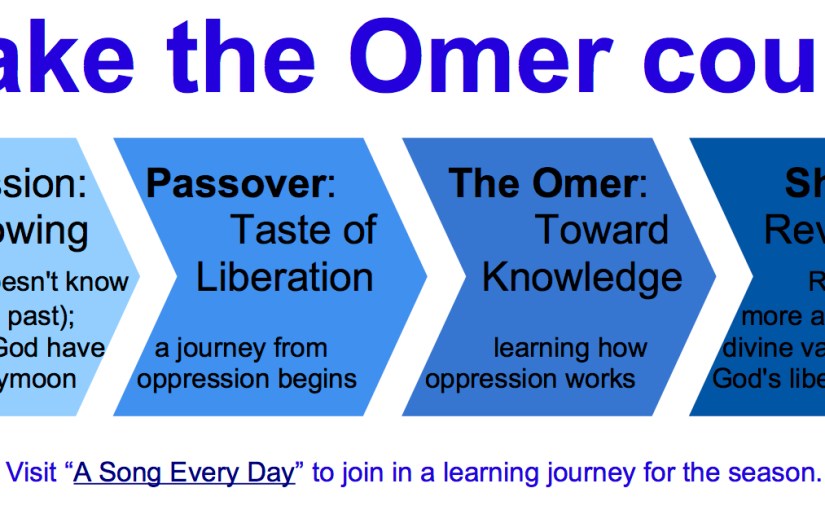
On the Road to Knowing: A Journey Away from Oppression

The Passover journey is launched in “not knowing” — as when a new Pharaoh arises who does not know Joseph (אֲשֶׁר לֹא-יָדַע, אֶת-יוֹסֵף, Exodus 1:8) or God (לֹא יָדַעְתִּי אֶת-יְהוָה, Exodus 5:2) — and it aims for “knowing”:

…You shall know that I am YHVH, your God…
וִידַעְתֶּם, כִּי אֲנִי יְהוָה אֱלֹהֵיכֶם (Exodus 6:7).

The Exodus experiences and our travels in the wilderness are meant to increase our knowledge of the divine so that we can better serve God. (See Silber “Rereading the Plagues”).

A key element in the journey from liberation to revelation is understanding the workings of oppression, and our part in them. We cannot work effectively to end what we do not comprehend.

So this year, moving from Passover to Shavuot, I commit to learning more about how oppression works and how liberation is accomplished. I invite others to join me:

Let’s work together, as we count the Omer, to make this Omer count.
Thoughts and sources welcome.

JourneyOmer

Share this graphic to encourage others to participate.

Continue reading On the Road to Knowing: A Journey Away from Oppression

Exodus: from state violence to resistance to liberation

The story of Exodus opens with state-mandated oppression and violence against a rapidly growing minority population, increasingly feared by the ruling majority (brief summary). Women of different communities and classes engage in resistance, separately and jointly, that eventually leads to toppling of the entire system.

From Violence to Resistance

Today, many in the U.S. are calling for acknowledgement of “the structural violence and institutional discrimination that continues to imprison our communities either in a life of poverty and/or one behind bars,” and recognition of “the full spectrum of our human rights and its obligations under international law.” Black Lives Matter addresses

…a world where Black lives are systematically and intentionally targeted for demise….an affirmation of Black folks’ contributions to this society, our humanity, and our resilience in the face of deadly oppression….we are talking about the ways in which Black people are deprived of our basic human rights and dignity. It is an acknowledgement Black poverty and genocide is state violence.

Midwives Shifrah and Puah act against the state, we are told, because “they feared God,” prompting them to act in preservation of life. Avivah Gottlieb Zornberg elaborates:

…the very extremity of the edict forces a new moral vision upon the midwives, a radical choice between life and death. Disobedience to Pharaoh becomes more than merely a refusal to kill, it becomes a total dedication to nourishing life.
— Zornberg, The Particulars of Rapture, p.23 (full citation)

Similarly, I think, the Herstory of #BlackLivesMatter exhorts us:

…when Black people cry out in defense of our lives, which are uniquely, systematically, and savagely targeted by the state, we are asking you, our family, to stand with us in affirming Black lives. Not just all lives. Black lives. Please do not change the conversation by talking about how your life matters, too. It does, but we need less watered down unity and a more active solidarities with us, Black people, unwaveringly, in defense of our humanity. Our collective futures depend on it.

Pledging Resistance?

Ferguson Action is asking individuals to declare 2015 their “year of resistance.”

I pledge to make 2015 my year of resistance to state violence against Black lives.

I challenge myself and those in my community to take risks as we confront the many ways that Black lives are diminished and taken from us….

This year, I will declare boldly and loudly through my words and actions, that #BlackLivesMatter.
Ferguson Action Pledge

Does Exodus — with its powerful examples of resistance — call us to anything less?
Continue reading Exodus: from state violence to resistance to liberation

First Steps in an Exodus from Racism

In the mid-20th Century, the Exodus story (neither Charlton Heston nor Christian Bales, but the second book of the bible) became part of the underpinnings of the Civil Rights Movement in the United States. Today, as a new civil rights movement evolves, how can we use the ancient Exodus narrative to once again help us explore key issues and increase understanding and involvement?
Continue reading First Steps in an Exodus from Racism

Power, Language, and Settling: Questions from Joseph’s Story

The Joseph story, which begins in this week’s Torah portion raises questions about language, about power and how it is used, and about the possibility of learning an entirely new narrative about a story of which we are a part:

  • How does the language we use, even inside our own heads, affect the way we view an encounter?
  • How does the way one individual is described affect our views of others who share some background with that individual?
  • What does it mean for one person or group of persons to have power over another? Is it as changeable as a garment? Do we recognize when we are wearing a garment of power?
  • Do we sometimes pretend a sense of brotherhood when it suits us and drop it when it doesn’t?
  • Can we, today — like the biblical Joseph — create circumstances that lead to a “dizzying awareness of new narrative” that leads to different action?
  • Do we, as individuals or as part of a collective, try to settle for our own peace, even if we know others are suffering? How hard do we, like the biblical Jacob, work to remain oblivious to strife before us, even if we helped engender it?

Finally: what does this portion say about “living in the midst of history” and entering the eight days of Chanukah, designed to bring us out of the lowest level of light?


Continue reading Power, Language, and Settling: Questions from Joseph’s Story

Opening and the Ark

What does it mean to open the Ark?

In my experience the Torah service exhibits more diversity than any other part of a Jewish service. Reading length varies across denominations. General approach ranges from informal circles embracing Torah to formal, long-standing choreography. And the Torah service is one spot where women’s absence on the bima, in congregations without egalitarian practice, is the most obvious. Moreover, it is one of the few moments where division of Jews into Kohen, Levite, and Yisrael is still obvious in Orthodox and Conservative congregations (where a kohen [priest] is called to the first aliyah [“going up” Torah honor] and a Levite to the second).

How much is shared across this variety? And what do the variations mean? — Are they matters of custom, preference, and leadership style, or theology? Which one(s) work for you and why?

The Torah service is not the only point when the Ark is open. But the beginning of the Torah service presents a prominent opportunity to contemplate what it means to us, individually and communally, to open the Ark… to approach Torah and have Torah brought into our midst.

Here is a prayer of my own, based on words commonly recited as the Ark is opened. Below that are links to the prayers that inspired mine — B’rich Shmei and Anim Zmirot — and more thoughts on opening the Ark.

What is your prayer for approaching the Torah?
To what are you opening?

Entering the Torah Service
Here in this Torah Service we travel the wilderness in the company of the Ark, stand again at Sinai, and re-enact the process of transmission and interpretation as multiple individuals rise to bring the Torah from script to voice. Time collapses. We join the ageless chorus reciting verses that challenge and comfort, awe and enrage, perplex and command. We feel the presence of Jews who have experienced much, in endurance and in celebration, preserving these words. We feel the call of future Jews depending on us to grasp this Tree of Life and hold it for them.

At this expansive point we pray that our hearts open to the essence of Torah and ask for the gift of God’s good light to guide us through our daily lives.

In this precious, liminal moment, fear and need merge with strength and hope. May we all, particularly those observing lifecycle events at the Torah, emerge from this service with a renewed sense of blessings. Let the divine flow of communication represented here bring to us, and to all whom we touch, peace, mercy, sustenance, and gratitude. Thank you for this good teaching. Amen
–Virginia Spatz

More on Opening the Ark

My prayer, above, is based in part on language and themes found in several prayers, including B’rich sh’mei [blessed is the Name], recited at the start of the Torah service.


בריך שמה דמרא עלמא
Blessed is the name of the ruler of the universe

(from Zohar, parashat vayakhel)

The Zohar says, “Rabbi Shimon said: When the scroll of Torah is removed from the ark to be read to the congregation, the heavenly gates of mercy are opened and love is aroused in the world above. Here a person adds….”B’rich sh’mei d’marei alma…. [Blessed is the name of the ruler of the universe!…]”

Blessed is the name of the Master of the universe. Blessed is your crown and your place [v’atrach] May You love your people Israel forever. Reveal the salvation of your right hand to your people in your sanctuary. Lead us to discover the goodness of your light, and accept our prayer in mercy. May it be your will to prolong our lives in happiness.

I am the servant of the Holy One, whom I revere and whose Torah I revere at all times. Not on mortals do I relay, nor upon angels [or “messengers”] do I depend, but on the God of the universe, the God of truth whose Torah is truth, whose prophets are truth, and who abounds in deeds of goodness and truth. In God do I put my trust; unto God’s holy, precious being do I utter praise. Open my heart to Your Torah. Answer my prayers and the prayers of all Your people Israel for goodness, for life, and for peace. Amen.
–See My People’s Prayer Book


BACK


אַנְעִים זְמִירוֹת וְשִׁירִים אֶאֱרֹג כִּי אֵלֶיךָ נַפְשִׁי תַּעֲרֹג
Soothing songs and poems I weave because my soul longs for You.

I was also inspired by a woman’s kavvanah [intention] associated with Anim Zemirot. This hymn is recited when the Ark is open, sometimes early morning, sometimes in concluding prayers; sometimes on Shabbat, often on Festivals. It is not included in the Shabbat Mishkan T’filah, but it does appear in the Weekday/Festival edition. Here’s a link to the full text of Anim Zemirot, sometimes called “Shir HaKavod [Song of Glory],” as well as several recordings.

Here is the women’s meditation from Aliza Lavie’s collection:.


Master of the universe. Just as the Holy Ark is opened here, so may a window be opened in heaven: the gates of mercy. May my prayer be accepted among the other pure prayers that are surely accepted before You, and may it be a crown for Your head….Remember me, my husband, my beloved children, and dear ones, at the time that is called a time of favor and a time of success, so that our lives may be called lives of joy, lives of sustenance, lives of blessing, lives of peace, lives of mercy, and of Your good teachings. Bless us with the three keys that have never been handed over to any emissary, but come about only through Your own blessing. With this I conclude; hurry to my aid, God of my deliverance.

…Protect us all from that which my heart fears, and spare me, my husband, and my children from mortal charity. Hear my prayer [name of worshipper], daughter of [mothers name], as You heard the righteous Hannah and the other righteous women. Amen. Selah
A Jewish Woman’s Prayer Book. Aliza Lavie NY: Spiegel & Grau, 2008


BACK

More Thoughts on Opening the Ark

A few more thoughts, from two different prayer books, on opening the Ark and taking out the Torah…

We approach the Torah slowly. First we open the ark so that the Torah is visible. We look at the Torah but refrain from touching. Next, the Torah is removed from the ark and held by the service leader. Later the Torah is carried through the congregation, and everyone can touch the Torah. This demonstrates that the Torah is not the property of those leading the services; the Torah belongs to the Jewish community. Finally, the coverings of the Torah scroll are removed, allowing us a privileged intimacy with the words we hear.
– Dan Ehrenkrantz, Kol Haneshamah [Reconstructionist] siddur

The verses we sing when we take the Torah scroll from the Ark and when we return it recall the Israelites’ journey through the wilderness, when they carried the Ark with them….We are a people defined by history. We carry our past with us. We relive it in ritual and prayer. We are not lonely individuals, disconnected with past and present. We are characters in the world’s oldest continuous story, charged with writing its next chapter and handing it on to those who come after us.
–Jonathan Sacks in Koren Sacks [Orthodox] Siddur, p.xxxiv-xxxv

BACK

Key Footnote

I asked local scholar Norman Shore for help with understanding the “three keys.” Here are the sources he provided, shared with gratitude.

R. Johanan said: Three keys the Holy One blessed be He has retained in His own hands and not entrusted to the hand of any messenger, namely, the Key of Rain, the Key of Childbirth, and the Key of the Revival of the Dead. The Key of Rain, for It is written, ‘The Lord will open unto thee His good treasure, the heaven to give the rain of thy land in its season,’ (Deut 28:12) The Key of Childbirth, for it is written, ‘And God remembered Rachel, and God hearkened to her, and opened her womb.'(Gen 30:22) The Key of the Revival of the Dead, for it is written, ‘And ye shall know that I am the Lord, when I have opened your graves.’ (Ezek 37:13). In Palestine they said: Also the Key of Sustenance, for it is said, Thou openest thy hand etc. (Ps 145:16) Why does not R. Johanan include also this [key]? — Because in his view sustenance is [included in] Rain.
— Babylonian Talmud, Taanit 2a-2b

And it came to pass after a while, that the brook dried up, because there had been no rain in the land (1 Kings 17:7). Now, when [God] saw that the world was distressed [because of the drought], it is written, ‘And the word of the Lord came unto him (Elijah), saying, Arise, get thee to Zarephath’ (ibid 8ff). And it is further written, ‘And it came to pass after these things, that the son of the woman, the mistress of the house, fell sick’ (ibid 17). Elijah prayed that the keys of resurrection might be given him, but was answered, “Three keys have not been entrusted to an agent: of birth, rain, and resurrection. Shall it be said, ‘Two are in the hands of the disciple[1] and [only] one in the hand of the Master?’ Bring [Me] the other and take this one, as it is written, ‘Go, shew thyself unto Ahab; and I will send rain upon the earth’ (ibid 18:1).”[2]
–Babylonian Talmud, Sanhedrin 113

Footnotes, like text, from Soncinco, public domain edition:
1) Since the key of rain was already in Elijah’s possession, and now he was asking for the key of resurrection too.

2) I but not Thou. The whole passage is adduced to shew how God, having given the key of rain to Elijah, obtained its return, and that the illness of the widow’s son was for that purpose.

RETURN from Footnote

Beyond Oppression: Passover Lessons

The Exodus story is not an obvious tale of oppressed and oppressor peoples learning to jointly create a more equal society. Instead the Israelites leave Egypt, taking Egyptian riches with them, and are chastised by their leader whenever they look back; the Egyptians suffer many plagues before Pharaoh lets the Hebrews go, and they endure further disaster when Pharaoh’s army is drowned in the Sea of Reeds. How can we use this violent and permanent parting as a model for overcoming a history of oppression and division to learn respectful coexistence?

I posed a Facebook query to this effect and was impressed at the range and depth of ideas in the off-the-cuff responses I received. I thought many seder tables might benefit from these suggestions for learning and discussion, and I wanted to post this before Passover in a way that others could access. Apologies for lack of citation and other sketchiness. All errors or failure to communicate friends’ brilliant thoughts are mine.
Continue reading Beyond Oppression: Passover Lessons

You Can’t Spend What You Ain’t Got: Eikev Prayer Links

In this portion, Moses presents the People with a jumble of sentiments — from sweeping promises to dire threats — which found their way into prominent roles in our prayers. And, while biblical context often has little to do with the use the siddur makes of the bible’s language, our prayers do reflect this portion’s tangled relationship between the People, God and others.
Continue reading You Can’t Spend What You Ain’t Got: Eikev Prayer Links

Be Not Afraid: Community and Challah

Two of the most iconically gendered concepts in Jewish prayer — that “tenth man” for a minyan, on the one hand, and taking challah, one of three “women’s commandments,” on the other — come from this week’s portion. But gender issues can, I think, distract from other prayer ideas suggested by these same verses.
Continue reading Be Not Afraid: Community and Challah