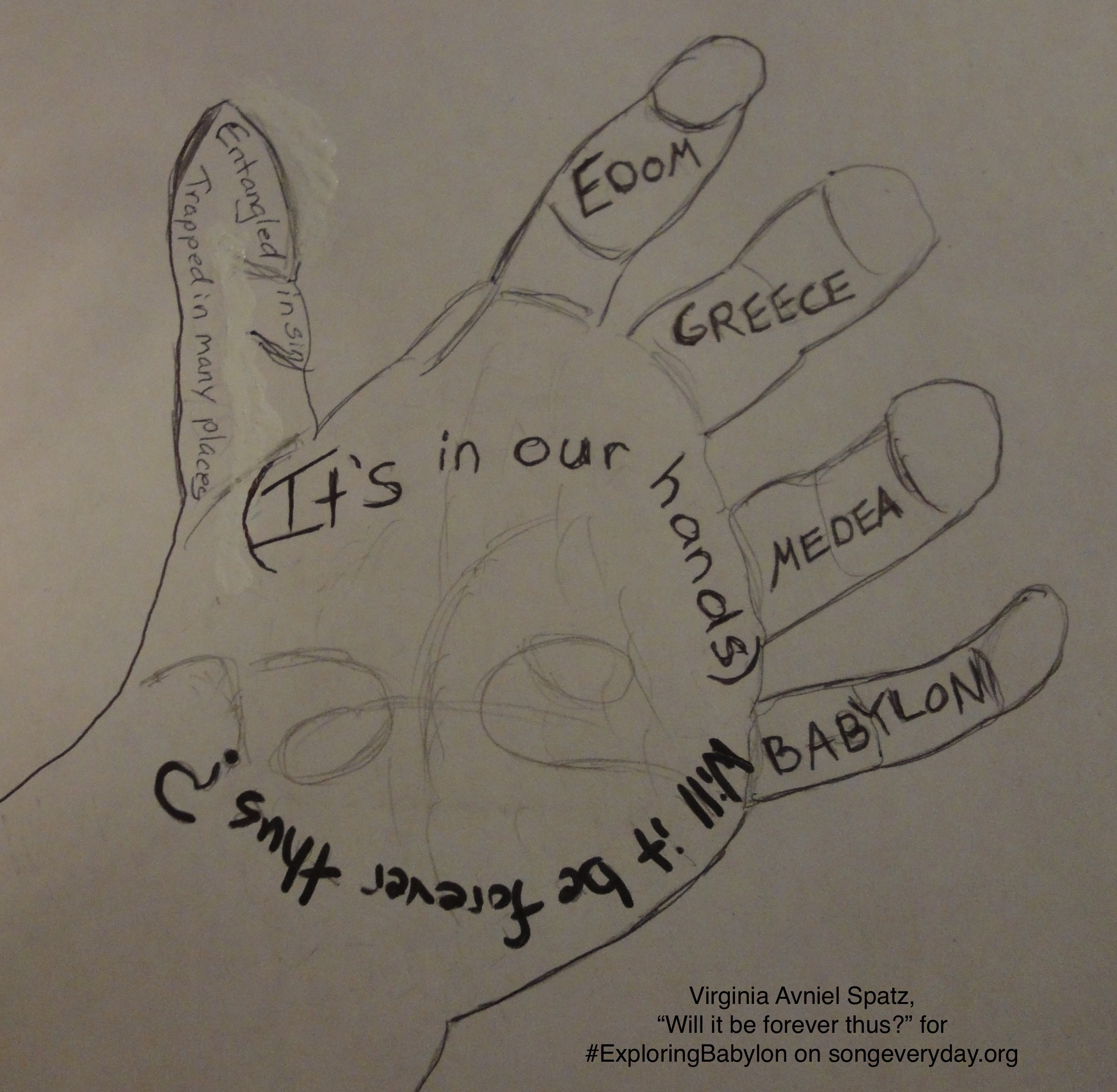
Jacob’s Dream and What’s Ours

Exploring Babylon Chapter 7.2

In the previous episode of #ExploringBabylon, I shared a pair of midrashim about Jacob’s Dream (Gen 28:12) from Midrash Tanchuma-Yelammedenu Vayetze 2. In Dream “Version #2,” God blames Jacob’s lack of faith, evidenced by his failure to ascend the ladder, for future oppression of Israel by Babylon, Persia, Greece, and Rome:

…since you did not have faith, your descendants will be oppressed by these four kingdoms with imposts, taxes on their crops, and poll-tax.
— Tanchuma Vayetze 2 cont. (Berman, p.186; full citation in previous post)

Version #2 concludes with a promise that the people will be saved due to the practice of pe’ah [corners], i.e., not harvesting one’s fields entirely, but leaving the corners for the poor (Lev 19:9-10, 23:22). Chapter 7.1 noted a few questions that this raises about the relationship between oppression and taxes, on the one hand, and faith, on the other. Here are further thoughts.

Let’s begin with the commandment of pe’ah, and travel backward through the midrashic territory.

Removing Wealth

1) Pe’ah, we learned, may be compared to withholding tax: “One does not even own one’s income until one has separated out the portion for the poor,” like “taxes that are withheld from income; it never really was yours anyway” (Jeffrey Spitzer, “Pe’ah: The Corners of Our Fields“). The mitzvah of pe’ah, and the associated attitude toward one’s earnings, is what will save the people from annihilation, according to Dream Version #2.

Biblical and rabbinic text focus a great deal on what individuals owe to the community, particularly to the most vulnerable — and pe’ah is just one of many related mitzvot that we might understand, following Spitzer, as akin to taxation for the public good. But ancient “taxation,” in ancient Jewish views, was something else.

2) The oppression, suffered under four kingdoms in Dream Version #2, encompasses “imposts, taxes on their crops, and poll-tax.” These taxes remove wealth from the local community for the needs of empire — be it Babylon, Persia, Greece, or Rome. Removing wealth from subject populations served to support the empire while also reducing the chance of rebellion in the provinces.

Such taxes, imposed from outside, were not viewed in Jewish tradition as commonweal-supporting. In addition, some ancient taxes were specifically designed to be punitive, such as poll-taxes on Jews in the wake of the 1st Century CE rebellion; diverting taxes from the Temple in Jerusalem to instead finance a temple for Jupiter in Rome was seen (and intended) as a particular affront.

3) In Dream Version #2, God announces that the kind of tax-oppression Jews experienced, as subjects of four foreign empires, can be explained by Jacob’s lack of faith and failure to ascend the ladder.

We don’t get Jacob’s side of the story. But we have a small clue in the text that follows the dream. When Jacob awakens, he makes a vow using an “if-then” construction:

And Jacob vowed a vow, saying: ‘If God will be with me, and will keep me in this way that I go, and will give me bread to eat, and raiment to put on, so that I come back to my father’s house in peace, then shall the LORD be my God…and of all that Thou shalt give me I will surely give the tenth unto Thee.’
— Gen 28:20-22

Most commentators read this, as discussed in “Jacob’s Contract with God,” as conditional only “in the way any contract or agreement is conditional” or as another form of affirming the covenantal relationship God has just announced. But I hear something else.

What’s Ours

Jacob, on the road to Haran, has just lost his home and any mundane sense of security. He hopes the sojourn will be temporary but does not yet know for sure and is not assured of future success, or even of shelter ahead. God’s promise is amazing, but Jacob sins by not grasping it.

“For all this they sinned still, and believed not in His wondrous works” (Psalm 78:32), we read in Dream Version #2. “Jacob” has shifted from a patriarch alone on the road to his national persona, which includes us.

We know from later text and tradition that the covenant God established with Abraham and Sarah, with Isaac and Rebecca, now reiterated with Jacob, obligates us to sharing resources in the ways outlined above, the mitzvah of pe’ah being a prime example. We are meant to acknowledge, all the time, in our thought and in our economic behavior that whatever we have is by the grace of God and not because we’re somehow entitled.

But Jacob, in his vow, sounds very like most of us most of the time: willing enough to give tzedakah, or otherwise contribute to the community, only after our own financial security is assured. This is a luxury denied to many.

And we have a great deal of work to do, as individuals, as communities, and on the national scale in the U.S., to examine what is ours and re-think how “our” stuff is distributed. This holiday of Thanksgiving calls those of us who are not of indigenous descent to carefully examine “ours” in the context of this land and its bounty. We must also look, nationally, at what is “ours” in the context of labor stolen from millions of enslaved people.

This is what I hear in Jacob’s dream. What about you?


“POLL TAX”
When I first encountered the midrash about poll-taxes, I confess my first thought was this was some kind of anachronistic reference to voting rights. For anyone else who may be confused….

“Poll,” meaning “head,” is used in two common, inter-related ways: Poll-taxes, since ancient times, are levied per person, as opposed to taxes on crops (income) or property, and imposed for a variety of reasons; history has seen a number of poll-taxes specifically aimed at Jewish communities. Poll is also used in voting contexts, where each “head” has a say in an election.

These two uses collide in the United States, where poll-taxes — in the sense of taxes on an individual, rather than on income or property — were used as a barrier to the polling place. The 24th Amendment made such use on the federal level unconstitutional in 1964, and subsequent rulings outlawed their use in state elections. Prior to that, poll taxes were used to prevent many people, primarily black citizens of the South, from exercising the right to vote.
BACK

Babylon, Taxes, and Thanksgiving

Exploring Babylon Chapter 7.1

Jacob heads back “there,” home of his mother’s and his grandparents’ people, in this week’s Torah portion, Vayetze (Gen 28:10-32:3; for more on “there“). But a great deal happens in the few verses between his leaving Beer Sheva and his arrival in Haran, and some of it sheds light for #ExploringBabylon.

In flight, after stealing his brother’s blessing (last week’s portion), Jacob pauses for the night:

וַיַּחֲלֹם, וְהִנֵּה סֻלָּם מֻצָּב אַרְצָה, וְרֹאשׁוֹ, מַגִּיעַ הַשָּׁמָיְמָה; וְהִנֵּה מַלְאֲכֵי אֱלֹהִים, עֹלִים וְיֹרְדִים בּוֹ
And he dreamed, and behold a ladder set up on the earth, and the top of it reached to heaven; and behold the angels of God ascending and descending on it.
— Gen 28:12 (Old JPS translation)

This dream, particularly its image of angels first ascending and then descending, has been the source of many tales and lessons. One such commentary, from Midrash Tanchuma (c. 500-800 CE), involves Babylon and taxes, and leads us to consider what Judaism demands regarding economic justice.

The Four Exiles

Earlier in #ExploringBabylon, we encountered two midrashim reading four exiles, or foreign dominations, into biblical text without apparent connection to exile: The first involved the earliest stages of Creation, Gen 1:2 (see “Babylon and the Beginning“); the second, the Binding of Isaac, Gen 22:13 (see “Entangled and Free“). Midrash Tanchuma Vayetze 2 uses a similar trope.

As in the previous examples, national exile is nowhere explicit in the biblical text, but an anxious uncertainty in the story provides a link. Here, Jacob’s precarious, liminal situation and God’s dream promise to “keep you wherever you go and bring you back into this land” (Gen 28:15), is linked to Israel’s national fate.

Two versions of dream commentary contain small variations that make for big midrashic differences. (The translations below are from Midrash Tanchuma-Yelammedenu, by Samuel A. Berman. Hoboken, NJ: Ktav, 1996).

Ascent and Descent

In version #1 of the dream midrash, God shows Jacob four specific angels:

  • the guardian angel of Babylon ascending seventy rungs of the ladder and descending,
  • the guardian angel of Media ascending fifty-two rungs of the ladder and descending,
  • the guardian angel of Greece ascending one hundred [I’ve also seen 180] rungs of the ladder and descending, and
  • the guardian angel of Edom ascending the ladder

Tanchuma Vayetze 2 (Berman, p.185)

Jacob could not see an end to this fourth angel’s ascent and so “cried out in terror: Perhaps Edom will never be compelled to descend.” God’s response is described with a combination of verses from the Tanakh:

Therefore fear thou not, O Jacob My servant, saith the LORD; neither be dismayed, O Israel; for, lo, I will save thee from afar, and thy seed from the land of their captivity; and Jacob shall again be quiet and at ease, and none shall make him afraid.

Though thou make thy nest as high as the eagle, and though thou set it among the stars, I will bring thee down from thence, saith the LORD.
— Jer 30:10, Obad 4

Here, as in the Creation (Gen 1:2) and the Akedah (Gen 22:13) midrashim, three of the four exiles/dominations are complete. The final domination persists: the “wicked empire,” rule of Teman (an Edomite clan), and Edom, in the Creation, Akedah, and Dream midrashim, respectively, all ways of referring to Rome. In the earlier midrashim, oppression will end with a messianic spirit (Creation story) and the ram’s horn (Akedah). Here, Roman rule seems endless, and Jacob despairs.

This version stops with Jacob’s despair and God’s assurance.

Faith and Taxes

In Version #2, “R. Berechiah, in the name of R. Helbo, and R. Simeon the son of Yosinah, maintained” that Jacob sees the fourth angel descend and God then asks Jacob why he does not ascend.

Whereupon our patriarch Jacob became distressed and asked: Shall I too be forced to descend, just as these are? The Holy One, blessed be He, responded: If you ascend, you will not be required to descend. Nevertheless, he did not ascend, for his faith was not sufficiently strong.
— Tanchuma Vayetze 2 cont. (Berman, pp.185-186)

R. Simeon ben Yosinah adds an interpretation of Ps 78:32, “For all this they sinned still, and believed not in His wondrous works,” to make Jacob’s failure more explicit:

The Holy One, blessed be He, said to Jacob: If you had ascended and trusted Me, you would never have been compelled to descend, but since you did not have faith, your descendants will be oppressed by these four kingdoms with imposts, taxes on their crops, and poll-tax.
— Tanchuma Vayetze 2 cont. (Berman, p.186)

Similarly to the midrashim on Gen 1:2 and 22:13, Version #2 has Jacob cry out: “Will this oppression continue forever?”

As in Version #1 above, God’s response is taken from Jer 30:10. Here, however, a second verse(30:11) is used to explain in detail how Jacob will survive while other nations perish. The key involves economic justice:

That is to say, “I will make an end of all the nations” (Jer 30:11) that reap their fields completely, but since the people of Israel do not reap their fields completely, “of thee I will not make an end.”
— Tanchuma Vayetze 2 cont. (Berman, p.186)


Economic Justice

The “people of Israel do not reap completely” refers to the mitzvah of “corners [pe’ah],” found in Leviticus:

And when ye reap the harvest of your land, thou shalt not wholly reap the corner of thy field, neither shalt thou gather the gleaning of thy harvest.
And thou shalt not glean thy vineyard, neither shalt thou gather the fallen fruit of thy vineyard; thou shalt leave them for the poor and for the stranger: I am the LORD your God.
— Lev 19:9-10; also Lev 23:22

The declaration that “corners” has “no prescribed measure” — that is, no upper limit — opens Mishnah tractate Pe’ah. Importance of this mishnah (Pe’ah 1:1) is stressed by its inclusion as a passage for daily study in many prayerbooks.

Jeffrey Spitzer, of American Hebrew Academy (Greesboro, NC), provides an overview of the mitzvah and its contemporary applications, for My Jewish Learning. He suggests equating pe’ah with withholding tax:

One does not even own one’s income until one has separated out the portion for the poor; one holds them briefly in trust for the poor. The challenge is to consider one’s tzedakah like the taxes that are withheld from income; it never really was yours anyway.
— Spitzer, “Pe’ah: The Corners of Our Fields

This withholding model helps explain the link between Jacob’s dream, as portrayed in this midrash, and ancient Israel’s national economic behavior. The upcoming Thanksgiving holiday in the U.S., and the economics of “Black Friday,” make this a particularly good time to consider what R. Simeon ben Yosinah meant us to learn from Jacob’s dream. More on this in chapter 7.2 of #ExploringBabylon. Meanwhile —

Questions to Consider

(1) What is the relationship between the midrash’s claim that Jacob lacks faith and the vow he makes when he awakens?

Consider what Jacob tells God the morning after the dream:

And Jacob vowed a vow, saying: ‘If God will be with me, and will keep me in this way that I go, and will give me bread to eat, and raiment to put on, so that I come back to my father’s house in peace, then shall the LORD be my God, and this stone, which I have set up for a pillar, shall be God’s house; and of all that Thou shalt give me I will surely give the tenth unto Thee.’
— Gen 28:20-22

Deuteronomy 10:18 says that God “loves the stranger, giving him food and raiment,” and some commentators say Jacob was asking no more than this. But, might it be that Jacob is showing a lack of faith by demanding the equivalent of income to which he is not (yet) entitled?

(2) How does the concept of pe’ah at the close of midrash version #2 relate to the particular kind of oppression the people experience?

(3) What can we learn from R. Simeon ben Yosinah’s labeling of taxes as oppression?

Notes

Of related interest: See this article on ancient taxation. Note how often taxes, especially those imposed by foreign powers, are discussed in the Talmud and other ancient records (including Christian Gospels). More on Rome and ancient Israel.


Sulam
Or perhaps a stairway. The Hebrew word “sulam” סֻלָּם is a one of those words used only once in the Tanakh (“hapax legomenon“), so determining exact meaning is a challenge.
TOP


Edom
The Book of Obadiah (21 verses in its entirety) is introduced as “the vision of Obadiah…concerning Edom.” Obadiah is dated to the period leading to Babylonian Captivity, during which it seems that Edom switched alliances. Centuries later, when the Roman, and then the Byzantine, Empire ruled the entire region — until mid-7th Century CE — “Edom” came to stand in for this seemingly endless outside force.
BACK


Jeremiah 30:11
“For I am with thee, saith the LORD, to save thee; for I will make a full end of all the nations whither I have scattered thee, but I will not make a full end of thee; for I will correct thee in measure, and will not utterly destroy thee.”
— Jer 30:11

Tanchuma Vayetzei’s third teaching about Jacob’s ladder concludes with an explanation of this “correct thee in measure” phrase:

I will punish you, O Israel, in this world in order to cleanse you of your iniquities for the sake of the world-to-come. Hence it is said: And he dreamed.
— Tanchuma Vayetzei 2

RETURN

Babylon and Reception History

Exploring Babylon: Chapter 6.2

If asked a few months ago, I would have guessed that “reception history” had to do with radio or internet signals or, possibly, some diplomacy pattern. But I’ve learned in the course of #ExploringBabylon that “Reception History of the Bible” is a frequently used, sometimes controversial, approach for many authors who are interested in exile, Babylon, and related topics. There is a lot of current argument about the definition of Reception History, what term to use for the field (more on this below), and its worth.

….In my studies so far, I haven’t found many scholars of Judaism who see themselves as having a dog in this fight (or however academics express it); but I also suspect that some aspects of Reception History are intrinsic to this project, particularly when it comes to disentangling the many ways Babylon has been understood over time, in- and outside Judaism….

This installment of #ExploringBabylon, therefore, offers a few glimpses into Reception History of the Bible, as well as related pursuits, which I hope will be of use as this series unfolds.

Basics

The Introduction to Oxford Handbook of the Reception History of the Bible (2011) notes that the “reception of the Bible comprises every single act or word of interpretation of that book (or books) over three millenia,” going on to define the field:

[Reception History is] usually—although not always—a scholarly enterprise, consisting of selection and collating shards of that infinite wealth of reception material in accordance with the particular interests of the historian concerned, and giving them a narrative frame.
— Jonathan Roberts, Introduction, p.1

Oxford’s Susan Gillingham explains, in a “Theory and Practice” volume, that she heard the field referred to as ‘biblical studies on holiday,’ and that, while the characterization was intended as condemnation, she finds it helpful in understanding how Reception History works:

…things which really mattered ‘back there’ seem to be not quite as urgent or pressing as you have time to focus on different opportunities – perhaps in art, or music or literature. And you can return with new projects which might complement the older, more familiar ones.

So the metaphor of a ‘holiday’ might work well in defining reception history in relation to biblical studies. It offers a change of perspective….
— Gillingham, p.17
See also Further Adventures #2

In The Hebrew Bible: New Insights and Scholarship, Peter Machinist (now professor emeritas at Harvard) describes Reception History as illuminating two forms of biblical complexity:

The history of the ways in which the Hebrew Bible has been received and dealt with by various human communities (Rezeptionsgeschichte), it may be argued, reveals two perspectives on the problem [of biblical complexity]. The first is historical [the Hebrew Bible as historical artifact]….[In] the second…the Bible is an object of study and appreciation in its own right, the text itself defining, at least primarily, the world within which it is to be read and interpreted [i.e., as religious scripture or as literature].
–Machinist, p.210, 213, The Hebrew Bible


Origin

As seen in the Handbook footnote quoted below, the origins of Reception History are traced to German scholars of Christian Scripture, thus many discussions reference German terms:

  • Wirkungsgeschichte,
  • Rezeptionsgeschichte, and
  • Auslegungeschichte.

These are translated, respectively, as follows (more or less):

  • “history of effects,” or influence, including use in homilies, visual arts, etc.
  • “history of reception,” or how faith communities understood the text, and
  • “history of interpretation.”

A pioneer in Reception History defines the field as focusing on reception of the Bible “during the formative centuries of the Christian religion.” Many others are less explicit but assume that “Bible” means Scripture as understood by Christians or simply default to Christian views of scripture. Oxford’s Centre for Reception History of the Bible, for example, does not specify a religious community as primary, but neither does it step very often outside of Christianity, even for comparative talks, such as “Picturing Abraham in Judaism, Christianity and Islam” (Dr. Aaron Rosen, Spring 2011).

A few scholars take a more inclusive view, either explicitly or by default.

Issues

Roland Boer objects to “Reception History” on the basis that it “assumes that the text is in some way original, the pad from which subsequent trajectories launch themselves forth.” He goes on to note that, in this view, “‘reception history’ may now be lumped under all those other approaches, like feminist, Marxist….all of which are supposedly anachronistic.” (Bible and Interpretation).

Boer is professor of humanities and social science, University of Newcastle (AU) and author of Rescuing the Bible, “a manifesto for general readers who are interested in the current relations between the bible and politics” (more below). He also has a piece in the “Implication, Difficulties, and Solutions” section of Reception History and Biblical Studies: Theory and Practice.

Brennan Breed takes a different critical view:

It appears that the supplementary nature of biblical reception adequately describes the entire history of the biblical text, from the beginning of its production until the present day. Those qualities presumed to be “original” by traditional biblical criticism simply do not exist. For this reason, I use the phrase “biblical reception history” to describe the entire history of production and transmission of the Bible – and it is important to note that one cannot delineate between two temporally discrete periods, one of “production” and another of “transmission.”
— Breed, “A Dangerous Supplement

Breed is faculty member of Columbia Theological Seminary and another contributor to Reception History and Biblical Studies: Theory and Practice. His article from that volume is available through Academia(dot)edu.

Many other scholars take issue with Reception History for various reasons, and some wonder if it’s really a new name for something their field has always done. Beyond the basics offered here, for background and orientation, most of the discussion is “academic,” so to speak, and not even tangential to this project.

Instability, Variety, and Giants

Returning to the Oxford Handbook, the Introduction addresses concerns that Reception History does not “coalesce” in one reading:

The more history of reception of the Bible one reads, the clearer it becomes that the human importance of the Bible does not lie in a single foundational meaning that, by dint of scholarly effort, may finally be revealed. This is…an acknowledgment that both inside and outside the doors of academia all of us live in a changing world in which engagements with the Bible are themselves every changing….

It is a recognition of the dynamic, living relationship between texts and readers, rather than an attempt to isolate and stabilize textual meanings from the mutability of human life.
— Roberts, p.1, 8

Responding to the publication and its Introduction, this preliminary review (from 2011, when the volume was brand new) highlighted a few of the challenges faced by the field. The most salient to #ExploringBabylon is “limiting the field of RH to the beliefs of certain, usually dominant, religious groups.” As it happens, the author of this comment is also a co-founder and editor of Relegere: Studies in Religion and Reception, which has as a policy inclusion of views from “any religious tradition at any point in history.” (So far, the publication appears to be drawing scholars from Christian traditions.)

In addition to editing Relegere, Deane Galbraith teaches religion at the University of Otago (NZ) and blogs at “Remnants of Giants: Biblical Giants and Their Reception.”

Handbook Footnote on Terms

Terms currently being offered to designate the kind of study encourged here include the German terms Wirkungsgeschichte and Rezeptionsgeschichte, harking back to H.-G. Gadamer and its subsequent development by H.R. Jauss, with those terms being translated into English equivalents such as the ‘history of effects’ or ‘reception history’, ‘reception criticism’, ‘reception studies’, ‘reception theory’, ‘biblical reception’, or ‘reception of the Bible’, ‘cultural history’, and in two essay in this volume…’cultural impact’ …and ‘ethology of the Bible’….The popularity of the term reception history, favoured here, is therefore for use now primarily because of its ubiquity, we would argue, and not for its explanatory power.
— Introduction to The Oxford Handbook. Michael Lieb, Emma Mason, Jonathan Roberts, eds., p.4
BACK

Rescuing the Bible

Roland Boer, Rescuing the Bible. (Malden, MA: Blackwell, 2007)

My task is to rescue the Bible from the clutches o the religious and political right, its most systematic abusers….
…the Bible is so multi-vocal that it is perfectly plausible to draw from it a deep current of revolutionary themes.
–Boer, from Preface & Introduction

BACK

Sources Cited:
The Oxford Handbook. Michael Lieb, Emma Mason, Jonathan Roberts, eds. (Oxford: Oxford University Press, 2011)

“Biblical Studies on Holiday? A Personal View of Reception History”
IN Reception History and Biblical Studies: Theory and Practice. Emma England and William John Lyons, eds. (London: Bloomsbury, 2015)

Terms

Babylon: Further Adventures #2

Exploring Babylon 6.1.2

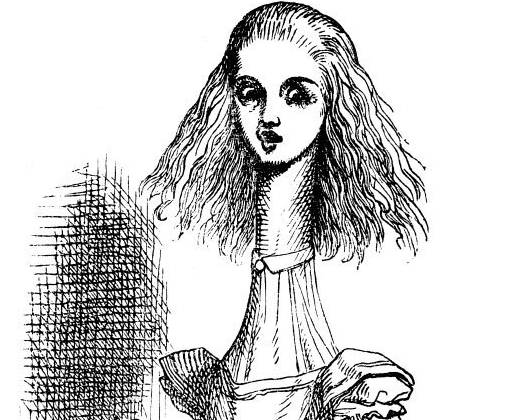
My adventures in Bibleland continue, and, not unlike poor Alice down the rabbit hole, I have reached several points in which I feared it would be an effort simply to keep in touch with my feet. (For anyone curious who has not been following: Adventures in Bibleland, and Further Adventures #1.) Here, I’m just going to spill my plight in the hope that readers can help me find my way.
AliceFeet

How I Got Where I am

I spend a lot of time with Jews. I study Torah, in its many forms, in the DC area where- and whenever possible. I make a serious effort to study with Jews of different backgrounds and beliefs, which I’m told is not all that common, and I am in touch with, and occasionally study and/or worship with, both Christians and Muslims who regularly engage with their texts and traditions. But my learning in the areas of text, belief, and practice is predominantly Jewish.

Until I started the #ExploringBabylon project, most of my reading around sacred text, on-line and in print, was also Jewish or from a deliberately interfaith perspective. And I read a lot.

Several decades ago, I earned a bachelor’s degree in Philosophy, and one of my current study partners and I are revisiting some of that territory via a book written by Diana Lobel, associate professor of religion at Boston University and formerly my in-person teacher, when she was active at the Jewish Study Center here in DC. (The Quest for God and the Good: World Philosophy as a Living Experience. NY: Columbia, 2011)

Just for thoroughness of the story, I have graduate degrees in math and educational technology, and I worked at universities in Chicago, Boston, and DC in my youth; but I remain a stranger to bible or Jewish studies in the academic world. Until my recent visit to the Woodstock Theological Library at Georgetown University — again, grateful for the access given to non-students — it had been a very long time since I’d been in any kind of academic setting for more than an hour’s lecture.

Now, I am aware that “religion” in libraries and most bookstores means “Christian religion” while Buddhism and Judaism, for example, are elsewhere. And, of course, “bible studies” means “study of the Bible from Christian perspectives.” What I didn’t quite realize was the extent to which academia encourages discussion of Jewish sacred text, and even “Judaism,” quite apart from interaction with any Jews at all.

Back to the Books

I was heartened to read, in Reception History and Biblical Studies Theory and Practice, a call for collaboration across faith communities within the academic world and across the town-gown divide, “between the academic community and other communities with a different remit.”

Susan Gillingham‘s essay, “Biblical Studies on Holiday? A Personal View of Reception History,” specifically mentions the need for inclusive studies:

The third criticism is perhaps more justified. This concerns the “particularly’ and ‘selectivity’ of reception history studies, and hence the problem of subjectivity on the part of anyone working in this field. I certainly find that the more I work on reception history, the more I am aware that I am an interpreter ‘frozen’ in a particular time and place and culture. So my perception is that of a western, English, white, middle-aged woman who also happens to be an Anglican Lay Reader. So I try to keep my eye on Christian and Jewish traditions, not only in the West but also in the East….
— Gillingham, p. 25

But I wasn’t sure whether to cheer or cry at the italicized “and Jewish” here:

For example, the hermeneutical models proposed by Gadamer and Luz do not take into sufficient account the need to assess both Christian and Jewish receptions of the text, a task which is essential for anyone working on the Psalms.
— Gillingham, p. 23

The challenge is such an important one, but the very emphasis, “and Jewish,” speaks volumes. I cannot help wonder whether academics reading this will take it as a reminder to include a few Jewish sources here and there in their own studies or read it as a call for inclusion of views from within Judaism.

I did actually cheer (silently, in deference to the setting) when I found this in the Africana Bible:

The reception of scriptures of Israel into the Christian canon was and is marked by usurpation, colonization, anti-Judaism, and anti-Semitism. Specifically, in the West and in cultures colonized by the West, the scriptures of Israel have regularly been mediated through gentilic culture and languages, particularly German, which is especially onerous in a post-Holocaust world.

…Responsible exegesis of the scriptures of Israel requires respecting the text itself, the traditions preserved in the text, and the God of the text.

[Rev. Gafney adds that “Jesus never pronounced the divine name,” and suggests more care in use of the four-letter name Jews do not use casually.]
— Wil Gafney, “Reading the Hebrew Bible Responsibly,” p.47-8


Collaborations?

My next trip to the library can center around call letters for Judaism instead of “bible” or “religion.” Or perhaps I can continue to struggle with how things work on the Christian side of the stacks. Maybe I should leave academia alone all together? But I’d much rather participate in some kind of collaborative studies.

I’d love to hear from anyone, in- or outside academic walls, who can point me to some joint studies, inclusive bible study societies, or even a more inclusive or collaborative section of the library or bookstore. I’d also appreciate any perspectives from those with more experience, in- and outside academia, in the study of sacred text.


Cited above:
Reception History and Biblical Studies Theory and Practice. Emma England and William John Lyons, eds. NY: Bloomsbury/T&T Clark, 2015

The Africana Bible. Hugh R. Page, Jr., general editor. Minneapolis: Fortress Press, 2010

Babylon: Further Adventures #1

Exploring Babylon: Chapter 6.1.1

Discussing text from this week’s Torah portion (Toldot, Genesis 25:19-28:9), I quoted yesterday comments about “The Isaac Complex” from Israel in Exile (Albertz). I noted my surprise at the author’s declaration that a particular verse “makes sense only” in a very specific historical context. I even created a little homage to the mouse’s “long tale” in Alice’s Adventures in Wonderland, to help explain my befuddlement and lead into my plea for comments about this on-going #ExploringBabylon series.
tale

Today, thanks to Woodstock Theological Library at Georgetown University, and their open-stacks policy, I was finally able to do some more relevant reading. Among the interesting and useful things I encountered was a response to Israel in Exile in the 2012 volume, By the Irrigation Canals of Babylon.

More on “Only”

Ralph W. Klein’s essay, “Israel in Exile after Thirty Years,” begins from the perspective of his own similarly titled work. In discussing Albertz’s book, Klein includes a substantial passage on use of the same word that had caught my notice: “only.”

Klein points out that Albertz dates biblical material based on a small number of passages and “how well they seem to fit a specific historical context, or even the claim that they only fit that context.” The first of Klein’s six examples is the one I quoted yesterday, Gen 26:1-5, about God’s command to Isaac not to go down to Egypt (Albertz, p.249). Klein continues:

In every one of these six cases, I can easily imagine other circumstances that may have been the context for these words. The condemnation of the voluntary migration to Egypt in Jeremiah is explicitly condemned for other reasons than the one labeled “only” by Albertz. Ezekiel’s condemnation of the false prophets of salvation in 13:9 fits easily, in my judgment, into his activity before the fall of Jerusalem 60 years earlier than Albertz allows. Albertz dates Gen 12:1-3 confidently to the mid-sixth century, but I remember a time when Hans Walter Wolff dated it with equal confidence to the tenth century.
— Klein, “Israel in Exile after Thirty Years,” p.15


More on Exile

NOTE: I had looked for reviews of Albertz’s Israel in Exile, and expected to find additional work building on his, but clearly I was not looking in the right places. Delighted to find at least one scholar objecting to his “only” and the otherwise decisive nature of his compositional theories. Hoping to find more.

Klein’s essay goes on to stress that engaging with aspects of Israel in Exile is mean to further conversation on the work of Albertz, “from whom we all have learned so much.” Klein encouraged the Exile group within the Society of Biblical Literature to “debate which biblical voices speak to and from the biblical exile, and when we think they do so.”

He also added, in a footnote:

I recognize that other participants in this consultation want to widen the discussion to deal with the issues of landlessness or the migration of peoples at different points in Israel’s history. These are legitimate theological and historical questions. My essay, however, has sought to define what is meant by the exile in the more narrow sense of the sixth century B.C.E.
Klein, p.19

And a cursory review of SBL happenings and publications suggests that focus following this paper was, indeed, on the wider “migration” themes, rather than defining exile.
Klein Exile

Ralph W. Klein is now Christ Seminary-Seminex Professor Emeritus of Old Testament, Lutheran School of Theology at Chicago. In addition to Israel in Exile: A Theological Interpretation (Minneapolis: Fortress Press, 1979), he has a lengthy list of publications (scroll down).

“Israel in Exile after Thirty Years,” is the opening essay IN By the Irrigation Canals of Babylon: Approaches to the Study of the Exile (John J. Ahn and Jill Middlemas, eds. NY: T&T Clark, 2012).

Babylon and Adventures in Bibleland

Exploring Babylon: Chapter 6.1

The last episode, Chapter 5.2, touched on ways the Torah stresses that Abraham comes from “there,” so he and his family remain apart from their neighbors. This week’s portion opens with a reminder that Rebecca is daughter of “Bethuel the Aramean of Paddan-arm, sister of Laban the Aramean” (Gen 25:20). Much has been made, midrashically, over the centuries of this emphasis. For the purposes of #ExploringBabylon, the key factor is still her origin “there.”

There and the Land

“There” — at Gen 25:20 (above) and when Jacob is sent off to Haran in Paddan-aram (27:43, 28:2-5) — brackets this portion. In between, “the land” is mentioned many times (26:1, etc.), along with the more unusual “lands” (26:3-4).

#ExploringBabylon will eventually venture into “the land,” with the help of teachers who can provide useful perspectives. At this point, the path detailed in Israel in Exile (Albertz 2003) leads in another direction.

Albertz describes much of Genesis as an “Exilic Patriarchal History,” meant to meet the needs of “an age when Israel was no longer a ‘great nation’ and no longer dwelt within secure borders” (p.250). In this context, the bulk of Isaac’s story (Genesis Chapter 26), has a particular goal:

The Isaac Complex recorded how the second patriarch, an alien in Philistia, rose with God’s help and blessing (Gen 26:12, 28, 29) from an endangered fugitive to a respected covenant partner of the Philistines. It suited admirably the conception of RPH1, who therefore elaborated it to make it the second pillar of his work.
Albertz, p.261

A footnote adds that “The Isaac Complex…may date from the end of the eight century, when Hezekiah claimed hegemony over the Philistine cities…” PH is “Patriarchal History (exilic edition),” and RPH1 is “redactor of the first exilic edition of PH.” Israel in Exile modifies “the classical Documentary Hypothesis,” with these more finely distinguished documents.

Albertz, as noted in previous posts, has been Professor of Old Testament at University of Muenster (Germany) since 1995, previously at universities of Siegen and Heidelberg. He describes Israel in Exile as a “new attempt at a comprehensive presentation of the exilic period.” Others call it a masterpiece of biblical and historical scholarship, and it is referenced by many (mostly Christian) scholars.

He concurs with an earlier scholar, Erhard Blum (Die Komposition der Vätergeschichte [Patriarchal History]), in declaring that God’s directive to Isaac to “stay” and “reside” in the land (26:1-5) represents a particular historical mind-set:

[YHVH’s] strange command to Isaac not to go down to Egypt despite the famine but to stay in Palestine instead makes sense only against the background of a time when there were large-scale migrations to Egypt that presented a survival problem for the Judeans in Palestine. The first time this situation obtained was during the exile (Jer 41:16-43:7).
— Albertz, p.249

Perhaps “makes sense only” lost something in translation. Still, this entire path — and its very decisiveness — raises a host of questions for this blog. (But see also “Further Adventures #1,” for a scholarly response to this “only.”)

“Either the well was very deep,
or she fell very slowly,
for she had plenty of time as she went down
to look about her and to wonder
what was going to happen next.”
Alice in Wonderland, Chapter 1


Rabbit Holes

Most of this #ExploringBabylon series has defaulted to the “pay no attention to the fingers behind the keyboard” style of writing encouraged in the author’s school years: share a mix of views from others, post only materials and ideas checked out with a few sources first, add personal notes largely for full-disclosure of possible prejudice, and keep things focused on the topic, not the author. But it’s time for a change, at least temporarily.

I started this series with some structure in mind and some initial research behind me. I intended to post, around the topics of Babylon and Exile, as I learned. Encountering so much new material at each step, however, meant struggling to decide which of many intriguing directions to take. I have tried to stay focused on the overall topics of oppression and exile. But there’s a fine and jagged line between something that is useful background for this project and something that is interesting – maybe even powerful Torah – but not really the point. And then there’s my tendency to meander.

….Deciding what might be useful or interesting to anyone but me is kind of a shot in the dark. I’m grateful to those who’ve already been in touch, and I hope others will chime in, via comments or by email (songeveryday at gmail), sharing your own expertise and resource suggestions as well as questions or topics you’d like to see addressed. Some just plain, “yes, I’m reading” notes would be helpful to me, as well….

As some readers of this blog already know, I have no credentials and little formal training in bible studies. I will be enlisting expert help and welcome all suggestions, resources, and tips. Meanwhile, a tale:

tale.jpg

If the history of biblical interpretation teaches us anything, it is that there have always been many interpretations of a biblical text And, as literary theory has shown, the interpretation will depend on who is doing the interpreting and for what purpose….

…The issue is not what the text means, but who controls its interpretation; who sets the agenda, who makes the rules, who confirms the validity of the results.
— Adele Berlin, “Literary Approaches to Biblical Literature,” p.64
IN The Hebrew Bible: New Insights and Scholarship

I find the souped-up Documentary Hypothesis a rabbit hole all its own. And just trying to understand the goals and premises of different branches of bible-related academia leads down an entirely different hole.

And a Looking Glass

In an effort to understand contemporary arguments about multiplicity of bible interpretation, I looked into some of the history. And I was surprised to learn that Catholicism employed a fourfold interpretive method that pre-dates the “PaRDeS” framework by several hundred years and probably influenced the quintessentially Jewish idea. I’ve also been surprised by apparent segregation, even within the academic world, between Christian and Jewish scholars and was struck by this note, opening the Jewish Studies in the Twenty-First Century series:

Meanwhile the fact that the Bible plays a significant role in several quite different communities forces those studying it (at least to the extent that they interact) to think about how it is treated in each tradition.
— preface, The Hebrew Bible: New Insights and Scholarship (2008)

All of which makes it difficult to figure out where #ExploringBabylon needs to go.

…I am seeking comments about how Jewish this series should be and how it should be Jewish. This is partly a question of background and interests readers share, or don’t. It’s also a question of how to approach the specific topic of Babylon, which is one that has been influenced so strongly by Christianity. Finally, it’s an issue of how best to tackle the goal of this project — seeking out new perspectives that will help Jews interact with challenges in- and outside Jewish communities — given that neither our history nor our future is independent of the wider culture.


Four-fold Interpretation

Venerable Bede (d. 735) and Rhabanus Maurus (d. 856) both taught fourfold approaches: literal, allegorical, anagogical (mystical, “upward”), and tropological (moral). Catechism adds:
“The Letter speaks of deeds; Allegory to faith;
The Moral how to act; Anagogy our destiny.”

Bahya ben Asher (1250-1340) introduced four interpretive paths:
1) the way of the Peshaṭ (plain sense)
2) the way of the Midrash (metaphorical, “to search”)
3) the way of Reason (exegesis),
4) the way of the Kabbalah (mystical).

The Zohar, published by Moses de Leon (1240-1305?) and credited to Shimon bar Yohai (2nd Century), includes these four:
1) Peshat
2) Remez (allegorical, “hint”)
3) Drash
4) Sod (secret, esoteric)

See Jewish Encyclopedia and Four Senses of Scripture (Catholicism). Several sources, including Jewish Encyclopedia note that Jewish scholars of Medieval Spain would have known the Catholic methods. See also James Kugel. How to Read the Bible: A Guide to Scripture Then and Now (NY: Free Press, 2007).
BACK

Rivers Dark

The sense of “from there” is complicated for the descendants of Abraham and Sarah, and there are several powerful ways in which “there” becomes part of their identity and remains an important force, even when not there.

Paul Kriwaczek (Babylon) points out that, unlike so many ancient cities and civilizations that are known only to scholars, Babylon “is still readily remembered for its pagan greatness” (p.168). He adds that this is primarily due to Jewish tradition:

To devout Christians, Babylon would always be the whore…To Rastafarians…she is the ultimate symbol of everything oppresses and crushes black people….To the world of Islam…the name of Babylon meant almost nothing….

Thus is was left to the Jews to keep the multi-faceted reality of the ancient centre of civilization alive in western cultural consciousness, waiting for the time when a new spirit of enquiry would lead European explorers to investigate…
Kriwaczek, pp.169-170

And, in honor of the first yahrzeit of Leonard Cohen (9/21/1934-11/9/2016)–

Be the truth unsaid
And the blessing gone,
If I forget
My Babylon.
— Leonard Cohen
By the Rivers Dark

BACK

The Language of There

Exploring Babylon: Chapter 5.2

“When I make a word do a lot of work like that,” said Humpty Dumpty,
“I always pay it extra.”

— Alice Through the Looking-Glass, Lewis Carroll (1871, chapter 6)

A few weeks ago, #ExploringBabylon looked at “them” who traveled with Terah from southern Babylon to northern Mesopotamia and a little of what “back there” meant for Abraham. In this week’s portion, we return with the elder servant (later identified as Eliezer) to what Abraham calls “my kindred” or “my birthplace.”

שָּׁם

Abraham is old and telling the elder servant of his household to go
אֶל-אַרְצִי וְאֶל-מוֹלַדְתִּי
“to my country, and to my kindred [or: the land of my birth”]
to get a wife for my son Isaac” (Gen 24:1-2). The servant (later identified as Eliezer) asks what to do, should he find a potential wife who doesn’t consent to return with him: Should he bring Isaac back…

Genesis 24:5
אֶל-הָאָרֶץ אֲשֶׁר-יָצָאתָ מִשָּׁם
…to the land from which you came?

24:6
פֶּן-תָּשִׁיב אֶת-בְּנִי שָׁמָּה
On no account take my son back there

24:7
וְלָקַחְתָּ אִשָּׁה לִבְנִי, מִשָּׁם
…get a wife for my son from there

24:8
לֹא תָשֵׁב שָׁמָּה
…do not take my son back there

In contrast to Gertrude Stein’s “no there there,” there is a lot of “there” here:

  • שָּׁם = “there”
  • שָׁמָּה = “to there” (ending hey makes a locative form)
  • מִשָּׁם = “from there” (beginning mem adds the preposition)

Commentators across the centuries have explored many “there” details: Did Abraham intend a specific place? Specific kin? Why did the servant later say he’d been sent to Abraham’s “father’s house and family” (Gen 24:38)? Why not encourage marriage with neighbor families? Was the union meant to seal some kind of family reconciliation? One of the most salient answers, for this blog’s purpose, stresses basic there-ness:

Abraham was sent away from his country, kindred and father’s house, so that he should have no further contact with them and be a stranger in a foreign clime…Similarly, his son must not marry [a Canaanite]. For this reason he was called Abraham the Hebrew, “that all the world was on one side and he on the other” (ivri means in Hebrew “a person from the other side” usually taken as a reference to Abraham’s origins in Mesopotamia — on the other side of the river).
— Nehama Leibowitz, New Studies in Breishit, p. 220

Abraham is ivri, from there. As in “not from here.” A key experience that his descendants will repeat — in Egypt, in the wilderness, in later exile. At this point in Genesis, Abraham and his family are becoming separate. That separateness will later help the people survive in Babylonian Captivity.

But this seems to be as much work as “there” is willing to do at the moment, regardless of how well paid.

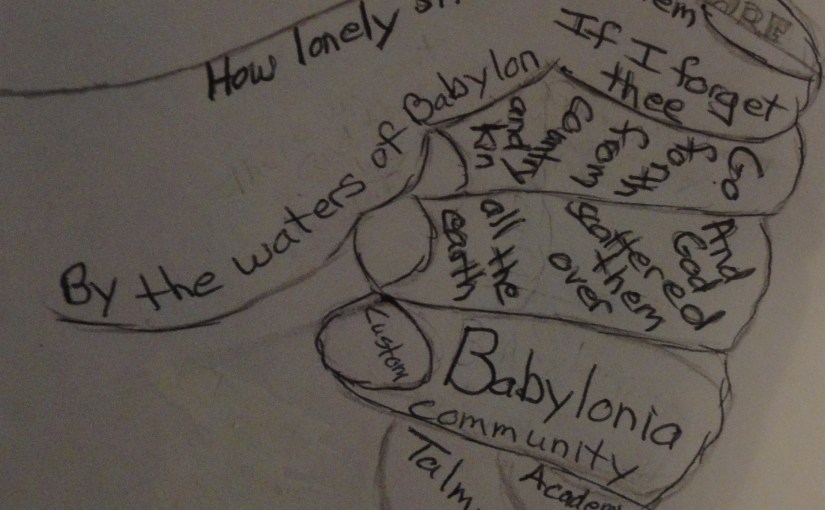
Babylon fist

This is a palm-map illustrating the #ExploringBabylon journey. We’re just not there yet.
(Think the Little Prince and the boa constrictor digesting an elephant.)

Language

Finally, the Rabbinic stories about Babylonian Captivity being in some sense “back home” for people of Abraham, included an important message about the language of “there”: “R. Hanina said: comment that ‘The Holy One exiled them to Babylonia because the language is akin to the language of the Torah.’ To underscore this, a footnote of sorts:

The very success of Jews in adapting to life in a foreign environment poses problems for the would-be compiler of a Jewish sourcebook. Greek was the dominant language of Diasporan Jews and their personal names were mainly Greek or Latin…
The Jews Among the Greeks and Romans: A Diasporan Sourcebook, Margaret H. Williams (Baltimore, MD: Johns Hopkins, 1998), pp. xi-xii

Babylon and the Writing on the Wall

Exploring Babylon: Chapter 5.1

The song, “Mene, Mene, Tekel” (Harold Rome, 1939) takes its name and chorus from the original, now proverbial, “writing on the wall” (Daniel 5:25):

MENE MENE TEKEL UPHARSIN
מְנֵא מְנֵא, תְּקֵל וּפַרְסִין

Rome’s satirical translation of the “writing on the wall” seems as appropriate to 2017 as to 1939, and it’s quite faithful to the biblical text:

King, stop your frolicking, stop your flaunting
you’ve been weighed and you’re found wanting
all your days are numbered days
the Lord don’t like dictators or dictators ways
— H. Rome “Mene, Mene, Tekel”
(Joe Glazer’s version; full lyrics, original and adapted)

This song also leads to further questions about how we understand and interact with sacred text, particularly at times of crisis. And it will give us a slightly different perspective for #ExploringBabylon.

Music of Protest and Power

When new, the song was banned from the radio and protested by both the Daily Worker and the Catholic Archdiocese of New York, among others. It was a later addition to the already controversial musical revue, Pins and Needles, November 1937 to June 1940. The satirical revue ran for 1108 shows, a record for Broadway shows at the time, and was performed throughout most of its run by amateurs from the International Ladies’ Garment Workers’ Union.

Labor and other social justice issues were frequent topics for Rome (1908 – 1993). For more, see 1993 NY Times obituary and the 2014 biography (Lyrical Satirical Harold Rome: A biography of the composer-lyricist. Tighe E Zimmers).

Joe Glazer (1918-2006), known as “Labor’s Troubadour,” often performed “Mene, Mene, Tekel” along with other organizing and protest songs (2006 NY Times obituary). Glazer settled in Silver Spring, MD and lent his voice — including renditions of this song — to early Jews United for Justice Labor Seders.

In a 1981 live performance, Glazer introduced the song’s historical and biblical background:

I want to close with one of the great song’s by Harold Rome. He wrote it at the height of Hilter’s move through Europe, Africa…he was gonna invade England. He was taking over everything, it looked pretty, pretty dark.

Old Harold Rome he took out the Bible, and he checked the Book of Daniel. He saw that old Belshazzar — he was riding high one day, and he got his comeuppance, because he saw the handwriting on the wall. It said: “MENE MENE TEKEL UPHARSIN,” in old Aramaic. “You have been weighed in the balances and you have been found wanting.”

He just took that story and he wrote it up. And that’s what helped to bring old Hitler down, I’ll tell you that.
— from “The Jewish Immigrant Experience in America”
Collector Records, Smithsonian Folkways

Smithsonian Folkways shares Glazer’s introduction and song here–

Rome’s 1962 Anniversary recording, lyrics (Rome and Glazer versions), and more posted here.

Guests were Shagging

Most of Glazer’s alterations to Rome’s lyrics are stylistic, including rhythm and story-telling preferences, and some changes to dialect. One of the biggest changes is the use of “the joint was jumping” in place of Rome’s “guests were shagging.” And this raises some interesting questions about study and use of the bible.

In the US in the 1930s, “shagging” was a relatively new term for a form of jazz dance. Swing dancers, especially in the South, still use the term, although the style has changed over the decades.

Someone more familiar with the history of British slang would know if “shag” was used in the 1930s for sexual intercourse — and if such usage was commonly known in the US; this would create a double-entendre. But it seems likely that the primary meaning in “Mene, Mene, Tekel” was that the banquet included spirited dancing, maybe something like this (from “A Day at the Races”) —

— or maybe this instruction video from Arthur Murray.

By the latter part of the 20th Century, the dance meaning was less generally current, and the Britishism had gained popularity in the US. So saying the “guests were shagging” at that point, when the song was in Glazer’s repertoire, could just sound crude.

This tiny example of how a change in language usage — even among primary speakers of the language alive to recall some of the shifting — is offered as a reminder of just how complex a project it is to interpret an ancient text that has traveled continents and cultures.

It can also point to a bit of what (mostly Christian) bible scholars call “reception history,” that is, how sacred text is understood and used in different generations. More on the general concept in the future.

Guests were Shagging?

Whatever Rome originally intended by “shagging” — an eager student of Broadway and dance could no doubt uncover this, if it’s not already known — sexuality and partner dancing are always closely entwined. Moreover, we are told in the Book of Daniel that Belshazzar is feasting with his “consorts and concubines” — “court and concubines” in the song lyrics (both versions). In addition, sexual license is an aspect of the ill-repute Babylon developed through the centuries (partly via Christian Scripture). More on this later, too.

In this respect, it’s unclear how much “sex” is included in any description of dancing at Belshazzar’s party. But the descriptions of partying in “Mene, Mene, Tekel” don’t sound like a condemnation of sexy jazz dancing, or of anyone but the king.

A musically-oriented interpreter with an ear to Europe in 1939 knows that the Reich was banning jazz as “degenerate music,” for its Jewish and Black associations. (See US Holocuast Memorial Museum just to start.) In that context, what does it mean that “guests were shagging, horns were blowin'” during Belshazzar’s banquet?

We have a hint in the song’s conclusion:

Now, the king of Babylon was slain
But the children of the Lord remain
All his idols turned to rust
crumbled are his kingdom and his power to dust

It’s not the dancers and horn players who turn to dust but the king and his power. More on all this as we continue #ExploringBabylon.

NOTES

Note 1: Daniel and the Writing
The Book of Daniel comes to us partially Hebrew and partially, including Chapter Five, in Aramaic. These four words on the wall, and Daniel’s interpretation of those mysterious words, is the heart of this chapter’s story. So, the words are generally left untranslated and rendered (IN ALL CAPS, e.g) so as to stand out.

It’s pronounced something like “menny, menny, teckle, oo-farseen.”

And this is the writing that was inscribed: MENE MENE, TEKEL UPHARSIN.
This is the interpretation of the thing: MENE, God hath numbered thy kingdom, and brought it to an end.
TEKEL, Thou art weighed in the balances, and art found wanting.
PERES, thy kingdom is divided, and given to the Medes and Persians.’
Then commanded Belshazzar, and they clothed Daniel with purple, and put a chain of gold about his neck, and made proclamation concerning him, that he should rule as one of three in the kingdom.
In that night Belshazzar the Chaldean king was slain.
— Daniel 5:25-30 (Old JPS) Mechon-Mamre

TOP

Babylon: Assimilation and Separation

Exploring Babylon: Chapter 4.2

While sojourning in Gerar (Gen 20), Abraham assumes there is “no fear of God in the place.” That’s what he tells King Abimelech, anyway:

וַיֹּאמֶר, אַבְרָהָם, כִּי אָמַרְתִּי רַק אֵין-יִרְאַת אֱלֹהִים, בַּמָּקוֹם הַזֶּה;
And Abraham said: ‘Because I thought: Surely the fear of God is not in this place;…
— Gen 20:11

Believing the worst of Gerar, Abraham had introduced Sarah as his sister. (The perceived benefit of this move is the subject of much commentary but beside the point at the moment.) Abimelech, based on Abraham’s information, had taken Sarah into his home as wife. But God warned Abimelech of the situation in a dream. And once Abimelech sorted things out, “all the wombs of his household,” which had closed in consequence of Abraham’s trick, healed.

“To his shame,” writes Rainer Albertz, “Abraham had to learn from Abimelech that a ‘Gentile nation’ could also be righteous” (Gen 20:4). Albertz suggests that entire narrative of Genesis 20 is meant to warn against “religious arrogance” and remind readers that, even in a foreign land, “there is also morality and piety” (Israel in Exile, p.265).

Reading the story of Gerar as a morality tale about the dangers of “religious prejudices,” helps make sense of an otherwise disturbing and puzzling text. It seems a powerful lesson any generation could use.

Whether Jews in Babylonian Captivity actually gleaned this lesson from existing Torah text — or from a “Patriarchal History” crafted during exile — is another question.

Lessons for Exiled People

Very old interpretations of Genesis 20 blame Abraham for thinking ill of Gerar. But Jewish scholarship actually dating midrashim about the dangers of religious prejudice to the Babylonian Captivity — again, that’s another question. (Comments, sources most welcome.)

Albertz goes even further than seeking interpretations of the text dating to the Captivity, though: He assigns Genesis 20 to an “exilic Patriarchal History.” He similarly assigns Genesis 21 and 22 to this document, arguing that these tales respond to the needs of a people in exile in these ways:

  • they affirm the value of other nations (e.g., Ishmael’s descendants);
  • the promote non-assimilation (Ishmael is cast out); and
  • they teach “trust in God even when God seemed to be…the most profound threat to Israel” (the Akedah). — Israel in Exile, p.264ff

The kind of scholarship in which Albertz and other, mostly Christian, scholars are engaged, is illuminating for #ExploringBabylon. But the documentary methodology itself is, at least at present, outside the main work of this project. Look for more from those who write about the Exile’s influence on Tanakh — and on contemporary lessons for communities in geographic flux — as this project progresses.

In a related avenue of study, Rev. Hugh R. Page, Jr. of Notre Dame examines ancient Hebrew poetry and its place in the Tanakh specifically from an Africana perspective. Ancient Hebrew poetry, he writes:

represents the earliest recorded musings of our biblical forebears on God, the universe, community, nature, humanity, and life’s ultimate meaning. Moreover, it offers a selective view of an Israelite ethos, born in crisis, that is dynamic, creative, pluriform, polyphonic, and transgressive. This is a community whose early challenges were not unlike those encountered by many Africana peoples today, particularly those dealing with the effects of social displacement and marginalization.
— Page, Israel’s Poetry of Resistance: Africana Perspectives on Early Hebrew Verse, p.ix (full citation and more)

Babylon: Entangled and Free

Exploring Babylon: Chapter 4.1

The ram stuck in the bush*, where Abraham finds him during the Binding of Isaac incident, reminded long-ago teachers of their own situation and their past Captivity in Babylon:

Throughout that day, Abraham saw the ram become entangled in a tree, break loose, and go free; become entangled in a bush, break loose, and go free; then again become entangled in a thicket, break loose, and go free.

The Holy One said, “Abraham, even so will your children be entangled in many kinds of sin and trapped within successive kingdoms – from Babylon to Medea, from Medea to Greece, from Greece to Edom.”

Abraham asked, “Master of the universe, will it be forever thus?”

God replied, “In the end they will be redeemed at [the sound of] the horns of this ram, as is said, ‘The Lord shall blow the horn [shofar] when He goes forth in the whirlwinds at Teman [Edom] [וְיָצָא כַבָּרָק חִצּוֹ; וַאדֹנָי יְהוִה בַּשּׁוֹפָר יִתְקָע, וְהָלַךְ בְּסַעֲרוֹת תֵּימָן]'” (Zech 9:14).
— Bialik & Ravnitsky, The Book of Legends/Sefer Ha-aggadah 42:45**

Like earlier commentary, which found these same periods of foreign control — Babylon, Medea, Greece, and Rome — in the second verse of the Creation story, this midrash promises future Redemption. (See “Babylon and the Beginning.”) Also, as in the previous midrash, everything depends on human repentance.

As Erica Brown puts it, this midrash teaches:

Wrong-doing will always catch us up in its thorny hold….The ram’s horn, the penitential cry of it, will remind us that we need not be stuck in the thicket. We can extricate ourselves.
— Brown, Confronting Scandal: How Jews Can Respond when Jews Do Bad Things. (Woodstock VT: Jewish Lights, 2010). p.125


Entangled

…and that brings us round again to the original intention behind this blog: The Exodus is, of course, the foundational story of Judaism, and there are many important lessons for our time and place to be gleaned from it and the Genesis stories which lead us there. There’s no escaping, however, that the Exodus is, in essence, the tale of a violent and permanent parting of oppressed and oppressor peoples.

And that metaphor has limits when it comes to trying to work out how people who share circumstances with both the oppressed and the oppressor, and generally have no intention to flee, can envision and work toward a better world.

Our tradition has long offered another metaphor: the far more complex and ambiguous narrative of exile, oppression and redemption. Thus, #ExploringBabylon was launched to consider ways our current realities reflect the multivalent image of Babylon, in the hope that this will help Jews in the U.S. find new visions for the future….

and Free

It is noteworthy that the midrash quoted above — as well as the one based on Genesis 1:2 (cited in the earlier post) — omits the Exodus when speaking of past instances of the people being “stuck.” For the teachers who wrote both midrashim, the Exodus was not in question: God and the people and the Torah remained in relationship born of that experience. What was in question was how the people, who by this time knew how hard it was to honor that relationship amid a complex world, were going to extricate themselves from their current entanglement.
ShofarHand

Questions for Consideration

  • Are we, as individuals and communities of Jews, hearing the ram’s horn today?
  • What are some of the thorny communal places we’re being called to address?
  • Is there a role for some kind of communal repentance?
  • Can the larger Jewish narrative, of being entangled and free and entangled again, help us find a way out of the thicket?


NOTES

* See this week’s Torah portion, Vayera (Genesis 18:1 – 22:24):
“And Abraham lifted up his eyes, and looked, and behold behind him a ram caught in the thicket by his horns. And Abraham went and took the ram, and offered him up for a burnt-offering in the stead of his son.
וַיִּשָּׂא אַבְרָהָם אֶת-עֵינָיו, וַיַּרְא וְהִנֵּה-אַיִל, אַחַר, נֶאֱחַז בַּסְּבַךְ בְּקַרְנָיו; וַיֵּלֶךְ אַבְרָהָם וַיִּקַּח אֶת-הָאַיִל, וַיַּעֲלֵהוּ לְעֹלָה תַּחַת בְּנוֹ.”
— Genesis 22:13
TOP

** This paragraph comes at the end of a three-page commentary on “The Binding of Isaac.” The The Book of Legends footnote cites Pesikta Rabbati 40:6 here. (Pesikta Rabbati is a holiday-based compilation of midrash, which is dated to Land of Israel, c.600 – c.900 CE.) But I cannot confirm the citation — and for all it’s extraordinary benefits, The Book of Legends English version does tend to muff citations — the verse from Zechariah above, e.g., is cited as “9:4” (The biblical reference is correct in the Hebrew version, but there is no chapter/verse with the Pesikta Rabbiti citation — way more than necessary, probably, but there it is.)
BACK