Oved with an Ayin

Confusion sometimes arises from the similarity, in English transliteration and in pronunciation, between two prominent words in the haggadah: ‘oved‘ meaning ‘slave’ and ‘oved‘ in the phrase “Arami oved avi,” from Deuteronomy 26:5. The previous post provided a little background on “‘oved‘ with an aleph.” And here, as promised, are a few examples of the word ‘avadim‘ as in “avadim hayinu [we were slaves].”

oved‘ with an ayin: Exodus

Words from the root עבד (oved — ayin-bet-dalet) appear frequently in the Torah and later books of the Tanakh, with many instances in the Exodus story.

For example, Pharaoh is told “let My people go, that they may serve Me” in Exodus 7:16, 8:1, 10:3,…:

שַׁלַּח עַמִּי,
וְיַעַבְדֻנִי.
“…let My people go, that they may serve Me.”
— Exodus 10:3

Pharaoh responds several times, telling Moses “Go ye, serve the LORD…” with some restrictions added:

לְכוּ
עִבְדוּ
אֶת-יְהוָה
רַק צֹאנְכֶם וּבְקַרְכֶם, יֻצָּג: גַּם-טַפְּכֶם, יֵלֵךְ עִמָּכֶם–
Go ye, serve the LORD;
only let your flocks and your herds be stayed; let your little ones also go with you.’
— Exodus 10:24

Later, reference is made again and again to the Israelites leaving “Egypt and the house of bondage.” (Exodus 10:3, 10:14, 20:2,…)

וַיֹּאמֶר מֹשֶׁה אֶל-הָעָם, זָכוֹר אֶת-הַיּוֹם הַזֶּה אֲשֶׁר
יְצָאתֶם מִמִּצְרַיִם
עֲבָדִים מִבֵּית
And Moses said unto the people:
‘Remember this day,
in which ye came out from Egypt,
out of the house of bondage;
— Exodus 13:3

When we recite Hallel at Passover and on other festival days, we reflect on our status as servant now only to God:

אָנָּה יְהוָה,
עַבְדֶּךָ: כִּי-אֲנִי
בֶּן-אֲמָתֶךָ אֲנִי-עַבְדְּךָ,
פִּתַּחְתָּ, לְמוֹסֵרָי.
Now, ABUNDANT ONE,
I am your servant.
I, your servant, child of your servant,
I whose fetters you have opened up.
— Psalm 116:16, Kol Haneshamah
in this prayerbook, NAMES in all caps substitute for YHVH

I beseech Thee, O LORD,
for I am Thy servant;
I am Thy servant,
the son of Thy handmaid; Thou hast loosed my bands.
— Psalm 116:16 JPS 1917

More Bondage and Servants

Forms of ‘oved‘ with an ayin, meaning servant or bondman, appear at many points in the Tanakh. Here are pre-Exodus examples:

In Genesis, we are told that Canaan will be cursed, becoming “servant of servants” or “lowest of slaves” — עֶבֶד עֲבָדִים (Gen 9:25)

When Judah and his brothers are in Egypt during the drought in Canaan and are caught in an apparent theft, Judah says to Joseph: “…we are your bondmen” —
הִנֶּנּוּ עֲבָדִים (Gen 44:16)

Post-Exodus, the people are meant to serve God alone. Should economic circumstances place one Israelite in bond to another, that must be a temporary status: “And if he be not redeemed by any of these means [just outline above], then he shall go out in the year of jubilee, he, and his children with him.” (Lev. 25:54)

כִּי-לִי בְנֵי-יִשְׂרָאֵל,
עֲבָדִים–עֲבָדַי הֵם,
אֲשֶׁר-הוֹצֵאתִי אוֹתָם מֵאֶרֶץ מִצְרָיִם: אֲנִי, יְהוָה אֱלֹהֵיכֶם.
For unto Me the children of Israel are
servants; they are My servants
whom I brought forth out of the land of Egypt: I am the LORD your God.
— Leviticus 25:55

When Nebuchadrezzar, king of Babylon, threatens Jerusalem, the prophet Jeremiah attributes the disaster to the people’s reneging on this command: “but afterwards they turned, and caused the servants and the handmaids, whom they had let go free [at the jubilee], to return, and brought them into subjection for servants and for handmaids” (Jer 34:11).

Later, when the exiles are allowed to return, Ezra remarks on God’s favor, despite the people’s sins:

כִּי-עֲבָדִים
אֲנַחְנוּ–וּבְעַבְדֻתֵנוּ, לֹא עֲזָבָנוּ אֱלֹהֵינוּ;
For we are bondmen;
yet our God hath not forsaken us in our bondage,
-Ezra 9:9
Avadim

posted on this seventh day of the Omer 5777, with this prayer:
“In remembrance of the Exodus from Egypt, we pray that you release all whose bodies and spirits remain captive and enable us to extend Your outstretched arm in the process of liberation.” (see Ritual Well)


Why is This ‘Oved’ Different from The Other Seder ‘Oved’?

“When do we eat?” is often identified as the fifth question at the Passover seder, after the prescribed four about dipping and reclining, bitter herbs and unleavened bread. Just as often, in my experience, people are asking about two Hebrew words that look identical in English transliteration: ‘oved‘ meaning ‘slave’ and ‘oved‘ in the phrase “Arami oved avi,” from Deuteronomy 26:5.

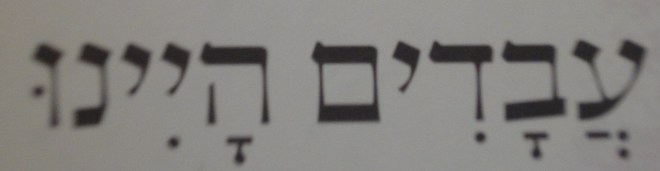
The Hebrew words for “slave,” “work,” and “worship” or “service” all have the same root. (More on “oved with an ayin” in a future post). But I have never heard anyone question the meaning of “avadim hayinu…” which appears near the start of the Passover telling: “We were slaves, and now we’re free.”

Note the letter ayin at the start of the word “avadim [slaves].”

Avadim.jpg
Avadim hayinu

The Deuteronomy verse, “Arami oved avi…” is another story. The ‘oved‘ with an aleph lends itself to several relatively straightforward translations as well as a traditional homelitical reading based on the biblical character most commonly identified with Aram.

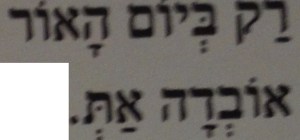
Note the letter “aleph” at the start of “oved [lost, perished, fugitive,…].”

AramiOvedAvi.jpg
Arami oved avi

For discussion of “Who is Arami?” and “What does it mean to be oved?” in the Deuteronomy setting and in the Passover Haggadah, see “Ki Tavo: A Path to Follow.” Here, just to explore Hebrew vocabulary a bit more, is a little background on the word ‘oved‘ (with an aleph) itself.

oved‘ with an aleph

Forms of ‘oved‘ (with an aleph) appear frequently in biblical text. Here are a few instances, along with some translations.

Jeremiah 9:11 —

מִי-הָאִישׁ הֶחָכָם וְיָבֵן אֶת-זֹאת
וַאֲשֶׁר דִּבֶּר פִּי-יְהוָה אֵלָיו וְיַגִּדָהּ;
עַל-מָה
אָבְדָה
הָאָרֶץ, נִצְּתָה כַמִּדְבָּר מִבְּלִי עֹבֵר.
Who is the wise man, that he may understand this?
And who is he to whom the mouth of the LORD hath spoken,
that he may declare it?
Wherefore is the land
perished and laid waste
like a wilderness, so that none passeth through?
— JPS 1917 translation

…Why is the land in ruins
— JPS 1999

Micah 7:2 —

אָבַד
חָסִיד מִן הָאָרֶץ,
וְיָשָׁר בָּאָדָם אָיִן:
The godly man is perished out of the earth,
and the upright among men is no more
— JPS 1917

The pious are vanished from the land
— JPS 1999

Psalms 9:7 —

אָבַד
זִכְרָם הֵמָּה
…their very memorial is perished.
— JPS 1917

…their very names are lost.
— JPS 1999 with note: “meaning of Hebrew uncertain”

Ezekiel 12:22 —

בֶּן-אָדָם, מָה-הַמָּשָׁל הַזֶּה לָכֶם,
עַל-אַדְמַת יִשְׂרָאֵל, לֵאמֹר:
יַאַרְכוּ, הַיָּמִים,
וְאָבַד,
כָּל-חָזוֹן.
‘Son of man, what is that proverb
that ye have in the land of Israel, saying:
The days are prolonged,
and every vision faileth?
— JPS 1917

…every vision comes to naught“?
— JPS 1999

One more point of comparison, just because Temple Micah’s Hebrew poetry group encountered this modern Hebrew instance — over studies during the Shabbat of Passover — and noted how ‘obed‘ with an aleph and ‘obed‘ with an ayin sound alike to most English-speaking, and to some Hebrew-speaking, ears.

Lost

Yehuda Amichai’s “Shir Ha-Chut La-Machut [Poem of the Needle for the Thread]” has not been published in English translation. Our group rendered this line from the poem as “Only in the day, you are lost in the light,” or “Only in the daylight, are you lost.” (We struggled with the expression “b’yom ha-ohr.”)

And, finally, here are several versions of Deuteronomy 26:5 —

וְעָנִיתָ וְאָמַרְתָּ לִפְנֵי יְהוָה אֱלֹהֶיךָ,
אֲרַמִּי אֹבֵד אָבִי,
וַיֵּרֶד מִצְרַיְמָה,
וַיָּגָר שָׁם בִּמְתֵי מְעָט; וַיְהִי-שָׁם,
לְגוֹי גָּדוֹל עָצוּם וָרָב.
And thou shalt speak and say before the LORD thy God:
‘A wandering Aramean was my father,
and he went down into Egypt,
and sojourned there, few in number;
and he became there a nation, great, mighty, and populous.
— JPS 1917

…’My father was a fugitive Aramean…’
— JPS 1999

‘An Aramean Astray my Ancestor”
— Everett Fox translation, 1995

posted on this sixth day of the Omer 5777, with this prayer:
“In remembrance of the Exodus from Egypt, we pray that you release all whose bodies and spirits remain captive and enable us to extend Your outstretched arm in the process of liberation.” (see Ritual Well)
April 22: 1968 and 2016

Who can say we’ve actually left Egypt?

poor_peoples_campaign_flyer_article
from the King Archive

April 22, 1968 was the original launch date for the Poor People’s Campaign. As we approach the beginning of Passover, on April 22, 2016, the very basic demands of 1968 have yet to materialize. Can your seder, or your Passover week, include some moments to reflect on how far we’ve (not) come in the last 50 years and consider how we might do better?

Here is a link to King’s remarks in the Campaign press release, a month before his assassination.

Here are some sources on the Campaign itself, which drew thousands to Washington, and included Resurrection City, erected on the National Mall in May:

A New Telling

In the 48 years since the Poor People’s Campaign, too little has changed, on the one hand. See, e.g: The Unfinished March and The Unfinished March: an Overview.

On the other hand, we have seen decades of generational poverty and violence and other oppressive conditions disproportionately affecting communities of color. And one thing which has changed in recent decades is the further development of Whiteness Studies, exploring the facts and impact of systemic racism.

Is there is room in your Passover and Omer practice for THAT maggid, for recalling — and telling the young or uninformed — how it is that Whiteness developed in this country and what it has meant? Follow #WhitenessHistoryMonth on Twitter, and see more below, for some bits to include.

Who can say we’ve actually left? “Wherever you live, it is probably Egypt,” Michael Walzer wrote.

…Do you live in a place in which some people are more equal than others? In America, the unemployment rate for African-Americans is nearly twice as high as it is for whites. Black people are five times as likely to be incarcerated as whites. Infant mortality in the black community is twice as high as it is among whites. America is a golden land, absolutely, and for Jews, it has been an ark of refuge. But it has not yet fulfilled its promise….
[Updated, additional statistics**]
…aren’t we still commanded to bring everyone out of Egypt?
New American Haggadah (Boston: Little, Brown, 2012)

Some generally related resources:
American Jewish World Service
Jews for Racial and Economic Justice

More coming soon. Please share your ideas and sources.

I believe the “Seeing White” album, with some #WhitenessHistoryMonth contributions is visible to all. (If not, I’ll work on other options.)


**Newer, and additional, statistics

Unemployment still nearly twice as high for black Americans as for whites (NPR), as noted in New American Haggadah. In fact, Black Americans with college degrees have higher unemployment that White Americans without a high school diploma (EPI).

Infant mortality among black families is still twice that found in white families, while Native Americans experience an infant mortality rate 150% that of white Americans. (CDC)

Black people in the U.S. are now SIX times more likely to be incarcerated as white people (NAACP), up from five times when New American Haggadah was published. The Sentencing Project finds similar disparity for Hispanic Americans. In addition, here is the growing disparity for U.S. school children:

For black children born in 1978, by the time they reached the age of 14, 14% had experienced a parent’s incarceration. For children born twelve years later, the rate rose to one quarter of black children witnessing a parent’s incarceration. The rate rose for white children as well – from 1% of white children born in 1978 having an incarcerated parent by the time they reached age 14 to 3% of white children born in 1990 experiencing a parent’s incarceration.
Education Town Hall

BACK

Racism: Congenital Deformity, Sickness Unto Death

It is time to re-order our national priorities. All those who now speak of good will and praise the work of such groups as the President’s Commission* now have the responsibility to stand up and act for the social changes that are necessary to conquer racism in America. If we as a society fail, I fear that we will learn very shortly that racism is a sickness unto death.
— “DR. KING CALLS FOR ACTION AGAINST POVERTY AND RACISM CITED IN RIOT STUDY; POOR PEOPLE’S CAMPAIGN STARTS APRIL 22 IN WASHINGTON,” 3/4/68 SCLC press release (see King archives)

*Nat’l Advisory Commission on Civil Disorder (report summary)

The president of the Southern Christian Leadership Conference continues, calling racism a “congenital deformity” of the United States:

whereEver since the birth of our nation, white America has had a schizophrenic personality on the question of race. She has been torn between selves—a self in which she proudly professed the great principles of democracy and a self in which she sadly practiced the antithesis of democracy. This tragic duality has produced a strange indecisiveness and ambivalence toward the Negro, causing America to take a step backward simultaneously with every step forward on the question of racial justice, to be at once attracted to the Negro and repelled by him, to love and to hate him. There has never been a solid, unified and determined thrust to make justice a reality for Afro-Americans…. What is the source of this perennial indecision and vacillation? It lies in the ‘congenital deformity’ of racism that has crippled the nation from its inception.
— Martin Luther King, Jr.,
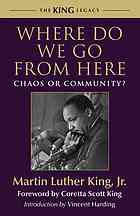
Where Do We Go From Here: Chaos or Community?
1967; Reprinted, Boston: Beacon Press, 2010

One month later, 48 years ago today, Martin Luther King was assassinated.

This year, Passover begins on April 22. Where do we go from here?
While everyone in the U.S. must be asking this question, it seems particularly incumbent on Jews as the annual festival of freedom approaches: None of us is free unless all of us is free.

Blasphemy of Pharaoh’s Overreach: Theology, Context and the Trouble I’ve Seen

“Claiming the center stage, just like Pharaoh and Caesar did in their time, has always been a blasphemous overreach that actually places oneself on the margins of God’s reign,” thus writes Drew G.I. Hart in Trouble I’ve Seen. 

This new title focuses on “Changing the Way the Church Sees Racism,” but much of what Hart says needs equal attention in the Jewish thought. (Trouble I’ve Seen: Changing the Way the Church Sees Racism. Harrisonberg, VA: Herald Press, 2016.)

Religious Thought and Practice

Hart notes the optional or alternative status of “women’s,” “peace,” or “black” theology:

According to [teacher John Franke] white male theologians have often seen themselves as objective and neutral overseers of Christian tradition. They function as “theological referees” for everyone else, while imagining their position as neutral and unbiased in the center of all the action….Missing is that white men have a social context too.

— p. 163, Trouble I’ve Seen

TroubleA parallel situation still applies all too well in much of the Jewish world. As does his analysis of how well-intentioned attempts at diversity and inclusion often fail to create real change. Many of his recommendations for the Church are ones other faith communities should explore as well:


  1. “Share life together.”
  2.  Practice solidarity. (See, e.g., Be’chol Lashon, Jewish Multi-Racial Network, and Jews of All Hues, as well as links at “Exodus from Racism”)
  3. “See the world from below,” by changing reading habits, for example. (See “Range of Possibilities” for some suggestions.)
  4. “Subvert racial hierarchy in the [religious infrastructure].”
  5. “Soak in scripture and the Spirit for renewed social imagination.” (Explore  “Pharaoh’s Hardened Heart,” e.g. and these resources from Reform Judaism’s Religious Action Center.)
  6. “Seek first the kingdom of God.”
  7. Engage in self-examination.

— from p. 176, Trouble I’ve Seen

Current and Historical Re-Examination

Hart’s exploration of “White Jesus” and related Church history may seem irrelevant to those outside the Christian faith. This is important background for every U.S. citizen, however, and worth review for those as yet unfamiliar.

Moreover, Jewish communities would do well to consider whether our members are aware of essential demographics — such as a recent study showing white men with criminal convictions more likely to get positive job-application responses than black men without a record (see p. 145) — and the individual and cumulative effect of everyday racism experienced by the author of Trouble I’ve Seen.

Most importantly, Jews must join our Christian neighbors in examining how we “resemble this remark”:

Too many in the American Church have perpetuated the myth that this land was build on Christian principle rather than on stolen land and stolen labor.

p.145, Trouble I’ve Seen

Hart’s new volume provides important food for thought as we continue to read Exodus this winter and experience it in the upcoming Passover season.

Hart
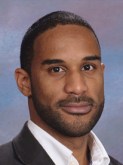
Drew G. I. Hart

More about “Anablacktivist” Drew G.I. Hart

Trouble I’ve Seen: Changing the Way the Church Sees Racism. Harrisonberg, VA: Herald Press, 2016.

What are you reading this Exodus season?

Please share your resources and your thinking.

Broken-Heartedness and the Days of Awe

One common, powerful theme of the high holidays is the idea of the broken heart. This is encapsulated prominently in the blowing of the shofar, with its shevarim [shattered] call. (See, e.g., The Shofar as Prayer at My Jewish Learning.)

All who hear the ram’s horn — during the preparatory month of Elul and the Days of Awe — are meant to experience a broken heart. And, so according to this story, is the one who sounds the shofar:

Rabbi Wolf, shofar blower in the synagogue of the Baal Shem Tov, has been studying special intentions for his annual role, but loses his crib sheet on the bima; forgetting everything, he blows the shofar with a broken heart. The Baal Shem Tov tells him,

“In the Palace of the King there are many rooms and halls, and each door to a room or a hall has a different key. But there is a better way to enter than to use the key, and this is to use an ax, which can open the locks of all the doors. The same is true of proper intentions. They are the keys to each and every gate, and every opening has the proper intention for it. However, the broken heart is an ax. It allows every person to enter all the gates and the halls of the King of Kings, the Holy One, Blessed be He.”
— Moshe Chaim Kalman, Or Yesharim.
see also The Light and Fire of the Baal Shem Tov.
Yitzhak Buxbaum. NY: Continuum, 2006.

Broken-heartedness is often described as requisite for prayer, particularly at the Days of Awe, as in this teaching from Abraham of Slonim (19th Century CE):

You should act in prayer as if you were a farmer: first you plow, then you seed, afterward you water, and finally things begin to grow. In prayer, first you have to dig deeply to open your heart, then you place the words of prayer in your heart, then you allow your heart to cry.
— found in Machzor Lev Shalem

Outside McPherson Square Metro Station, 9/15/15
At McPherson Square Metro Station, 9/15/15

In a season dedicated to atonement and forgiveness, reminders to open one’s heart are important. But how are we meant to respond to this call when our hearts are already broken? when we’re just barely hanging on?

Around the corner from the temporary synagogue where Fabrangen Havurah holds high holiday services, this message was painted on the sidewalk.

…An alternative thought for Shabbat Shuvah [the sabbath of “return”].

(Beyond 48)

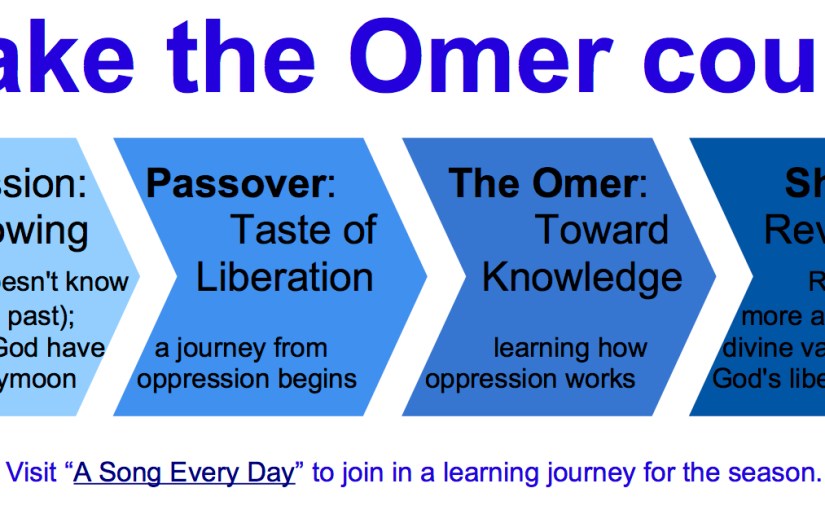
This particular Omer journey was designed to move from Oppression — a place where Pharaoh does not know his own past and Israel and God have yet to honeymoon — through learning more about oppression and liberation to Sinai. The goal was to “reach Sinai more able to hear divine values, serve God’s liberation work.”

I was reminded by my study partner, Amy Brookman, this afternoon that Martin Buber describes Sinai as a “lowly” kind of place — not unlike the thorn bush where Moses met God earlier in the Exodus story. We learn from this that humility is absolutely key in gaining anything from Sinai.

We learn, too, from the Sinai narrative that communicating (with God) is not a simple or straightforward matter. Moreover, I believe we learned on this journey that communicating about racism and related issues is difficult: To really learn anything new about oppression and how it works in general, and how it is affecting people today, means letting go of old (probably more comfortable) perspectives. And that means experiencing some sense of loss and pain.

Amy also shared a piece of Torah from Gilah Langner, “Revisiting the Ten Commandments” (From Kerem 13):

The midrash tells us: God sent along two angels to each and every Israelite, one to lay a hand upon the heart to keep body and soul together, and the other to lift up the head of each Israelite to behold God.

It’s a beautiful image, especially if you like angels. But set aside the
angels for a moment, and notice that the midrash is keying in on the life-and-death quality of Sinai.

Who Counts 50?

I suggest we take these these thoughts with us as we enter the holiday of Shavuot:

1) humility to hear,
2) the challenge of real communication, with associated loss and pain,
3) the life-and-death quality of this communication.

I’ll add, too, a commentary relayed to Fabrangen West by David Blumenstein this month: We are told both to count 50 days and to count seven full weeks. We carefully count the 49 days and seven weeks, but what about that last day? That, midrash [sorry citation missing], suggests is counted by God.

So I close this 49-day journey with a prayer:

May what we have learned so far on this 49-day/seven-week journey bring us to where we need to be, individually and collectively, so that God can count in that last day. And may the angels holding us up give us strength to risk serious communication, with one another and with God.

Shabbat Shalom and Chag Sameach

We counted 48 on the evening of May 21. Tonight, we count….

Making the Omer Count

from On the Road to Knowing: A Journey Away from Oppression
A key element in the journey from liberation to revelation is understanding the workings of oppression, and our part in them. We cannot work effectively to end what we do not comprehend.

So this year, moving from Passover to Shavuot, I commit to learning more about how oppression works and how liberation is accomplished. I invite others to join me:

Let’s work together, as we count the Omer, to make this Omer count.

Thoughts and sources welcome.

JourneyOmer

Share this graphic to encourage others to participate.

A Meditation

Aware that we are on a journey toward knowing God — from liberation to revelation — I undertake to know more today than I did yesterday about the workings of oppression.

I bless and count [full Hebrew blessings in feminine and masculine address]:

Blessed are You, God, Ruler/Spirit of the Universe, who has sanctified us with Your commandments and commanded us to count the Omer.

Today is forty-nine days which are seven weeks in the Omer.
Hayom tish’ah v-arba’im yom shehaym shiv’ah shavuot la-omer.

In the spirit of the Exodus, I pray for the release of all whose bodies and spirits remain captive, and pledge my own hands to help effect that liberation.

God expresses concern that divine communication with “break forth upon them [פֶּן-יִפְרֹץ בָּהֶם יְהוָה]” (Exodus 19:22).

Even the priests have to exercise caution lest “[THE NAME] break forth upon them [אֶל-יְהוָה–פֶּן-יִפְרָץ-בָּם] (Exodus 19:24).

When God has already “said” the Ten Commandments, THEN we learn 1) that the People perceived a jumble and want Moses to speak with God in their stead, and 2) that God “already spoke to you [plural] דִּבַּרְתִּי עִמָּכֶם.”

And all the people perceived the thunderings, and the lightnings, and the voice of the horn, and the mountain smoking; and when the people saw it, they trembled, and stood afar off. And they said unto Moses: ‘Speak thou with us, and we will hear; but let not God speak with us, lest we die.’ And Moses said unto the people: ‘Fear not; for God is come to prove you, and that His fear may be before you, that ye sin not.’ And the people stood afar off; but Moses drew near unto the thick darkness where God was. And the LORD said unto Moses: Thus thou shalt say unto the children of Israel: Ye yourselves have seen that I have talked with you from heaven.
— Exodus 20:14-18

BACK

Enough, yet? (Beyond 47)

Singing Dayenu [“enough for us”] is a 1000-year old Passover tradition. The 15-stanza poem thanks G-d for 15 blessings bestowed upon the Jews in the Exodus. Had G-d only parted the seas for us, “It would have been enough” we say for each miracle or divine act, thus humbly appreciating the immensity of the gifts. KB Frazier’s reworking of the poem addresses us, rather than G-d. It calls us to greater action for justice, saying “lo dayenu” (it would not have been enough) in recognition of the work still unfinished.

1. If we had sparked a human rights revolution that would unite people all over the world and not followed our present day Nachshons as they help us part the sea of white supremacy and institutional racism
Lo Dayenu
….

10. If we had truly listened to the stories, pain and triumphs of our brothers and sisters of color without feeling the need to correct, erase or discredit them and did not recognize the Pharaohs of this generation
Lo Dayenu
11. If we had worked to dismantle the reigns of today’s Pharoahs and had not joined the new civil rights movement
Lo Dayenu
12. If we had marched, chanted, listened, learned and engaged in this new civil rights movement and not realized that this story is our story, including our people and requiring our full participation
Lo Dayenu
jfrej_blm_cropped13. If we had concluded that our work is not done, that the story is still being written, that now is still the moment to be involved and that we haven’t yet brought our gifts and talents to the Black Lives Matter movement
Lo Dayenu

— from the #BlackLivesMatter Haggadah Supplement, Jews For Racial and Economic Justice


We counted 47 on the evening of May 20. Tonight, we count….

Making the Omer Count

from On the Road to Knowing: A Journey Away from Oppression
A key element in the journey from liberation to revelation is understanding the workings of oppression, and our part in them. We cannot work effectively to end what we do not comprehend.

So this year, moving from Passover to Shavuot, I commit to learning more about how oppression works and how liberation is accomplished. I invite others to join me:

Let’s work together, as we count the Omer, to make this Omer count.

Thoughts and sources welcome.

JourneyOmer

Share this graphic to encourage others to participate.

A Meditation

Aware that we are on a journey toward knowing God — from liberation to revelation — I undertake to know more today than I did yesterday about the workings of oppression.

I bless and count [full Hebrew blessings in feminine and masculine address]:

Blessed are You, God, Ruler/Spirit of the Universe, who has sanctified us with Your commandments and commanded us to count the Omer.

Today is forty-eight days which are six weeks and six days in the Omer.
Hayom shmonah v-arba’im yom shehaym shishah shavuot veshishah yamim la-omer.

In the spirit of the Exodus, I pray for the release of all whose bodies and spirits remain captive, and pledge my own hands to help effect that liberation.

BACK

Reaping the Omer (Beyond 46)

In her book, The Other Talmud, Rabbi Judith Abrams notes that “Nowadays, we count the days of the Omer, but in the days of the Temple, they reaped the omer.”

Let’s give Shavuot the makeover it deserves….

We can transform the Omer counting from the dolorous business it’s become to what it probably was before: a countdown that gets more and more raucous the closer we get to the holiday….It could be a celebration of our history, from biblical times right up to the present.
— Abrams, The Other Talmud: the Yerushalmi, Unlocking the Secrets of the Talmud of Israel for Judaism Today. (Woodstock, VT: Jewish Lights, 2012), pp. 159-160

These weeks of “Making the Omer Count” have offered thoughts and resources designed to widen our reaping during the omer and our perspectives as we approach Sinai for the giving of the Torah.

Oftentimes, on this journey that makes so clear how much work is still to be done to make the harvest equitable to all, I think rather irritably: Aren’t we there yet?

As we get closer and closer to Shavuot this year, however, I appreciate the vision Judith Abrams presents: A countdown that becomes more raucous with every voice added to it, streets wider and wider as more and more perspectives are added.

If you’re ready….

We counted 46 on the evening of May 19. Tonight, we count….

Making the Omer Count

from On the Road to Knowing: A Journey Away from Oppression
A key element in the journey from liberation to revelation is understanding the workings of oppression, and our part in them. We cannot work effectively to end what we do not comprehend.

So this year, moving from Passover to Shavuot, I commit to learning more about how oppression works and how liberation is accomplished. I invite others to join me:

Let’s work together, as we count the Omer, to make this Omer count.

Thoughts and sources welcome.

JourneyOmer

Share this graphic to encourage others to participate.

A Meditation

Aware that we are on a journey toward knowing God — from liberation to revelation — I undertake to know more today than I did yesterday about the workings of oppression.

I bless and count [full Hebrew blessings in feminine and masculine address]:

Blessed are You, God, Ruler/Spirit of the Universe, who has sanctified us with Your commandments and commanded us to count the Omer.

Today is forty-seven days which are six weeks and five days in the Omer.
Hayom shiv’ah v-arba’im yom shehaym shishah shavuot vechamishah yamim la-omer.

In the spirit of the Exodus, I pray for the release of all whose bodies and spirits remain captive, and pledge my own hands to help effect that liberation.

BACK

Malcolm X and the Power of Small Things (Beyond 45)

“The fame we get from fighting for the freedom of others creates a prison for us,” Malcolm X wrote in 1964 to Azizah al-Hibri, then a college student at the American University in Beirut. Their brief in-person connection and subsequent correspondence are still treasured by Dr. al-Hibri, now retired as chair of KARAMAH: Muslim Women Lawyers for Human Rights, the international organization she founded. Moreover, the papers and their story illustrate some important things about leadership, race, gender, and media.

from correspondence between Dr. Azizah al-Hibri and Malcolm X

As president of the college debating society, al-Hibri arranged for Malcolm to speak on campus while he was touring and also had the opportunity to get to know him during his brief visit. A shared ice cream at the airport launched a correspondence between the two that continued until his death in February 1965. At his request, al-Hibri kept her correspondence private for over 40 years.

In 2012, al-Hibri released a few pieces of correspondence and donated other papers (still private for now) to America’s Islamic Heritage Museum. She said then, in a speech at DC’s Masjid Muhammad, that she wanted to ensure that Muslims are “proud” and “happy” about connections with the slain leader and to forge bonds between the African American Muslim community, with historical connections to the Nation of Islam, and what many call the “immigrant” Muslim community, with different historical roots.

Here’s more from the July 2012 East of the River Magazine story:

From his correspondence it is clear that he already suspected that his life and work were coming to an end. But he knew, even though al-Hibri didn’t yet, that her future as a leader was ahead of her.

It was unusual in 1964, for a woman to be president of an organization like the college debating society, al-Hibri notes. And she, like many women of that decade, had not yet envisioned for herself anything like her role today as professor of U.S. law and international human rights advocate. It was similarly odd to consider that women might be leaders of Islam. But Malcolm X saw beyond the confines of his time, says al-Hibri, pointing to words of encouragement – to her as a woman and a Muslim leader – inscribed in a book he gave her: “You have and are everything it takes to create a new world – leadership is needed among women as well as among men…”
full article here


The Power of Small Things

Of all the stories I covered for East of the River Magazine, this is one that sticks with me as most fascinating and important —

  • the young al-Hibri’s not knowing about U.S. racial dynamics, what her college dean meant about “airing the country’s dirty laundry”
  • al-Hibri’s struggle to reconcile the man she met with the picture she later saw portrayed in the U.S. media
  • the race-sensitive context of her later decision to share her experience, while keeping most of the correspondence private
  • Malcolm X’s interest in corresponding with someone outside the “prison” of his work
  • his recognition of the need for women leaders in politics and in Islam, before many saw it in 1964

I share this today, in honor of Malcolm X, El-Hajj Malik El-Shabazz (born Malcolm Little, 5/19/25-2/21/65). I share it in recognition of the work of Dr. al-Hibri and KARAMAH — a small, powerful organization. I share it as a shout out to the too-little-known Americas Islamic Heritage Museum. And I share it to acknowledge the hard and complex work of overcoming racism between religious brothers and sisters.

Perhaps most importantly, I return to this story again and again as an example of the power of small interactions to shape our world.

We counted 45 on the evening of May 18. Tonight, we count….

Making the Omer Count

from On the Road to Knowing: A Journey Away from Oppression
A key element in the journey from liberation to revelation is understanding the workings of oppression, and our part in them. We cannot work effectively to end what we do not comprehend.

So this year, moving from Passover to Shavuot, I commit to learning more about how oppression works and how liberation is accomplished. I invite others to join me:

Let’s work together, as we count the Omer, to make this Omer count.

Thoughts and sources welcome.

JourneyOmer

Share this graphic to encourage others to participate.

A Meditation

Aware that we are on a journey toward knowing God — from liberation to revelation — I undertake to know more today than I did yesterday about the workings of oppression.

I bless and count [full Hebrew blessings in feminine and masculine address]:

Blessed are You, God, Ruler/Spirit of the Universe, who has sanctified us with Your commandments and commanded us to count the Omer.

Today is forty-six days which are six weeks and four days in the Omer.
Hayom shishah v-arba’im yom shehaym shishah shavuot ve-arba’ah yamim la-omer.

In the spirit of the Exodus, I pray for the release of all whose bodies and spirits remain captive, and pledge my own hands to help effect that liberation.


Race and Religion

I am sure many readers are aware, as I am, of anti-racism, police-brutality protests in Israel as well as in the U.S. and of the shameful legacy there; not being Israeli or particularly closely connected with Israeli culture, I have chosen to leave that topic for the better informed. I do believe, however, that Muslims and Jews face similar issues and can learn from one another on these issues, even as problems BETWEEN communities persist.
BACK