Trouble to See #2: Beyond Central Casting

further thoughts and references on Jews and Racial Justice….

from PBS program on Ethiopian Jews

“Bernie Sanders Looks Like Everyone’s Jewish Grandpa…,” read a headline on the Jewish Daily Forward website earlier this election season. But Sanders doesn’t look anything like these Jewish men, some of whom are probably grandpas, or like many Sephardic grandpas. He doesn’t look like the grandparents of many Jewish children in the United States. Bernie Sanders looks like Jewish grandpas from only one part of the world.

The blurb was meant to be cute, sure, but it still promotes an extremely limited view of who “looks Jewish.” (Sadly, the Forward lets the same sloppy “Jewish looks” idea inform news stories as well.) This, in turn, helps validate widespread challenging of anyone who doesn’t look like “a Jew” Central Casting might send.

Jews of color, in particular, report being frequently singled out and questioned about their background — despite that fact that this is contrary to a number of Jewish teachings.

This is just one way in which Jewish communities have work to do, more than most of us would like to admit,
in the area of racial justice.

(How) Are You Jewish?!

Not all Jews of color are Jews by choice. But the Talmud’s specific stress on not embarrassing a proselyte or child of a proselyte (Baba Metzia 58b) seems apropos. As does Jewish law forbidding differentiating between Jews by choice and Jews by blood (see, e.g., Yebamot 47b).

More generally, Jewish tradition teaches “verbal wrongs”
are more serious than monetary ones
and that shaming a person in public is the same as shedding blood
(Baba Metzia 58b, again).

It is sometimes argued that people are “merely curious” and not attempting to shame a person who looks “different.” But this ignores what Jews of color, and others who don’t necessarily resemble Ashkenazi Jews, have repeatedly said: Being harassed with demands to explain yourself and your connection to Judaism is not welcoming; it is exhausting to be singled out all the time and demoralizing to have one’s identity challenged.

Micah810_53Michael Twitty, an African American Jew, describes how other Jews regularly question his presence in Jewish space and often demand: “Were you born Jewish?” (Jews United for Justice “Racial Justice Seder“)

MaNishtana, “100% Black, 100% Jewish, 0% Safe,” has his identity challenged so often, he says, that he finally penned a book entitled Fine, thanks. How Are You, Jewish?

In her famous poem, “Hebrew Mamita,” Vanessa Hidary speaks about a man complimenting her with, “You don’t look Jewish. You don’t act Jewish.” Eventually, she develops this  response:

Bigging up all people who are a little miffed
‘cuz someone tells you you don’t look like
or act like your people. Impossible.
Because you are your people.
You just tell them they don’t look. period.
listen here

Jewish Diversity and Racial Justice

One organization that has been working for years to “foster an expanding Jewish community that embraces its differences,” is Be’chol Lashon: In Every Tongue. Among their offerings are research, resources, and diversity-celebrating materials.

Recognizing and celebrating diversity within Jewish communities also means addressing the discrimination and risk that fellow Jews face because of their color. See, e.g., “#MyJewish and Why It Matters.” This is another crucial element in the story of Jews and Racial Justice. (more soon)

NOTE

The same publication has made factual errors in the past based on assumptions about who “looks Jewish.”
BACK

Trouble to See #1: Expelling a Crease or Two

[updated 8/15] At the invitation of Temple Micah‘s Lunch and Learn program (8/10/16), I shared some thoughts about Jews and Racial Justice. I appreciate the opportunity. As promised, I offer the references cited for anyone who wants to explore further: Jews and Racial Justice reference page. I also include below a link to the SongRiseDC rendition of Ella’s Song (from Ella Baker & Sweet Honey and the Rock) that I was unable to share during the talk.

And just to clarify: I share in these “Trouble to See” posts some views which are not my own, for purposes of learning and discussion. But nothing here is the view of Temple Micah.

Skip ahead:
Expelling Creases from the Fold
Trouble to See

Through this talk, I succeeded in annoying a number of people — including myself — for a whole variety of reasons. (I’d like to think that’s some sign of success, given the topic.) At best what I shared can only be the beginning of a long, complicated — and, ultimately, very difficult — conversation.

Trouble to See

We began this afternoon, and I hope we can all continue exploring, with the idea of taking “trouble to see,” based on commentary about Moses at the Burning Bush.  MicahTrouble1


Here’s the commentary —


and the questions I hope we can ask, as we look back on what we think we know about race and racial justice:MicahTrouble2

This is the original post, from 2015, exploring the idea of taking “trouble to see” following the death of Walter Scott.

BACK

Expelling Creases from the Fold

Creases

As part of this exercise in turning the neck, taking “trouble to see” aspects of our past experience in new light, I shared a portion of my memoir/essay, “Skins,” which will appear in the forthcoming Expelling Creases from the Fold, an anthology published by Liberated Muse Arts Group. Thanks to Liberated Muse for allowing me to share this material in advance of its publication.

Here’s a link to the full talk. The reading of “Skins” begins around minute 18:00. (Not the best quality video, sorry. Looking forward to the anthology!!)
BACK

Ella’s Song

Sorry I could not share the SongRise version of “Ella’s Song” during the lunch today. For all in the room today — and anyone else who does not know “Ella’s Song” — as SongRise’s Sarah Beller explains in her introduction: The lyrics are words of Ella Baker, one of the founders of Student Nonviolent Coordinating Committee, and the music was created by Sweet Honey and the Rock.

Last note: the SongRise video cuts off mid-way through their second powerful number, “A Change is Gonna Come.” more on that later…
BACK

Matot: Heavy Tongue, or the House of Cards theory of bible study

I want to begin by acknowledging my teacher, Max Ticktin z”l, for whom the period of shloshim is coming to a close and whose connections to Temple Micah are more varied and interesting than I knew before he died. Max taught me — and others in several generations — a lot about who is and is not an enemy, of ourselves personally and of the People Israel.

Dvar torah on parashat Matot, Temple Micah 7/30/16

These remarks focus on the story of vengeance, Numbers 30:1ff. This is an odd and troubling story in many ways. I chose to study it, in part because I worry about the consequences of failing to examine the uglier parts of our tradition, and in part because its very oddness makes it interesting.

A few odd things

One odd thing is that we are told Pinchas was the priest of the campaign, but we are not told who the military leader was.

Another odd thing is how the otherwise terse story stops to tell us that Pinchas brought the “holy utensils” — which many commentators believe means the Ark — and the shofar. This makes the whole thing sound terrifyingly like something out of “Raiders of the Lost Ark” (Paramount 1981) or any of our contemporary wars that make use of religious iconography to wreak havoc on perceived enemies.

It seems to me — although I didn’t find commentary saying this, exactly — that the religious details, the priest, the holy utensils, and the shofar, hint at the spiritual aspect of the story. However distasteful and scary most of us find this today, the idea that a war should be fought to kill some people in order to preserve other people’s spiritual health, that was a part of biblical storytelling.

Midianites and Moabites, Balak and Pinchas

The Torah and many commentaries are clear that this whole issue with the Midianites is a war on people who tempted the Israelites into idolatrous behavior. We might think (and many commentaries remark) that the problem would be with the Moabites because it was the Moabites with whom Israel engaged in harlotry and idolatry in what is called here “the matter of Baal Peor.”

Back at the close of parashat Balak, we are told that Israel became “attached to Baal Peor and the wrath of God flared up against them” (citation). Moses and the judges had just ordered the Israelites to turn on one another and kill men attached to Baal Peor when the Israelite male, Zimri, and the Midianite female, Cozbi, perform what is generally understood to be public sex acts at the Tent of Meeting. Then Pinchas runs them through with a spear, stopping a plague we had not been told was happening. Just the one Midianite, Cozbi, is mentioned there. But both nations collaborated in hiring Balaam to curse Israel. So perhaps they were collaborating in the incidents involving Baal Peor, too. However it came to be, God told Moses back in chapter 25, at the start of parashat Pinchas, to harass [tsaror] the Midianites and kill them because they had attached [tsorerim] Israel “through the conspiracy against you [the Israelites] in the matter of Peor.”

Hasidic commentary says this harassing is a sort of eternal command, because the temptation to the Israelites will persist. The idea is that once they have tasted debauchery, it will be impossible to keep desire from arising again. So Israel must now be eternally harassing those who harassed them with temptation.

If the Israelites could have been warned some other way to be eternally vigilant to stop evil urges in themselves, we might have an easier time with the lesson. But that is not what Or HaChaim teaches, and that is not how the Torah text unfolds. Instead….

God tells Moses to harass the Midianites in chapter 25. And then we have a census and some legal material, a list of offerings, and a long treatise on vows. After all that, here in chapter 31, God tells Moses to take vengeance — now the verb is different, nekom –against the Midianites.

This is another odd bit and one of my favorites.

Another odd thing

Back when the whole mess started, we have a break between portions introduced right at the height of the Baal Peor matter. Israel’s idolatry and the incident of Zimri & Cozbi ends parashat Balak. Pinchas is rewarded for his action that stops Cozbi & Zimri in the next portion. And that’s where we see the command to harass Midian, at the start of parshat Pinchas.

The portion break suggests that the story was just too far out of control and the Rabbis wanted to cool things off….This is a very famous break, often discussed in the commentary. For more, see “Pinchas and the scary friend….But that’s a later, conscious choice of how we are to read and learn this text. The Torah itself inserts the five-chapter break between the precipitating events and God’s call for harassment, on the one hand, and, on the other hand, this episode of vengeance.

Moreover, we have so many odd things in both places. Pinchas acts to stop a plague that is not mentioned before it stops. Moses and God speak of a conspiracy against the Israelites involving sexual misconduct. But the only conspiracy we’re told about in the text is the one to hire Balaam to curse the people. Balaam is blamed (in commentary and in the text here) for whatever sexual acts and idolatry are happening, even though the last we heard of him, he went home after blessing Israel with words we still celebrate every morning in the prayers. (See, e.g., “Balak prayer links”.)

Missing Bits

I think the missing bits and the halting way the story is told suggest a struggle — with facts, perhaps, or with feelings and ideologies that lead to death and disaster. If we take nothing else away from this, I believe the Torah wants to ensure that conspiracy and war and people turning on one another is not read smoothly or accepted easily.

Avivah Zornberg, the brilliant and very Freudian teacher of Torah, believes the Torah itself has an unconscious that is suppressing trauma. (See The Murmuring Deep, citation coming). I’m not sure I buy her whole theory, but I do think we should listen to the pauses and the stuttering and the weird missing bits as closely as we listen to the story tht reads more easily… maybe more closely.

Midianites: enemies?

And meanwhile Moses, who argued with God so many times before has nothing to say in the text in support of the Midianites who protected and nurtured him in his youth. Nothing to say about his extended family and the legacy of Jethro, his father-in-law, who contributed so much to his own learning and helped Israel set up a judicial system.

It’s not much of a surprise that we don’t hear from Zipporah, as we rarely hear from women, even ones who face down God to save their husbands from death (see the “night incident” at the inn in early Exodus; citation coming). But Moses has nothing to say on her behalf?

We’re not the first generation to notice the oddness of this incident and Moses’s close connection to Midianites. Early commentary says that is why, although God tells Moses to exact vengeance, Moses sends others and stays back himself. Of course, this says nothing about the fact that he lets it happen, anyway, even appears to orchestrate it; it also discounts the fact that Moses is quite aged here and perhaps unable to command in battle.

But the interesting point to note, I think, is that Numbers Rabbah acknowledged the relationship between Moses and Midian, and tries to address how hard it all was and how thoroughly entangled were all the players here.

The contemporary biblical literary teacher Robert Alter says this about Baal Peor in chapter 25:

The Israelite attitude toward its neighbors appears to have oscillated over time and within different ideological groups between xenophobia, a fear of being drawn off its own spiritual path by its neighbors, and an openness to alliance and interchange with surrounding peoples.

–Alter’s Torah commentary

In reference to this passage in chapter 31, he says:

Either two conflicting traditions are present in these texts, or, if we try to conceive this as a continuous story, Moses, after the Baal Peor episode reacts with particular fury against the Midianiate women (not to speak of all the males) because he himself is married to one of them and feels impelled to demonstrate his unswerving dedication to protecting Israel from alien seduction. But it must be conceded that the earlier picture of the Midianite priest Jethro, Moses’s father-in-law, as a virtual monotheist and a benign councilor to Israel does not accord with the image in these chapters of the Midianite women enticing the Israelits to pagan excesses.

One more possibility comes to mind….

House of Cards theory of bible analysis

Maybe there was a conspiracy involving Balaam and the Midianite kings but orchestrated by some other entity for reasons of their own, some kind of House-of-Cards-type plot to discredit the Midianites and turn Israel against them — or to make us believe Midian and Israel were enemies and would always be. Maybe the plot was so successful that Moses turned against his own earlier supporters because of it, so successful that the narrator can make us believe the story really moves from “go kill more people to undo you own spiritual troubles” to instructions for how to become ritually clean after carrying out more vengeance. But whichever Frank Underwood was behind the plot is no longer available — to look  us straight in the eye, breaking the Torah’s fourth wall, so to speak  — and confess what’s really going on and why, or to at least offer another version of the truth.

This is not too different from Zornberg’s unconscious theory. Because they both boil down to the fact that the Torah itself cannot say, maybe no longer knows, what caused the People to lose their spiritual way and then turn on neighbors and allies in an attempt to cope, make some sense of it.  But the Torah is still able to tell us in its stuttering way, full of missing bits and confusion, that the tale is maybe not as straightforward as it might sometimes be portrayed, that vengeance is not a simple matter with a clear beginning and end, that it’s not something that ends well…or even ends:

In the middle of his rant to the leaders for not killing enough, Moses is somehow back to a lecture on ritual purity after touching the dead. And we are not told at this point if his ranting instructions were carried out (and we know from later stories in Tanakh that there are plenty of Midianites still in the land).

A heavy tongue returns

It occurred to me late in preparing these remarks that perhaps the rambling and stuttering of this story is related to what Shelley Grossman described here about Moses a few weeks ago: his aging and use of an old playbook and how he no longer has his siblings at his side. Remember, too, that Moses tried to refuse the Exodus mission, back at the Burning Bush, by telling God he was “heavy-mouthed” and “heavy-tongued” (Alter’s words). At the time, God told Moses not to worry because Aaron could speak. But now, Aaron and Miriam are gone and we have, instead, Pinchas — Aaron’s grandson whom we first meet when he is in the middle of a violent act, committing a killing that we are later told is part of a covenant of peace.

So maybe what we witness here is a story that is moving forward under emerging leadership but related by a man who has reverted to heavy-tongue, reporting to us that his own demise will follow on the heels of vengeance on people he once knew as family and fellow monotheists. Maybe it’s a kind of last gift to Moses — and to us — that the old, heavy-mouthed stuttering voice comes through to warn us that no such tale can be told without stumbling and missing bits.

NOTES

Max David Ticktin (1922 – 2016)

There are many on-line obituaries and memorials to Max. My favorite is this one by Rabbi Arthur Waskow. And in the way of such things, I was carrying the Torah through the Micah congregation just a few days after Max’s funeral and, even though Max did not attend services at Micah would not have been there to touch me with his tzitzit, I found myself equal parts profoundly sad at the knowledge that we would all be missing his touch and deeply grateful for the myriad ways he had already touched so many of us.

BACK

The Torah Portion

The Torah portion Matot is comprised of Numbers 30:2 – 32:42. Temple Micah is following the schedule of readings used in Israel and, therefore, one week ahead of many congregations in the diaspora at this point in the calendar.
BACK

Confronting Jackals of Injustice

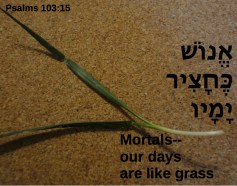
“Who will confront the wickedness of all the raw racial hatred marinating in this free land?” asked Rev. T. Anthony Spearman during the North Carolina Council of Churches recent “Seminar on Race, Power, and Privilege.” The powerful sermon begins with a text from 2 Samuel 21: When her sons and five other men are subject to an extrajudicial execution and left without burial, Rizpah mounts a single-handed protest. She maintains a vigil for six months — “risking her own safety and sanity,” as Rev. Spearman describes it — until King David is finally moved to order proper burial for all seven men.

“Back around 9th Century BCE, [Rizpah] would have been my choice for mother of the year,” Rev. Spearman declares. “In all of antiquity there may of a certainty be none as devoted, radical or courageous.” He elaborates:

In her world, she had no authority. Hers was a voiceless life. She was devoid of power…a victim of what seems to be this nation’s cherished legacy, the hierarchy of human values that are known as …classicism, sexism, and racism.

detail of 1875 painting by George Becker. See, e.g., Heroines of the Bible in Art (1900)
George Becker, 1875 (Detail). See, e.g., Heroines of the Bible in Art (C. E. Clement, Boston, 1900)

Allan Aubrey Boesak says this mother does what she does — risks, resists, and reconciles an entire nation — all by her lonesome and silent self. She demonstrates how to truly beat a sword into a plowshare by doing justly, loving mercy and walking justly with her God.

…[Rizpah’s witness] is not dissimilar to that of Sybrina Fulton, Lesley [McSpadden] Brown, Samaria Rice..

From the beginning of the harvest til the rain fell down, her motherly heart was broken but her devotion was fully intact. For about six months R risks her safety and sanity to drive away the vultures of viciousness, the vultures of vulgarity, the vultures of victimization…. the jackals of injustice…

…although in anguish for the dead, her actions were on behalf of the living…only two of the young men were her sons, she fought on behalf of them all.
— from T. Anthony Spearman’s April 23 sermon (full sermon below)

Rev. Spearman notes that Rizpah’s story is not currently in Christianity’s common lectionary — it is also missing from annual Jewish reading cycles — and suggests its inclusion so that more people would be prompted to follow her example. Meanwhile, Rev. Spearman calls us:

Our times are in search of those with spirit of Rizpah, those who will rise up and do justice, love mercy and walk humbly with their God, those who will stand against the ones who keep making and upholding unjust laws.

Is there anyone willing to bend the moral arc just a little bit more?
Anyone willing to repent for the deaths of so many of our sons and our daughters?
Who will shoo the vultures away from the corpse of Michael Brown and Freddie Gray?
Who will discourage the jackals from ravaging the transgender body of Zella Ziona?
…demanding the repeal of House Bill 2?
Who will rise up and…confront the wickedness of all the raw racial hatred marinating in this land?

It’s time for us to confront racism. It’s time for us to confront privilege, it’s time for us to confront power.
— Spearman (full sermon in video below)                                                              NC Council of Churches’ Critical Issues Seminar: Race, Power, and Privilege

Six Months is a Long Vigil

Six months is a long time for the sort of vigil Rizpah kept: “Can you just imagine the gruesome scene with those seven blood-covered bodies…,” Rev. Spearman asks, offering graphic details and concluding with “and the noble Rizpah protecting them from the scavengers waiting to gorge themselves on those corpses.”

buttonSix months is also a long time for the sort of vigil Beverly Smith has been keeping: Alonzo Fiero (Zo) Smith, age 27, died in custody of DC special police officers (SPO), November 1, 2015, in confusing circumstances that included no criminal charges; his death was ruled a homicide with compression of the torso (SPO knelt on his back, for one example) a contributing factor. For six months, Ms. Smith has been demanding accountability for what happened to her son. And, just like Rizpah, and the mothers of many other victims of police brutality, Ms. Smith is demanding justice for others as well as her own child. She waits still.

On May 1, the sixth-month anniversary of Zo’s homicide, District residents joined Ms. Smith in a march and rally honoring his memory and demanding, in his name, community control of police. (Read about Zo’s case and his mother’s campaign in East of the River and the Washington Informer; learn about the Justice 4 Zo community)

And, of course, many parents and concerned community members — including some whom Rev. Spearman included in his sermon — have been keeping similar vigil in one way or another for much longer. (See, e.g., Listening to Voices of Grief and Struggle.) Many of those involved in these struggles have joined together in groups like Mothers Against Police Brutality and Coalition of Concerned Mothers.

Where Were Rizpah’s Neighbors?

Rev. Spearman and Allan Aubrey Boesak, whom he cites, note that Rizpah accomplished what she did “all by her lonesome and silent self.” This rightly characterizes the bible story and highlights the power of one individual to make a difference. But it leaves open the question of what Rizpah’s neighbors were doing — or not doing — for the months she kept her vigil alone:

Did neighbors just shake their heads at Rizpah while going about their own business? Were most people too caught up in demands of their own lives to involve themselves? Or, perhaps, fearing to speak out against King David? Or, just maybe, were some of Rizpah’s fellow citizens working elsewhere, in whatever ways were available to them, in support of her protest? Did groups organize solidarity actions that didn’t make it into Second Samuel?

Rizpah’s example of solo action is inspiring and important. And I would hope that each of us answers, “I will,” when faced with Rev. Spearman’s query: “Who will rise up and…confront the wickedness of all the raw racial hatred marinating in this land?” But I also pray that none of us is left, like Rizpah, to face those “vultures of viciousness” or “jackals of injustice” alone.

LongworthRev. Spearman is incoming president of the NC Council of Churches and senior pastor of St. Philip African Methodist Episcopal Zion Church in Greensboro. He is active in the Forward Together Movement/Moral Mondays.

I had the honor of meeting and protesting with Rev. Spearman as part of a Black Lives Matter Die-In at the U.S. House of Representatives in early 2015.

BACK

April 22: 1968 and 2016

Who can say we’ve actually left Egypt?

poor_peoples_campaign_flyer_article
from the King Archive

April 22, 1968 was the original launch date for the Poor People’s Campaign. As we approach the beginning of Passover, on April 22, 2016, the very basic demands of 1968 have yet to materialize. Can your seder, or your Passover week, include some moments to reflect on how far we’ve (not) come in the last 50 years and consider how we might do better?

Here is a link to King’s remarks in the Campaign press release, a month before his assassination.

Here are some sources on the Campaign itself, which drew thousands to Washington, and included Resurrection City, erected on the National Mall in May:

A New Telling

In the 48 years since the Poor People’s Campaign, too little has changed, on the one hand. See, e.g: The Unfinished March and The Unfinished March: an Overview.

On the other hand, we have seen decades of generational poverty and violence and other oppressive conditions disproportionately affecting communities of color. And one thing which has changed in recent decades is the further development of Whiteness Studies, exploring the facts and impact of systemic racism.

Is there is room in your Passover and Omer practice for THAT maggid, for recalling — and telling the young or uninformed — how it is that Whiteness developed in this country and what it has meant? Follow #WhitenessHistoryMonth on Twitter, and see more below, for some bits to include.

Who can say we’ve actually left? “Wherever you live, it is probably Egypt,” Michael Walzer wrote.

…Do you live in a place in which some people are more equal than others? In America, the unemployment rate for African-Americans is nearly twice as high as it is for whites. Black people are five times as likely to be incarcerated as whites. Infant mortality in the black community is twice as high as it is among whites. America is a golden land, absolutely, and for Jews, it has been an ark of refuge. But it has not yet fulfilled its promise….
[Updated, additional statistics**]
…aren’t we still commanded to bring everyone out of Egypt?
New American Haggadah (Boston: Little, Brown, 2012)

Some generally related resources:
American Jewish World Service
Jews for Racial and Economic Justice

More coming soon. Please share your ideas and sources.

I believe the “Seeing White” album, with some #WhitenessHistoryMonth contributions is visible to all. (If not, I’ll work on other options.)


**Newer, and additional, statistics

Unemployment still nearly twice as high for black Americans as for whites (NPR), as noted in New American Haggadah. In fact, Black Americans with college degrees have higher unemployment that White Americans without a high school diploma (EPI).

Infant mortality among black families is still twice that found in white families, while Native Americans experience an infant mortality rate 150% that of white Americans. (CDC)

Black people in the U.S. are now SIX times more likely to be incarcerated as white people (NAACP), up from five times when New American Haggadah was published. The Sentencing Project finds similar disparity for Hispanic Americans. In addition, here is the growing disparity for U.S. school children:

For black children born in 1978, by the time they reached the age of 14, 14% had experienced a parent’s incarceration. For children born twelve years later, the rate rose to one quarter of black children witnessing a parent’s incarceration. The rate rose for white children as well – from 1% of white children born in 1978 having an incarcerated parent by the time they reached age 14 to 3% of white children born in 1990 experiencing a parent’s incarceration.
Education Town Hall

BACK

Racism: Congenital Deformity, Sickness Unto Death

It is time to re-order our national priorities. All those who now speak of good will and praise the work of such groups as the President’s Commission* now have the responsibility to stand up and act for the social changes that are necessary to conquer racism in America. If we as a society fail, I fear that we will learn very shortly that racism is a sickness unto death.
— “DR. KING CALLS FOR ACTION AGAINST POVERTY AND RACISM CITED IN RIOT STUDY; POOR PEOPLE’S CAMPAIGN STARTS APRIL 22 IN WASHINGTON,” 3/4/68 SCLC press release (see King archives)

*Nat’l Advisory Commission on Civil Disorder (report summary)

The president of the Southern Christian Leadership Conference continues, calling racism a “congenital deformity” of the United States:

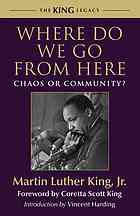
whereEver since the birth of our nation, white America has had a schizophrenic personality on the question of race. She has been torn between selves—a self in which she proudly professed the great principles of democracy and a self in which she sadly practiced the antithesis of democracy. This tragic duality has produced a strange indecisiveness and ambivalence toward the Negro, causing America to take a step backward simultaneously with every step forward on the question of racial justice, to be at once attracted to the Negro and repelled by him, to love and to hate him. There has never been a solid, unified and determined thrust to make justice a reality for Afro-Americans…. What is the source of this perennial indecision and vacillation? It lies in the ‘congenital deformity’ of racism that has crippled the nation from its inception.
— Martin Luther King, Jr.,
Where Do We Go From Here: Chaos or Community?
1967; Reprinted, Boston: Beacon Press, 2010

One month later, 48 years ago today, Martin Luther King was assassinated.

This year, Passover begins on April 22. Where do we go from here?
While everyone in the U.S. must be asking this question, it seems particularly incumbent on Jews as the annual festival of freedom approaches: None of us is free unless all of us is free.

Blasphemy of Pharaoh’s Overreach: Theology, Context and the Trouble I’ve Seen

“Claiming the center stage, just like Pharaoh and Caesar did in their time, has always been a blasphemous overreach that actually places oneself on the margins of God’s reign,” thus writes Drew G.I. Hart in Trouble I’ve Seen. 

This new title focuses on “Changing the Way the Church Sees Racism,” but much of what Hart says needs equal attention in the Jewish thought. (Trouble I’ve Seen: Changing the Way the Church Sees Racism. Harrisonberg, VA: Herald Press, 2016.)

Religious Thought and Practice

Hart notes the optional or alternative status of “women’s,” “peace,” or “black” theology:

According to [teacher John Franke] white male theologians have often seen themselves as objective and neutral overseers of Christian tradition. They function as “theological referees” for everyone else, while imagining their position as neutral and unbiased in the center of all the action….Missing is that white men have a social context too.

— p. 163, Trouble I’ve Seen

TroubleA parallel situation still applies all too well in much of the Jewish world. As does his analysis of how well-intentioned attempts at diversity and inclusion often fail to create real change. Many of his recommendations for the Church are ones other faith communities should explore as well:
  1. “Share life together.”
  2.  Practice solidarity. (See, e.g., Be’chol Lashon, Jewish Multi-Racial Network, and Jews of All Hues, as well as links at “Exodus from Racism”)
  3. “See the world from below,” by changing reading habits, for example. (See “Range of Possibilities” for some suggestions.)
  4. “Subvert racial hierarchy in the [religious infrastructure].”
  5. “Soak in scripture and the Spirit for renewed social imagination.” (Explore  “Pharaoh’s Hardened Heart,” e.g. and these resources from Reform Judaism’s Religious Action Center.)
  6. “Seek first the kingdom of God.”
  7. Engage in self-examination.

— from p. 176, Trouble I’ve Seen

Current and Historical Re-Examination

Hart’s exploration of “White Jesus” and related Church history may seem irrelevant to those outside the Christian faith. This is important background for every U.S. citizen, however, and worth review for those as yet unfamiliar.

Moreover, Jewish communities would do well to consider whether our members are aware of essential demographics — such as a recent study showing white men with criminal convictions more likely to get positive job-application responses than black men without a record (see p. 145) — and the individual and cumulative effect of everyday racism experienced by the author of Trouble I’ve Seen.

Most importantly, Jews must join our Christian neighbors in examining how we “resemble this remark”:

Too many in the American Church have perpetuated the myth that this land was build on Christian principle rather than on stolen land and stolen labor.

p.145, Trouble I’ve Seen

Hart’s new volume provides important food for thought as we continue to read Exodus this winter and experience it in the upcoming Passover season.

Hart
Drew G. I. Hart

More about “Anablacktivist” Drew G.I. Hart

Trouble I’ve Seen: Changing the Way the Church Sees Racism. Harrisonberg, VA: Herald Press, 2016.

What are you reading this Exodus season?

Please share your resources and your thinking.

“Wrestling Jerusalem” and Listening thru Oppression

“…but they did not heed because of shortness of spirit-breath” (Exodus)
“It’s complicated…” (“Wrestling Jerusalem”)


Early on in the Exodus story, we learn that the Hebrew slaves in Egypt were unable to absorb Moses’ message of imminent redemption because of “shortness of breath” or “crushed spirit” due to “hard work” or “cruel bondage” (Exodus 6:9; see note below).

At this point, Moses asks God how it is that he, of “blocked speech,” will be able to communicate God’s message to Pharaoh, when even the Israelites won’t listen to him. The story continues with a strong focus on Pharaoh’s inability to hear, alternately attributed to “stubbornness” (e.g., Ex 7:13) and “hardness of heart” (e.g., Ex 8:11). Hebrew below.

Aaron Davidman in Wrestling Jerusalem (Photo: Teddy Wolff)
Aaron Davidman in “Wrestling Jerusalem,” now at DC’s Mosaic Theater (Photo: Teddy Wolff)

So, at the center of the Exodus story is a massive, multi-faceted failure to communicate: a prophet/leader with blocked speech (more literally: “uncircumcised lips”), slaves who cannot breathe well enough to communicate clearly, and a ruler who cannot even hear his own magicians (Ex 8:15) and servants (Ex 10:7). The story reminds us how difficult it is for communication to succeed across communities and through oppression. And the story warns us of the dangers of failing in those communication attempts.

Aaron Davidman‘s one-man play, “Wrestling Jerusalem” — currently [January 2016] at Mosaic Theater Company of DC — embodies at least 17 different voices, from across Israel and Palestine, in monologue and in argument. Each voice provides a very specific perspective, unique to the conflict he is exploring. Throughout the performance, however, echoes of the U.S. conflict come through loud and clear.

Wrestling Jerusalem and the U.S.

In the play, one Palestinian voice explains that the only Israelis he has met are soldiers who often mistreat him and rarely recognize his humanity. How many people of color in the U.S. have a similar experience with white people?

Photo: Teddy Wolff
Photo: Teddy Wolff

Many Black communities in the U.S. view police, not as protectors of peace, but as a “White” power structure occupying and terrorizing their neighborhood. Too many people of color know white people only as government representatives and developers ready to view them as problems to be “fixed.”

“Wrestling” characters, alternately inhabiting Davidman’s body, argue about Hamas: Is it a community organization with a strong feeding program? or an armed group bent on the destruction of Israel? Would donations ear-marked for food programs simply enable violent resistance? With minor changes, these same words have been used to discuss the Black Panther Party or the Nation of Islam: Caring for the ‘hood? Or plotting the downfall of the U.S. power structure?

It’s Complicated
The performance opens with a brilliant “multi-logue” beginning with the pronouncement: “It’s complicated.” Davidman tries to identify the conflict’s start: With the ’67 war? Or 1948 — called either “the Catastophe” or the “War of Independence,” depending on one’s perspective? Maybe with earlier Arab or Jewish violence…or with the British or the Romans? It closes with cries of “If only the world would just leave us alone!” and “If only the world would get involved!”

It’s hard not to hear another set of wrestlers with a parallel litany of “how it started.” Beginning perhaps with Sandra Bland or Trayvon Martin, extending to Emmett Till and Medgar Evers, lives and livelihoods lost in riots of the 20th Century or the 19th, uprisings and mobs of the 18th Century. Then stretching back through U.S. economic dependence on labor of enslaved people and beyond to European views of the “Dark Continent.”

“Help us!” “Leave us alone!”
We might also hear, echoed in the final lines, calls for police to stop “occupying” black neighborhoods and for “Displacement Free” development zones, on the one hand, and on the other, attempts to involve the the U.N. in human rights violations within the United States.

Photo: Teddy Wolff
Photo: Teddy Wolff

The “Aaron” character of “Wrestling Jerusalem” tells us, as he rides the bus through security checkpoints, that he’s been to Israel many times but never before crossed into Ramallah. Likewise, how many residents of north or west Chicago rarely, if ever, cross 75th Street to the South? How many residents of western Washington, DC, seldom cross the Anacostia River? And, of course, vice versa.

Listen!

So many other elements of “Wrestling Jerusalem” — from description of inter- generational trauma to discussion of if/when to take up arms — apply equally to the United States. Davidman’s gift to the conflict around Israel is in embodying and weaving together, with respect, so many voices: Arab and Jew, Israeli and Palestinian, settler and soldier, partier, tourist, and long-time Liberal Israeli rabbi. Each is given the floor and heard in turn. In giving them each something of himself as well as their own unique voices, commonality and difference, Davidman helps us listen across conflict and through oppression.

In a sense, “Wrestling Jerusalem” is an antidote for the Exodus’ failures to communicate. May we listen equally well to the many, often-overlooked perspectives of conflict in the United States.

-1Tickets still available for limited DC run, through January 24.


Thanks to Elliot Eder and participants in Fabrangen West and to the LCVY Hill Torah Discussion Group for Exodus insights that inspired these remarks.

Exodus 6:9
וַיְדַבֵּר מֹשֶׁה כֵּן, אֶל-בְּנֵי יִשְׂרָאֵל; וְלֹא שָׁמְעוּ, אֶל-מֹשֶׁה, מִקֹּצֶר רוּחַ, וּמֵעֲבֹדָה קָשָׁה.
Moses [delivered God’s message of imminent redemption] to the Children of Israel. But they did not heed Moses, because of shortness of breath and hard work [or crushed spirits due to cruel bondage].

מִקֹּצֶר רוּחַ mi-kotzer ruach
ruach = “breath” and “spirit”
mi-kotzer ruach = “shortness of breath” or “crushed spirit”

וּמֵעֲבֹדָה קָשָׁה m’avodah kashah
avodah = “work,” “bondage,” and “worship”
m’avodah kashah = “hard work” or “cruel bondage”

וַיֶּחֱזַק לֵב chazak lev
“stubbornness” (literally: strong of heart; e.g., Ex 7:13)

וְהַכְבֵּד אֶת-לִבּוֹ kh’veid et-libo
“hardness of heart” (literally: heavy of heart; e.g., Ex 8:11)
BACK

Life, Liberty, and the Promise of Peace

Readers may have noticed a long silence on this blog. But I have not been entirely silent.

At start of June 2015, I began an additional blog, #SayThisName, to mark those lost to homicide and police action in the District of Columbia. Since then, I have personally typed out and said aloud the names of 95 individuals lost in our city in less than six months. The list includes friends of friends, a domestic murder-suicide a few blocks from my home, and a shooting on the steps of a church across from my work. I glimpsed a few seconds of the latter scene nearly three months ago, and the picture rarely leaves me for long. These are not statistics or abstractions. And this recitation has, it seems, captured a large part of my voice.

I am grateful to Temple Micah (DC), one of my spiritual homes, for their practice — several months old now — of listing the names of those lost to violence in the city as we rise to recite Mourners Kaddish. It is clearly having an effect on many in the congregation, including our new rabbi, Susan Landau, who is also new to DC. While guns are not behind every death in our town, they play a big role. And Rabbi Landau is joining with others nationally to address this problem.

Rabbi Landau spoke powerfully at the interfaith “United to Stop Gun Violence,” November 3, at the National Cathedral.

Project End Gun Violence activists with Rep. Elizabeth Esty (D-CT 5th, Newtown-Sandy Hook) at the Cathedral 11/3/15

Rabbi Landau’s remarks begin at 23:00 above.
Imam Talib Shareef of DC’s Masjid Muhammad speaks at 28:00.
Film includes other local and national activists, prayers, and song.

Many national groups working on gun violence from one angle or another participated in the November 3 event. Some of the resources shared there appear on this page.

See also this blog with resources on childhood trauma, a big part of the situation.

Additional related sources: “Stragglers on the Road Away from Bondage” and “Honoring a Teacher,” and “Meditations on Morning Blessings.”

Prayer Draft

To support National Gun Violence Prevention Sabbath, which is coming up December 10-14, 2015, I am crafting a prayer to be part of Temple Micah (DC) services on that weekend.

It is based on the prayer “for our country” in Mishkan T’filah, the most recent prayerbook of the Central Conference of American Rabbis. (Mishkan T’filah, NY: CCAR, 2007. This prayer is on p.258 here.)

[this blog originally shared a draft for comments]

Here is an updated version for considering, sharing, and, most importantly, for praying!

Prayer Amid Gun Violence Prayer Amid Gun Violence

Broken-Heartedness and the Days of Awe

One common, powerful theme of the high holidays is the idea of the broken heart. This is encapsulated prominently in the blowing of the shofar, with its shevarim [shattered] call. (See, e.g., The Shofar as Prayer at My Jewish Learning.)

All who hear the ram’s horn — during the preparatory month of Elul and the Days of Awe — are meant to experience a broken heart. And, so according to this story, is the one who sounds the shofar:

Rabbi Wolf, shofar blower in the synagogue of the Baal Shem Tov, has been studying special intentions for his annual role, but loses his crib sheet on the bima; forgetting everything, he blows the shofar with a broken heart. The Baal Shem Tov tells him,

“In the Palace of the King there are many rooms and halls, and each door to a room or a hall has a different key. But there is a better way to enter than to use the key, and this is to use an ax, which can open the locks of all the doors. The same is true of proper intentions. They are the keys to each and every gate, and every opening has the proper intention for it. However, the broken heart is an ax. It allows every person to enter all the gates and the halls of the King of Kings, the Holy One, Blessed be He.”
— Moshe Chaim Kalman, Or Yesharim.
see also The Light and Fire of the Baal Shem Tov.
Yitzhak Buxbaum. NY: Continuum, 2006.

Broken-heartedness is often described as requisite for prayer, particularly at the Days of Awe, as in this teaching from Abraham of Slonim (19th Century CE):

You should act in prayer as if you were a farmer: first you plow, then you seed, afterward you water, and finally things begin to grow. In prayer, first you have to dig deeply to open your heart, then you place the words of prayer in your heart, then you allow your heart to cry.
— found in Machzor Lev Shalem

Outside McPherson Square Metro Station, 9/15/15
At McPherson Square Metro Station, 9/15/15

In a season dedicated to atonement and forgiveness, reminders to open one’s heart are important. But how are we meant to respond to this call when our hearts are already broken? when we’re just barely hanging on?

Around the corner from the temporary synagogue where Fabrangen Havurah holds high holiday services, this message was painted on the sidewalk.

…An alternative thought for Shabbat Shuvah [the sabbath of “return”].