Locating Psalm 30, Redux

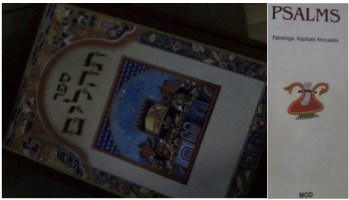
In the divisions of psalms for weekly or monthly recitation of the book, the ring of psalms we’ve been exploring is split over two days. Neither recitation cycle is my practice, so I don’t know how the pause affects reading. (If any reader has a weekly or monthly recitation practice, please let us know your thoughts.) And I don’t know of meditations or other teachings that focus on the daily groupings. (Anyone have resources to share?) But I do spend time with the Raphael Abecassis paintings which divide daily readings in this Sefer Tehillim.

“Firmament Between the Waters” for Day Two divides Psalms 28 and 29 from Psalm 30.

Abecassis
from “Firmament Between the Waters,” by Raphael Abecassis

Apropos of the ring of connection between Psalms 28-30, this painting offers an interesting link between “The God of glory thunders” (Psalm 29:3) and “Therefore, Glory will sing praise to You, and will not be silent” (Psalm 30:13).

insetFirmament
detail: R. Abecassis, “Firmament Between the Waters”

More about Abecassis and his artwork.

28 of 30 on Psalm 30
No Longer National Novel Writing Month, but continuing the focus on Psalm 30 (“Thirty on Psalm 30”) begun as a NaNoWriMo-Rebel project. Whole series (so far).

NOTE:
Five Books
1-41, 42-72, 73-89, 90-106, and 107-150.
Weekly Recitation
Sunday: 1-29; Monday: 30-50; Tuesday: 51-72; Wednesday: 73-89; Thursday: 90-106; Friday: 107-119; Saturday: 120-150.
Monthly Recitation
…Day 4 of 30: 23-28; Day 5: 29-34….
BACK

NOTE:
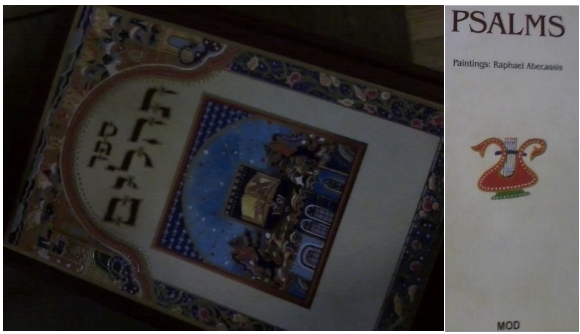
Psalms, Paintings: Raphael Abecassis, MOD.
(c) 2002. All rights reserved to the Ministry of Defense, Israel. ISBN 965-05-1179-2.
In addition to illustrated borders around psalms and prayers, the book has paintings to introduce each of the seven weekly divisions of psalms as well as a smattering of smaller illustrations and elaborate end papers.

MOD_Psalter

There is a larger, bilingual volume called “The Psalms of David” that appears to have similar illustrations.

BACK

Eighteen (or 19) Names, Seven Voices

In the last post, we considered a ring of connection linking Psalms 28, 29, and 30. (See “Psalms Near 30.”) One of the key elements was the repetition of God’s voice in Psalm 29. The seven mentions of God’s voice, along with the repetition of God’s name, also extend this ring of connection to the Shabbat and weekday Amidah.

God’s Name in Psalms 29 and 30

In discussing the origins of the Standing Prayer, with its eighteen foundational blessings, the Rabbis offer several explanations, including this one based on Psalm 29:

Corresponding to what were these eighteen blessings instituted… Rabbi Hillel, son of Rabbi Shmuel bar Nahmani, said: Corresponding to the eighteen mentions of God’s name that King David said in the psalm: “Give unto the Lord, O you sons of might” (Psalm 29)….
— B. Berakhot 28b, Koren Steinsaltz commentary

With regard to the nineteenth, they add:

Corresponding to what was the nineteenth blessing instituted? Rabbi Levi said: According to Rabbi Hillel, son of Rabbi Shmuel bar Nahmani …the nineteenth blessing corresponds to a reference to God in that psalm, where a name other than the tetragrammaton was used: “The God of glory thunders” (Psalms 29:3)….
— B. Berakhot 28b

We saw early on in this series a tradition that Psalm 30 was added to the liturgy under the influence of Jewish mystics because the psalm “mentions the name of God ten times, and Jewish mystics saw in this a hint of the s’firot, the ten aspects of the Godhead” (Siddur Lev Shalem ). I still count only nine appearances of YHVH in Psalm 30, however, couldn’t find a source that detailed the ten mentions of God’s name, and wonder if maybe the tenth was hidden. (See “The Whole Nine Yards.”)

In a similar vein to the Talmud’s handling of the nineteenth blessing, here is one way to find ten mentions of God’s name in Psalm 30:

שְׁמַע-יְהוָה וְחָנֵּנִי; יְהוָה, הֱיֵה-עֹזֵר לִי
Hear, O Lord, and be gracious to me. O Lord, be my helper.

The formulation “O Lord, be my helper,” alludes to the meaning of the Tetragrammaton: “For I will be with you” (see Exodus 3:12-15, and Onkelos, according to Ramban‘s reading in his commentary on the words: אֶהְיֶה אֲשֶׁר אֶהְיֶה eHyeh asher eHyeh). At all events, the combination הי הֱיֵה, Hashem heyeh, “O Lord, be,” is a play on the spelling of the two words.”
The Jerusalem Commentary, p.226

In this way, verse 11 suggests the tenth mention of God’s name in Psalm 30 without spelling it out directly. Hinting at the Name seems quite fitting with many themes of the psalm and with musical and chant settings for this verse in particular.

God’s Voice

Continuing their discussion of the Amida, the Rabbis touch on the seven blessings of the Shabbat Standing Prayer: 

Corresponding to what were these seven blessings of the Shabbat Amida prayer instituted?… Rabbi Halafta ben Shaul said: Corresponding to the seven “voices” which David mentioned on the waters; in other words, the seven times that “the voice of God” is mentioned in Psalms 29, which served as the source for the weekday prayer.
— B. Berakhot 29a

In the previous post, outlining a ring of connection between Psalms 28, 29, and 30, I suggested that Psalm 29’s focus on God’s voice can be read as a response to Psalm 28’s fears of God’s silence or idleness. And then Psalm 30 loops us back to Psalm 28’s themes of supplication, crying out, rescue from the pit, and God as strength and help.

As noted also in “Psalms Near 30,” the powerful, majestic, etal. voices of God — especially if considered in response to a personal plea for connection and rescue — seem reminiscent of God’s speeches in The Book of Job, chapters 38ff…

….Except that in Psalm 29 it’s the human speaker who is extolling God’s voices. And, based on the passages in Berakhot, the psalm is somehow the source of the Amida. So, God’s voice in all its shattering, shake-inducing fire in some sense prompts our Standing Prayer.

Is it that standing before God that eventually turns lament into dancing, undoes the sackcloth, and dresses us in joy? It’s a long way from “the pit” to a place where one’s “whole being might sing hymns to [God] endlessly.” The changes expressed in Psalm 30, which follows on the ring from Psalm 28 to 29 — and into the prayers Psalm 29 inspires — are huge and visceral. A little bit like Job, post-whirlwind, saying: “I had heard You with my ears, But now I see You with my eyes” (Job 42:5).


27 of 30 on Psalm 30
No Longer National Novel Writing Month, but continuing the focus on Psalm 30 (“Thirty on Psalm 30”) begun as a NaNoWriMo-Rebel project. Whole series (so far).


NOTE:
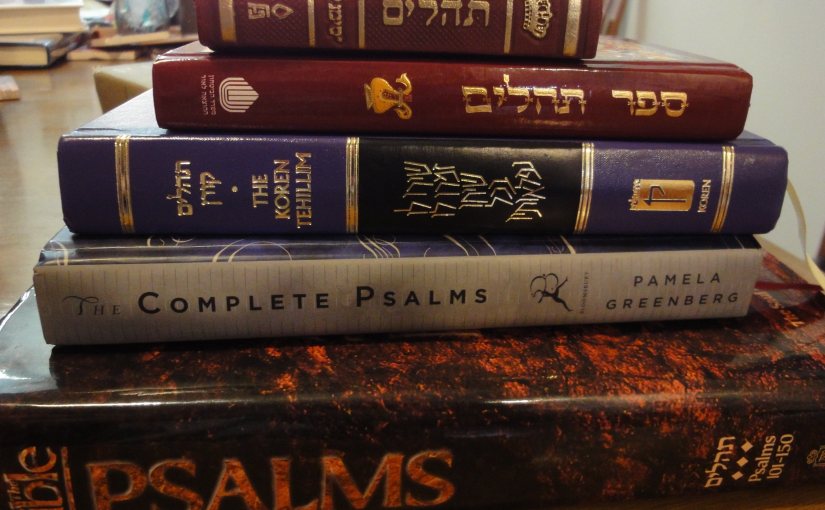
Koren Talmud Bavli. Volume 1: Tractate Berakhot. Jerusalem: Koren, 2012.
This English in this bilingual edition combines translation, in bold type, with additional narration from Rabbi Adin Steinsaltz in ordinary font. The English-opening section also offers English notes, complete with illustrations, and full Hebrew text. The Hebrew-opening section provides traditional layout without translation. The 42-volume set is still being released. In addition to print editions, PDFs — which include the illustrations and all — are available for $9.95/each. Visit Koren for more information.

If you’re looking for a free, accessible English-only versions, visit Halakhah.com.

BACK


NOTE:
Onkelos translates Exodus 3:14 without attempting to render key phrases into Aramaic:

Then the Lord said to Moses, “Ehyeh Asher Ehyeh.” And He said, “Thus shall you say to the Israelites, ‘Ehyeh sent you to me.'”
Onkelos: On the Torah (Jerusalem: Geffen, 2006)

An additional note says that “Ibn Ezra regards Ehyeh as God’s name and asher ehyeh as a description of God’s nature.”

BACK-2
Psalms Near 30

The last post discussed various divisions of the Book of Psalms, for study and recitation, as well as arrangement by “juxtaposition.”

Book One
In his introduction to The Jerusalem Commentary on Psalms, Amos Hakham writes:

The question about the order of the psalms was attributed in the Talmud to a heretic….But the conclusion stands regarding the system behind the arrangement of the psalms and it shows us the right way to examine the relationships between them” (p.XXXIV; see also previous post)

Juxtaposed Expressions
Hakham notes that “many psalms were juxtaposed because they contain similar expressions,” offering an example of the shared expressions — עֹז or מָעוֹז of strength, refuge, or stronghold — in Psalms 27-31:

  • Psalm 27:1 — יְהוָה מָעוֹז-חַיַּי
    The Lord is the refuge of my life
  • Psalm 28:8 — יְהוָה עֹז-לָמוֹ; וּמָעוֹז
    The Lord is their strength and refuge…
  • 29:11 — יְהוָה–עֹז, לְעַמּוֹ יִתֵּן
    The Lord will give strength to His people
  • 30:8 — בִּרְצוֹנְךָ, הֶעֱמַדְתָּה לְהַרְרִי-עֹז
    O Lord, by Your favor You made my mountain stand strong
  • 31:3 — הֱיֵה לִי, לְצוּר-מָעוֹז
    Be for me a fortified rock
  • 31:5 — כִּי-אַתָּה, מָעוּזִּי
    …For You are my stronghold
    The Jerusalem Commentary, p.XXXIV

Moreover, Hakham says, “Three consecutive psalms may be connected to each other in a ring (a-b, b-c, c-a).” In that spirit….

Ring of Connection

A>>B
Psalm 28 opens with a plea and a worry:

אַל-תֶּחֱרַשׁ מִמֶּנִּי
פֶּן-תֶּחֱשֶׁה מִמֶּנִּי

  1. be not Thou deaf unto me; lest if Thou be silent unto me
  2. do not disregard me, for if You hold aloof from me
  3. be not deaf to me, lest You remain idle regarding me
    — respectively: JPS 1917, JPS 1985, Jerusalem Commentary

Then criticizes those who

  1. give no heed to the works of the LORD, nor to the operation of His hands do not
  2. consider the LORD’s deeds, the work of His hands
  3. do not pay heed to the deeds of the Lord and to the work of His hands
    — respectively: JPS 1917, JPS 1985, Jerusalem Commentary

Psalm 28:6 uses the expression “שְׁמַע קוֹל תַּחֲנוּנַי — Hear the voice of my supplications.” Then, as if in response to fears of God’s silence or idleness, Psalm 29 extols God’s voice [קוֹל] seven times: upon the waters, powerful; majestic; breaking cedars; hewing flames of fire; shaking the wilderness; causing hinds to tremble and stripping forests bare.

None of this is a direct answer to the psalmist’s personal plea, of course. In fact, it is powerfully reminiscent of God’s outsize response to Job. But Psalm 29 is the antithesis of silence, surely, as well as a proclamation of the work of God’s hands.

B>>C
As Psalm 29 concludes, the scene is “His Temple” (v.9) — with images of God on the throne, giving “strength to His people” and blessing them with peace (vv.10-11) — while Psalm 30 is associated with the bringing of First Fruits.

The term “כָּבוֹד [glory]” appears four times in Psalm 29: “Ascribe to the Lord the glory and strength” (v.1), “Ascribe to the Lord the glory of His name” (v.2), “The God of glory thunders” (v.3), and “…His Temple all say: Glory.” (v.9). Psalm 30 concludes with “כָּבוֹד [glory]” singing praise to God. In addition

C>>A
Images in Psalm 30 draw back toward Psalm 28: God as strength and help, crying out to God, and “those who go down into the pit” (30:4 and 28:1).

Moreover, Psalm 30:9 uses the expression “אֶתְחַנָּן — I made supplication,” while, as noted above, Psalm 28:6 uses the expression “שְׁמַע קוֹל תַּחֲנוּנַי — Hear the voice of my supplications.”

Thus, it seems to me, Psalms 28-30 form the kind of ring — A>>B>>C>>A — Hakham describes. I think perhaps the loop is also more complex, leading us to weave in other texts…. (more to come).


26 of 30 on Psalm 30
No Longer National Novel Writing Month, but continuing the focus on Psalm 30 (“Thirty on Psalm 30”) begun as a NaNoWriMo-Rebel project. Whole series (so far).

NOTE:
Five Books:
1-41, 42-72, 73-89, 90-106, and 107-150.
Weekly Recitation:
Sunday: 1-29; Monday: 30-50; Tuesday: 51-72; Wednesday: 73-89; Thursday: 90-106; Friday: 107-119; Saturday: 120-150.
Monthly Recitation:
…Day 4 of 30: 23-28; Day 5: 29-34….
BACK

Locating Psalm 30

The Book of Psalms is divided in several different ways: into five books, into seven and thirty sets for recitation over the course of a week or a month, and by attribution and other identifiers for the purpose of study. Using these divisions, Psalm 30 has a number of locations.

Book One
Psalm 30 is in the first of the five books — counted as one, not five, of the 24 bible books. Thematically, notes Amos Hakham in The Jerusalem Commentary:

    • “psalms in the first book relate to the kingdom of the house of David at its height,”
    • those in second reflect “times of trouble and defeat,”
    • in the third, a period of humbling of the kingdom, and
    • in the fourth and fifth, exile and rebuilding.
      — p.XXXV-VI

This does not necessarily imply that Psalm 30 and others in the first book are of earlier composition. With the exception of Psalm 137 — which mentions Babylonian Exile — there are no references to extra-biblical events to help in dating; scholars disagree as to whether Psalm 137 itself should be assigned to the period in Babylon, post-Exile — with some choosing to assign it, prophetically, to King David. Generally, scholars date the Book of Psalms, overall, from somewhere between David’s reign in 10th Century BCE and post-Exile, with collection as late as 4th Century BCE.

Some contemporary scholars seek dates based on linguistic aspects, specific biblical connections, or theological ideas. Previous posts in this series have discussed attempts to assign Psalm 30 to the Hasmonean or Levitical periods, based on its superscription. Encounters with the psalm today, however, for individual and communal prayer, can incorporate ideas around Temple service, re-dedication at Chanukah, and other historical associations without dating the psalm to a specific period.


Chronology
The Rabbis discuss chronology in the Book of Psalms when asked why Psalm 3, “when David fled from before Absalom his son” (see 2 Sam 15), appears before Psalm 57, “when he fled from Saul in the cave” (see 1 Sam 22), an event which happened earlier in David’s life:

for us who do derive interpretations from juxtaposition there is no difficulty. For R. Johanan said: How do we know from the Torah that juxtaposition counts? Because it says, [The works of God’s hands] are established [סְמוּכִים] for ever and ever, they are done in truth and uprightness (Ps. 111:8).
— (B. Berakhot 10a)

“סְמוּכִים,” translated in Psalm 118 as “established” (JPS 1917) or “well-founded” (JPS 1985), can also mean “nearby,” as in “adjacent (in space)” or “around (in time).”

The passage from Berakhot continues:

Why is the chapter of Absalom (Ps. 3) juxtaposed to the chapter of Gog and Magog (Ps. 2)? So that if one should say to you, is it possible that a slave should rebel (“nations shout, people plan in vain”) against his master, you can reply to him: Is it possible that a son should rebel against his father? Yet this happened; and so this too.

Hakham calls this a “polemical answer,” adding: “But the conclusion stands regarding the system behind the arrangement of the psalms and it shows us the right way to examine the relationships between them” (p.XXXIV).

Stay tuned for some juxtapositions around Psalm 30 — as this series winds down.


25 of 30 on Psalm 30
No Longer National Novel Writing Month, but continuing the focus on Psalm 30 (“Thirty on Psalm 30”) begun as a NaNoWriMo-Rebel project. Whole series (so far).

NOTE:
Five Books:
1-41, 42-72, 73-89, 90-106, and 107-150.
Weekly Recitation:
Sunday: 1-29; Monday: 30-50; Tuesday: 51-72; Wednesday: 73-89; Thursday: 90-106; Friday: 107-119; Saturday: 120-150.
Monthly Recitation:
…Day 4 of 30: 23-28; Day 5: 29-34….
BACK

Adulting through Chanukah, part 2

In “Hanukkah for Grown-Ups,” Marianne Novak describes “adult initiative” needed to see rebellion as “the only viable option for the future of the Jewish people.” The previous post here noted a parallel with Psalm 30’s moments of terrifying uncertainty, as well as some challenges involved in relying on “a small section of the Jewish community to see” the way forward in terms of political action. (Details on Novak and publication below; see also previous “Thirty on Psalm 30” post.) But “adult initiative” comes in many forms. And below are a few related thoughts from another teacher.

How Big Was the Miracle?

Why do we celebrate eight nights as a “miracle,” when we are told that there was available purified oil “sufficient for one day’s lighting” (B. Talmud Shabbat 21b): Wouldn’t that make the additional seven nights miraculous but the first night ordinary?

Since Joseph Caro (16th Century, Safed; mystic and codifier of laws) posed this question — now often called “Beit Yosef’s Question” — many responses have been offered. Most of those I’ve read — and here are 25 answers distilled from many more — focus on the legal/logistical aspects of the question.

I am more interested in a more basic question…what Novak describes as the miracle of Jews seeking to rededicate the community through “being conscientious and thoughtful Jewish adults.” That, it seems to me, is the miracle of the first night: a group of Jews deciding, in less than ideal conditions, to create light where there was none in the faith that it would grow.

Hanukkah and Year Round

In his book, Seasons of Our Joy, Rabbi Arthur Waskow summarizes the two, sometimes apparently contradictory, aspects of the holiday:

  • “the standpoint of the Rabbi,” on the one hand, focusing on Zechariah’s “not by might…but by spirit” rather than “insurgent politics”;
  • “the standpoint of the Maccabee,” on the other, emphasizing “human courage and doggedness” and the “need to organize…to build might and use power…”

He then suggests that we see Hanukkah (using his spelling from here on for simplicity) as a time of darkness of both sun and moon, both military and cultural disaster, on the one hand, and spiritual darkness on the other:

The miracle at the Temple came at a moment…when even military victory had proven useless because the Temple could not be rededicated in the absence of sacred oil….

The real conflict is not between the Rabbi and the Maccabee, between spiritual and political, but between apathy and hope…

Seen this way, Hanukkah can become a time for accepting both the Maccabee and the Rabbi within us, seeing them as different expressions of the need to experience despair and turn toward hope. Seen this way, Hanukkah can become a resource to help us experience our moments of darkness whenever they occur throughout the year– and strike new sparks.
— Waskow (Boston: Beacon Press, 1982), p. 100

This view of Hanukkah brings us back to Psalm 30, as Psalm of the Day, prompts us to acknowledge darkness and weeping which “tarries for the night” as well as joy that “comes in the morning.” Moreover, Psalm 30 can be part of Hanukkah as a resource for the whole year, reminding us in the daily liturgy to acknowledge the darkness, insecurity, and weeping we and/or others in our community may be experiencing before we move on to celebrating:

You turned my mourning into dancing;
You loosed my sackcloth, and girded me with gladness;
So that my glory may sing praise to You, and not be silent;
O LORD my God, I will give thanks to You for ever.
— verses 12-13 (1917 JPS slightly adapted)


24 of 30 on Psalm 30
No Longer National Novel Writing Month, but continuing the focus on Psalm 30 (“Thirty on Psalm 30”) begun as a NaNoWriMo-Rebel project. Whole series (so far).


NOTE:
A bio for Marianne Novak appears at Maharat Yeshivat, where she is in the class of 2019. Her dvar torah was published as part of The Jewish Orthodox Feminist Alliance‘s “Shema Beoklah: Hear Her Voice” series. Earlier installments in the series are available online. publication is available

BACK

Adulting through Chanukah, part 1

In “Hanukkah for Grown-Ups,” Marianne Novak describes differences between Purim — another holiday that is not commanded in the bible but delineated later by the Rabbinic tradition — and Hanukkah (I’ll uses JOFA’s spelling here for simplicity):

With Hanukkah, Antiochus enforced severe decrees but didn’t chose a specific doomsday for the Jewish people, as Haman does in Megillat Esther [the Purim story]. The Jews in the Persian Empire had no choice to but act. It was do or die. but with Hanukkah, it took the understanding of a small section of the Jewish community to see that the situation was indeed dire. They had to make the decision alone: There was no clear voice from God…It took adult initiative to comprehend why rebellion was the only viable option for the future of the Jewish people.
— “Shema Bekolah: Hear Her Voice series
from The Jewish Orthodox Feminist Alliance

This reminds me of Psalm 30, verses 7-8, in which the psalmist describes terror when God’s face is hidden:

וַ֭אֲנִי אָמַ֣רְתִּי בְשַׁלְוִ֑י בַּל־אֶמּ֥וֹט לְעוֹלָֽם׃

When I was untroubled, I thought, “I shall never be shaken,”

יְֽהוָ֗ה בִּרְצוֹנְךָ֮ הֶעֱמַ֪דְתָּה לְֽהַרְרִ֫י עֹ֥ז הִסְתַּ֥רְתָּ פָנֶ֗יךָ הָיִ֥יתִי נִבְהָֽל׃

for You, O Lord, when You were pleased, made [me] firm as a mighty mountain. When You hid Your face, I was terrified.

The expression is sometimes employed to mean that God is not apparent to the individual due to their own or the community’s sin. In the Purim story and some other narratives, common readings see God’s hand throughout, however lost and frightened the actors within the story may be. In the Joseph story, as well, Jacob and his sons take many actions — including selling Joseph into slavery — without narrative direction from God. But eventually Joseph declares that it was all God’s doing: “God has sent me ahead of you to ensure your survival on earth, and to save your lives in an extraordinary deliverance” (Genesis 45:7).

In her piece on Hanukkah, Novak concludes:

…It was truly a miracle that a small group of Jews from within a Jewish community was able to rededicate Israel to Judaism. When we publicize the miracles of Hanukkah, we not only note God’s hand in the story but also remind ourselves that we can take responsibility for the survival of our people. By being conscientious and thoughtful Jewish adults, we also have faith that God will then come and help us.

This is a powerful, troubling conclusion. In the times of Antiochus and the Maccabean revolt, as at most other times in Jewish history, I suspect, there are a number of small groups seeking to rededicate Israel to Judaism. Yes, we must take responsibility for the survival of our people, but — without direct command from God — we must tread very carefully as none of us know WHICH of our many small groups has chosen the direction that will succeed or how any damage we do to one another on the way may not be repaired.

23 of 30 on Psalm 30
No Longer National Novel Writing Month, but continuing the focus on Psalm 30 (“Thirty on Psalm 30”) begun as a NaNoWriMo-Rebel project. Whole series (so far).


NOTE: This new piece — which arrived through snail mail! — was not yet posted on their website, as of Dec. 7, although there are plenty of other fine teachings on this holiday and many other topics. I suspect this piece will be posted soon. And anyone interested can join their snail-mail list.
BACK

The Pits and the Lights

There are several parallels between Psalm 30 and the Joseph story, including their pits.

Psalm 30 praises God for having “preserved me from going down into the Pit [bor, בֽוֹר]”:

יְֽהוָ֗ה הֶֽעֱלִ֣יתָ מִן־שְׁא֣וֹל נַפְשִׁ֑י חִ֝יִּיתַ֗נִי מיורדי־[מִיָּֽרְדִי־] בֽוֹר׃
O LORD, You brought me up from Sheol, preserved me from going down into the Pit.

In this week’s Torah portion (Mikeitz, Gen 41:1-44:17), Joseph is finally brought up from the dungeon [min-habor, מִן־הַבּ֑וֹר] (Gen 41:14), while Joseph is earlier thrown into a pit by his brothers (Gen 37: 23-24).

During the earlier incident, Judah says, “What profit is it if we slay our brother and conceal his blood?” (Gen 37:26) — language that is similar to Ps 30:10: “What profit is there in my blood, when I go down to the pit?” And then Jacob, upon learning of his son’s apparent demise, says he will go down to Sheol in mourning (37:35), like the psalmist in verse 4.

In addition to these language echoes, Psalm 30 and the Joseph story share basic themes of extreme reversals from despair to joy, from strength to terror and back again. Many teachers have noticed the parallels, although no favorite dvrei torah on the subject come to mind. (Please share any that you find helpful.) Moreover, the context of Chanukah brings additional light-and-darkness focus to Psalm 30.

Does Psalm 30 sound different while we’re reading the Joseph story? During these festival days?

22 of 30 on Psalm 30
No Longer National Novel Writing Month, but continuing the focus on Psalm 30 (“Thirty on Psalm 30”) begun as a NaNoWriMo-Rebel project. Whole series (so far).

Dedications

Medieval commentary on the holiday of Chanukah asks, “How many dedications [channukot] were there?” The answer is that there were seven, and we are offered two lists.

Seven Dedications:

  1. heaven and earth,
  2. the wall of Jerusalem, in the time of Nehemiah,
  3. the Second Temple, “those who came up from exile,”
  4. of the priests — the Hasmonean re-dedication,
  5. the world to come,
  6. of princes (Bamidbar), and,
  7. finally, the First Temple: “The dedication of the Sanctuary [v’chanukat hamikdash, וחנוכת המקדש], which this is speaking of ‘A psalm; a song of dedication of the House, of David’ (Psalm 30:1).”

Immediately following, we read, “Another explanation. There are seven channukot,” with a slightly different list:

Another explanation:

  1. creation of the world,
  2. completion of the Mishkan by Moses,
  3. the First Temple: “The dedication of the House [v’chanukat habayit, וחנוכת הבית], as it is written “A psalm; a song of dedication of the House, of David” (Psalm 30:1).”
  4. the Second Temple,
  5. the wall of Jerusalem,
  6. the “current one of the House of Hasmonean,”
  7. the world to come, “because even that has lights.”

— See Pesikta Rabbati Chapter 2 for both lists, associated citations, and more commentary on Chanukah.

The second list above includes “dedication of the House” (“chanukat habayit“) in what seems like a chronological order, from creation of the world, to world to come. The first uses the expression “v’chanukat hamikdash,” translated as “dedication of the Sanctuary,” in a list that looks less chronological — its ordering is obscure to me — but culminates with Sanctuary.

Jewish tradition includes many notions about “sanctuary,” from the metaphorical — understanding mikdash as a symbol of the covenantal relationship with God or a representation of the human body-soul, for example — to the concrete/political, as in Mikdash: The Jewish Sanctuary Movement, protecting today’s immigrants. Many Jews see Chanukah as an opportunity to rededicate sanctuary, however that is understood.

Tonight we light the first candle. As the eight nights progress, we’ll consider more about dedication and the words of Psalm 30, Chanukah’s psalm for the day. How, and to what, are you rededicating?
twocandles

21 of 30 on Psalm 30
No Longer National Novel Writing Month (NoLoNaNoWriMo?), but continuing the focus on Psalm 30 (“Thirty on Psalm 30”) begun as a NaNoWriMo-Rebel project. Whole series (so far).

NOTE: This post was updated on the evening of 12/3/18 with corrected lists of the dedications, with help from Norman Shore.

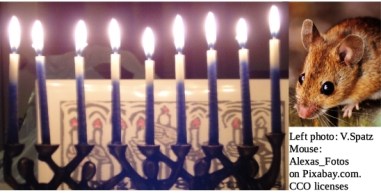
Mouse and Menorah

In Perek Shira, as noted in the previous two posts, verses from Psalm 30 join a chorus of praise in which “each of God’s creatures, plants and animals, mountains and rivers, sings out to its Creator in a special way.” Our prayers, are part of a “cosmic symphony” says Rabbi Arthur Green:

The prayers of Israel are recited in a special language and a distinctive form. There is a way in which they belong to the Jewish people and to us alone. But prayer is also a universal act, one that binds the whole human community together with all of nature, calling forth in us an appreciation of life as an ongoing celebration of the gift of being.
— from Kol Haneshemah (citation below)

This idea leads to the commentary in Pesikta Rabbati — medieval commentary on the holidays — which tells us that there were seven dedications, channukot, from dedication of heaven and earth in Breishit to the “dedication of the world to come, because even that has lights…”

More on the seven dedications as November (National Novel Writing Month) ends and Chanukah begins.

20 of 30 on Psalm 30
As a National Novel Writing Month Rebel, I write each day of November while not aiming to produce a novel. This year I focus on Psalm 30 (“Thirty on Psalm 30”) in the hope that its powerful language will help us through these days of turmoil and toward something new, stronger and more joyful, as individuals and as community. Whole series (so far)…. Look for this not-necessarily-novel writing project to extend into Chanukah, which begins just as NaNoWriMo ends, and apologies to anyone who is bothered by the strange posting schedule.

Mouse and Menorah.jpg

NOTE:
Comment appears on page 704 of Kol Haneshemah: Shabbat V’chagim, the prayerbook published by Reconstructionist Press, 1996. Full citation at Source Materials. For more on Art Green, visit his website.

Kol Haneshemah includes select verses from Perek Shira as an alternative P’sukei D’zimrah. Among them is the first Mouse verse, translated as follows:

The mouse says: “I shall exalt you, O REDEEMING ONE, for you delivered me, and gave my enemies no joy on my account.” (Psalm 30:2).

Kol Haneshemah does not include the verse-conversation when the mouse is captured by the cat. See “And the Mouse Says” and “Glory and the Swallow” for more on Perek Shira.
TOP

And the Mouse Says…

In addition to the swallow, the mouse [עַכְבָּר] also speaks a verse from Psalm 30 in Perek Shira:

עַכְבָּר אוֹמֵר. אֲרוֹמִמְךָ יְיָ כִּי דִלִּיתָנִי וְלֹא־שִׂמַּחְתָּ אֹיְבַי לִי׃ (תהלים ל ב)
And the Mouse says, “I extol You, O LORD, for You have impoverished me/lifted me up, and not let my enemies rejoice over me.” (Ps. 30:2)
— Perek Shira, Chapter 5; more on the Mouse below

As with “kavod” in verse 13 — which, as previously discussed, is translated in many ways in addition to “glory” — דִלִּיתָנִי [dilitani] has a number of translations. But the one used in Nosson [Natan] Slifkin’s 2003 translation of Perek Shira stands far apart:

    • The 1917 JPS has “Thou hast raised me up” for “dilitani” in Psalm 30;
    • The 1985 JPS has “You have lifted me up”;
    • Other translations use “delivered,” as well as “lifted” and “raised”;
    • Rabbi Zalman Schachter-Shalomi has the less usual, “you set me free so that my enemies could not gloat at my troubles”;
    • Slifkin alone has “impoverished me.”

…The Hebrew word for “impoverish” (decrease, deplete, etc…), דִּלֵּל (dileil), shares a dalet-lamed pair with dillitani. Possibly Slifkin is following a line of commentary that uses the similarity to translate the verb as “impoverish.” In the context of Perek Shira, some version of lifting would seem to parallel the warning, “from there I will bring you down” (Obadiah 1:4) which is uttered by the Cat. (See note below for links to the whole conversation between Cat and Mouse.) For the purposes of “Thirty on Psalm 30,” however, we can return to the ways dillitani is understood in the context of the psalm itself….

A Few Notes on dillitani

The Hebrew word here comes from a root meaning “to draw water” and probably originally referred to drawing water up from a well. It may have retained this connotation when this psalm was written: water and well imagery abounds in the Bible…
— Joel Hoffman (“What the Prayers Really Say” commentator), My People’s Prayer Book, vol.5

The following quotation is from The Jerusalem Commentary (broken up here into easier to read lines but otherwise unchanged:

You have lifted me up,” is derived from the root דלה, DLH (see Exodus 2:19: “And he also drew water [דָּלֹה דָלָה daloh dalah] for us”), whose primary meaning is “drawing water from a deep place.” [NOTE: OUr verse is the only example in the Bible of the root דלה, DLH, in the pi’el conjugation.] The expression, “You have lifted me up,” bears various interpretations:

  • …from my humble position (as in Psalm 113:7: “He raises the poor from the dust”);
  • You have lifted me up from my sickbed;
  • You have raised me from the underworld, as is stated in verse 4, below…
  • You kept me alive, that I should not go down into the pit” (the word דִלִּיתָנִי, dillitani, hints at the pail [דְּלִי, d’li] which is used to draw water from a well);
  • You have granted me victory over my enemies.

At all events, the word דִלִּיתָנִי, dillitani, corresponds to the word אֲרוֹמִמְךָ, aromimkha: You have lifted me up, and I will extol You (lift You up).”

More later.


19 of 30 on Psalm 30
As a National Novel Writing Month Rebel, I write each day of November while not aiming to produce a novel. This year I focus on Psalm 30 (“Thirty on Psalm 30”) in the hope that its powerful language will help us through these days of turmoil and toward something new, stronger and more joyful, as individuals and as community. Whole series (so far)…. Look for this not-necessarily-novel writing project to extend into Chanukah, which begins just as NaNoWriMo ends, and apologies to anyone who is bothered by the strange posting schedule.

NOTE
In fact, the Mouse is one of the few animals who speaks more than one line in Perek Shira. The others are the Rooster, which speaks eight times, and the Cat, which speaks once before and once after catching the Mouse.

After being captured by the Cat —

וְעַכְבָּר אוֹמֵר. וְאַתָּה צַדִּיק עַל כׇּל־הַבָּא עָלַי כִּי־אֱמֶת עָשִׂיתָ וַאֲנִי הִרְשָֽׁעְתִּי
And the Mouse concedes, “You are just for all that comes upon me, for you have acted truthfully, and I have been wicked.”

This second Mouse speech is a singular version of the plural expression of Nehemiah 9:33:

וְאַתָּ֣ה צַדִּ֔יק עַ֖ל כָּל־הַבָּ֣א עָלֵ֑ינוּ כִּֽי־אֱמֶ֥ת עָשִׂ֖יתָ וַאֲנַ֥חְנוּ הִרְשָֽׁעְנוּ׃
Surely You are in the right with respect to all that has come upon us, for You have acted faithfully, and we have been wicked.

There is undoubtedly a lot to pursue here. But it’s tangential to Psalm 30 — and Perek Shira is not something I’ve studied before.

See the whole exchange between Cat and Mouse at Sefaria. The dialogue appears in a slightly different order in this (PDF) booklet version, Perek Shira (Slifkin).
TOP

BACK to translation discussion