Babylon: Babel’s (Distant) Background

Exploring Babylon: Chapter 3.1

The Hebrew “Bavel” is translated into English as “Babel” in Genesis and as “Babylon” when it appears elsewhere in the Tanakh. Bavel as Babel shows up in a total of two verses in the entire Torah text: Gen 10:10, Nimrod’s legacy — “the beginning of his kingdom was Babel, and Erech, and Accad, and Calneh, in the land of Shinar,” and Gen 11:9, the close of what is usually called “The Tower of Babel” story. Bavel, now Babylon, is not mentioned again until 2 Kings 17:30, during the exile of the northern kingdoms.

After that, the Concordance (Even-Shoshan 1998) lists 281 additional appearances Bavel in the prophets and two in Psalm 137. Down the road, we’ll explore Babylon references in the later Tanakh. For now, let’s return to the Genesis.

Babel and Babylon

Jewish commentary on Gen 11:1-9 often treats the Bavel of Genesis as a place apart from history and geography. The focus is on the Babel tale’s placement in the Torah: after the Flood — when Noah’s descendants were told to “be fruitful and multiply and fill the earth” (Gen 9:1) — and before Terah, Abraham, Sarah, and Lot leave Ur (Gen 11:31). Babylon is far in the background, often unremarked.

For example, Rabba Sara Hurwitz, of Yeshivat Maharat, recently shared a lovely, powerful dvar torah for the Torah portion Noach (Gen 6:9-11:32):

And God models how to exist in a world of diversity. In verse 7, when God goes down to mete out their punishment, God says: “Come let US go down.”

Rashi, addressing the question of who God is talking to, suggests that God “took counsel with the Angels, with his judicial court.” Surely God knows how to mete out judgment and punishment, as he has already done unilaterally in the Torah without discussing it with the Angels? Perhaps, God turns to them to asses their thoughts on the sin of the people, to hear their opinion, to debate the pros and cons of scattering the people all over the world. By addressing the Angels, God models how to collaborate with others. Diverse ideas, when debated in a respectful manner, can lead to growth, greater productivity, and ultimately harmony.

…The challenge with diversity is to reject the tendency toward segregating, and running away from conflict. For out of conflict, when we are willing to confront one another with healthy debate, tolerance is born…
— Hurwitz, ָ”Harmony, not Conformity

Hurwitz’s dvar torah is about Babel, not Babylon. She mentions no historical city or empire. Plenty of homelies, in- and outside the Orthodox world, identify Babel with Babylon and incorporate views of the latter; idol-worship, smugness of place, and failure to follow God’s commandments are common themes linking Babel and Babylon. However large a role Babylon plays in any given dvar torah, the overarching point is to help us better understand the Torah, ourselves, and our obligations as Jews — not to tease out insights on life in ancient Babylon.

Still, Jewish bible study has long examined the relationship of the historical, geographical Babylon to the Babel of Genesis 11. For thousands of years, that discussion has returned again and again to concepts of unity and difference, centralizing and dispersing. And for thousand of years, intentionally or not, those discussions have incorporated political ideas about these themes.

Because Babylon, in its many guises, is never far away from Jewish consciousness. Remember: We’ve already found Babylon in the primordial stuff of Creation and in the formation of the first earthling….

It’s Complicated

Erin Runions analyses Babylon as a complex, often contradictory, theme in U.S. culture and politics. From a non-Jewish academic perspective, she writes about the Tower:

The Tower of Babel appears in political and religious discourse when people want to think about what holds the United States together in the face of its racial and cultural diversity. Because the Babelian creation of diverse languages is typically read as both God’s will and at the same time a punishment, the story lends itself well to representing a range of attitudes about difference. A confusing ambivalence about unity and about too much diversity emerges. Via the Babel story, Babylon is sometimes used to promote tolerance toward sexual and ethnic difference, insofar as U.S. Americans see themselves as benevolent toward difference. At other times it is used to stigmatize and attack difference as embodying a problematic unity without moral distinctions.
The Babylon Complex: Theopolitical Fantasies of War, Sex, and Sovereignty (NY: Fordham University Press, 2014), p. 22-23

Runions calls Babylon “a surprisingly multivalent symbol” in U.S. culture and politics and then dedicates 300 pages to unpacking its complexities. Much of The Babylon Complex is outside the scope of this blog’s project. But Runions’s work illuminates how the surrounding culture understands and uses the concept of Babylon — and those insights are crucial, however tangential.

We’ll explore The Babylon Complex further another day. For the moment, let’s return to Rabba Hurwitz’s image of God modeling “how to collaborate with others” and add a postscript.

Different Folks

This past week, Playing for Change re-shared this video — one of my favorites among an enormous menu of great, community-building music. Sly Stewart’s great lines —

You love me
you hate me
You know me and then
Still can’t figure out the bag I’m in

seem so appropriate to this stage of #ExploringBabylon and Hurwitz’s charge to us.

Plus: Who doesn’t need hundreds of children singing and dancing to Sly and the Family Stone’s “Everyday People”?!

More here for those interested, about TurnAround Arts and Playing for Change.

Babylon: the Earthling and the Tower

Exploring Babylon: Chapter 2.2

What did the Talmud mean by calling an apparently obscure town in then-contemporary Babylon the source of the first human’s “buttocks”? And what, if anything, can we learn from the remark?

Babylon makes several appearances, directly and indirectly, in the early chapters of Genesis:

  • Bavel” first appears directly in a genealogy list identifying Nimrod, descendant of Noah through Ham, as the founder of Babylon (Gen 10:10);
  • the Tower of Babel story appears in Genesis 11:1-9, with the name “Bavel” linked to God’s confounding of language and scattering of peoples;
  • as discussed in “Babylon and the Beginning,” the Babylonian Captivity, that is, exile of Israelites during the 6th Century BCE, is read into Gen 1:2; and
  • Babylon, as a geographic and cultural location for rabbis of the Talmud, enters commentary on the creation of the first human (Gen 2:7-8):


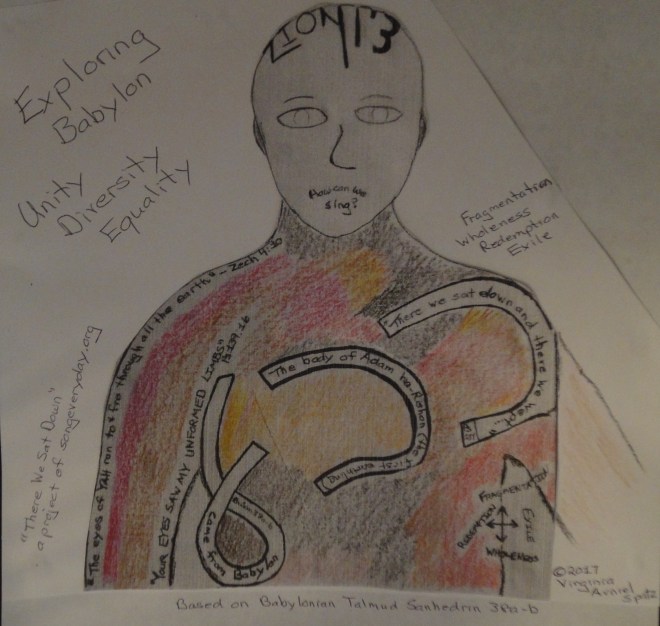
It has been taught: R. Meir used to say: The dust of the first human [adam ha-rishon] was gathered from all parts of the earth, for it is written, “Your eyes saw my unformed substance” [N1], and further it is written, “The eyes of the Lord run to and fro through the whole earth” [N2]. R. Oshaiah said in Rav’s name [N3]: Adam’s trunk came from Babylon, his head from Eretz Yisrael [N4], his limbs from other lands, and his buttocks (Soncino: private parts), according to R. Aha, from Akra di Agma [N5].
— Babylonian Talmud Sanhedrin 38a-b
adapted from Soncino translation
Notes below


The Earthling

Rabbi Meir’s comment — specifying the dust used to create ha-adam (Gen 2:7) and explain where the earthling was before being placed in the garden (Gen 2:8) — is frequently cited to support the egalitarian message that all humans, from whatever land, come from one source. It also celebrates both diversity and unity of humanity.

Rav’s further specifics — from a time when Babylon was growing in importance as a center of Jewish life, while Zion was still the metaphorical “head” — can also be understood more generally to speak to our divided, or blended, natures.

Similar concepts are found in the 12th Century Yehuda HaLevi poem, “My heart is in the East, and I am at the ends of the West,” and even 20th Century pieces, like “I left my heart in San Francisco” (Cory/Cross, 1953; popularized by Tony Bennett). The quintessential verses of Psalm 137, with its many interpretations over the centuries, continue to add layers to the idea that portions of our being remain in Babylon and Zion.

Before getting to R. Aha’s comment, here is an attempt to illustrate some of the divisions and blends we might embody in Exploring Babylon. This is the second project I’ve posted based on ideas in Personal Geographies: Explorations in Mixed-Media Mapmaking by Jill K. Berry; here’s the first. And here is a completely different visual approach to Torah.

earthling


Notes:

N1: Ps. 139:16. Many commentaries relate Psalm 139 to the creation of the first human; some attribute the psalm, or part of it, to Adam.
BACK


N2: “The eyes of the LORD run to and fro throughout the whole earth,” is similar to language in Zech 4:10 —

עֵינֵי יְהוָה, הֵמָּה מְשׁוֹטְטִים בְּכָל-הָאָרֶץ.
which are the eyes of the LORD, that run to and fro through the whole earth.

— and identical to part of 2 Chronicles 16:9 —

כִּי יְהוָה, עֵינָיו מְשֹׁטְטוֹת בְּכָל-הָאָרֶץ
…for the eyes of the LORD run to and fro throughout the whole earth…

The Soncino translation cites Zechariah. The Koren/Steinsaltz translation cites Chronicles.

The Soncino notes add that, perhaps, this teaches “‘equality of man’, all men having been formed from one and the same common clay.”
BACK


N3:Rab, or Rav (Abba Arika), was a leading teacher in 3rd Century CE Babylon. He came from a prominent family in Jewish Babylonia and was a disciple of Rabbi (Judah the Prince, or Yehuda ha-Nasi), redactor of the Mishnah and major leader of Jews under Roman occupation, before returning to Babylon to teach. Rav founded the academy at Sura and helped establish what became Babylonian Judaism. The other major academy of the time was at Pumbedita (see N5 below).
BACK


N4: The Soncino notes that Eretz Yisrael was considered “the most exalted of all lands,” and so is linked with the head, as the “most exalted” body part.
BACK


N5: A Babylonian town (also spelled: Akra d’Agama, Akra de-Agma), which some sources situate near Pumbedita, where a Talmudic academy was established in the 3rd Century CE. Also possibly a low-lying area, and/or in the south of Babylon. More on this town and R. Aha’s comment…
BACK

Akra de-Agma in the Notes

Louis Ginzberg’s reference to the above passage includes a parenthetical remark: “Akra de-Agma (a town in Babylon, notorious on account of the loose morals of its inhabitants).” The Soncino notes on Sanhedrin 38b quote this remark without elaboration or any further source. (See Legends of the Jews, Vol 5:15, Jewish Publication Society, 1925). Meanwhile, numerous teachers of the last century cite this remark on loose morals of Akra de-Agma as fact, but I can’t find any independent sources that suggest anything of the kind.

The name “Akra di Agma” appears also in Baba Batra 127a, while “Akra” and “Agama” are mentioned as two neighboring locales in Baba Metzia 86a. Both of these passages mention the place(s) in the context of rabbinical life, without any commentary on the morals, loose or otherwise, of the inhabitants.

Steinsaltz adds this marginal note to San 38b:

Akra de-Agma. This is apparently the name of a Babylonian city, perhaps in the south of the country. According to the [Shulkhan] Arukh this was a lowly place, either from a physical or ethical standpoint, and for this reason it is said that from here the dust used to create Adam’s buttocks was taken.

Combining the Soncino and Steinsaltz notes might suggest that Ginzberg was relying on, or extending, something in Shulkhan Arukh (16th Century code of Joseph Karo). But it still seems like something else might be going on with Akra de-Agma.


Three hypotheses:

On the one hand, this teaching is so specific in its place names. And, we know Akra de-Agma is near the academy at Pumbedita, while Rav’s academy was based in the town of Sura. So, I can’t help wondering if there’s some sort of in-joke involved in identifying ha-adam‘s buttocks (or “privates”) with a rival academy — like Harvard students calling New Haven a hick town or Howard alumni talking trash about Hampton.

On the other hand, this teaching is speaking of ha-adam and so suggesting what it means to be human in a wider sense. In this more symbolic context, I wonder if Akra de-Agma somehow became a synechdoche for the many ways Babylon itself — by the time of the Shulkhan Arukh and later centuries — came to mean danger and wildness, particularly of a sexual nature.

Finally, George Carlin’s “FM & AM – The 11 O’Clock News” comes to mind:

It’s 8 O’Clock in Los Angeles
It’s 9 O’Clock in Denver
It’s 10 O’Clock in Chicago
In Baltimore, it’s 6:42!

Could it be that Akra de-Agma was the Baltimore of Babylon?

In that case, I think, the composition of ha-adam rishon, the first earthling, might be tied up with the Tower or Babel theme: Will humanity be of one speech or idea — “devarim ahadim,” as at the start of the Babel story — or be “scattered over the face of the earth” as the people fear and ultimately experience, at the close of the story?

What can we take from the story of ha-adam rishon and the Tower of Babel to help us avoid either extreme?

Stay tuned. And share your thoughts, too.

BACK

Babylon and the Beginning

Exploring Babylon: Chapter 2.1

Ancient commentary finds reference to exile, to Babylon in particular, as early as the bible’s second verse:

Now the earth was unformed [תֹהוּ] and void [וָבֹהוּ] and darkness [וְחֹשֶׁךְ] was upon the face of the deep [עַל-פְּנֵי תְהוֹם]; and the spirit of God hovered over the face of the water [וְרוּחַ אֱלֹהִים, מְרַחֶפֶת עַל-פְּנֵי הַמָּיִם]”
— Gen 1:2

R. Simeon b. Lakish equates “tohu [unformed]” with Babylon and subsequent expressions in the verse with other “powers” (or “empires”) that dominated Israel: Medea/Persia, Greece, and “the Wicked State” (Rome). Finally, he links “the spirit of God” hovering over the water with Messianic spirit and reasons that it’s on account of the water (over which the spirit hovers) — likened to repentance, based on Lamentations 2:19, “…pour out thy heart like water…” — that Redemption will come.[1].

God makes order from chaos. In the beginning of Creation and in Reish Lakish’s day. Four separate kinds of confusion and darkness are but prelude. As in that hovering just before God created light and then divided light from darkness, the dawn of Redemption is just a moment away. Through this allegory, one verse of the Creation story thus encapsulates the People’s history, fears, and faith. And the experience of Babylonian captivity is shapes it all.

Estimated Impact

Jacob Neusner’s introduction to Genesis Rabbah notes that the sages of the time — Christian Palestine of the 4th-5th Century CE (incorporating earlier teachings) — “entertained deep forebodings about Israel’s prospects.” They understood the Torah to be “the story of Israel, the Jewish people, in the here and now,” however, and so read it to speak to the needs of their time:

So the importance of Genesis, as the sages of Genesis Rabbah read the book, derives not from its lessons about the past but from its message for Israel’s present–and especially its future….a prophesy for a near tomorrow.
–Neusner, p.2

Based on the Babylonian exile and subsequent return to rebuild the Temple, “hope persisted that the same pattern would find renewal–and the prophets’ promise of redemption.” (p.4, Jacob Neusner. Confronting Creation: How Judaism Reads Genesis: An Anthology of Genesis Rabbah [Eugene, OR: Wipf & Stock Publishers, 1991]).

Biblical scholar Rainer Albertz [2] estimates that “half the material in the Hebrew Bible came into being or was substantially shaped” during the Babylonian Exile. A decade or so later, he suggested that “about 70 percent of the Hebrew Bible tackles the questions of how the catastrophe of exile was possible and what Israel can learn from it.”

But Albertz’s method does not appear to extend to readings, like those of Genesis Rabbah, in which verses unrelated to exile on the surface — that is, on a pashat (literal or simple) level — are allegorically linked. So, perhaps the percentage of the Hebrew Bible understood as relating to exile should be raised even further?

Questions for Consideration

Questions posed in Chapter 1.1 touched on feelings of safety and fragility. As we move beyond the sukkah and into the new year’s Torah cycle:

  • Does the vision of Genesis Rabbah, including the precarious nature of the political situation, have resonance for this year’s Torah cycle?
  • Does the notion of being so close to chaos, confusion, and darkness seem ancient or current?
  • What about the idea that Redemption can also be very near?
  • Does repentance, in this context, seem possible?
  • Is reading “(foreign) powers” into the early Creation story disturbing? hopeful?
  • Does a strong focus on exile and return, even for verses that seem unrelated, deepening bible reading? or flatten it?
  • Can knowing that we (and the Presence suffering with us) made it back, or out from under, help us now?

NOTE:

1) R. Simeon b. Lakish said:
Unformed [“tohu” תֹהוּ] = Babylon, because the prophet Jeremiah wrote about the Babylonian exile: “I beheld the earth, and, lo, it was waste [וְהִנֵּה-תֹהוּ]…” (Jer. 4:23). Void [“bohu” וָבֹהוּ] = Medea/Persia; Dark [“hoshech” וְחֹשֶׁךְ] = Greece; the Face of the Deep [“al p’nei t’hom” עַל-פְּנֵי תְהוֹם] = “the Wicked State” (i.e., Rome). Reish Lakish equated the Spirit of God with the Messianic spirit, citing Isaiah 11:2 — And the spirit of the Lord shall rest upon him [the Messiah].

This teaching closes by asking, “In the merit of what will the Messiah come?” And answering:

[For the sake of that which] hovered over the face of the waters, i.e. in the
merit of repentance which is likened to water, as it is written, Pour out thy heart like water (Lam. 2:19)

–Genesis Rabbah 2:4

R. Simeon b. Lakish (3rd Century CE, Palestine) is also known as Reish Lakish.

Genesis Rabbah is thought to date be the oldest of the Midrash Rabbah collections. A translation by R. Dr. H. Freedman is available via the great Internet Archive.
BACK


2) Rainer Albertz (profile; C.V.) has a Ph.D in Protestant Theology from the University of Heidelberg. He is the son of a Heinrich Albertz (1915–1993), one-time major of (West) Berlin and a pacifist, anti-Nazi Christian minister.

Israel in Exile: The History and Literature of the Sixth Century B.C.E., translated by David Green (Atlanta: Society of Biblical Literature, 2003).

“More and Less than a Myth: Reality and Significance of Exile for the Political, Social, and Religious History of Judah,” IN By the Irrigation Canals of Babylon: Approaches to the Study of the Exile, edited by John J. Ahn & Jill Middlemas (NY: Continuum, 2012).
RETURN

God’s Presence Accompanied Them

Exploring Babylon: Chapter 1.2

Deuteronomy closes with hopes, on the banks of the Jordan and declarations of Israel’s particular relationship to God:

So Israel dwelt in safety
the fountain of Jacob alone…

Happy are you, O Israel!
Who is like you, a people saved by the LORD,
the shield of your help,
and the sword of your triumph!
–Deut 33:28-29

Much later, after Israel had experienced more trial and loss and exile, the idea developed that God was in exile along with the People, as much in need of rescue as the People. In particular, Sukkot prayers include a verse, “Ani va-ho” — sometimes translated as “Yourself and us!” or “Rescue me and the divine name!” — followed by another that begs:

As You rescued the communities You exiled to Babylonia, and Your merciful Presence accompanied them — so save us.

This line of thought, which has been developing for centuries, is mean to teach that “when there is suffering in the world, God is not on the side of the oppressors. Rather God is with the oppressed and suffers with them” (from Or Hadash: A Commentary on Siddur Sim Shalom; download and more at Rabbinical Assembly).

The idea that “God is with the oppressed” is too often, I fear, used as a sort of universal Coup-fourré card, a “safety” to correct any “hazard,” so as to stay on the road.

…For those who never played the old card game Mille Borne, maybe “ace in the hole” or “Get out of jail free” card will make more sense; but I find Coup-fourré — the process whereby one is able to surmount a pitfall and keep rolling along — more apt here….

It is way too easy to let “God is with the oppressed” console the already comfortable while leaving the afflicted with their travails. As we enter the new year, I think it’s time for the comfortable among us to examine our “safety” cards.


Following God’s Example

We must ask ourselves where we are when there is suffering and injustice in the world. It’s not enough to be concerned or write letters or even stand out in the street in protest — although all of those things are important. God went into exile with us, and something similar is required of us, if we are to make any progress on racial and ethnic justice issues.

We must take steps to remove any sense that we are somehow entitled to dwell in safety — as we find Israel at the close of Deuteronomy — when others cannot. If God could join us in exile, we can work to dismantle White Supremacy and other protections that can never be equally shared. Where there is suffering in the world, we cannot simply declare ourselves “on the freedom side.”

We’ve got to follow God’s example, to the extent we are able, and be willing to be vulnerable, explore what it’s really like in Babylon, not just our romantic ideas about it from outside. We have to look carefully at any place where oppression thrives and ask, “how we are complicit?” Really, deeply, honestly ask ourselves and our communities: “Which side are you on, my people, which side are you on?”

And then take action, even if it means compromising our own safety or sense of self.

NOTE: A version of this mini-dvar [word, sermon] was given at Fabrangen and Tikkun Leil Shabbat joint Simchat Torah celebration, 10/11/17.

“Babylon” (Bavel) means many things in Judaism and in U.S. popular culture. Join “A Song Every Day” in Exploring Babylon over the next 40 weeks.


Which Side Are You On?

Background on the song/chant —

Florence Reece (more here) wrote “Which side are you on?” lyrics in 1931 as part of labor organizing effort —

Freedom Singers adapted it for the mid-20th Century Civil Rights movement —

A version of this is still used, as in #BlackBrunch in Oakland (above), but protestors in the Movement for Black Lives also use a combination song and chant, as in this snippet:

Chant: [Example Leader] was a Freedom Fighter
who taught us how to fight
We gonna fight all day and night
until we get it right

Sing: Which side are you on, my people, which side are you on?
We’re on the freedom side!

Siddur as Hometown: Don’t Dismiss the Travel Guide

When the ancient Rabbis want to etch something in memory and make it part of regular practice and belief, they stick it in the siddur. I cannot specific cite a source for this pronouncement, which I included in a recent dvar torah — although Berakhot, the Babylonian Talmud’s Tractate on Blessing, is one source that lends lots of support to this idea.

The prayerbook is such a rich environment, but it’s easy to miss most of it as we pass through. We often treat the siddur like our own hometown: we can imagine why others are fascinated and seeking to learn more, but we just want to traverse it to get wherever we’re trying to reach; a travel guide for the place we’ve been living for decades seems beside the point. Additional teachings that have developed over the centuries, to explain why things are (or are not) in the siddur and elaborate on ideas contained in the prayers, can be terrific resources, though.

Here are a few:

  • The dvar torah on Parashat Re’eh, mentioned above: The Commandment to See
  • Small archive of Divrei Tefillah, words about prayer, produced by congregants at Congregation Rodfei Zedek (Chicago); dvar by Rebecca Milder is quoted in above
  • Elaborate Making Prayer Real website, with articles and webinars and more; related to book by Rabbi Mike Comins, released in 2010 (and frequently quoted on THIS blog).
  • Re-recommend exploring something along the lines of “Map Your Heart Out

interlude: Summer 5777

Tammuz is interlude, reiteration, steady growth,” writes Debbie Perlman, describing the month in the Jewish calendar which began this past weekend. She goes on to reference sprinklers, weeds, and fields already planted, concluding:

Hear us as we move into this time of increase,
As we gather up sunlight and breezes and rains
To lay aside against the unknowns ahead.
Hear us as we call You in truth.
— from “Ninety-One: Rosh Chodesh Tammuz”
IN Flames to Heaven: New Psalms for Healing & Praise

A few words about “interlude” and gathering up “against the unknowns ahead.”

“Against the Unknowns Ahead”

Taking a wide view of the Jewish calendar, we’re in a sort of dip between two peaks: Shavuot, festival of “receiving Torah,” and Simchat Torah, festival of “rejoicing in the Torah.”

For seven weeks, beginning on the second night of Passover, we counted “up” to Shavuot. The next milestone on the calendar, 40 days later, commemorates the incident of the Golden Calf — in other words, our failure to “receive” Torah very well. The Fast of Tammuz (this year: 7/11/17) launches a downward swing with “The Three Weeks” and Tisha B’Av, mourning loss of both Temples and other calamities faced by the Jewish people.

From that lowest point (9 Av, this year: 8/1/17), we begin the climb toward the new year, through the high holidays, Sukkot and, finally, Simchat Torah (this year: 10/13/17).

But right now, we’re still in the 40 days between Shavuot and the Fast of Tammuz. Reading ourselves into the Exodus story: We are still in the early days of liberty from Egyptian slavery; Moses is still on the mountain, obtaining the first tablets, which have yet to be smashed. We know nothing about the Golden Calf or the Spies and the decades of tromping in the desert, realizing the best we can hope for is that the next generation will make it out. Today, still, is about anticipation and hope for immediate changes in the life of our community.

From the vantage point of the Exodus story, this is a great time to “lay aside against the unknowns.” With a view to the Jewish calendar — and to the civic calendar in the U.S. — this is an important interlude to shore up resources for the challenging days ahead.

“When you come…”

The Torah potion Ki Tavo (“When You Come…”; Deut 26:1-29:8) is bookmarked by two fascinating passages: Near the beginning is he passage we read at the Passover seder, recapping our ancestors’ journey and our own through the Exodus; toward the end, we are told that it took forty years for us to understand what happened.

Deuteronomy 26: 5-10

וְעָנִיתָ וְאָמַרְתָּ לִפְנֵי יְהוָה אֱלֹהֶיךָ, אֲרַמִּי אֹבֵד אָבִי, וַיֵּרֶד מִצְרַיְמָה, וַיָּגָר שָׁם בִּמְתֵי מְעָט; וַיְהִי-שָׁם, לְגוֹי גָּדוֹל עָצוּם וָרָב.
And thou shalt speak and say before the LORD thy God: ‘A wandering Aramean was my father, and he went down into Egypt, and sojourned there, few in number; and he became there a nation, great, mighty, and populous.

וַיָּרֵעוּ אֹתָנוּ הַמִּצְרִים, וַיְעַנּוּנוּ; וַיִּתְּנוּ עָלֵינוּ, עֲבֹדָה קָשָׁה
And the Egyptians dealt ill with us, and afflicted us, and laid upon us hard bondage.

וַנִּצְעַק, אֶל-יְהוָה אֱלֹהֵי אֲבֹתֵינוּ; וַיִּשְׁמַע יְהוָה אֶת-קֹלֵנוּ,
וַיַּרְא אֶת-עָנְיֵנוּ וְאֶת-עֲמָלֵנוּ וְאֶת-לַחֲצֵנוּ
And we cried unto the LORD, the God of our fathers, and the LORD heard our voice, and saw our affliction, and our toil, and our oppression.

וַיּוֹצִאֵנוּ יְהוָה, מִמִּצְרַיִם, בְּיָד חֲזָקָה וּבִזְרֹעַ נְטוּיָה, וּבְמֹרָא גָּדֹל–וּבְאֹתוֹת, וּבְמֹפְתִים.
And the LORD brought us forth out of Egypt with a mighty hand, and with an outstretched arm, and with great terribleness, and with signs, and with wonders.

[these two verses are not part of the Haggadah:]
וַיְבִאֵנוּ, אֶל-הַמָּקוֹם הַזֶּה; וַיִּתֶּן-לָנוּ אֶת-הָאָרֶץ הַזֹּאת, אֶרֶץ זָבַת חָלָב וּדְבָשׁ.
And He hath brought us into this place, and hath given us this land, a land flowing with milk and honey.

וְעַתָּה, הִנֵּה הֵבֵאתִי אֶת-רֵאשִׁית פְּרִי הָאֲדָמָה, אֲשֶׁר-נָתַתָּה לִּי, יְהוָה;
וְהִנַּחְתּוֹ, לִפְנֵי יְהוָה אֱלֹהֶיךָ, וְהִשְׁתַּחֲוִיתָ, לִפְנֵי יְהוָה אֱלֹהֶיךָ.
And now, behold, I have brought the first of the fruit of the land, which Thou, O LORD, hast given me.’ And thou shalt set it down before the LORD thy God, and worship before the LORD thy God.

Deuteronomy 29: 1-3

וַיִּקְרָא מֹשֶׁה אֶל-כָּל-יִשְׂרָאֵל, וַיֹּאמֶר אֲלֵהֶם:
אַתֶּם רְאִיתֶם, אֵת כָּל-אֲשֶׁר עָשָׂה יְהוָה לְעֵינֵיכֶם בְּאֶרֶץ מִצְרַיִם, לְפַרְעֹה וּלְכָל-עֲבָדָיו, וּלְכָל-אַרְצוֹ
And Moses called unto all Israel, and said unto them: Ye have seen all that the LORD did before your eyes in the land of Egypt unto Pharaoh, and unto all his servants, and unto all his land;

הַמַּסּוֹת, הַגְּדֹלֹת, אֲשֶׁר רָאוּ, עֵינֶיךָ–הָאֹתֹת וְהַמֹּפְתִים הַגְּדֹלִים, הָהֵם.
the great trials which thine eyes saw, the signs and those great wonders;

וְלֹא-נָתַן יְהוָה לָכֶם לֵב לָדַעַת, וְעֵינַיִם לִרְאוֹת וְאָזְנַיִם לִשְׁמֹעַ, עַד, הַיּוֹם הַזֶּה.
but the LORD hath not given you a heart to know, and eyes to see, and ears to hear, unto this day.

Shabbat Ki Tavo falls this year between Labor Day, the traditional end of the U.S. “summer vacation” (9/4/17), and Rosh Hashanah, the beginning of the new year (9/21/17). A sort of meta-interlude.

Now, in the interlude of early Tammuz, perhaps we can begin to “gather up sunlight and breezes and rains,” our communities’ stories and our own, in preparation for the travels ahead.

Oved with an Ayin

Confusion sometimes arises from the similarity, in English transliteration and in pronunciation, between two prominent words in the haggadah: ‘oved‘ meaning ‘slave’ and ‘oved‘ in the phrase “Arami oved avi,” from Deuteronomy 26:5. The previous post provided a little background on “‘oved‘ with an aleph.” And here, as promised, are a few examples of the word ‘avadim‘ as in “avadim hayinu [we were slaves].”

oved‘ with an ayin: Exodus

Words from the root עבד (oved — ayin-bet-dalet) appear frequently in the Torah and later books of the Tanakh, with many instances in the Exodus story.

For example, Pharaoh is told “let My people go, that they may serve Me” in Exodus 7:16, 8:1, 10:3,…:

שַׁלַּח עַמִּי,
וְיַעַבְדֻנִי.
“…let My people go, that they may serve Me.”
— Exodus 10:3

Pharaoh responds several times, telling Moses “Go ye, serve the LORD…” with some restrictions added:

לְכוּ
עִבְדוּ
אֶת-יְהוָה
רַק צֹאנְכֶם וּבְקַרְכֶם, יֻצָּג: גַּם-טַפְּכֶם, יֵלֵךְ עִמָּכֶם–
Go ye, serve the LORD;
only let your flocks and your herds be stayed; let your little ones also go with you.’
— Exodus 10:24

Later, reference is made again and again to the Israelites leaving “Egypt and the house of bondage.” (Exodus 10:3, 10:14, 20:2,…)

וַיֹּאמֶר מֹשֶׁה אֶל-הָעָם, זָכוֹר אֶת-הַיּוֹם הַזֶּה אֲשֶׁר
יְצָאתֶם מִמִּצְרַיִם
עֲבָדִים מִבֵּית
And Moses said unto the people:
‘Remember this day,
in which ye came out from Egypt,
out of the house of bondage;
— Exodus 13:3

When we recite Hallel at Passover and on other festival days, we reflect on our status as servant now only to God:

אָנָּה יְהוָה,
עַבְדֶּךָ: כִּי-אֲנִי
בֶּן-אֲמָתֶךָ אֲנִי-עַבְדְּךָ,
פִּתַּחְתָּ, לְמוֹסֵרָי.
Now, ABUNDANT ONE,
I am your servant.
I, your servant, child of your servant,
I whose fetters you have opened up.
— Psalm 116:16, Kol Haneshamah
in this prayerbook, NAMES in all caps substitute for YHVH

I beseech Thee, O LORD,
for I am Thy servant;
I am Thy servant,
the son of Thy handmaid; Thou hast loosed my bands.
— Psalm 116:16 JPS 1917

More Bondage and Servants

Forms of ‘oved‘ with an ayin, meaning servant or bondman, appear at many points in the Tanakh. Here are pre-Exodus examples:

In Genesis, we are told that Canaan will be cursed, becoming “servant of servants” or “lowest of slaves” — עֶבֶד עֲבָדִים (Gen 9:25)

When Judah and his brothers are in Egypt during the drought in Canaan and are caught in an apparent theft, Judah says to Joseph: “…we are your bondmen” —
הִנֶּנּוּ עֲבָדִים (Gen 44:16)

Post-Exodus, the people are meant to serve God alone. Should economic circumstances place one Israelite in bond to another, that must be a temporary status: “And if he be not redeemed by any of these means [just outline above], then he shall go out in the year of jubilee, he, and his children with him.” (Lev. 25:54)

כִּי-לִי בְנֵי-יִשְׂרָאֵל,
עֲבָדִים–עֲבָדַי הֵם,
אֲשֶׁר-הוֹצֵאתִי אוֹתָם מֵאֶרֶץ מִצְרָיִם: אֲנִי, יְהוָה אֱלֹהֵיכֶם.
For unto Me the children of Israel are
servants; they are My servants
whom I brought forth out of the land of Egypt: I am the LORD your God.
— Leviticus 25:55

When Nebuchadrezzar, king of Babylon, threatens Jerusalem, the prophet Jeremiah attributes the disaster to the people’s reneging on this command: “but afterwards they turned, and caused the servants and the handmaids, whom they had let go free [at the jubilee], to return, and brought them into subjection for servants and for handmaids” (Jer 34:11).

Later, when the exiles are allowed to return, Ezra remarks on God’s favor, despite the people’s sins:

כִּי-עֲבָדִים
אֲנַחְנוּ–וּבְעַבְדֻתֵנוּ, לֹא עֲזָבָנוּ אֱלֹהֵינוּ;
For we are bondmen;
yet our God hath not forsaken us in our bondage,
-Ezra 9:9

Avadim

posted on this seventh day of the Omer 5777, with this prayer:
“In remembrance of the Exodus from Egypt, we pray that you release all whose bodies and spirits remain captive and enable us to extend Your outstretched arm in the process of liberation.” (see Ritual Well)

Why is This ‘Oved’ Different from The Other Seder ‘Oved’?

“When do we eat?” is often identified as the fifth question at the Passover seder, after the prescribed four about dipping and reclining, bitter herbs and unleavened bread. Just as often, in my experience, people are asking about two Hebrew words that look identical in English transliteration: ‘oved‘ meaning ‘slave’ and ‘oved‘ in the phrase “Arami oved avi,” from Deuteronomy 26:5.

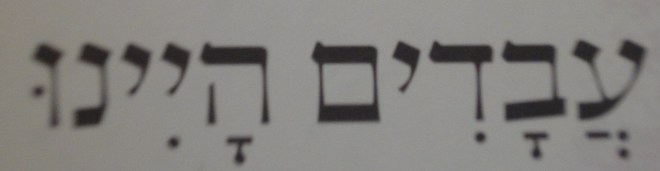
The Hebrew words for “slave,” “work,” and “worship” or “service” all have the same root. (More on “oved with an ayin” in a future post). But I have never heard anyone question the meaning of “avadim hayinu…” which appears near the start of the Passover telling: “We were slaves, and now we’re free.”

Note the letter ayin at the start of the word “avadim [slaves].”

Avadim.jpg
Avadim hayinu

The Deuteronomy verse, “Arami oved avi…” is another story. The ‘oved‘ with an aleph lends itself to several relatively straightforward translations as well as a traditional homelitical reading based on the biblical character most commonly identified with Aram.

Note the letter “aleph” at the start of “oved [lost, perished, fugitive,…].”

AramiOvedAvi.jpg
Arami oved avi

For discussion of “Who is Arami?” and “What does it mean to be oved?” in the Deuteronomy setting and in the Passover Haggadah, see “Ki Tavo: A Path to Follow.” Here, just to explore Hebrew vocabulary a bit more, is a little background on the word ‘oved‘ (with an aleph) itself.

oved‘ with an aleph

Forms of ‘oved‘ (with an aleph) appear frequently in biblical text. Here are a few instances, along with some translations.

Jeremiah 9:11 —

מִי-הָאִישׁ הֶחָכָם וְיָבֵן אֶת-זֹאת
וַאֲשֶׁר דִּבֶּר פִּי-יְהוָה אֵלָיו וְיַגִּדָהּ;
עַל-מָה
אָבְדָה
הָאָרֶץ, נִצְּתָה כַמִּדְבָּר מִבְּלִי עֹבֵר.
Who is the wise man, that he may understand this?
And who is he to whom the mouth of the LORD hath spoken,
that he may declare it?
Wherefore is the land
perished and laid waste
like a wilderness, so that none passeth through?
— JPS 1917 translation

…Why is the land in ruins
— JPS 1999

Micah 7:2 —

אָבַד
חָסִיד מִן הָאָרֶץ,
וְיָשָׁר בָּאָדָם אָיִן:
The godly man is perished out of the earth,
and the upright among men is no more
— JPS 1917

The pious are vanished from the land
— JPS 1999

Psalms 9:7 —

אָבַד
זִכְרָם הֵמָּה
…their very memorial is perished.
— JPS 1917

…their very names are lost.
— JPS 1999 with note: “meaning of Hebrew uncertain”

Ezekiel 12:22 —

בֶּן-אָדָם, מָה-הַמָּשָׁל הַזֶּה לָכֶם,
עַל-אַדְמַת יִשְׂרָאֵל, לֵאמֹר:
יַאַרְכוּ, הַיָּמִים,
וְאָבַד,
כָּל-חָזוֹן.
‘Son of man, what is that proverb
that ye have in the land of Israel, saying:
The days are prolonged,
and every vision faileth?
— JPS 1917

…every vision comes to naught“?
— JPS 1999

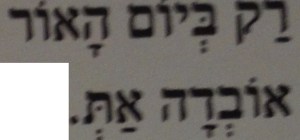
One more point of comparison, just because Temple Micah’s Hebrew poetry group encountered this modern Hebrew instance — over studies during the Shabbat of Passover — and noted how ‘obed‘ with an aleph and ‘obed‘ with an ayin sound alike to most English-speaking, and to some Hebrew-speaking, ears.

Lost

Yehuda Amichai’s “Shir Ha-Chut La-Machut [Poem of the Needle for the Thread]” has not been published in English translation. Our group rendered this line from the poem as “Only in the day, you are lost in the light,” or “Only in the daylight, are you lost.” (We struggled with the expression “b’yom ha-ohr.”)

And, finally, here are several versions of Deuteronomy 26:5 —

וְעָנִיתָ וְאָמַרְתָּ לִפְנֵי יְהוָה אֱלֹהֶיךָ,
אֲרַמִּי אֹבֵד אָבִי,
וַיֵּרֶד מִצְרַיְמָה,
וַיָּגָר שָׁם בִּמְתֵי מְעָט; וַיְהִי-שָׁם,
לְגוֹי גָּדוֹל עָצוּם וָרָב.
And thou shalt speak and say before the LORD thy God:
‘A wandering Aramean was my father,
and he went down into Egypt,
and sojourned there, few in number;
and he became there a nation, great, mighty, and populous.
— JPS 1917

…’My father was a fugitive Aramean…’
— JPS 1999

‘An Aramean Astray my Ancestor”
— Everett Fox translation, 1995

posted on this sixth day of the Omer 5777, with this prayer:
“In remembrance of the Exodus from Egypt, we pray that you release all whose bodies and spirits remain captive and enable us to extend Your outstretched arm in the process of liberation.” (see Ritual Well)

Rivers of His Hands

“The rivers of his hands [נהרות ידיו] poured into his good deeds,” reads the Yehuda Amichai poem “My Father.” The Hebrew Poetry group at Temple Micah discussed this poem on Shabbat, and I later recalled some background which seems related.

Rabbi Meir says in Pirkei Avot:

Anyone who involves himself in Torah for its own sake merits many things…and the secrets of the Torah are revealed to him, and he becomes like an ever-strengthening spring, and like a river that does not stop [וּכְנָהָר שֶׁאֵינוֹ פוֹסֵק]…
— Pirkei Avot 6:1, from Sefaria

In addition, the biblical concept of “נָהָר — nahar” provides further relevant background.

A River Goes Out

River images are pretty common in biblical text. The word “נָהָר — nahar” is used 120 times in the Hebrew bible, with 98 uses translated as “river,” according to this concordance . (The word is also rendered “flood” or “floods” or “streams.” Strong’s Exhaustive Concordance is widely available on the web and very handy; here’s more about this Christian resource.) But the first “nahar” in particular seems related to both the verse from Avot and Amichai’s poem.

“A river comes forth from Eden to water the garden.”
V’nahar yotzei me’eden lehashkot et hagan
וְנָהָר יֹצֵא מֵעֵדֶן
— Genesis 2:10

Noting that the river “yotzei [goes out, comes forth]” from Eden, a contemporary teacher writes:

How ironic. Wouldn’t the river be more likely to water the Garden if it flowed INTO the Garden? The deepest answer is that Torah is compared to lifegiving waters. The more one gives Torah over to others the more watering comes back in return. The more one teaches, the more one learns. The more we give of ourselves to others, the more we get back in return.
blog of Rabbi Baruch Binyamin Hakohen Melman

Amichai’s poem, “My Father,” says nothing about Torah. But the images he shares seem consistent with — and I’d argue, built on — biblical and rabbinic ideas of rivers sustained by their “going out.”

Warring Nations, Sibling Tears

The Torah portion Toldot (Gen. 25:19 – 28:9) illustrates the struggles of nations and individuals. We are simultaneously the inheritors of this mess and the participants – all of them – in the heart-breaking. So, I want to look at the sad state we’re in and see if we can find a way through by considering different aspects of the story.

Opening and Closing Angst

toldotRebecca’s story in this portion is bookended by two moments of terrible angst, both involving her children as individuals and as nations. She cries, “If so, why am I?” and learns that she carries two warring nations in her womb (Gen. 25:22ff).

— not unlike our situation right now, as U.S. citizens, I think.

Toward the end of the portion we are told that Jacob headed off “to Paddan-aram, to Laban the son of Bethuel the Aramean, brother of Rebecca, mother of Jacob and Esau.” (Gen. 27:45)

Her stated hope – that Jacob will remain with Laban just long enough for Esau’s wrath to cool – is not realized in her lifetime. Later, Isaac’s death is reported, but hers is not. So this is the last image in the Torah that we have of Rebecca: an individual who somehow birthed two nations, and then worked to manipulate their fates, now holding out hope for reconciliation between them, as one seethes and the other inherits, and she watches them part.

At no point in this portion do we see the extreme hospitality and generosity she exhibited at the well where she gave Eleazar a drink and watered his camels. We don’t see it from her, it’s not present in Isaac’s wranglings over the wells, and its antithesis appears when Jacob refuses to share food with his hungry brother without forcing Esau into a permanent abdication of rights.

Lentil Disaster and Beyond

Rabbi Elliot Cosgrove points out in a 2011 drash:

Jacob and Esau could not share a bowl of lentil soup without provocation, never mind a Thanksgiving dinner. Unlike modern psychology, the Torah does not find the primary shaper of human identity between parent and child, but rather between siblings. — “Brother, Can You Spare a Blessing?

And the state of the siblings in this portion is a deep and painful mess.

In addition to the lentil disaster, there is the deception over the blessing and Esau’s threat to kill Jacob because of it.

We learn from a 19th Century midrash that Rebecca convinced Jacob to flee, saying:

Whichever of you will be slain I shall be bereaved in one day, since one will be no more, slain, and the murderer of his brother will be detested by me as an enemy and stranger, and will be, in my eyes, as non-existing. I will thus be bereaved of both of them.
Em Lemikra: A commentary on Pentateuch (R. Elijah Benamozegh; 1823-1900)
found in Neshama Leibowitz Studies in Genesis: “Mother of Jacob and Esau”

An important midrashic thought to remind us that any murder destroys at least two lives. And I think it suggest that, like Rebecca, we are partially responsible for creating – or allowing – conditions that can lead to murder and we might consider our responsibility to help create better conditions that could prevent murders.

And then, even when murder is avoided, we still have to cope with Esau’s cry.

A Sibling’s Cry

As their story unfolds, we learn – from at least disparate two threads of commentary – that a single cry from Esau had repercussions for Jacob for centuries and into the current day.

After Isaac gave the blessing to Jacob, Esau “cried with a loud and bitter cry” (27:34): וַיִּצְעַק צְעָקָה, גְּדֹלָה וּמָרָה עַד-מְאֹד

Breishit Rabbah points to a similar expression in the Esther story after Mordechai learns of the edict against the Jews (4:1):

Jacob made Esau break out into a cry but once, and where was he punished for it? In Shushan the capital, as it says: “And he cried with a loud and bitter cry.” (וַיִּזְעַק זְעָקָה גְדוֹלָה וּמָרָה*)

*“cry” is spelled differently in the two verses, but Nechama Leibowitz calls the phrases identical, and clearly Breishit Rabbah saw a link.

In this midrash, the twins shift from individual brothers to nations, as retribution for tears of Esau, the man, comes – in God’s own time – to Jacob, the nation of Israel. As Leibowitz explains it: “The Almighty, who takes note of our tears, also takes note of those shed by the wicked Esau. They also are noted and cry out for retribution.” (Note: The “wicked” is Leibowitz’s adjective, one common in traditional interpretations.)

The Zohar also tells us that the tears of Esau do not exist solely within this portion’s narrative: Instead, it is taught that the Messiah will not come until Esau’s tears have stopped flowing. (Zohar II, Shemot 12b; more below)

It seems that both Esau and Jacob are understood as their national selves in the Zohar’s understanding. In both commentaries, however, Esau’s tears blur into a much something larger than one man’s injury.

Sibling Tears Today

As it happens, my older sister, Martha, and I had a chance over the summer to discuss the state of the nation and of our extended family. Martha reminded me that our dad – whose 40th yahrzeit passed in August – used to say that peace, in any kind of communal or national sense, was impossible until brothers learned to get along. And, he said, the bible taught how unlikely that was. Still, we were led to believe, as I recall, that the fate of the world rested on our small shoulders whenever any of the four of us had a minor spat.

While I doubt that our dad knew Breishit Rabbah or the Zohar, he managed to convey a similar sense, on the one hand, of the magnitude and persistence of interpersonal injuries and, on the other hand, of our power to affect change on a communal or national level by improving relationships with those closest to us.

At a recent program on racial justice, held at Adas Israel, an activist and teacher, black woman and a Jew, Yavilah McCoy stressed the importance of being what she calls “proximate” to the people with whom we are struggling for justice – in both senses, that is, those we oppose and those we join in common struggle. Proximity is the only way people learn and change, she said.

McCoy gave an example that stuck with me: If your auntie badmouths your mom, you don’t write to the New York Times about it; you talk to auntie and mom. And that, she said, is how injuries are resolved.

So, that’s what I’d like to discuss:

  • What are our possibilities for resolving very old and very painful circumstances between brother individuals and brother nations?
  • When are we Rebecca? When Esau? And when Jacob?
  • And when are we Isaac, who seems so damaged and confused himself that he lets everyone else do the emotional work?

One last note: Centuries of commentary appear to speak of the persistence of Esau’s tears without claiming that he should have received the blessing or even that anyone in the story should have behaved differently.

Postscript on brothers, etc.

The portion drifts constantly from the personal to the national, beginning with the opening verse –

וְאֵלֶּה תּוֹלְדֹת יִצְחָק, בֶּן-אַבְרָהָם: אַבְרָהָם, הוֹלִיד אֶת-יִצְחָק.
“This is the line” – or: “these are the offspring” – “of Isaac son of Abraham – Abraham begot Isaac” (24:19).

There are several traditional explanations for starting the line of Isaac with “Abraham begot Isaac.” One idea that caught my attention is from the 13th Century teacher, Chizkuni: The odd phrasing emphasizes that Abraham not only sired Isaac but raised him, and he did so after his name and destiny were changed to Abraham, “father of multitude of nations” (Gen 17:5).


The stress on “multitude of nations” is particularly important to consider at this point, poised between the lineage of Ishmael – which includes twelve princes by their nations (25:16) – and that of Isaac, which will include Esau and Jacob, who are both brothers and nations.

NOTES:

In the Midrash it is written: “Messiah, son of David, will not come until the tears of Esau have ceased to flow.” The children of Israel, who are God’s children, pray for mercy day and night; and shall they weep in vain so long as the children of Esau shed tears? But “the tears of Esau” – that does not mean the tears which the people of the earth weep and you do not weep; they are the tears that all human being weep when the ask something for themselves, and pray for it. And truly: Messiah, son of David, will not come until such tears have ceased to flow, until you weep because the Divine Presence is exiled, and because you year for its return.
— Martin Buber. The Way of Man/Ten Rungs, p. 199
NY: Citadel Press, 2006 (Ten Rungs, originally published Schocken 1947)

See also “Tears of Sorrow, Tears of Redemption” by Rabbi Toba Spitzer on Kol Nidre 5762 (shortly after 9/11/2001):

Maybe this is what we can learn out of the depths of the tragedy we have witnessed. That redemption will come when all tears have ceased, when all sources of suffering have been repaired. Our redemption is somehow linked to the fate of even those whom we consider our enemies. Their tears and ours are ultimately not so different.

The human spirit is so large when we allow it to be; the incredible outpouring of bravery and love and money in these past two weeks is testament to that. Let’s not squander this opportunity to make the most of what we’ve learned about ourselves, the good and the bad. Let’s name the sins that need to be named, let’s confess them together, and then let’s come together to begin to imagine a better way. Let’s dry Esau’s tears, and our own, and begin to figure out what it will take to make redemption real.
(Zohar II, Shemot 12b)

BACK