Hebrew Poetry: Idiosyncratic Resources

I read Dr. Seuss when I was little. I poured over the illustrations in Stevenson’s A Child’s Garden of Verses, although I don’t recall caring much for its verses. If my household discussed poetry at all it was most likely a piece of doggerel in a Mike Royko column (Chicago Daily News then).

I do remember being struck by “We Real Cool,” by Gwendolyn Brooks (1917 – 2000), when it was introduced to us at school. But we were given to understand that this was not “real poetry,” which only lessened my faint interest in the topic. Any connection between Bible and poetry only added, for both literary genres, further impenetrability.

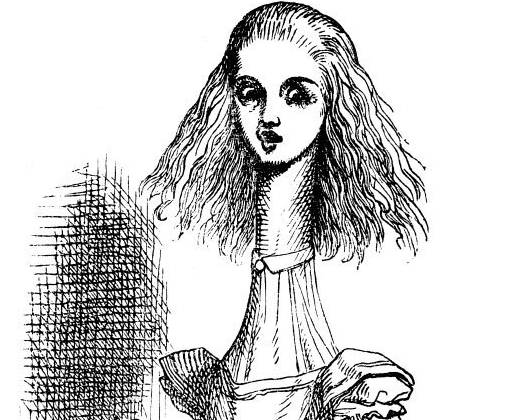
I meant by “impenetrability” that we’ve had enough of that subject, and it would be just as well if you’d mention what you mean to do next, as I suppose you don’t mean to stop here all the rest of your life.
— Humpty Dumpty to Alice, Alice Through the Looking Glass

“Real Poetry”

Later schooling didn’t improve my relationship to poetry, and I avoided it pretty successfully in college….except for my forays into writers’ groups, where I continued to find poetry a foreign, and often self-absorbed, form of expression. I did come to enjoy authors like Adrienne Rich, Marge Piercy, and Alicia Ostriker. But I think my early training stuck, so that I somehow classified this as outside the realm of “real poetry.”

When, nearly fifteen years ago, I began studying the poetry of Yehuda Amichai, it was with the intention of improving my Hebrew and for the connections, in Open Closed Open, to the prayerbook. I was convinced I didn’t like poetry and/or that it was somehow beyond me.

Attempting to read poetry in a language that is foreign to me proved fortuitous in that it taught me how hard poetry is to translate — and, therefore, some of the power poetry can convey. Plugging along word-by-word forced me into looking carefully at the language, much more carefully than I generally do when reading my native English. Eventually, I became a sort of convert to poetry as a means of expression and started to investigate the field as it suited me and whatever poem I was exploring.

All of this is to say that I have zero credentials for understanding poetry in general or Hebrew poetry in specific. I do spend a lot of time with the Hebrew Bible, but, again, without any formal training. Whatever I’ve learned is pretty haphazard. I don’t think I’m the only one who was taught some unhelpful things about “real poetry,” however, so I share what I’ve found hoping it’s of use to others….

Africana Perspectives and Fortress Press

As the annual Torah cycle brings us soon to the Song of the Sea, I recommend “Zora Neale and the Lawgiver in Conversation: Exodus 15 and Moses: Man of the Mountain” by Hugh R. Page, Jr. This piece appears in Israel’s Poetry of Resistance: Africana Perspectives on Early Hebrew Verse (Minneapolis, MN: Fortress, 2013), an unusual volume combining the author’s personal essay and poetry with theological discussion:

At that time Moses and the Israelites
Sang this song about YHWH.
Here are the words:

…My power is in Jah‘s song,
Surely, He is my salvation.
He is indeed my god.
That is why I praise him.
He is my ancestral god.
Therefore, I extol him.
— Page, Israel’s Poetry of Resistance, p.21

Page’s use of “Jah” here, he explains, is part of a “conscious effort to bring these biblical poems into more direct conversation with contemporary Africana music that articulates spiritualities of resistance…” (ibid, p.27). Throughout the book, the author focuses on how biblical poems disrupt their “textual surroundings,” and how that helps foster a theology that can work to “resist and dismantle exploitative institutional structures” (ibid., p.26).

Page summarizes his argument for pursuing ancient Hebrew poetry:

Early Hebrew poetry gives us ready access to the spiritual musings of some of our ancient Jewish spiritual forebears….It shows us the role that poets and poetic language played in shaping our conceptions of the divine and our understanding of how God’s self-disclosure to humanity unfolds. It forces us to deal with the symbolic nature of theological and poetic language and asks that we stretch ourselves intellectually as people of faith.
— ibid, p.129-30

I originally found this book while exploring various aspects of exile and life in Babylon. I am enjoying it differently at this juncture. Here’s more about the book, including a link to sample pages.

Fortress, by the way, is a Christian press established in 1962 offering some important, intersectional perspectives on bible reading. Here is a little more about them and their 2010 Peoples’ Companion to the Bible.

Medieval Poetry

When my study partner and I were seeking some new text, with a new perspective, I consulted an old teacher, Diana Lobel. She offered a number of suggestions, including The Gazelle: Medieval Hebrew Poems on God, Israel and the Soul by Raymond P. Scheindlin (NY: Oxford University Press, 1991). We are working our way through this volume, reading poems by Judah Halevi, Solomon ibn Gabirol, Moses ibn Ezra, with Scheindlin’s literary and theological commentary on each one.

The poems are provided in Hebrew, with English translation as well as additional linguistic commentary. Beyond the individual poems and their exegesis, Scheindlin’s book highlights ways in which Arabic and Hebrew traditions are interwoven and build upon each other. We have found The Gazelle helpful in considering questions about literary borrowing and adaptation, assimilation, and preservation of minority culture.

I have found studying these poems instructive in unlocking some of the mystical imagery in the work of contemporary Israeli poet, Rivka Miriam. I am sure we will continue to see resonance of these medieval works in other Hebrew poets, as well as in music.

Seeking more background, I stumbled upon this Medieval Hebrew Poetry website. [Archival link] Henry Rasof, who created the site as part of his master’s thesis from Gratz College, is a poet in his own right as well. UPDATE 1/6/25: Seeking to update links, I discovered that Henry Rasof passed away in 2022. He had been seeking a new editor to take over the site, back when, but no one stepped up. Rasof, z”l, said then that he discovered the topic late in life “and has since been bitten by the bug” — just in case a reader has been bitten by a similar bug or knows someone interested in a new project. Here is an archival link to Boulder Jewish News with Rasof’s posts.

Modern Poetry — and a Sale!

Amidst an effort to reorganize this blog, some of the resource pages were sort of misplaced. While I work to sort that out, I posted some poetry-related resources, focusing on contemporary Hebrew poets.

And, in the process of updating some of that information, I discovered that Wayne State University Press — which publishes The Modern Hebrew Poem Itself, among other related resources — is offering 40% everything until January 11.

And the Mouse Says…

In addition to the swallow, the mouse [עַכְבָּר] also speaks a verse from Psalm 30 in Perek Shira:

עַכְבָּר אוֹמֵר. אֲרוֹמִמְךָ יְיָ כִּי דִלִּיתָנִי וְלֹא־שִׂמַּחְתָּ אֹיְבַי לִי׃ (תהלים ל ב)
And the Mouse says, “I extol You, O LORD, for You have impoverished me/lifted me up, and not let my enemies rejoice over me.” (Ps. 30:2)
— Perek Shira, Chapter 5; more on the Mouse below

As with “kavod” in verse 13 — which, as previously discussed, is translated in many ways in addition to “glory” — דִלִּיתָנִי [dilitani] has a number of translations. But the one used in Nosson [Natan] Slifkin’s 2003 translation of Perek Shira stands far apart:

    • The 1917 JPS has “Thou hast raised me up” for “dilitani” in Psalm 30;
    • The 1985 JPS has “You have lifted me up”;
    • Other translations use “delivered,” as well as “lifted” and “raised”;
    • Rabbi Zalman Schachter-Shalomi has the less usual, “you set me free so that my enemies could not gloat at my troubles”;
    • Slifkin alone has “impoverished me.”

…The Hebrew word for “impoverish” (decrease, deplete, etc…), דִּלֵּל (dileil), shares a dalet-lamed pair with dillitani. Possibly Slifkin is following a line of commentary that uses the similarity to translate the verb as “impoverish.” In the context of Perek Shira, some version of lifting would seem to parallel the warning, “from there I will bring you down” (Obadiah 1:4) which is uttered by the Cat. (See note below for links to the whole conversation between Cat and Mouse.) For the purposes of “Thirty on Psalm 30,” however, we can return to the ways dillitani is understood in the context of the psalm itself….

A Few Notes on dillitani

The Hebrew word here comes from a root meaning “to draw water” and probably originally referred to drawing water up from a well. It may have retained this connotation when this psalm was written: water and well imagery abounds in the Bible…
— Joel Hoffman (“What the Prayers Really Say” commentator), My People’s Prayer Book, vol.5

The following quotation is from The Jerusalem Commentary (broken up here into easier to read lines but otherwise unchanged:

You have lifted me up,” is derived from the root דלה, DLH (see Exodus 2:19: “And he also drew water [דָּלֹה דָלָה daloh dalah] for us”), whose primary meaning is “drawing water from a deep place.” [NOTE: OUr verse is the only example in the Bible of the root דלה, DLH, in the pi’el conjugation.] The expression, “You have lifted me up,” bears various interpretations:

  • …from my humble position (as in Psalm 113:7: “He raises the poor from the dust”);
  • You have lifted me up from my sickbed;
  • You have raised me from the underworld, as is stated in verse 4, below…
  • You kept me alive, that I should not go down into the pit” (the word דִלִּיתָנִי, dillitani, hints at the pail [דְּלִי, d’li] which is used to draw water from a well);
  • You have granted me victory over my enemies.

At all events, the word דִלִּיתָנִי, dillitani, corresponds to the word אֲרוֹמִמְךָ, aromimkha: You have lifted me up, and I will extol You (lift You up).”

More later.


19 of 30 on Psalm 30
As a National Novel Writing Month Rebel, I write each day of November while not aiming to produce a novel. This year I focus on Psalm 30 (“Thirty on Psalm 30”) in the hope that its powerful language will help us through these days of turmoil and toward something new, stronger and more joyful, as individuals and as community. Whole series (so far)…. Look for this not-necessarily-novel writing project to extend into Chanukah, which begins just as NaNoWriMo ends, and apologies to anyone who is bothered by the strange posting schedule.

NOTE
In fact, the Mouse is one of the few animals who speaks more than one line in Perek Shira. The others are the Rooster, which speaks eight times, and the Cat, which speaks once before and once after catching the Mouse.

After being captured by the Cat —

וְעַכְבָּר אוֹמֵר. וְאַתָּה צַדִּיק עַל כׇּל־הַבָּא עָלַי כִּי־אֱמֶת עָשִׂיתָ וַאֲנִי הִרְשָֽׁעְתִּי
And the Mouse concedes, “You are just for all that comes upon me, for you have acted truthfully, and I have been wicked.”

This second Mouse speech is a singular version of the plural expression of Nehemiah 9:33:

וְאַתָּ֣ה צַדִּ֔יק עַ֖ל כָּל־הַבָּ֣א עָלֵ֑ינוּ כִּֽי־אֱמֶ֥ת עָשִׂ֖יתָ וַאֲנַ֥חְנוּ הִרְשָֽׁעְנוּ׃
Surely You are in the right with respect to all that has come upon us, for You have acted faithfully, and we have been wicked.

There is undoubtedly a lot to pursue here. But it’s tangential to Psalm 30 — and Perek Shira is not something I’ve studied before.

See the whole exchange between Cat and Mouse at Sefaria. The dialogue appears in a slightly different order in this (PDF) booklet version, Perek Shira (Slifkin).
TOP

BACK to translation discussion

Glory versus Silence

As noted previously, one of the key aspects of “kavod,” however it and the rest of Ps. 30:13 is translated, is its opposition to silence. We looked at Rabbi Shefa Gold’s practice about “finding the glory inside,” by examining whatever might be silencing us/our glory, and “pouring it out to God” (Gold’s teaching).

Returning to an idea from a few posts back, “I Called, We Called: –chanting separately and together, as we call out in Psalm 30, we offer and receive some of the human connection that Rabbi Polen sees as part of the way prayer is answered — raises the question of if/how we can find our own glory, if others are silenced. Our liberation — and our joy — is bound up together.


17 of 30 on Psalm 30
As a National Novel Writing Month Rebel, I write each day of November while not aiming to produce a novel. This year I focus on Psalm 30 (“Thirty on Psalm 30”) in the hope that its powerful language will help us through these days of turmoil and toward something new, stronger and more joyful, as individuals and as community. Whole series (so far)…. apologies to anyone who finds multiple-post days too much.

There’s Glory for You! — Part 2

In “The Spirit of Prayer,” Abraham Joshua Heschel warned:

It is not enough to know how to translate Hebrew into English; it is not enough to have met a word in the dictionary and to have experienced unpleasant adventures with it in the study of grammar. A word has soul and we must learn how to attain insight into its life.
— see previous post for citation

Translation alone may not be enough, but it can give us some insight into the life of a word or a phrase.

In the previous look at “kavod” in Psalm 30, we saw the word translated in Jewish versions as “glory,” “depths,” “soul,” “whole being,” and just plain “I.” Here, for additional perspectives, are some Christian translations and notes for verse 13 (or 12 — NOTE: Christian scholars generally do not count superscriptions as verses in psalms, so the numbering differs by one from Jewish sources) of the psalm.

More Translations

The book of psalms from the original Hebrew with various readings and notes by the late Alexander Geddes, LL. D (1807):

Therefore I will praise thee, my glory!
Never will I be silent in thy praise
[“f” — as in “filent in thy praife” — changed to “s” for readability]

The Greek interpreters read another word, the English of which is honour; as if the psalmist had said, thou hadst so firmly established mine honour; and this reading by some late translators. The other I think more poetical and expressive – Ver. 12. I will praise thee, my glory!

The present Hebrew runs thus: Glory will praise thee, and will not be silent. But the Syriac translator read both verbs in the first person; and I have no doubt of his being the original lection.

— Geddes, p.46 (London: printed for J. Johnson in St. Paul’s Courtyard by Richard Taylor & Co, Shoe-Lane)

Bay Psalm Book being the earliest New England Version (1862):

That sing to thee my glory may
and may not silent be
Lord my God I will give thanks
evermore to thee

The Psalms: A historical and spiritual commentary offers two readings:

  • many, with the Septuagint (LXXX), “my glory” for “that my glory should make music to you and not be silent,” taken as a reference to “his soul restored in royal glory.”
  • others “change the vowels to give ‘my liver’ and then render ‘my heart,’”
    — J.H. Eaton, The Psalms: A historical and spiritual commentary
    (T&T Clark, A Continuum Imprint 2003), p.143

NIV Study Bible (1985) gives us, “that my heart may sing to you and not be silent,” with the following footnotes:

[30:12] heart. Lit. “glory (see note on 7:5)

[7:5] me. Lit. “my glory,” a way of referring to the core of one’s being (see 16:9; 30:12; 57:8; 108:1 and notes).

Most of the 50+ translations available through “Bible Gateway” similarly use “heart” or “soul,” a few “glory” or “whole being.” But there are also more interpretive offerings:

  • To the end that my tongue and my heart and everything glorious within me may sing praise to You and not be silent.
    Amplified Bible (1965-1987)
  • You have restored my honor. My heart is ready to explode, erupt in new songs! It’s impossible to keep quiet!
    The VOICE (2012)
  • How could I be silent when it’s time to praise you?
    Now my heart sings out loud, bursting with joy—
    a bliss inside that keeps me singing,
    “I can never thank you enough!”
    Passion Translation (2017)


Beyond Translation

“…There’s glory for you!”

“I don’t know what you mean by ‘glory,'” Alice said.

Humpty Dumpty smiled contemptuously. “Of course you don’t—till I tell you….”
more on “glory” Through the Looking Glass

Whatever English is chosen to translate “kavod,” or however we relate to the Hebrew directly, one aspect of its life seems to be that it is antithetical to silence. All the tribulations in the psalm — enemy triumph, the underworld or the pit, God’s anger and hiding of God’s face, mourning and sackcloth — cannot keep it from singing.

Rabbi Shefa Gold teaches a practice to help in “finding the glory inside and pouring it out to God.” She asks us to “examine what it is that silences that glory,” and then “look beneath the obstacle” for the “glory that wants to be acknowledged and celebrated.” Here’s her chanting practice for this verse.

In that sense, we’re all part Alice, waiting for Humpty Dumpty to tell us what “kavod” means in the context of the psalm, and part Humpty Dumpty, knowing that it’s up to us to identify whatever obstacles are blocking our own glory in this particular instance.


16 of 30 on Psalm 30
As a National Novel Writing Month Rebel, I write each day of November while not aiming to produce a novel. This year I focus on Psalm 30 (“Thirty on Psalm 30”) in the hope that its powerful language will help us through these days of turmoil and toward something new, stronger and more joyful, as individuals and as community. Whole series (so far)…. apologies to anyone who finds multiple-post days too much.

There’s Glory for You! – Part 1

Rabbi Diane Elliot noted, a few posts back, her practice of taking “the time to work with a word or a phrase” from the prayers and then using that “backstory” when returning to the same prayer in other settings (“Wordless Verses“). Abraham Joshua Heschel also wrote, addressing fellow rabbis in 1953, about the importance of spending time with individual words in the prayers:

We must learn how to study the inner life of the words that fill the world of our prayerbook….A word has a soul, and we must learn how to attain insight into its life….We forgot how to find the way to the word, how to be on intimate terms with a few passages in the prayerbook. Familiar with all the words, we are intimate with none.
— “The Spirit of Prayer” (citation)

One of the many words and phrases worth pausing to consider in Psalm 30 is “glory” —

לְמַעַן, יְזַמֶּרְךָ כָבוֹד– וְלֹא יִדֹּם
יְהוָה אֱלֹהַי, לְעוֹלָם אוֹדֶךָּ
So that my glory may sing praise to Thee, and not be silent;
O LORD my God, I will give thanks unto Thee for ever.
— Ps. 30:13 (1917 JPS translation; others below)


Translating “Glory,” Part 1

To begin, it is usually instructive to notice where translators vary in rendering a particular phrase. Verse 13 yields a lot of variety. Here is a selection of Jewish translations, offered in reverse chronological order:

  1. that I might sing of Your glory and not be silent:
    ADONAI my God, I thank You, always
    — Rabbinical Assembly, Siddur Lev Shalem, 2016
  2. that my soul may sing Your praises and never cease.
    I will acknowledge You forever, LORD my God.
    — R. Eli Cashdan, Koren Tehillim, 2015
  3. So that my depths might sing out to you and never be stilled,
    God, my Help, I will spill out gratitude to you forever.
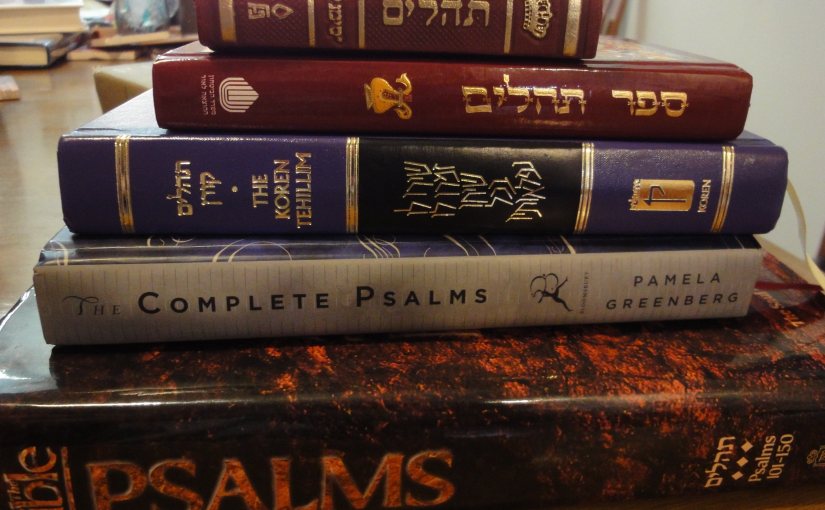
    — Pamela Greenberg, The Complete Psalms, 2010
  4. Therefore my glory will sing praise to You, and will not be silent.
    O Lord, my God, I will give thanks to You forever.
    The Jerusalem Commentary, Mosad Harav Kook, 2003 (see note)
  5. that I might sing praise to You. I will not be silent!
    Adonai my God, I will laud you forever!
    My People’s Prayer Book, Lawrence Hoffman (ed) 2001
  6. That I might sing Your praises unceasingly,
    that I might thank You, Adonai my God, forever
    — R. Jules Harlow 1985 trans, adapted for Or Hadash 1998
  7. that [my] whole being might sing hymns to You endlessly;
    O LORD my God, I will praise You forever.
    — JPS 1985 (via Sefaria); 1917 JPS (via Mechon-Mamre) is above

NOTES from The Jerusalem Commentary (source #4 above):
“The expression ‘glory will sing, praise to You, and will not be silent,’ implies that the silence of grief will be turned into a song of gladness, and thus this verse is a continuation of what was stated in the previous verse, ‘You loosened my sackcloth…’

“Some commentaries explain the word כָּבוֹד, kavod, to mean ‘I myself,’ like כְּבוֹדִי, k’vodi.” [cf. commentary on 7:6 where note explains that “my glory” or “my honor,” like “my soul,” means just plain, “me.”]

So, we have kavod translated as:

  • glory,
  • depths,
  • soul,
  • whole being, and
  • just plain “I.”

More soon…


15 of 30 on Psalm 30
As a National Novel Writing Month Rebel, I write each day of November while not aiming to produce a novel. This year I focus on Psalm 30 (“Thirty on Psalm 30”) in the hope that its powerful language will help us through these days of turmoil and toward something new, stronger and more joyful, as individuals and as community. Whole series (so far)…. apologies to anyone who finds multiple-post days too much.

NOTE:
“The Spirit of Prayer” was published in the Proceedings of the Rabbinical Assembly of America [Conservative], Vol. XVII, 1953, and reprinted as a pamphlet. Eventually (1996), the lecture was included in Moral Grandeur and Spiritual Audacity (See Source Materials)
BACK

The Well of Sight, Seeing, Seen

Ishmael, Isaac, and a Reunion of Cousins” raised questions about what it means for Isaac to settle at Beer Lahai Roi, the wellspring that is already home to Ishmael, after the brothers have buried their father, Abraham. The Shalom Center proposes bringing this story (Gen 25:7-11) into the Days of Awe to suggest “turning and healing” of the painful Torah passages read at Rosh Hashanah. And in the context of the high holidays, the wellspring’s history seems particularly powerful.

On the run from ill-treatment by Sarah, Hagar has a divine encounter in the wilderness. An angel finds her at a wellspring on the road and demands: Where have you come from and where are you going? (Gen 16:8). An essential question for individuals at the season of repentance and return. Also key for “renewing the cousinship” of Blacks and Jews, another relationship in need of “turning and healing.”

At the conclusion of Hagar’s wilderness encounter, we read:

וַתִּקְרָא שֵׁם-יְהוָה הַדֹּבֵר אֵלֶיהָ, אַתָּה אֵל רֳאִי: כִּי אָמְרָה, הֲגַם הֲלֹם רָאִיתִי–אַחֲרֵי רֹאִי
עַל-כֵּן קָרָא לַבְּאֵר, בְּאֵר לַחַי רֹאִי–הִנֵּה בֵין-קָדֵשׁ, וּבֵין בָּרֶד
And she called the LORD who spoke to her, “You Are El-roi,” by which she meant, “Have I not gone on seeing after God saw me!”
Therefore the well was called Beer-lahai-roi; it is between Kadesh and Bered.—
— Gen 16:13-14

In her 1984 Texts of Terror, Phyllis Trible pointed out extraordinary aspects of this story, including the fact that Hagar names God — the only biblical character to do so (more here). And the name she uses has a lot to tell us.

El-roi” is translated in a variety of ways and sometimes, as in the 1985 JPS (above), not translated. But all the renderings revolve around sight: God of vision, God of my seeing, God who sees me. This, I think, points to one meaning of Isaac moving to this place: Reconciliation in unlikely if estranged parties cannot see and feel seen, so the brothers both settling in a place of seeing bodes well.

“Renewing the cousinship” of Blacks and Jews requires a lot of seeing. Coming to a place with a powerful history of seeing by/of oppressed and traumatized people could be a great beginning.

SeesMe_graphic

Rivka Miriam: at age 13 and 60+

A 13-year-old poet wrote one of the pieces recently enjoyed by the Hebrew Poetry group at Temple Micah (DC), I was surprised to learn.

The poem “Still” opens the collection called These Mountains: Selected Poems of Rivka Miriam, and it was one of the first we discussed by this poet. This review excerpt includes lines from the 1966 “Still,” contrasting it with lines from a poem written in 2009 and published in the two-volume Collected Poems [Kol Shirei Rivka Miriam] (2010):

Here, for example, are lines from an early book and a recent one: ‘God knocked on my window/ and the skin of my face shone . . . the walls were too narrow/ so he left my room and fled/ into the fields’ (tr. Linda Zisquit). And then: ‘It seems that not only God is hiding/ the earth is hidden too’. God who is present and disappears, and his existence beyond the field of vision though on some perceptible wavelength, are motifs running through all of Miriam’s work. While the second quote was written when she was 57, the first she wrote when she was merely 13. Her first book, My Yellow Dress, was published when she was 14.
— Erez Schweitzer (translated by Lisa Katz)

“A School of her own: on Rivka Miriam’s Collected Poems [excerpt],” originally in Haaretz (16 Feb 2011), can be found on Poetry International.

Poetic Developments

Schweitzer points out central themes in Miriam’s work: womb and grave; the presence and absence of God; laughter and tears as the foundation of spiritual experience; history as a continuous present, adding:

exactly because of its unity of theme and style over so many years, her body of poetry may be read in an attempt to extract the developmental, biographical and artistic processes in it.

Our poetry discussion group has only begun reading Miriam’s work. And we are somewhat divided regarding the relevance of a poet’s biography to their work and vice versa. But this background is a welcome addition to the little bit that is available (or that I have found, so far) in English.

Additional Resources

Here is a short biography of Rivka Miriam.

Here, is a TLV1 Israel in Translation podcast, including the poems “Elul” and “In the Beginning God Created.” (I found its title, “Rivka Miriam on asking forgiveness,” misleading.)

A gender-neutral translation of “In the Beginning God Created” appears in Siddur Lev Shalem:

In the beginning God created
the heavens that actually are not
and the earth that wants to touch them.
In the beginning God created
threads stretching between them —
between the heavens that actually are not
and the earth that cries out for help
And God created humans
for each person is a prayer and a thread
touching what is not
with a tender and delicate touch.
— Rivka Miriam, trans by David C. Jacobson

Extending the theme of creation, Rabbi Steven Sager translates and discusses Miriam’s poem, “Created on the Second Day.” Search the the Sicha, “Continuing Conversation” site for more from Rivka Miriam in the context of various midrashim and other topics.

INVITATION: Hebrew Poetry group at Temple Micah meets first, third, and fifth Saturdays after Shabbat morning service. All welcome. Discussion in English, poems explored in both Hebrew and English.

These Mountains: Selected Poems of Rivka Miriam. New Milford, CT: The Toby Press, 2009.
The collection clearly identifies “Still” as from her first publication (1966), but I somehow failed to notice the date, and I know our discussion of the poem never touched on feeling the poet was young or the material immature.
BACK

Notes on Jeremiah: Max Ticktin’s Scribbles

Exploring Babylon Chapter 21

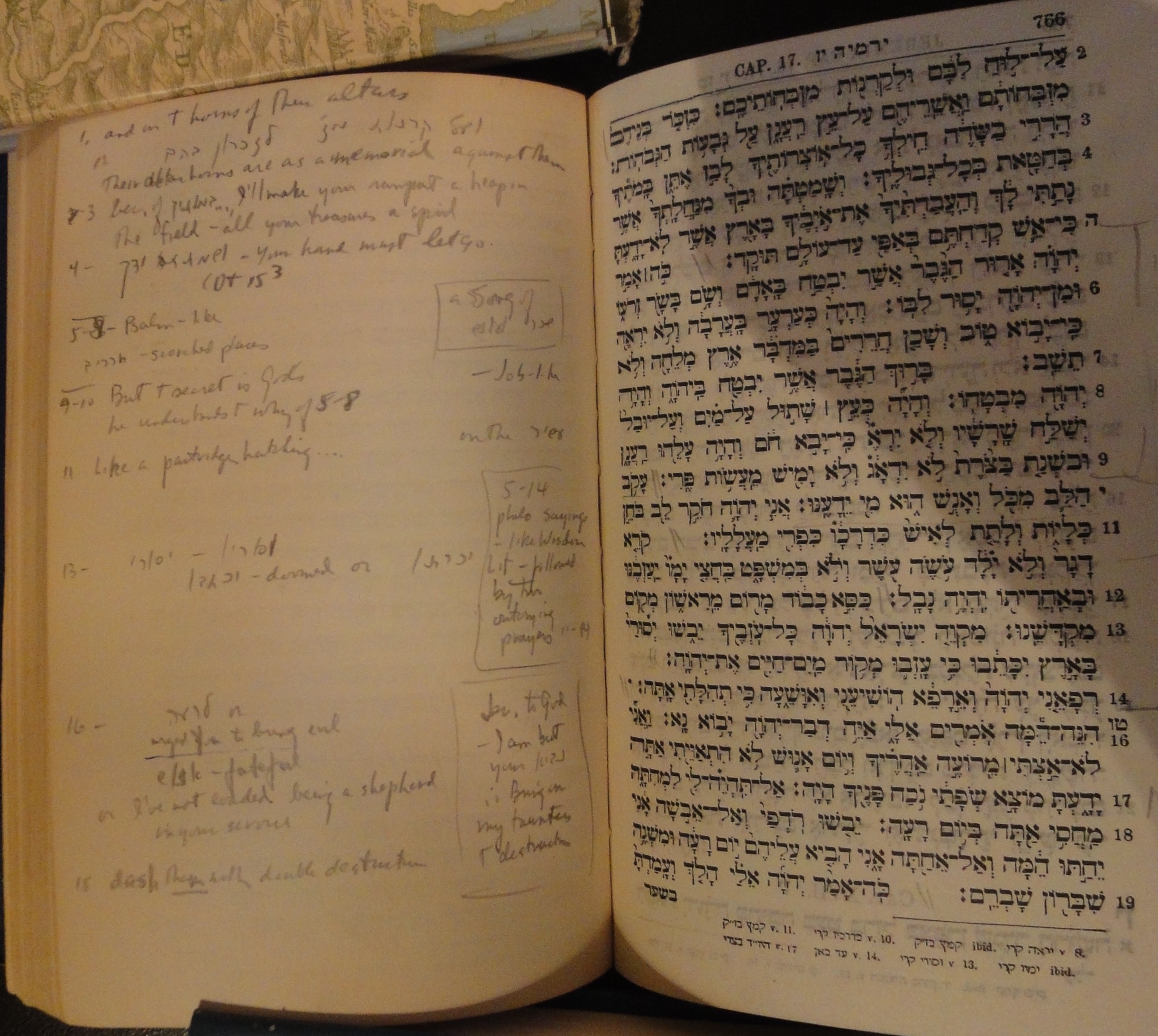
Several updates below. In addition to the many other things he left us, Max Ticktin z”l (1920-2016) left behind a lot of books, and his family kindly offered them to interested community members. Some of the volumes I inherited this way are from a Tanakh that was re-bound, as a gift for Max early in his rabbinical career, with pages opposite the text for his own notes.*

Some of Max’s notes are straightforward translation or links to related verses. Some are literary, some theological. Occasionally, his chuckle is obvious. Sometimes the notes are just opaque, to me anyway. Whatever the content, I consider it a great privilege and pleasure to have Max’s scribblings accompany me in my studies. (See also The Hebrew Bible (Greenspan).)

Some Notes and Questions

Here, pertinent to this week of Behar-Bechukotai, are some annotations for Jeremiah Chapter 17 (Haftarah for Bechukotai  is Jer 16:19-17:14).

Max on Jeremiah_Cropped
Notes by Rabbi Max Ticktin on Jeremiah 17

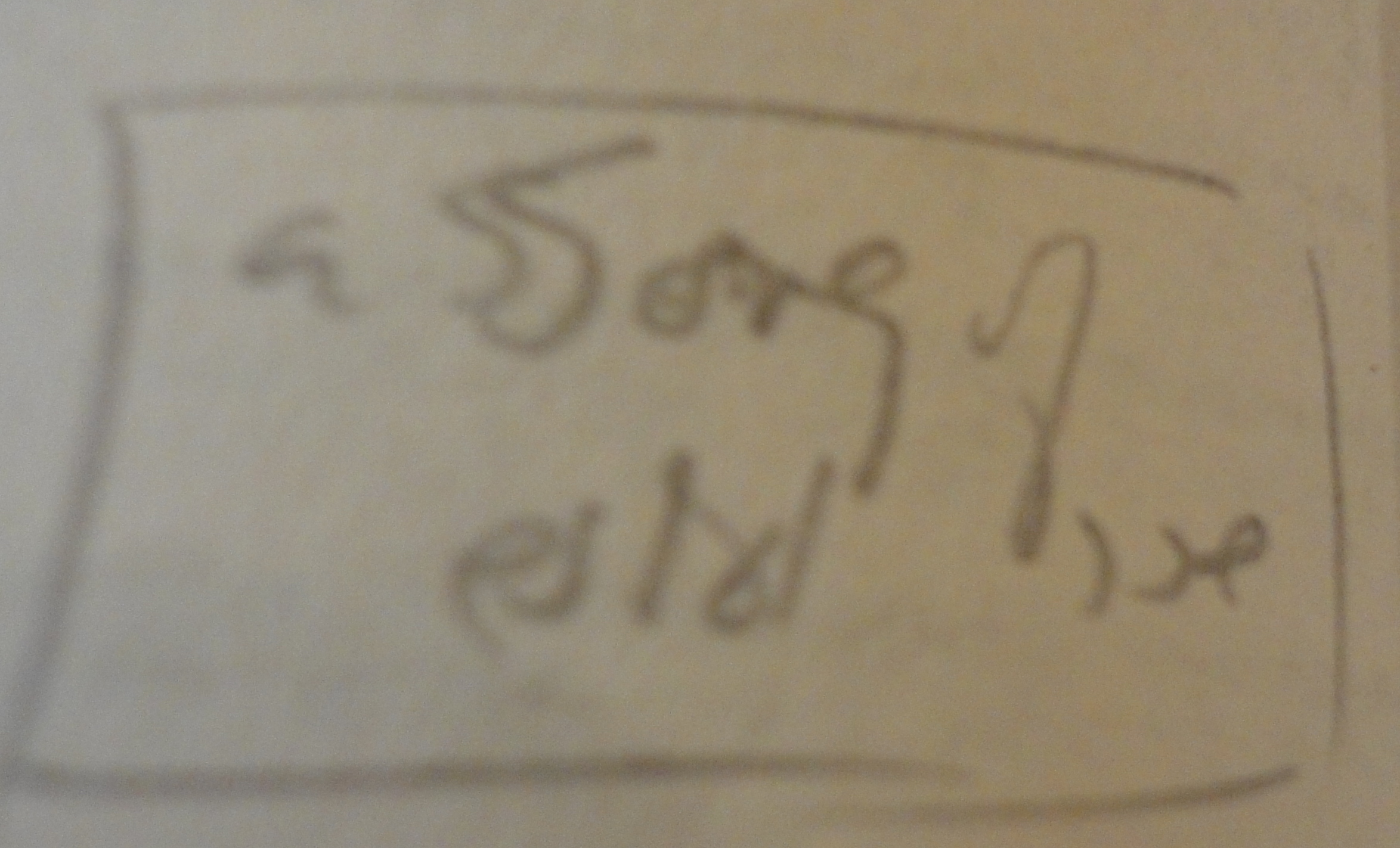
I am hoping someone with more background and/or better skill at reading Hebrew script can decipher this comment:

A Song of.jpg
Close-up: “A song of…,” annotation to Jer. 17:5-8

“A song of…[??]”
?? שכר ועונש ??
?? retribution? punishment? payback?

UPDATE 5/11: sources tell me my rendering of the Hebrew “שכר ועונש” is correctly spelled and can be transliterated “sachar va’onesh” and translated as “reward and punishment.”**.

 
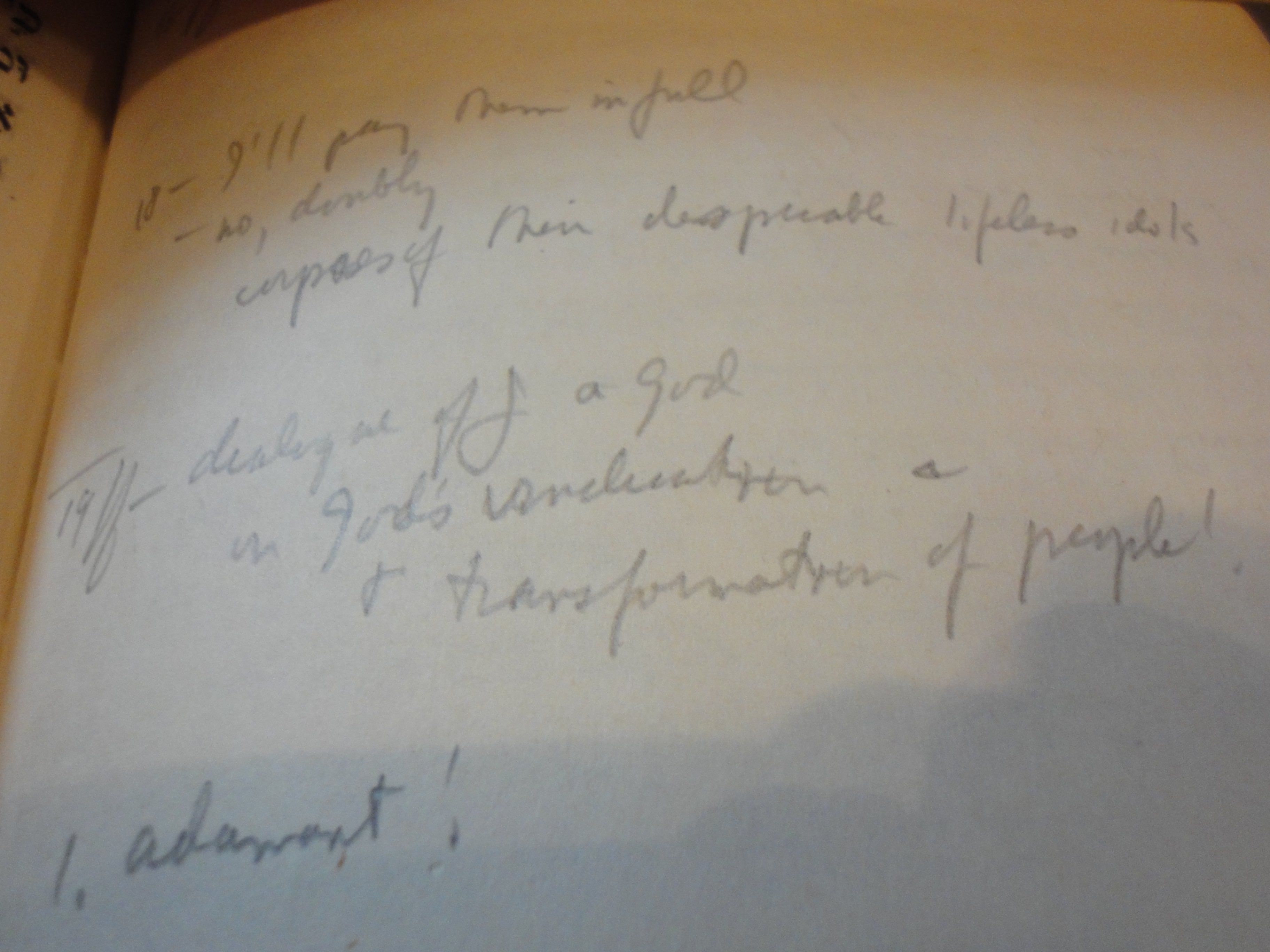
And maybe some experts at English handwriting can fill in what I’m missing here:

Max on Chapter 16
Notes on Jeremiah 16:18 – 17:1

19ff — dialogue of Jeremiah and God on God’s [??] the transformation of people!

Note: based on other passages, that lonely lowercase “a” = “and,” and the lowercase “t” = “the.”

UPDATE 5/13: A member of the Fabrangen community suggest that the word I couldn’t read may be “inclination.” Another points out that “the letter ‘C’ with a bar over it is often an abbreviation for ‘with’ in the form ‘cum’.” So, then we’d have something like: “dialogue of Jeremiah and God on God’s inclination with the transformation of people!”


Babylon and Transformation

Not sure exactly what this haftarah, with or without Max’s commentary, adds to #ExploringBabylon. But I am very interested in two images for God, both found in Jer 17:13 —

  • mikveh yisrael [מִקְוֵה יִשְׂרָאֵל]” or “hope of Israel” and
  • mekor mayim chayyim [מְקוֹר מַיִם-חַיִּים],” or “fountain of living waters”

and how these are related to “the transformation of people!”

More to come, maybe. Meanwhile, please let me know your ideas about how to read the above comments.

[On this 40th day of the omer, making five weeks and five days. — 5778]

NOTES

* I recall Max mentioning this gift and how much it meant to him several times, and I expected that regulars at Fabrangen and Jewish Study Center activities would share similar recollections. But I have not heard from others who remember him saying this….which makes it all the more interesting that it turns out I know family members of the rabbi who gave Max these books.

ADDITION 5/11 (not exactly “Update”): It’s not the most common of conversation topics, but somehow, long before Max died, Rabbi Danny Zemel of Temple Micah (DC) mentioned to me that his grandfather had once related, with great fondness, giving the special, re-bound copy of the Tanakh. Rabbi Zemel’s grandfather, Rabbi Solomon Goldman (1893-1953), served Anshe Emet Synagogue in Chicago from 1929-1953, where he and young Max connected.

Long after that brief conversation, while exploring the books the Ticktins were giving away, I happened upon two volumes that resembled the ones Max and Rabbi Zemel had both described. I was so excited, I had to double-check that the family meant to part with them. I was reassured and gratefully added them to my pile.

When I emailed a picture of the fly leaf to Rabbi Zemel, he recognized his grandfather’s writing. So I was delighted to be able to share one of the volumes with Rabbi Goldman’s family.

On occasion, I marvel at the odds of that book making it back “home,” in a sense. The Jewish world is sometimes small, but Reform and havurah circles — like Temple Micah and Fabrangen — don’t interact all that much; my participation in both communities is unusual. So, I am tempted to call it “bashert [fate, destiny].” But then I see Max rolling his eyes at me and explain it instead as follows.

Max had an uncanny ability to connect deeply, and very specifically, with so many people: Everyone who passed through that Ticktin library after Max’s passing surely found a special treasure that seemed destined just for them. In addition, although I never knew him, Rabbi Goldman had a large impact on Judaism far beyond his own, influential congregation — and clearly he made an impression on Max who, however accidentally, impressed on me, as Rabbi Goldman did on a young Danny Zemel, that these books embody an enduring connection between lifelong students of bible.
TOP


** “A Song of Reward and Punishment”? Didn’t Leonard Cohen write that? Maybe Sarah Rindner’s recent piece on “The Lehrhaus” — which links Leonard Cohen and this week’s Torah portion — put the idea in my mind. But I can somehow hear him singing it, even though I’m pretty sure there’s no such song in his opus. In any case, establishing that the words on the page say something like, “A Song of Reward and Punishment,” is only prelude to understanding the passage from Jeremiah and its context….

UPDATE 5/13: Here’s my homage to Leonard Cohen and the prophet Jeremiah.

BACK

Exile, Passover, and Melting Pot

Exploring Babylon Chapter 18

“The Americas were far. The Americas were different. It was rabbinic exile.” This, writes Rabbi Oran Zweiter, is how European immigrant rabbis to the New World felt, beginning with Rabbi Isaac Aboab da Fonesca, who left Holland for Brazil in 1642. Aboab (1607-1693), the first ordained rabbi known to make such a move, served the Jewish community in Recife until after Portugal re-captured the Dutch colony in 1654.

There is much of interest for #ExploringBabylon in Zweiter’s article, published in honor of Aboab’s yahrzeit, Adar 27, (March 14 in 2018). In preparation for Passover, however, let’s direct our attention to one phrase that links the New World to Mitzraim.

Please note: this piece, first posted late on March 18, was updated slightly at 9:00 a.m. March 19.

Brazil, kur ha-barzel

Zweiter illustrates Aboab’s “personal feelings of exile” using examples from his Brazil-based writings:

Aboab’s [vidui/confessional] poem is an account of the Portuguese siege. It is also a deeply personal reflection on what it meant for him to be sent as a rabbi to the far end of the world. He used biblical words with similar pronunciation and spelling to allude to Brazil, such as kur ha-barzel, the “melting pot,” which in the Torah refers to Egypt (Deuteronomy 4:20).

Similarly, Aboab referenced the new geography in which the Jews found themselves….

Brazil “represented a state of exile,” the Jewish community were “Dwellers in the shadows of the universe,” and Aboab declared: “For my sin, I have been tossed to a faraway land.”

Aboab’s sense of exile for sin makes the play on words with “Brazil” and “kur ha-barzel” a poignant one. Zweiter’s translation of the latter as “melting pot” adds another interesting layer of meaning.

Isaac_Aboab_Fonseca
R. Isaac Aboab. Image in public domain, from Brown University

Uses of “kur

My concordance lists three uses of “kur ha-barzel” in the Tanakh:

וְאֶתְכֶם֙ לָקַ֣ח יְהוָ֔ה וַיּוֹצִ֥א אֶתְכֶ֛ם
מִכּ֥וּר הַבַּרְזֶ֖ל
מִמִּצְרָ֑יִם לִהְי֥וֹת ל֛וֹ לְעַ֥ם נַחֲלָ֖ה כַּיּ֥וֹם הַזֶּֽה׃
but you the LORD took and brought out of Egypt,
that iron blast furnace,
to be His very own people, as is now the case.
— Deuteronomy 4:20

כִּי-עַמְּךָ וְנַחֲלָתְךָ, הֵם, אֲשֶׁר הוֹצֵאתָ מִמִּצְרַיִם,
מִתּוֹךְ כּוּר הַבַּרְזֶל.
For they are Your very own people that You freed from Egypt,
from the midst of the iron furnace.
— 1 Kings 8:51

“Hear the terms of this covenant, and recite them to the men of Judah and the inhabitants of Jerusalem! And say to them, Thus said the LORD, the God of Israel: Cursed be the man who will not obey the terms of this covenant,
אֲשֶׁר צִוִּיתִי אֶת־אֲבֽוֹתֵיכֶם בְּיוֹם הוֹצִיאִי־אוֹתָם מֵאֶרֶץ־מִצְרַיִם
מִכּוּר הַבַּרְזֶל
לֵאמֹר שִׁמְעוּ בְקוֹלִי וַעֲשִׂיתֶם אוֹתָם כְּכֹל אֲשֶׁר־אֲצַוֶּה אֶתְכֶם וִהְיִיתֶם לִי לְעָם וְאָנֹכִי אֶהְיֶה לָכֶם
לֵאלֹהִים׃
which I enjoined upon your fathers when I freed them from the land of Egypt,
the iron crucible,
saying, ‘Obey Me and observe them, just as I command you, that you may be My people and I may be your God’— [11:4]
in order to fulfill the oath which I swore to your fathers, to give them a land flowing with milk and honey, as is now the case.” And I responded, “Amen, LORD.”
— Jeremiah 11:2-5

There are six more uses of the word “kur“: Two in Proverbs (17:3, 27:21), three in Ezekiel (22:18, 20, 22), and one in Isaiah (48:10). The word is “always metaphorically employed to describe great trouble and misery,” according to the 1906 Jewish Encyclopedia. Moreover, all uses involve trial in relation to sin, and four of the six specifically reference Jews suffering God’s wrath.

Furnace, Forge, and Crucible

When Zweiter describes Aboab’s Brazil/barzel pun, he translateskur ha-barzel” as “melting pot.” Perhaps Aboab’s poem includes other clues that point to “melting pot.” The Deuteronomy verse that Zweiter cites, the first use of the expression “kur ha-barzel” for the experience of Hebrew slaves in Egypt, is not usually translated that way, however.

Instead, we find:

  • “iron blast furnace” (JPS, quoted above),
  • “iron crucible” (Artscroll),
  • “Iron Furnace” (Fox), and
  • “iron forge” (Alter).

Alter’s translation includes this note:

The argument of the sermon now moves another step back in time, from Sinai to the Exodus. The origins of Israel as a people subject to another people in whose land it dwelled, rescued from the crucible of slavery by God, are adduced as further evidence of God’s unique election of Israel.


Melting Pot

The first use of the expression “melting pot” in American English is dated to 1887 by Merriam-Webster. The term came to describe the peculiar struggles in the U.S. around immigration and assimilation. This usage was popularized by Israel Zangwill’s play, The Melting Pot, which was first performed — and reportedly applauded by President Theodore Roosevelt — in 1908.

It seems unlikely that Aboab, in Brazil in the mid-17th Century, could have envisioned the scenes of Ellis Island, in the early 20th, that inspired this speech:

America is God’s Crucible, the great Melting-Pot where all the races of Europe are melting and re-forming!…A fig for your feuds and vendettas! Germans and Frenchmen, Irishmen and Englishmen, Jews and Russians—into the Crucible with you all! God is making the American.
— David Quixano to Verendal, The Melting Pot
more below

But Zweiter’s use of the expression is interesting and provocative in the context of Passover:

  • It highlights the tension between “God’s unique election of Israel” in the Exodus story and the notion of “God making the American”;
  • It raises more general questions about divine providence and civic duty, exile and learning; and
  • It reminds us that the concept of “melting pot” is no more gentle than “iron blast furnace” or some of the other translations for “kur ha-barzel.”

Zweiter concludes his piece:

The writings of Rabbi Isaac Aboab, the first rabbi in the Americas, reveal challenges that would continuously confront rabbis, immigrant and native alike, in the Americas. His writing reflects the uniqueness of the Jewish experience in the New World from its earliest stages. His story demonstrates that the challenges that have faced spiritual leadership in the Americas are not new. They began with the very first rabbi to settle, however shortly, in the New World.

In that sense, Aboab’s experience is precursor to that of Zangwill’s Quizano family, with the mezuzah, “Stars-and-Stripes,” mizrach, and old-world violin competing for space at the front door. And with these words, Zweiter’s piece prods us to think, as Passover approaches, about the peculiarly American aspects of the challenge in the Deuteronomy verse: “but you, the LORD took and brought out of Egypt, that iron blast furnace [or melting pot], to be God’s very own people, as is now the case.”


NOTES:
I have no direct access to Aboab’s writings, which I believe are extant in Portuguese and Hebrew and not widely available. Zweiter cites Hakhmei Recife Ve-Amsterdam, with a link to the National Library of Israel; here is a more direct link, for what it’s worth, to the catalog listing for rare books.
BACK

Isaiah 48:10 uses the phrase “kur oni” —

הִנֵּה צְרַפְתִּיךָ, וְלֹא בְכָסֶף; בְּחַרְתִּיךָ,
בְּכוּר עֹנִי
Behold, I have refined thee, but not as silver; I have tried thee
in the furnace of affliction [sometimes: poverty].

— which calls to mind Passover’s “lechem oni,” bread of affliction or poverty. This verse is also related to an odd, and cryptic, midrash (B. Chag 9b) on poverty. More on this soon, I hope.
RETURN

Closing lines of The Melting Pot:

DAVID: There she lies, the great Melting Pot—listen! Can’t you hear the roaring and the bubbling? There gapes her mouth [He points east]—the harbour where a thousand mammoth feeders come from the ends of the world to pour in their human freight. Ah, what a stirring and a seething! Celt and Latin, Slav and Teuton, Greek and Syrian,—black and yellow—

VERA: Jew and Gentile—

DAVID: Yes, East and West, and North and South, the palm and the pine, the pole and the equator, the crescent and the cross—how the great Alchemist melts and fuses them with his purging flame! Here shall they all unite to build the Republic of Man and the Kingdom of God. Ah, Vera, what is the glory of Rome and Jerusalem where all nations and races come to worship and look back, compared with the glory of America, where all races and nations come to labour and look forward!

NOTE: This play, and historical notes, are available via Project Guttenberg (public domain). If you have not read it, or read it recently, check it out!
RETURN


The Language of There

Exploring Babylon: Chapter 5.2

“When I make a word do a lot of work like that,” said Humpty Dumpty,
“I always pay it extra.”

— Alice Through the Looking-Glass, Lewis Carroll (1871, chapter 6)

A few weeks ago, #ExploringBabylon looked at “them” who traveled with Terah from southern Babylon to northern Mesopotamia and a little of what “back there” meant for Abraham. In this week’s portion, we return with the elder servant (later identified as Eliezer) to what Abraham calls “my kindred” or “my birthplace.”

שָּׁם

Abraham is old and telling the elder servant of his household to go
אֶל-אַרְצִי וְאֶל-מוֹלַדְתִּי
“to my country, and to my kindred [or: the land of my birth”]
to get a wife for my son Isaac” (Gen 24:1-2). The servant (later identified as Eliezer) asks what to do, should he find a potential wife who doesn’t consent to return with him: Should he bring Isaac back…

Genesis 24:5
אֶל-הָאָרֶץ אֲשֶׁר-יָצָאתָ מִשָּׁם
…to the land from which you came?

24:6
פֶּן-תָּשִׁיב אֶת-בְּנִי שָׁמָּה
On no account take my son back there

24:7
וְלָקַחְתָּ אִשָּׁה לִבְנִי, מִשָּׁם
…get a wife for my son from there

24:8
לֹא תָשֵׁב שָׁמָּה
…do not take my son back there

In contrast to Gertrude Stein’s “no there there,” there is a lot of “there” here:

  • שָּׁם = “there”
  • שָׁמָּה = “to there” (ending hey makes a locative form)
  • מִשָּׁם = “from there” (beginning mem adds the preposition)

Commentators across the centuries have explored many “there” details: Did Abraham intend a specific place? Specific kin? Why did the servant later say he’d been sent to Abraham’s “father’s house and family” (Gen 24:38)? Why not encourage marriage with neighbor families? Was the union meant to seal some kind of family reconciliation? One of the most salient answers, for this blog’s purpose, stresses basic there-ness:

Abraham was sent away from his country, kindred and father’s house, so that he should have no further contact with them and be a stranger in a foreign clime…Similarly, his son must not marry [a Canaanite]. For this reason he was called Abraham the Hebrew, “that all the world was on one side and he on the other” (ivri means in Hebrew “a person from the other side” usually taken as a reference to Abraham’s origins in Mesopotamia — on the other side of the river).
— Nehama Leibowitz, New Studies in Breishit, p. 220

Abraham is ivri, from there. As in “not from here.” A key experience that his descendants will repeat — in Egypt, in the wilderness, in later exile. At this point in Genesis, Abraham and his family are becoming separate. That separateness will later help the people survive in Babylonian Captivity.

But this seems to be as much work as “there” is willing to do at the moment, regardless of how well paid.

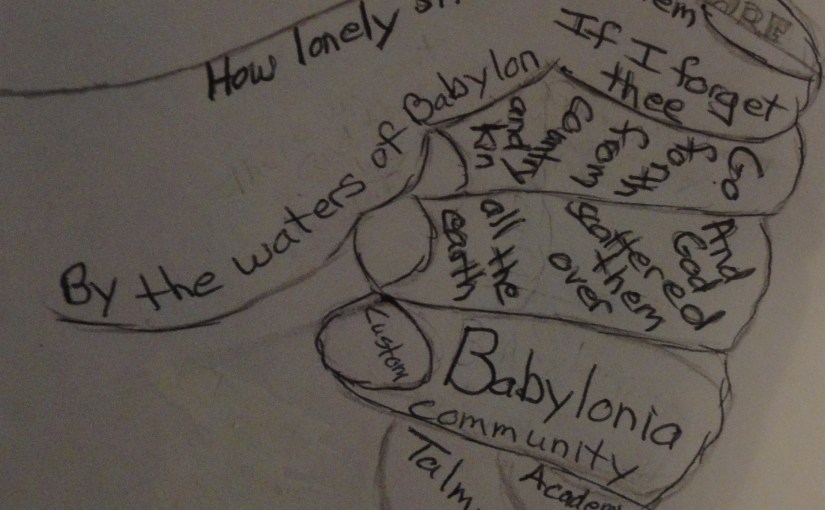
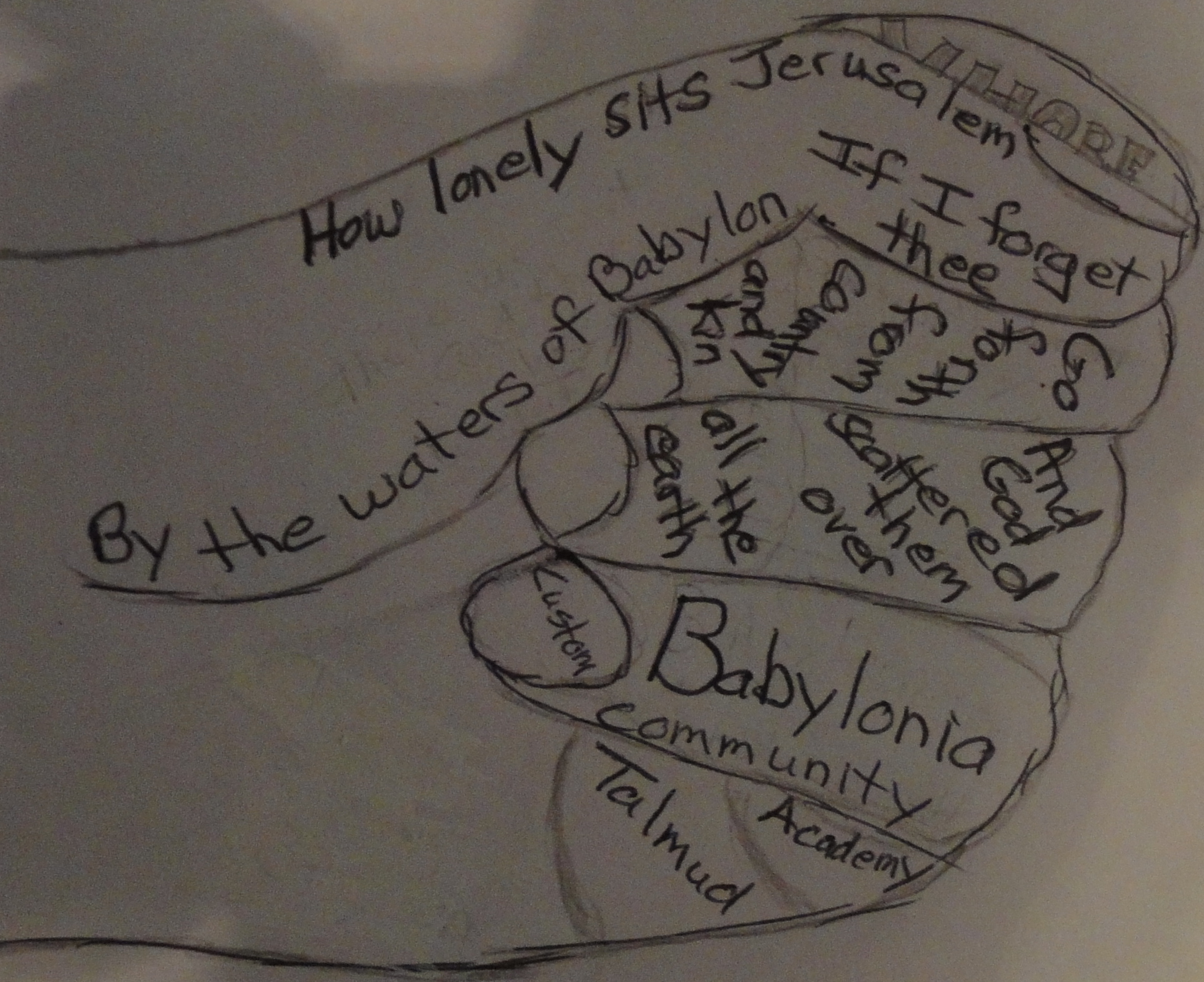
Babylon fist

This is a palm-map illustrating the #ExploringBabylon journey. We’re just not there yet.
(Think the Little Prince and the boa constrictor digesting an elephant.)

Language

Finally, the Rabbinic stories about Babylonian Captivity being in some sense “back home” for people of Abraham, included an important message about the language of “there”: “R. Hanina said: comment that ‘The Holy One exiled them to Babylonia because the language is akin to the language of the Torah.’ To underscore this, a footnote of sorts:

The very success of Jews in adapting to life in a foreign environment poses problems for the would-be compiler of a Jewish sourcebook. Greek was the dominant language of Diasporan Jews and their personal names were mainly Greek or Latin…
The Jews Among the Greeks and Romans: A Diasporan Sourcebook, Margaret H. Williams (Baltimore, MD: Johns Hopkins, 1998), pp. xi-xii