Blog

Word- and Picture-Power

This season reminds us – even if we didn’t have recent events screaming reminders at us – that words, and related mind-pictures have tremendous power. And this Torah portion (Re’eh: Deut. 11:26-16:17) warns us that we have an individual and a collective responsibility to ensure that word- and picture-power in the community does not endanger the flow of blessing or somehow impede God’s Mercy from manifesting.

The commandment to see and to recognize blessing and curse, both individually and collectively, is complicated and challenging.

If each of us is challenged to see, as part of a collective awakening, we are also challenged as a community to honor what others see. And what may look like blessing from one perspective might appear as a curse in other quarters.

Complete dvar Torah: The Commandment to See

interlude: Summer 5777

Tammuz is interlude, reiteration, steady growth,” writes Debbie Perlman, describing the month in the Jewish calendar which began this past weekend. She goes on to reference sprinklers, weeds, and fields already planted, concluding:

Hear us as we move into this time of increase,
As we gather up sunlight and breezes and rains
To lay aside against the unknowns ahead.
Hear us as we call You in truth.
— from “Ninety-One: Rosh Chodesh Tammuz”
IN Flames to Heaven: New Psalms for Healing & Praise

A few words about “interlude” and gathering up “against the unknowns ahead.”

“Against the Unknowns Ahead”

Taking a wide view of the Jewish calendar, we’re in a sort of dip between two peaks: Shavuot, festival of “receiving Torah,” and Simchat Torah, festival of “rejoicing in the Torah.”

For seven weeks, beginning on the second night of Passover, we counted “up” to Shavuot. The next milestone on the calendar, 40 days later, commemorates the incident of the Golden Calf — in other words, our failure to “receive” Torah very well. The Fast of Tammuz (this year: 7/11/17) launches a downward swing with “The Three Weeks” and Tisha B’Av, mourning loss of both Temples and other calamities faced by the Jewish people.

From that lowest point (9 Av, this year: 8/1/17), we begin the climb toward the new year, through the high holidays, Sukkot and, finally, Simchat Torah (this year: 10/13/17).

But right now, we’re still in the 40 days between Shavuot and the Fast of Tammuz. Reading ourselves into the Exodus story: We are still in the early days of liberty from Egyptian slavery; Moses is still on the mountain, obtaining the first tablets, which have yet to be smashed. We know nothing about the Golden Calf or the Spies and the decades of tromping in the desert, realizing the best we can hope for is that the next generation will make it out. Today, still, is about anticipation and hope for immediate changes in the life of our community.

From the vantage point of the Exodus story, this is a great time to “lay aside against the unknowns.” With a view to the Jewish calendar — and to the civic calendar in the U.S. — this is an important interlude to shore up resources for the challenging days ahead.

“When you come…”

The Torah potion Ki Tavo (“When You Come…”; Deut 26:1-29:8) is bookmarked by two fascinating passages: Near the beginning is he passage we read at the Passover seder, recapping our ancestors’ journey and our own through the Exodus; toward the end, we are told that it took forty years for us to understand what happened.

Deuteronomy 26: 5-10

וְעָנִיתָ וְאָמַרְתָּ לִפְנֵי יְהוָה אֱלֹהֶיךָ, אֲרַמִּי אֹבֵד אָבִי, וַיֵּרֶד מִצְרַיְמָה, וַיָּגָר שָׁם בִּמְתֵי מְעָט; וַיְהִי-שָׁם, לְגוֹי גָּדוֹל עָצוּם וָרָב.
And thou shalt speak and say before the LORD thy God: ‘A wandering Aramean was my father, and he went down into Egypt, and sojourned there, few in number; and he became there a nation, great, mighty, and populous.

וַיָּרֵעוּ אֹתָנוּ הַמִּצְרִים, וַיְעַנּוּנוּ; וַיִּתְּנוּ עָלֵינוּ, עֲבֹדָה קָשָׁה
And the Egyptians dealt ill with us, and afflicted us, and laid upon us hard bondage.

וַנִּצְעַק, אֶל-יְהוָה אֱלֹהֵי אֲבֹתֵינוּ; וַיִּשְׁמַע יְהוָה אֶת-קֹלֵנוּ,
וַיַּרְא אֶת-עָנְיֵנוּ וְאֶת-עֲמָלֵנוּ וְאֶת-לַחֲצֵנוּ
And we cried unto the LORD, the God of our fathers, and the LORD heard our voice, and saw our affliction, and our toil, and our oppression.

וַיּוֹצִאֵנוּ יְהוָה, מִמִּצְרַיִם, בְּיָד חֲזָקָה וּבִזְרֹעַ נְטוּיָה, וּבְמֹרָא גָּדֹל–וּבְאֹתוֹת, וּבְמֹפְתִים.
And the LORD brought us forth out of Egypt with a mighty hand, and with an outstretched arm, and with great terribleness, and with signs, and with wonders.

[these two verses are not part of the Haggadah:]
וַיְבִאֵנוּ, אֶל-הַמָּקוֹם הַזֶּה; וַיִּתֶּן-לָנוּ אֶת-הָאָרֶץ הַזֹּאת, אֶרֶץ זָבַת חָלָב וּדְבָשׁ.
And He hath brought us into this place, and hath given us this land, a land flowing with milk and honey.

וְעַתָּה, הִנֵּה הֵבֵאתִי אֶת-רֵאשִׁית פְּרִי הָאֲדָמָה, אֲשֶׁר-נָתַתָּה לִּי, יְהוָה;
וְהִנַּחְתּוֹ, לִפְנֵי יְהוָה אֱלֹהֶיךָ, וְהִשְׁתַּחֲוִיתָ, לִפְנֵי יְהוָה אֱלֹהֶיךָ.
And now, behold, I have brought the first of the fruit of the land, which Thou, O LORD, hast given me.’ And thou shalt set it down before the LORD thy God, and worship before the LORD thy God.

Deuteronomy 29: 1-3

וַיִּקְרָא מֹשֶׁה אֶל-כָּל-יִשְׂרָאֵל, וַיֹּאמֶר אֲלֵהֶם:
אַתֶּם רְאִיתֶם, אֵת כָּל-אֲשֶׁר עָשָׂה יְהוָה לְעֵינֵיכֶם בְּאֶרֶץ מִצְרַיִם, לְפַרְעֹה וּלְכָל-עֲבָדָיו, וּלְכָל-אַרְצוֹ
And Moses called unto all Israel, and said unto them: Ye have seen all that the LORD did before your eyes in the land of Egypt unto Pharaoh, and unto all his servants, and unto all his land;

הַמַּסּוֹת, הַגְּדֹלֹת, אֲשֶׁר רָאוּ, עֵינֶיךָ–הָאֹתֹת וְהַמֹּפְתִים הַגְּדֹלִים, הָהֵם.
the great trials which thine eyes saw, the signs and those great wonders;

וְלֹא-נָתַן יְהוָה לָכֶם לֵב לָדַעַת, וְעֵינַיִם לִרְאוֹת וְאָזְנַיִם לִשְׁמֹעַ, עַד, הַיּוֹם הַזֶּה.
but the LORD hath not given you a heart to know, and eyes to see, and ears to hear, unto this day.

Shabbat Ki Tavo falls this year between Labor Day, the traditional end of the U.S. “summer vacation” (9/4/17), and Rosh Hashanah, the beginning of the new year (9/21/17). A sort of meta-interlude.

Now, in the interlude of early Tammuz, perhaps we can begin to “gather up sunlight and breezes and rains,” our communities’ stories and our own, in preparation for the travels ahead.

Chana Bloch: Her Memory For a Poetic Blessing

Chana Bloch, poet, translator, and teacher, died on May 19, 2017. Among her major translation projects are the Song of Songs with Ariel Bloch (then husband) and, with Chana Kronfeld, Yehuda Amichai’s Open Closed Open (NY: Harcourt, 2000). For several years, she edited Persimmon Tree, a publication of the arts by women over 60.

Bloch’s poem about beginnings, “Chez Pierre, 1961,” appeared in Poetry Magazine (1990) and in the more recent collection Far Out: Poems of the 60s. Her final literary work, The Moon Is Almost Full, is due out in September of this year.

“Questions of Faith” a substantial interview about Bloch’s experience of Judaism.

May her memory be for a blessing

Obituaries:
Jewish Weekly
Tablet

Amichai’s Love and the Entwives

A highway detours in order to give two lovers some privacy in their “bit of eternity,” in the opening stanza of Yehuda Amichai’s “Pinecones in the Tree Above.” Several stanzas later, “she is the walled public garden of the city, and he, the road which moves away from her” (Abramson, p.101 — see notes below).

YA 46
from “Pinecones on the Tree Above” in Collected Poems

Like Pine Cones, Ents and Entwives

The “Pine Cones” series is the second set of love poems [after “Six Poems for Tamar”] published in a collection called “Now and in Other Days” (1955). The garden/road stanza is, as Abramson notes, one of eight short portraits of the same lovers: “like two associations in one mind: as he is referred to, so is she; they are like two lightbulbs in a lamp each one alone too dark but together lighted they are a festival of light….They are like two stones at the bottom of a hill, secluded and alone…”

Each stanza consists of rhymed couplets, which, Abramson continues: “affirm the isolated perfection of love; yet even at their most serene the lovers are separate entities, two lightbulbs, two stones, two numbers. The poems offer an apparent affirmation of love, yet separateness and isolation are implicit in them.” (Abramson, see below)

Considering this stanza, readers find many contrasts, some of them Freudian, between the movement-oriented man and the enclosure-focused woman. For me, the contrast Amichai draws is reminiscent of Tolkein’s wandering Ents and their inability to connect with the more settled Entwives (The Lord of the Rings — full citation below)

Ents are Middle Earth’s very old, male, tree-like creatures who have somehow “lost” their female counterparts, the Entwives. They’re not dead, just missing and missed, Treebeard (AKA Fangorn) tells the hobbits:

…the Ents gave their love to things that they met in the world, and the Entwives gave their thought to other things, for the Ents loved the great trees, and the wild woods, and the slopes of the high hills…But the Entwives gave their minds to the lesser trees, and to the meads in the sunshine beyond the feet of the forests…Entwives desired order, and plenty, and peace (by which they meant that things should remain where they had set them). So the Entwives made gardens to live in. But we Ents went on wandering, and we only came to the gardens now and again.
The Two Towers

“They walked together…”

Treebeard’s description of the old days for Ents and Entwives sounds a little like Jeremiah’s prophetic vision of God and Israel, together in the desert just after leaving Egypt:

When the world was young, and the woods were wide and wild, the Ents and the Entwives – and there were Entmaidens then: ah! the loveliness of Fimbrethil, of Wandlimb the lightfooted, in the days of our youth! – they walked together and they housed together.
The Two Towers

The devotion of your youth, Your love as a bride— How you followed Me in the wilderness, In a land not sown.
— Jer. 2:2

The “Pine Cones” lovers reflect the togetherness of the above metaphors — when the lovers appear like two stones, e.g., together resting at the bottom of a hill, watching seasons pass. But they do not find Amichai’s concept of “true love,” according to Abramson: “Ahavah be-emet [true love], the coupling of both spirit and flesh, is still undiscovered and it is only for a brief moment that the bulbs achieve a “festival of light,” unbounded unity in each other…”

And that undiscovered territory, she argues, has additional implications:

The notion of separateness offered by the couplets in “Pine Cones,” implying that the lovers have failed to achieve perfect unity, indicates their separation also from God.
— Glenda Abramson. The Writing of Yehuda Amichai: A Thematic Approach.
Albany: SUNY Press, 1989, p.101

“Our hearts did not go on growing in the same way,” Treebeard says of Ents and Entwives. The prophets of Israel, Jeremiah included, tell us that reconciliation between God and the People is still possible, although disappointment and anger have reigned for centuries. And what of Amichai’s lovers? Our study group still has four stanzas of “Pine Cones” to translate and discuss, but I do see that the last word of the poem is הפרידה [separation]. Stay tuned.

Notes:

Abramson, Glenda. The Writing of Yehuda Amichai: A Thematic Approach. Albany: SUNY Press, 1989.

Amichai, Yehuda. Collected Poems [5 vols.]. Jerusalem: Schocken, 2002-2004 [Shirei Yehuda Amichai]. “Pinecones on the Tree Above” i

Harshav, Benjamin & Barbara. Yehuda Amichai: A Life of Poetry 1948-1994. NY: Harper Collins, 1995. NOTE: the “highway” stanza is included in the Harshavs’ selected translations; the garden/road stanza is omitted.
TOP

Tolkein, J.R.R. The Two Towers (Book 2 of 3, The Lord of the Rings). London: George Allen and Unwin, 1954.

For more on Ents —

  • Tolkein, Christopher. Treason of Isengard: The History of The Lord of the Rings, Part Two (The History of Middle-Earth, Vol. 7). Boston: Houghton Mifflin, 1989.
  • Not All Who Wander Are Lost (Middle Earth blog), particularly “What Happened to the Entwives

BACK

Malcolm X and The Power of Small Things

“The fame we get from fighting for the freedom of others creates a prison for us,” Malcolm X wrote in 1964 to Azizah al-Hibri, then a college student at the American University in Beirut. Their brief in-person connection and subsequent correspondence are still treasured by Dr. al-Hibri, now retired as chair of KARAMAH: Muslim Women Lawyers for Human Rights, the international organization she founded. Moreover, the papers and their story illustrate some important things about leadership, race, gender, and media.

Originally posted in slightly different form on May 19, 2015.
Story published in East of the River, July 2012.

from correspondence between Dr. Azizah al-Hibri and Malcolm X

As president of the college debating society, al-Hibri arranged for Malcolm to speak on campus while he was touring and also had the opportunity to get to know him during his brief visit. A shared ice cream at the airport launched a correspondence between the two that continued until his death in February 1965. At his request, al-Hibri kept her correspondence private for over 40 years.

In 2012, al-Hibri released a few pieces of correspondence and donated other papers (still private for now) to America’s Islamic Heritage Museum. She said then, in a speech at DC’s Masjid Muhammad, that she wanted to ensure that Muslims are “proud” and “happy” about connections with the slain leader and to forge bonds between the African American Muslim community, with historical connections to the Nation of Islam, and what many call the “immigrant” Muslim community, with different historical roots.

Here’s more from the July 2012 East of the River Magazine story:

From his correspondence it is clear that he already suspected that his life and work were coming to an end. But he knew, even though al-Hibri didn’t yet, that her future as a leader was ahead of her.

It was unusual in 1964, for a woman to be president of an organization like the college debating society, al-Hibri notes. And she, like many women of that decade, had not yet envisioned for herself anything like her role today as professor of U.S. law and international human rights advocate. It was similarly odd to consider that women might be leaders of Islam. But Malcolm X saw beyond the confines of his time, says al-Hibri, pointing to words of encouragement – to her as a woman and a Muslim leader – inscribed in a book he gave her: “You have and are everything it takes to create a new world – leadership is needed among women as well as among men…”
full article here


The Power of Small Things

Of all the stories I covered for East of the River Magazine, this is one that sticks with me as most fascinating and important —

    • the young al-Hibri’s not knowing about U.S. racial dynamics, what her college dean meant about “airing the country’s dirty laundry”
    • al-Hibri’s struggle to reconcile the man she met with the picture she later saw portrayed in the U.S. media
    • the race-sensitive context of her later decision to share her experience, while keeping most of the correspondence private
    • Malcolm X’s interest in corresponding with someone outside the “prison” of his work
    • his recognition of the need for women leaders in politics and in Islam, before many saw it in 1964

I share this today, in honor of Malcolm X, El-Hajj Malik El-Shabazz (born Malcolm Little, 5/19/25-2/21/65). I share it in recognition of the work of Dr. al-Hibri and KARAMAH — a small, powerful organization. I share it as a shout out to the too-little-known Americas Islamic Heritage Museum. And I share it to acknowledge the hard and complex work of overcoming racism between religious brothers and sisters.

Perhaps most importantly, I return to this story again and again as an example of the power of small interactions to shape our world.

Originally posted on May 19, 2015.

Distance, part 2

The distance between people and God, and if/how that distance may be bridged, is a major question in theology, philosophy, and the arts, including contemporary Hebrew poetry. The previous post looked at related ways that “touch” [Hebrew: נָגַע] occurs both in Maimonides’ Guide for the Perplexed and in some verses from Yehuda Amichai. The distance between people and God is explored in a different way in the poetry of Leah Goldberg, according to Rabbi Dalia Marx in “Israeli ‘Secular’ Poets Encounter God.”

Goldberg’s God

Marx’s essay explores three Israeli poets, all considered “secular” rather than “religious,” in order to show that “religiosity and engagement with God are not limited to classical forms of prayer and to ‘religious’ circles.” In addition to Goldberg, poets discussed are Yona Wallach (1944-1985) and Orit Gidali (b. 1974).

Marx analyzes several Goldberg poems, including the series “From the Songs of Zion.” This four-poem series, Marx tells us, looks at the question raised in Psalm 137: How can we sing God’s song in a strange land? It concludes with “Journeying Birds” (translated here by Marx):

That spring morning
heaven grew wings.
Wandering westward,
the living heavens recited
T’fillat Haderekh: [22]
“Our God,
bring us in peace
beyond the ocean
beyond the abyss,
and return us in fall
to this tiny land
for she has heard our songs.” [23]
— Leah Goldberg IN Marx, pp.188-189

The essay continues:

Unlike Goldberg’s other poems discussed here, “Journeying Birds” reflects no distance from God — who appears like the God of tradition and who is addressed in a heartfelt prayer for a safe journey. Yet the prayer emanates from the mouth of birds, not the poet’s. What is impossible for her, who does not possess the language of prayer, can be uttered freely and naturally by the birds.

This is not a typical poem for Goldberg in the sense that she uses a familiar liturgical phrase, T’fillat Haderekh, even drawing upon its contents, which, traditionally, asks God “to bring us to our destination for life…and peace…and to return us to our homes in peace.” Like traditional Jewish prayer too, the birds speak in the first person plural [24]. Goldberg, by contrast, could only address “my God,” not the “traditional God” of common Jewish prayer [25].

…Goldberg often writes about birds, who symbolize, for her, joy and freedom. [26]. In this very native and local poem she allows birds to address the ineffable with a joyful prayer that she cannot make herself.
— Marx, “Israeli ‘Secular’ Poets Encounter God,”
IN Encountering God, p.189

The comment above about Goldberg’s use of “my God” refers to two poems also discussed in Marx’s essay: “I Saw My God at the Cafe” and “The Poems of the End of the Journey, 3.” The former does not address God, but describes “my God” in the third person. The latter begins, “Teach me, my God…,” and remains singular and personal throughout:

Teach me, my God, to bless and to pray
Over the secret of the withered leaf, on the glow of ripe fruit…
…Lest my day become for me simply habit.
— Goldberg, from “The Poems of the End of the Journey”
Poems II. Tel Aviv: Hakibbutz Hame’uchad, 1986

NOTE: See Marx’s essay for her translations and discussion of these poems. The full three-part “Poems of the Journey’s End,” translated by Rachel Tzvia Back, appears as a Haaretz poem of the week. (Requires a little patience with ads, but the poem will show up, free of charge).

Tradition and Alienation

In “Poems of the Journeys End,” Goldberg “negotiates with the living God from whom she feels alienated,” Marx tells us: “Traditional prayers are a manifestation of faith; this one is a supplication for faith to arise” (Encountering God, p. 188).

Perhaps it’s a question of chicken and egg, in terms of who picks up a siddur in the first place. But traditional prayers, in contrast to Marx’s declaration, are filled with words and imagery meant to spark a prayerful attitude…a sense of faith, one might say, which the siddur does not take for granted. (Imagining that we are imitating choruses of angels, joining our voices with “all living things who praise,” outright begging God to “open our lips.”)

Moreover, far from being new or unique in Goldberg’s poem(s), a feeling of distance or alienation from God is a major theme in the Book of Psalms. The Jerusalem Commentary on Psalms, e.g., includes a category called “descriptions of the spiritual distress of the psalmist, who feels himself far away from God” (p.xxiii).

It seems hard to believe, in fact, that Goldberg’s “Poems of the Journeys End” is not in active in dialogue with these themes in the psalms:

And he shall be like a tree planted by streams of water,
that brings forth its fruit in its season, and whose leaf does not wither;
and all that it produces prospers.
— Psalm 1:3

So teach us to number our days, that we may get us a heart of wisdom.
— Psalm 90:12

But, somehow, her poetry seems to be read as oddly disconnected from the tradition that helped forge it:

As the orison of an ever-receding horizon, Lea Goldberg’s poems blur the line between the secular and religious divide. They reach for a “contiguity” (Dan Miron’s term) between tradition and a breach with that tradition, awakening anew the religious power of the Hebrew language. And so, this volume of poetry speaks uniquely to this generation of Jewish readers. It should be kept by one’s bedside, read as meditations, “blessings” or “hymns of praise” each morning and night, just as God renews Creation each day (Psalms 104), in the glory of dappled-things, a “withered leaf” or “ripe fruit”, reviving “all things counter, original, spare, and strange” (Gerard Manley Hopkins, “Pied Beauty”), so that your words do not blur in vulgar gibberish, so that your days not turn mundane.
— Rachel Adelman, 2005 review of a Goldberg volume

Hers? Mine? Ours?

Psalms are an odd hybrid of poetry and prayer. It’s not clear where they would fall when Marx declares, in “Israeli ‘Secular’ Poets Encounter God,” that prayer and poetry share an affinity but differ in essentials. But it seems odd that Marx makes so much of Goldberg’s shift from first-person singular to plural in the three poems discussed, without even mentioning that the psalms also include first-person singular and plural language, for both narrator and address to God.

Marx concludes her essay by reiterating the hope, expressed by poet Avot Yeshurun, that “Hebrew literature should renew prayer.” And she does make her point that ‘secular’ poets participate in a “vivacious religious sentiment…far richer and more bountiful than initially expected” (Encountering God, pp.196-197). But her decision to contrast poetry with “traditional prayer,” without mentioning psalms serves to dissociate Goldberg’s work from its background.

Psalms have, it seems, been considered somewhat old-fashioned for millenia —

When the sages in the Second Temple period composed the prayers and blessings that all Jews are obligated to recite, they created new texts rather than selecting chapters from Psalms….The main reason for this tendency seems to have been that the psalms were written in an ancient poetic style not easily understood in the Second Temple period. The rabbis used a style similar to the spoken language of their day, so that ordinary Jews could understand them.
Jerusalem Commentary on the Psalms, p. xliii

— but also demand their own renewal: “Sing unto the LORD a new song” (Psalm 149:1).

Goldberg’s “withered leaf” and desire to avoid the mundane are a fine example of renewing an old theme — except when authors, like Adelman, fail to mention the theme being renewed.

NOTES

“Israeli Secular Poets Encounter God” by Rabbi Dalia Marx
IN Encountering God: El Rachum V’chanun: God Merciful and Gracious. Lawrence A. Hoffman, editor. Woodstock, NY: Jewish Lights, 2016
Full paper also posted on Academia
TOP

Marx’s end-notes:

22. T’fillat Haderekh (literally, “the Road Prayer”) is the title of the traditional prayer for beginning a journey.

23. Leah Goldberg, Milim Achronot (Last Words) (Tel Aviv, 1957) reprinted in Poems II, 221 (my translation, DM).
BACK

24. Talmud, Berakhot 29b

25. For another exception, see Amir, “Prophecy and Halachah,” 52-53.
[Yehoyado Amir, “Prophecy and Halachah: Toward Non-Orthodox Religious Praxis in (Eretz) Israel. Tikvah Working Paper 06/12 (New York: NYU School of Law, 2012)]

26. Lieblich, Learning about Lea, 237
[Amia Lieblich, Learning about Lea (London: Athena Press, 2003)]
BACK

Roads, Birds, and Distance: Amichai, Goldberg, and the Rambam

“Touch” [Hebrew: נָגַע] is a word-of-the-week, as my study partner and I plow slowly through Maimonides’ Guide for the Perplexed. This common verb, as it happens, is central to a Yehuda Amichai piece Temple Micah’s Hebrew Poetry group discussed this past Shabbat. The two explorations of touch shed a little extra light on one another — and on the Leah Goldberg poem, “Journeying Birds,” which our group also considered. (more on Amichai and the Hebrew Poetry group) Note: this post updated slightly 5/18/17.

Highway to Heaven

Maimonides’ non-stop stress on God’s non-corporeal nature might seem, for contemporary readers, like way too much attention on the obvious. Until very recently, I confess, I thought The Guide for the Perplexed was engaged in page after page of beating a horse long-dead, if ever it lived: After all, who among us, in this day (or in 1200 CE, for that matter), is convinced that the God of the Jews has literal feet? But I’ve come to appreciate a subtle truth in The Guide that shares a lot with Amichai’s use of playful irony and with Leah Goldberg’s God-approaching themes.

In Chapter XVIII of The Guide, the Rambam discusses the verb “touch” [נָגַע] and two others:

The three words karab, “to come near,” naga’, “to touch,” and nagash, “to approach,” sometimes signify “contact” or “nearness in space,” sometimes the approach of man’s knowledge to an object, as if it resembled the physical approach of one body to another.

…Wherever a word denoting approach or contact is employed in the prophetic writings to describe a relation between the Almighty and any created being, it has to be understood in the latter sense.
— Maimonides, The Guide for the Perplexed
(M. Friedlander, trans., pp.50-51)

The path “nearer” to God is a “spiritual approach, i.e., the attainment of some knowledge, not, however, approach in space,” Maimonides explains, citing these texts:

The LORD is near [קָרוֹב] to all who call Him,
to all who call Him with sincerity
קָרוֹב יְהוָה, לְכָל-קֹרְאָיו– לְכֹל אֲשֶׁר יִקְרָאֻהוּ בֶאֱמֶת.
— Psalms 145:18

Observe therefore and do them; for this is your wisdom and your understanding in the sight of the peoples, that, when they hear all these statutes, shall say: ‘Surely this great nation is a wise and understanding people.’
For what great nation is there, that hath God so nigh [קְרֹבִים] unto them, as the LORD our God is whensoever we call upon Him?
And what great nation is there, that hath statutes and ordinances so righteous as all this law, which I set before you this day?
— Deuteronomy 4:6-8 (The Guide cites 4:7)

But as for me, the nearness of God [קִרְבַת אֱלֹהִים] is my good;
I have made the Lord GOD my refuge, that I may tell of all Thy works.
— Psalms 73:28

Yet they seek Me daily, and delight to know My ways; as a nation that did righteousness, and forsook not the ordinance of their God, they ask of Me righteous ordinances, they delight to draw near unto God [קִרְבַת אֱלֹהִים יֶחְפָּצוּ].
— Isaiah 58:2 (Yom Kippur’s “Is this the fast I require?” passage)

—-“spiritual approach” citations from The Guide, chapter XVIII

While the philosopher often speaks of “knowledge” as essential in “spiritual approach,” his illustrative texts here suggest that the real requirement is intention or focus.

Bow Thy Heavens

Maimonides closes his chapter on “contact by comprehension,” with a return to the verb “touch.”

In the passage “Touch (ga’) the mountains, and they shall smoke” [Ps. 144:5], the verb “touch” is used in a figurative sense, viz., “Let my word touch them”….as if he who now comprehends anything which he had not comprehended previously had thereby approached a subject which had been distant from him. This point is of considerable importance.
The Guide, p.51

The verse Rambam cites —

יְהוָה, הַט-שָׁמֶיךָ וְתֵרֵד; גַּע בֶּהָרִים וְיֶעֱשָׁנוּ
O LORD, bow Thy heavens, and come down;
touch [גַּע — ga’] the mountains, that they may smoke.

— is often linked with Exodus 19:18 with its smokey revelation: “Now mount Sinai was altogether on smoke, because the LORD descended upon it in fire.”

Maimonides has already gone to great pains to explain that God is no nearer “whether a person stand at the center of the earth or at the highest point of the ninth sphere, if this were possible.” But he doesn’t argue that asking God to “touch the mountains” or “bow the heaves” is meaningless. To the contrary, he takes the verse’s extreme imagery as a comment on the power of God’s “touch,” understood as comprehending a “subject which had been distant.”

For Maimonides, any biblical images of God “approaching,” “nearing,” or “touching” serve to emphasize change of human cognition. In a similar literary move, Amichai gives agency to a paved road in order to emphasize a human couple’s state of mind.

Highway Decision-making

While most of his later works use free verse, some of Amichai’s earlier pieces, including “Pinecones on the Tree Above,” rhyme. This long piece begins with a few verses about a highway and two lovers:

[It] reached (הגיע) almost here — but thinking of
The bit of eternity that a lover and his love

Found here, close to their everyday drone
Made a detour and left them alone.
— Amichai, “Pinecones on the Tree Above”

IN Yehuda Amichai: A Life in Poetry, 1948-1994
Benjamin & Barbara Harshav, translators (NY: Harper Collins, 1994).

The highway’s apparent consciousness — making the decision not to touch the couple — is happily accepted within the context of the verses: The playful image only enhances the reader’s understanding that it’s the couple who feel that the road, and world beyond, cannot touch them for the moment.

My contemporary Bilingual Learners Dictionary notes that the Hebrew verb naga’ — nun-gimmel-ayin — means “touch,” “concern,” and “connection.” A more prosaic description of Amichai’s scene might have said the road “didn’t concern them” or that the couple’s intimate connection dis-connected them from the nearby road. The couple’s state of mind, their lack of connection/concern with the road, is only emphasized by poetically giving (their) agency to the highway.

Should a reader object to the playful granting of decision-making ability to the highway, the poetry would cease to function. The poetry would equally fail for a reader who somehow believed that roads do, in fact, make choices. In a similar vein: Should a budding philosopher object to a God capable of sky-bending and mountain-smoking, Psalms 144:5 would lose its power. The verse also fails when such extraordinary imagery is taken as even potentially factual.

God Approaches

I’m still at start of The Guide, and remain pretty seriously perplexed, but I am increasingly sympathetic to Maimonides’ approach and find it oddly poetic — or, perhaps, oddly “Amichai-ish.” In approach, that is, not in content. (Although Amichai’s themes sometimes involve God and the distance between man and God, I don’t think “Pinecones on the Tree Above” is intended to explore this territory.) Leah Goldberg’s “Journeying Bird,” on the other hand, shares some of the philosopher’s quest for understanding how humans and God might approach one another. [Next post]

Oved with an Ayin

Confusion sometimes arises from the similarity, in English transliteration and in pronunciation, between two prominent words in the haggadah: ‘oved‘ meaning ‘slave’ and ‘oved‘ in the phrase “Arami oved avi,” from Deuteronomy 26:5. The previous post provided a little background on “‘oved‘ with an aleph.” And here, as promised, are a few examples of the word ‘avadim‘ as in “avadim hayinu [we were slaves].”

oved‘ with an ayin: Exodus

Words from the root עבד (oved — ayin-bet-dalet) appear frequently in the Torah and later books of the Tanakh, with many instances in the Exodus story.

For example, Pharaoh is told “let My people go, that they may serve Me” in Exodus 7:16, 8:1, 10:3,…:

שַׁלַּח עַמִּי,
וְיַעַבְדֻנִי.
“…let My people go, that they may serve Me.”
— Exodus 10:3

Pharaoh responds several times, telling Moses “Go ye, serve the LORD…” with some restrictions added:

לְכוּ
עִבְדוּ
אֶת-יְהוָה
רַק צֹאנְכֶם וּבְקַרְכֶם, יֻצָּג: גַּם-טַפְּכֶם, יֵלֵךְ עִמָּכֶם–
Go ye, serve the LORD;
only let your flocks and your herds be stayed; let your little ones also go with you.’
— Exodus 10:24

Later, reference is made again and again to the Israelites leaving “Egypt and the house of bondage.” (Exodus 10:3, 10:14, 20:2,…)

וַיֹּאמֶר מֹשֶׁה אֶל-הָעָם, זָכוֹר אֶת-הַיּוֹם הַזֶּה אֲשֶׁר
יְצָאתֶם מִמִּצְרַיִם
עֲבָדִים מִבֵּית
And Moses said unto the people:
‘Remember this day,
in which ye came out from Egypt,
out of the house of bondage;
— Exodus 13:3

When we recite Hallel at Passover and on other festival days, we reflect on our status as servant now only to God:

אָנָּה יְהוָה,
עַבְדֶּךָ: כִּי-אֲנִי
בֶּן-אֲמָתֶךָ אֲנִי-עַבְדְּךָ,
פִּתַּחְתָּ, לְמוֹסֵרָי.
Now, ABUNDANT ONE,
I am your servant.
I, your servant, child of your servant,
I whose fetters you have opened up.
— Psalm 116:16, Kol Haneshamah
in this prayerbook, NAMES in all caps substitute for YHVH

I beseech Thee, O LORD,
for I am Thy servant;
I am Thy servant,
the son of Thy handmaid; Thou hast loosed my bands.
— Psalm 116:16 JPS 1917

More Bondage and Servants

Forms of ‘oved‘ with an ayin, meaning servant or bondman, appear at many points in the Tanakh. Here are pre-Exodus examples:

In Genesis, we are told that Canaan will be cursed, becoming “servant of servants” or “lowest of slaves” — עֶבֶד עֲבָדִים (Gen 9:25)

When Judah and his brothers are in Egypt during the drought in Canaan and are caught in an apparent theft, Judah says to Joseph: “…we are your bondmen” —
הִנֶּנּוּ עֲבָדִים (Gen 44:16)

Post-Exodus, the people are meant to serve God alone. Should economic circumstances place one Israelite in bond to another, that must be a temporary status: “And if he be not redeemed by any of these means [just outline above], then he shall go out in the year of jubilee, he, and his children with him.” (Lev. 25:54)

כִּי-לִי בְנֵי-יִשְׂרָאֵל,
עֲבָדִים–עֲבָדַי הֵם,
אֲשֶׁר-הוֹצֵאתִי אוֹתָם מֵאֶרֶץ מִצְרָיִם: אֲנִי, יְהוָה אֱלֹהֵיכֶם.
For unto Me the children of Israel are
servants; they are My servants
whom I brought forth out of the land of Egypt: I am the LORD your God.
— Leviticus 25:55

When Nebuchadrezzar, king of Babylon, threatens Jerusalem, the prophet Jeremiah attributes the disaster to the people’s reneging on this command: “but afterwards they turned, and caused the servants and the handmaids, whom they had let go free [at the jubilee], to return, and brought them into subjection for servants and for handmaids” (Jer 34:11).

Later, when the exiles are allowed to return, Ezra remarks on God’s favor, despite the people’s sins:

כִּי-עֲבָדִים
אֲנַחְנוּ–וּבְעַבְדֻתֵנוּ, לֹא עֲזָבָנוּ אֱלֹהֵינוּ;
For we are bondmen;
yet our God hath not forsaken us in our bondage,
-Ezra 9:9

Avadim

posted on this seventh day of the Omer 5777, with this prayer:
“In remembrance of the Exodus from Egypt, we pray that you release all whose bodies and spirits remain captive and enable us to extend Your outstretched arm in the process of liberation.” (see Ritual Well)

Why is This ‘Oved’ Different from The Other Seder ‘Oved’?

“When do we eat?” is often identified as the fifth question at the Passover seder, after the prescribed four about dipping and reclining, bitter herbs and unleavened bread. Just as often, in my experience, people are asking about two Hebrew words that look identical in English transliteration: ‘oved‘ meaning ‘slave’ and ‘oved‘ in the phrase “Arami oved avi,” from Deuteronomy 26:5.

The Hebrew words for “slave,” “work,” and “worship” or “service” all have the same root. (More on “oved with an ayin” in a future post). But I have never heard anyone question the meaning of “avadim hayinu…” which appears near the start of the Passover telling: “We were slaves, and now we’re free.”

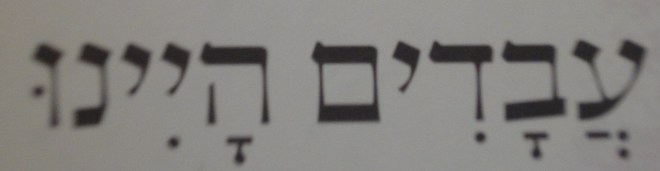
Note the letter ayin at the start of the word “avadim [slaves].”

Avadim.jpg
Avadim hayinu

The Deuteronomy verse, “Arami oved avi…” is another story. The ‘oved‘ with an aleph lends itself to several relatively straightforward translations as well as a traditional homelitical reading based on the biblical character most commonly identified with Aram.

Note the letter “aleph” at the start of “oved [lost, perished, fugitive,…].”

AramiOvedAvi.jpg
Arami oved avi

For discussion of “Who is Arami?” and “What does it mean to be oved?” in the Deuteronomy setting and in the Passover Haggadah, see “Ki Tavo: A Path to Follow.” Here, just to explore Hebrew vocabulary a bit more, is a little background on the word ‘oved‘ (with an aleph) itself.

oved‘ with an aleph

Forms of ‘oved‘ (with an aleph) appear frequently in biblical text. Here are a few instances, along with some translations.

Jeremiah 9:11 —

מִי-הָאִישׁ הֶחָכָם וְיָבֵן אֶת-זֹאת
וַאֲשֶׁר דִּבֶּר פִּי-יְהוָה אֵלָיו וְיַגִּדָהּ;
עַל-מָה
אָבְדָה
הָאָרֶץ, נִצְּתָה כַמִּדְבָּר מִבְּלִי עֹבֵר.
Who is the wise man, that he may understand this?
And who is he to whom the mouth of the LORD hath spoken,
that he may declare it?
Wherefore is the land
perished and laid waste
like a wilderness, so that none passeth through?
— JPS 1917 translation

…Why is the land in ruins
— JPS 1999

Micah 7:2 —

אָבַד
חָסִיד מִן הָאָרֶץ,
וְיָשָׁר בָּאָדָם אָיִן:
The godly man is perished out of the earth,
and the upright among men is no more
— JPS 1917

The pious are vanished from the land
— JPS 1999

Psalms 9:7 —

אָבַד
זִכְרָם הֵמָּה
…their very memorial is perished.
— JPS 1917

…their very names are lost.
— JPS 1999 with note: “meaning of Hebrew uncertain”

Ezekiel 12:22 —

בֶּן-אָדָם, מָה-הַמָּשָׁל הַזֶּה לָכֶם,
עַל-אַדְמַת יִשְׂרָאֵל, לֵאמֹר:
יַאַרְכוּ, הַיָּמִים,
וְאָבַד,
כָּל-חָזוֹן.
‘Son of man, what is that proverb
that ye have in the land of Israel, saying:
The days are prolonged,
and every vision faileth?
— JPS 1917

…every vision comes to naught“?
— JPS 1999

One more point of comparison, just because Temple Micah’s Hebrew poetry group encountered this modern Hebrew instance — over studies during the Shabbat of Passover — and noted how ‘obed‘ with an aleph and ‘obed‘ with an ayin sound alike to most English-speaking, and to some Hebrew-speaking, ears.

Lost

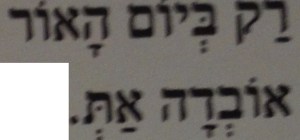
Yehuda Amichai’s “Shir Ha-Chut La-Machut [Poem of the Needle for the Thread]” has not been published in English translation. Our group rendered this line from the poem as “Only in the day, you are lost in the light,” or “Only in the daylight, are you lost.” (We struggled with the expression “b’yom ha-ohr.”)

And, finally, here are several versions of Deuteronomy 26:5 —

וְעָנִיתָ וְאָמַרְתָּ לִפְנֵי יְהוָה אֱלֹהֶיךָ,
אֲרַמִּי אֹבֵד אָבִי,
וַיֵּרֶד מִצְרַיְמָה,
וַיָּגָר שָׁם בִּמְתֵי מְעָט; וַיְהִי-שָׁם,
לְגוֹי גָּדוֹל עָצוּם וָרָב.
And thou shalt speak and say before the LORD thy God:
‘A wandering Aramean was my father,
and he went down into Egypt,
and sojourned there, few in number;
and he became there a nation, great, mighty, and populous.
— JPS 1917

…’My father was a fugitive Aramean…’
— JPS 1999

‘An Aramean Astray my Ancestor”
— Everett Fox translation, 1995

posted on this sixth day of the Omer 5777, with this prayer:
“In remembrance of the Exodus from Egypt, we pray that you release all whose bodies and spirits remain captive and enable us to extend Your outstretched arm in the process of liberation.” (see Ritual Well)

MiShebeirach for Circles of Pain

bullet_hole
photo: Treona Kelty

Introduction: Every bullet leaves pain in circles rippling outward, like the diameter of the bomb the Israeli poet Yehuda Amichai once described. Amichai’s bomb extends from 30 centimeters to the immediate range of dead and wounded, out to a solitary mourner “far across the sea,” finally encompassing “the entire world in the circle.” (Chana Bloch’s translation.)

Monday’s shooting on Benning Road killed Ayana McAllister, 18, home from college on spring break, and injured her roommate, Aqueelah Brown, 19, who was visiting. It traumatized Ayana’s sister, N’Daja, 19, who was also present. Friends and acquaintances suffer in ripples outward from two family circles that will never be the same, from school communities forever changed, and from Fort Chaplin Apartments, where such shootings are too commonplace. And somewhere in that web of sorrow and confusion are neighboring toddlers who experience, without knowing in any conscious way, the calculations their caregivers make every time they leave the house.

Note: In Jewish tradition, “Mi Shebeirach” [“May the one who blessed…”] prayers use a formula that calls on memory and relationship, a personal-divine history of sorts, to make a request of God. Traditions vary today and have varied throughout history regarding timing and content of such prayers, but requests for healing are a common use in most traditions. There are many articles on the topic. Here’s one interesting piece from Sh’ma written not long after the death of Debbie Friedman (February 23, 1951 – January 9, 2011). Friedman, singer/song-writer and faculty member of the Hebrew Union College, created a musical “Mi Shebeirach” that was extremely popular in the late 20th Century and had a strong influence on how the prayer is perceived and used.

See also related prayers and meditations

Mi Shebeirach for Circles of Pain

May the one who blessed our ancestors,
Abraham, Isaac and Jacob, Sarah, Rebecca, Rachel and Leah,
and our extended family,
Lot and his kin, Hagar, Ishmael, Esau, Bilhah and Zilpah
– a clan that knew its share of trauma and grief –
bless and heal those recovering from violence, loss, and terror.
May the Blessed Holy One be filled with compassion
for all those experiencing ripples of violence.
May God swiftly send all who need it a renewal of body and spirit.
May our community health be restored
and our collective strength revived.
And let us say, Amen.