After six weeks of Svara study around the concept of “overturning a betrothal,” here are a few thoughts on force and how it works in commerce and in the subset of acquisition in the ancient world known as marriage or betrothal. The bulk of this post is a PDF, and most of this in its present form will make little sense to anyone who hasn’t studied the passage in question (Baba Batra 47b-48a).
…More to come soon, I hope — the final session of our summer bet midrash is about to begin….
Meanwhile, for anyone interested, here is Adrienne Rich (1977 “Natural Resources) in conversation with the rabbinic worldview. Without attempting to translate the phrases from Baba Metzia highlighted between Rich’s verses, they emphasize “his will,” forcing him to say he agrees, his betrothals, and his use of sexual intercourse to effect a betrothal.
Remembering bible study participants at Mother Emanuel EME Church in Charleston, SC, victims of a 2015 mass murder, by a white supremacist.
This past week, three elders were murdered at Saint Stephen’s Episcopal Church in Vestavia Hills, AL. A month earlier, one man was killed and five others injured at Geneva Presbyterian Church in Laguna Woods, CA.
These church killings are in addition to the widely reported mass shootings in East Buffalo, NY, and Uvalde, TX, and to SEVENTY OTHER MASS SHOOTINGS between May 14 and June 16. (Mass shooting data at Gun Violence Archive). Many victims have been Asian, Black, and Latine.
No words beyond a request to recall those lost, all who mourn for them, and all who continue to organize in their memories, in your practice this weekend. Here are some names of those lost, recently and at this time in years past.
June 17, 2015 — Mother Emanuel
Pastor (and SC Senator) Rev. Clementa C. Pinckney, 41 Cynthia Graham Hurd, 54 Susie Jackson, 87 Ethel Lee Lance, 70 Depayne Middleton-Doctor, 49 Tywanza Sanders, 26 Rev. Daniel Simmons, 74 Sharonda Coleman-Singleton, 45 Myra Thompson, 59
June 16, Vestavia Hills, AL — Saint Stephen’s Episcopal
Walter Rainey, 84; Sarah Yeager, 75 third victim, 84, died at the hospital
For the record: This is not considered a “mass shooting,” as defined by the Gun Violence Archive (four or more injured, exclusive of the alleged perpetrator). A news story from WVTM
May 15, Laguna Woods, CA — Geneva Presbyterian
Dr. John Cheng, Geneva Presbyterian Church.
Five others injured in this Taiwanese church. A news story from Heavy.com
May 14, East Buffalo, NY — TOPS Supermarket
Ruth Whitfield, 86 Pearly Young, 77 Katherine Massey, 72 Deacon Heyward Patterson, 67 Celestine Chaney, 65 Aaron Salter, Jr., 55 Roberta A. Drury, 32 Margus D. Morrison, 52 Andre Mackneil, 53 Geraldine Talley, 62
June 11 — 18-year-old Saige Ballard June 12 — 34-year-old Alphonzo Jones June 13 — 17-year-old Xavier Spruill June 15 — 30-year-old Israel Mattocks June 15 — 16-year-old Deandre Coleman June 16 — 42-year-old Dimaris Smith June 16 — 29 year-old Christian Gabriel Monje (May 30 shooting)
DC shooting yahrzeits this week
2021
June 17 — 28-year-old Demonte Thompson
June 18 — 42-year-old Everette Faison
June 18 — 52-year-old Benson Thorne Sr.
2020
June 11 — 32-year-old Kevin Redd
June 11 — 18-year-old Saige Ballard
June 13 — (Mass shooting: 5 injured, two killed) 19-year-old Zymia Joyner 19-year-old Rashard Waldo
June 14 — 21-year-old Albert Smith,
2019
June 13 — 24-year-old Devin Butler
June 14 — 43-year-old Damon Bell
June 15 — 37-year-old Richfield Chang
June 16 — 30-year-old Arkeem Jackson
June 19 — 29-year-old Juan Marcell Grant
2018
June 11 — 24-year-old Daymond Chicas
June 12 — 24-year-old Syles Kealoha
June 12 — 22-year-old Marqueese Alston (police shooting)
June 13 — 43-year-old Larry Harrell
June 14 — 23-year-old Dontae Mitchell
2017
June 12 — 33-year-old June 14 — 28-year-old Julius Leroy Foreman June 16 — 25-year-old Malik Hill
2016
June 14 — 20-year-old Devonte Crawford June 18 — 40-year-old Stephanie Goodloe
In Talmud studies at Svara: a traditionally radical yeshiva, as at houses of Jewish text study for 1500 years or more, students are asked to recite what is written from memory. At Svara, students are celebrated for giving voice to and “owning” a recitation of a few words, the whole long passage the class has been learning, or anything in between. Many of us struggle with this practice for all kinds of reasons. This session, I’ve been struggling with whether I can voice these particular words.
Over the weekend, I learned something new about a relatively common word that appears in our passage and in one that is being taught in a different class. I think it is helping me figure out some next steps in reciting, or not reciting, my particular passage this term.
Trigger warning: this Talmud passage is about legal discussion of capital punishment and executing youth; responses travel through difficult, racist territory.
The word
R’ Bronwen Mullin said her class, which is also discussing capital punishment-related texts (in a different passage, not the class I am taking this term), talked about the tiny word “Atu.” It is commonly used to introduce a rhetorical question, like “Is it because….?” in English. But, R’ Bronwen said their class did a deep dive into the meaning “Atu” — which Jastrow’s Talmud dictionary says is an abbreviation of a word meaning “for the protection of.”
אָטוּ (abbrev. of אמטול, v. אַמְטוּ). Atu — an abbreviation of amtul, which means “for the protection of” and so: “for the sake of, on account of.” (A definition appears below, and here’s a link to the entry in Jastrow Talmud dictionary at Sefaria.)
So, R’ Bronwen said, the question could be asked of the passage in which it appears: “What are you/we protecting?”
The Passage
I went back to the passage where this word appears in text I’ve been struggling to recite, from Babylonian Talmud Sanhedrin 68b.
Disclaimer: the ancient rabbis are here using the legal tools they had to make sure no one is ever declared “ben sorer umoreh [rebellious and wayward child]” (Deut 21:18-21)…their intentions don’t necessarily make the text easy to read:
אנן הכי קאמרינן אטו בן סורר ומורה על חטאו נהרג על שם סופו נהרג וכיון דעל שם סופו נהרג אפילו קטן נמי
Our class, taught by R’ Benay Lappe, came to a translation something like this: “So, we are saying it is because of his [past] sin that the wayward/rebellious son is executed? Rather: on account of his end [for an ultimate, later act] he is killed. And because he is to be killed for a later act, even a minor can be considered.”
אפילו קטן נמי — afilu katan nami [even small one also]
A Recitation
The particular wording that opens this section, “So we are saying,” was found in Frank’s Practical Talmud Dictionary (for “אנן הכי קאמרינן”). My study partner and I were reminded of the Plastic Ono Band chanting, “All we are saying is give peace a chance.” I even offered a little singsong: “So, we are saying: give kids a chance!” Then I started writing, a few days ago, thinking of Yoko and John in bed in 1969.
But I quickly landed with with Gil Scott-Heron and 2Pac instead:
So, we’re protecting this notion of executing a boy for his sin?
Instead of war on poverty They got a war on drugs so the police can bother me And I ain’t never did a crime I ain’t have to do But now I’m back with the facts, givin’ it back to you –2Pac, “Changes” 1998
talking blame and guilt, though he’s a minor? afilu katan nami
Or, no: We fear for his “end,” trouble he might one day cause?
“You see them? Look at the color of their skin
That one is probably dangerous.”– 2018 Poetry Slam entry
calling him a danger, small as he is! afilu katan nami
based on a future adults (who may be strangers) imagined for him?!
“The Hate U Give Little Infants F***s Everybody” –2Pac
condemning even the small one?! afilu katan nami
Well, I’m new here, and I forget Does that mean big, or small?
No matter how far wrong you’ve gone You can always turn around –Gil Scott-Heron, “I’m New Here,” 2010
NOTE: I only know the GSH version, but song was written Bill Callahan (sorry for previous accidental mis-attribution)
talking execution when he’s a minor, though!
The Loudest Question
What are you protecting?!
It has been such a struggle, for my study partner and me, to approach this text through the roar of “Super-predator!” “Chronic behavior problem!” “Thug!!” We’ve been hearing this chorus for much of our lives used to protect property and some people, often those who are already far safer than most, from youth perceived as threats. Across the U.S., this means primarily endangering youth of color in the name of “public safety.” Where each of us lives, this is disproportionately directed toward Black children.
How does this passage reflect — maybe help create — the idea that some people have a right to protect themselves from perceived threats: our country’s “tough on crime” policies that protect some at the expense of others, all based on that chorus of “thug!”?
And it’s that “thug” that kept leading my mind back to Tupac Shakur and then to Gil Scott-Heron. Eventually, though, 2Pac’s “THUG-LIFE” led me to another question…
Another Question
That THUG-LIFE concept, and my conversations with rabbis Bronwen and Benay, led me, eventually, to ask: Who am I protecting in not reciting that piece of Talmud?
Black children are expected to leave the house every day in places that continue to view them as a dangers — “some type of demon, killers, or something like that” (see below) — meaning their every step is a risk.
Black children are expected to learn history that, especially in the current trend toward removing all context, either erases or demonizes them — meaning every page is a minefield for them.
If Black kids of all ages — and queer kids and kids with disabilities, visible and not — can show up and try to learn from flawed texts that constantly endanger them, maybe I can recite this…even if I’m simultaneously screaming?
And Questioning Questions
In her recent piece “How We Question,” R’ Bronwen wrote about naming our intentions when we question Torah and existing rabbinic discussion. Talmudic tradition, she wrote, “always invites us into the audacity” —
the audacity of naming what our intentions are in the act of questioning; of elevating the questioning itself to a radically reparative and transformative plane. When we fail to do this, our shortcomings, our implicit (and sometimes explicit) biases, take over a situation, and the bright light of possibility is overshadowed. Hopefully, we can continue to make our fairy-Rabbi-ancestors proud by refusing to take our questions for granted. When we examine our questions we find our deepest motivations and intentions, and through that process we bring more light into the world- the light that we need to guide us in this time of crash. How we question, as our fairy-Rabbi-ancestors intuited, might be the very torch we need.
— “How We Question,” by R’ Bronwen Mullin, from Svara: a traditionally radical yeshiva (29 Adar Bet 5782, 4/1/22)
It has been hard, during this class on the rebellious child, to figure out which of my reactions to the Talmud text are really reactions to public policy discussions in my town right now and which are about one particular theological question.
There’s a sort of hidden “What/who are you protecting?” embedded in this passage. The ancient rabbis sought to reconcile their understanding of divinity with a text, apparently in God’s name, demanding the death of this wayward and rebellious child. One resolution they suggested was reading the passage in a way that protected God’s intentions — that’s how the Talmud got to the idea that the text is somehow about killing a minor for something they might someday do as an adult.
…still screaming from my place of still limited understanding: Why would anyone think it a good idea to demonize young people to “rescue God”?! And, given that the text chose that road, (how) do I voice, attempt to own, these words?
Some Additional Voices
I’mma be very honest, some adults won’t just believe in us just like that. It’s going to take them some time to believe in what we want to do and what we want to achieve in life. They think we’ll grow up and be some type of demon, killers, or something like that, but that’s not what we really are. We’re trying to build something.
Kevin Mason, 16 — “Voices of Wards 7 and 8 Youths,” DCist 3/31/22
“And, 12-year-old Isiah Jones adds, it shouldn’t be too difficult for adults to learn more about what kids need.
“’They could come find out,’ he says.”
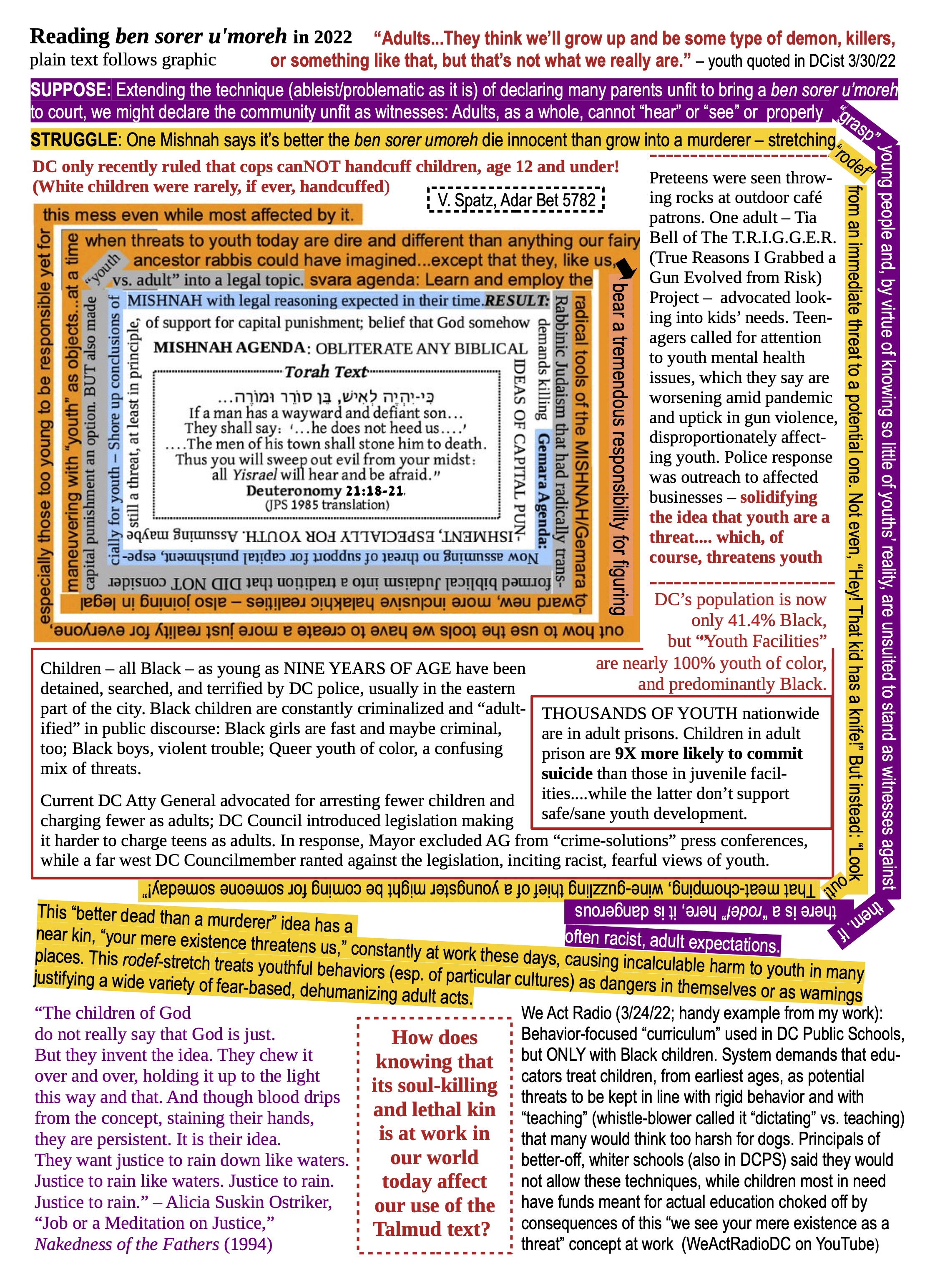
Graphic with Torah, Deut 21:18-21, and discussion.
downloadable version with graphic and full text below
Svara teaches: The revolution will not be translated. It’s our breath and our voices that keep the ancient text alive and redeem it with our collective learning. I am not yet sure if I’m ready to “own” this particular text. It’s already been one illuminating, if incredibly difficult, journey.
…Still not resolved — and there are still four hours of class left to learn…Meanwhile: so much gratitude to Svara, R’ Benay, R’ Bronwen, all the faculty and other students, and especially my amazing chevruta. Although, of course, all the above except direct quotes from R’ Bronwen and poets, are my words and responsibility….
The revolution will not be right back after a message about a white tornado, white lightning, or white people You will not have to worry about a dove in your bedroom, the tiger in your tank, or the giant in your toilet bowl The revolution will not go better with Coke The revolution will not fight germs that may cause bad breath The revolution will put you in the driver’s seat
Gil Scott-Heron, “The Revolution Will Not Be Televised,” 1970
From Jastrow’s Talmud Dictionary
אָטוּ (abbrev. of אמטול, v. אַמְטוּ) 1)on account of, because of, for the sake of(h. . קנסו שוגג א׳ מזיד they fined the inadvertent transgressor for the sake of the wilful one (in order to prevent wilful sin). Git. 53ᵇ; a. fr. —2) (in questions expressing surprise, indignation) is it because? do you mean to say? Ib. 7ᵃ א׳ אנא לא ידענא do I not know it myself? Ib. 30ᵇ א׳ ברשיעי עסקינן is it with wicked men we have to deal? (i.e. shall we presume deliberate sin?); a. v. fr.
Ask those who survived before us. During the year I produced “Community through Covid,” I spent a lot of time exploring outdoor schooling and architectural encouragement for air-circulation current 100 years ago. Seeking new perspective on current, hyper-local grief, I settled into study of a mid-20th Century work by a Chicago Hebrew poet.
…I’ve written before about how much I was moved by reading about Lake Michigan in Hebrew. And I have enjoyed getting to know the — very different — work of the two poets featured in Women’s Hebrew Poetry on American Shores: Poems by Anne Kleiman and Annabelle Farmelant (Detroit: Wayne State University Press, 2016). I’ve also been quite fortunate to have brief, very helpful correspondence with both translators — Adriana X. Jacobs and Yosefa Raz. Dr. Raz also put me in touch with Anne Kleiman’s daughter, Adina….
Last week, as I struggled with a number of deeply sad local issues, I realized that the looming J6 anniversary — which means something quite different for neighbors of the site — was bringing up more deep feelings, some of which I’d half forgotten I still carried and had no idea how to resolve. In the process, I found myself drawn into this stanza from Anne Kleiman:
Now, just as last year, same season, same melody, same pain… and the day still shrouded in fog and the hand still groping…
— untitled stanza, translated by Yosefa Raz
I looked more closely at the eight untitled stanzas that follow a poem called “To the Musician,” and found myself more and more engaged with the journey the poet describes of loss and grief, through change and compassion, toward acceptance, maybe hope.
“Still Groping”
To explore the Hebrew, I used a Biblical Concordance instead of a dictionary. I was led to verses I know well and verses that were new to me. Along the way, I developed more of an appreciation for how and why Anne Kleiman expressed herself in Hebrew. And I returned again and again to the words that spoke so powerfully to me on the anniversary of J6 — “Now, just as last year, same season…” — each time with the words resonating with more and more biblical background.
While I don’t know when the poem was actually written, I also poked around in a variety of sources to refresh my memory of events and circumstances that would have been current for a Chicago resident around 1947. A few minutes with history can be a reminder that we’re not the first generation to face crises with no easy fix and pressures from many directions. And reading the words of those who struggled under burdens of the past, and still managed to share a few thoughts, can be lightening.
Eventually, I created a page to share sections of Kleiman’s poetry, with Raz’s translations and notes, along with my own annotations. Check out “Hebrew Humpty Dumpty Vision.”
I love the work of Anne Kleiman and the quite different work of Annabelle Farmelant and regularly find myself grateful to them and to their translators. I’m also grateful to Wayne State University Press for making available this and many other important titles. The Modern Hebrew Poem Itself, e.g.
Few More Days to Save on Books, BTW
As it happens, there are, as of this writing, a few days left in the annual WSU Press 45% off promotion; academic books are still pricey, but it’s a substantial discount….until Jan 14.
The Book of Exodus — in fact a passage from last week’s Torah portion — makes an odd appearance in the movie, Marshall (2017 — Netflix subscribers, NOTE: The movie leaves that platform on Jan 1, 2022.) At first, oddities in the way the verses show up broke my willing suspension of disbelief. Eventually, however, I came to appreciate the scene and light it sheds back on the Exodus story.
Marshall and Friedman
The movie is based on a 1941 court case with Civil Rights implications. Here’s a summary of the real-life court case, published years before the movie was released. Here’s information about the movie, from IMDB, starring Chadwick Boseman (1976-2020) and Josh Gad (b. 1981).
Early on in the story — in real life as in the movie — Thurgood Marshall, then NAACP’s itinerant attorney, must convince Sam Friedman, a Connecticut attorney specializing in insurance, to take up Joseph Spell’s defense. Friedman, 38, had no experience in criminal cases; Marshall, 32, had the experience but was refused standing as co-counsel by the judge.
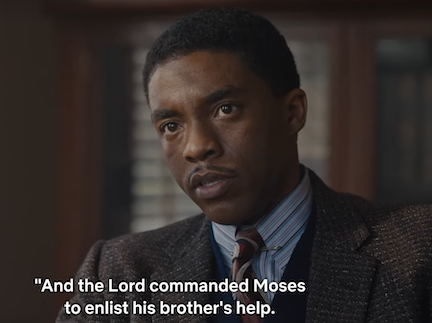
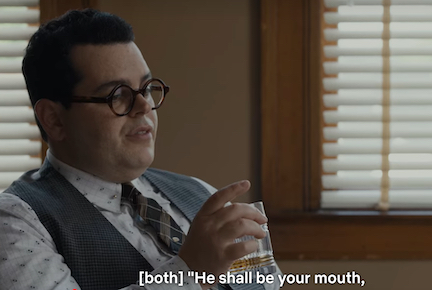
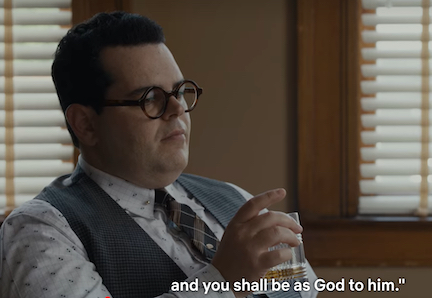
Once the lawyers learn that Marshall is forbidden to speak at all at the trial, they have a short, tense conversation — while another lawyer who might take the case waits on the telephone. Without preamble, Marshal intones: “And the Lord commanded Moses to enlist his brother’s help.” Friedman recognizes the reference and joins in, saying along with Marshall: “He shall be your mouth, and you shall be as God to him.”
Friedman agrees to take the case. Throughout the trial, Marshall directs his colleague’s every move, until eventually — as in the historical case — they win a not-guilty verdict.
Office scene: Chadwick Boseman, as Marshall, sitting erect in a business suit, offers a biblical reference.
Opposite Marshall: Josh Gad, as Friedman, leaning back in tie and vest, but no jacket, and holding a glass of liquor, joins Marshall in reciting….
…both men conclude: “you shall be as God to him.”
Exodus 4:14-16
Moses and Aaron together pleading with Pharaoh to let the People go is among the most well-known Bible stories. Prior to that, at the close of the Burning Bush scene (Exodus 3:1ff), is a less famous passage: God becomes angry with Moses, promises to be “with the mouth” of both brothers, and tells Moses to be “as God” to Aaron (Ex 4:14-16).
These are not the most mellifluous verses, the most often quoted, or the most likely to land on inspirational household decorations. Still, both lawyers know this passage well enough to quote. And, although translations are quite varied, due in part to awkward phrasing in Hebrew, men from different backgrounds have somehow learned the same English words by heart.
Moreover, Marshall begins with Moses being commanded to enlist Aaron’s help, something not found in the Hebrew or in any translation I could find. Possibly this paraphrase is from a popular culture source of the 1920-30s, although there is no suggestion of that in the scene, or a commonly accepted Sunday-school rendition. Perhaps Marshall KNOWS the quote is not quite right and altered it for a point.
…Or, my best guest: movie-makers were content using not-quite-Bible, even in a scene where the words seem so pivotal; in other words, they were far less obsessed than I with issues of translation and transmission**….
I only found one discussion of the movie mentioning this scene, and its author is entirely unconcerned by what I found anomalous. In fact, Rabbi Elliot Gertel’s piece adds more layers of mismatch: he says that Marshall “quotes” and Friedman “is able to complete the verse,” but then offers a quotation himself that differs substantially from what is actually said in the movie:
…God’s words to Moses in the Book of Exodus (4:16), regarding Aaron: “And he shall be God’s spokesman to the people, that he shall be to you a mouth, and shall be to him in God’s stead.” Impressively, Sam is able to complete the verse.
“Marshall” — Civil Rights and Old-Fashioned Shul Jews (November 2017)
TEXT NOTES: R’ Gertel appears to be using a modified version of Old JPS: “And he shall be thy spokesman unto the people; and it shall come to pass, that he shall be to thee a mouth, and thou shalt be to him in God’s stead.” More translations (some would have been similar in 1941; some are newer) at Bible Hub. Bilingual Hebrew/English for Exodus Chapter 4; interactive text with commentary.
Thurgood and Sam
I didn’t see this movie when it was new and don’t know if there was discussion at the time around use of the Bible story. As noted above, the quotation itself snapped me out of believing in the story as it was presented; a side effect of this shift of perspective, for better or worse, was a new look at the Exodus story.
When Thurgood says “God commanded Moses to enlist his brother’s help,” I hear three things:
asking for Sam’s help in a way that the Bible text itself does not support: God tells Moses to meet Aaron and vice versa (4:27) but never tells Moses to ask for help;
suggesting divine imperative behind the request: if God told Moses/Thurgood to ask, Aaron/Sam has no choice of response; and
calling Sam his brother.
When Sam joins in reciting a version of Exodus 4:16, I also hear three sentiments:
acknowledging brotherhood with Thurgood;
recognizing that the request is bigger than the individuals involved; and
agreeing to a role that, like Aaron, only he can play at that point.
If Aaron and Moses ever had a conversation weighing their responsibilities or wondering if/how they could operate as a brother-team, that’s hidden deep inside the white space between the Bible’s letters. But the text suggests that Moses and Aaron were relative strangers, if not entirely unknown to one another, prior to God’s call to each of them. So maybe the two tales — of Sam and Thurgood, Aaron and Moses — can shed mutual light on how individuals with no history or reason for trust can recognize sibling-partners in one another.
Another resonance between the tales is a pattern of objection, frustration, and acquiescence. Moses objects repeatedly to God’s call at the Burning Bush; God gets angry, and then announces the Aaron-mouth Moses-“God” team. Sam raises objection after objection to Joseph Spell as a client: he was dishonorably discharged from the Service, he left behind a wife and two children, he was charged with theft at another job… Thurgood snaps that criminal defendants are not ideal citizens and tells Sam he has no time for “selling” the task, he just needs him to do it, at which point the not-quite-Bible text seals the Sam-mouth Thurgood-“God” team.
R’ Gertel wonders, parenthetically, if Thurgood is being immodest by equating himself with Moses, and through Exodus 4:16, “as God.” The Thurgood of this Marshall film is nothing if not chutzpadik. But that is beside the point for the link between the lawyers’ story and Exodus. The real chutzpah, I think, is on the part of writers Michael and Jacob Koskoff.
Marshall as Midrash
Given that the Koskoffs paraphrased Exodus 4:14 and left out the part about God promising to be with both brothers in 4:15, sticking with the obscure and awkward pronouncement of 4:16, “…you shall be as God to him [וְאַתָּה תִּהְיֶה-לּוֹ לֵאלֹהִים, ve’atah tihyeh-lo le’Elohim],” must have been deliberate. In addition, the clunky language choice is part of a pivotal moment, creating the brother-team. And one effect of bringing this “as God” in at this point is to equate Civil Rights legal maneuvers to the Exodus Story.
Michael Koskoff (1942-2019) was a lawyer who saw parallels between Friedman’s work and his own, in defense of Black Panthers, e.g. But is this lionizing of legal efforts “immodesty” on anyone’s part? Or is it hinting at a kind of Legal Liberation Theology?
R’ Gertel’s piece about “Old Fashioned Shul Jews” closes with a question about whether/how: “…ties to synagogue and Jewish life have brought a precious and irreplaceable quality to social action by Jews.” This is a crucial question to ponder without romanticizing Jewish involvement in the Civil Rights movement.
And a fictionalized view of real life lawyers battling an inequitable system, in- and outside the courtroom, can illuminate the relationship of Aaron and Moses, two siblings who barely knew one another, taking up a dangerous and uncertain path toward undoing oppression.
**R’ Gertel’s “Old Fashioned Shul Jews” spends a fair amount of ink on the meaning of carrying and exchanging of money on the sabbath in one Marshall scene. As with my obsession with the use of a pseudo-quotation from the bible, I think the best explanation is that no one associated with the movie thought to worry about this being considered a violation of Shabbat by many Jews.
I have rarely lived with a pet and had no idea how to respond to the question of how to grieve Jewishly. I am grateful to those who shared these resources:
Another friend suggested, “speaking as a pet parent who has lost pets,” that an appropriate response is a donation to a pet shelter.
Still another said that kaddish is a “public affirmation of belief in the power and sovereignty of the Almighty, even in times of grief,” so why not? It should be noted, however, that this suggestion is contrary to a number of prominent views about the recitation of Mourners’ Kaddish. See also this general post on Jews and Pets from My Jewish Learning.
This document — “Bava Metzia 58b with DS9 and related background” — was prepared in my own wrestling with text on ona’at devarim, “harmful speech,” explored at SVARA this season. Thanks to all in, and supporting, Mixed-Level Bet Midrash fall 2021/5782: teacher R’ Bronwen Mullin, Fairies Sarit Cantor and Annie Kaufman, fellow bet midrash students. Special thanks to my chevruta who was a wonderful partner in exploration.
Responsibility for this document and anything not directly attributed to someone else, is, for better or worse, mine alone. (Bava Metzia 58b can be found at Sefaria.)
Here is a different form of exploration around some of the same ideas, particularly the concept of blood being shed by humiliating someone… or draining away at their identity, drop by drop….and yes, I know, there are mixed metaphors in the whole “becoming white” thing.
In the Book of Genesis, Rachel steals the teraphim that were her father’s (31:19). Meanwhile, Laban accuses Jacob of stealing “my gods [elohai]”; Jacob responds, speaking of “elohekha” [your gods], using Laban’s term; and a tent-by-tent search is conducted (Gen 31:30-33). Rachel and the teraphim then re-appear in Gen 31:34-35. Why “elohim” when it’s Jacob and Laban, and teraphim only when Rachel is around?
…The word “teraphim” is used three times in Rachel’s presence, and then never again in the Torah. In the prophetic books, there are a dozen more mentions of teraphim (Judges, Samuel, Kings, Ezekiel, Hosea, and Zechariah). “Elohim” is grammatically plural and means both (plural) gods or judges and (singular) name of God of Israel….
Many would attribute the shift in language to different source texts. Perhaps, though, vocabulary change indicates fundamental differences in experience. Genesis itself doesn’t tell us what the elohim/teraphim meant to any of the individuals or the households involved. But, we do find a few clues in the text.
Two relationships
After the search fails, Jacob and Laban do not again mention the elohai, which remain abstract, another element in a larger argument over possessions and twenty years of grievances. There is intensity between Jacob and Laban, but other family members recede into the men’s power struggle: Women and children become inanimate or invisible, while households gods seem to disappear. One moment, Jacob is declaring theft of elohim worthy of death-penalty; the next, they’re well and truly forgotten.
Meanwhile, whatever the teraphim were to anyone else, they do seem important to Rachel. She had no idea, when they were leaving home, that Jacob would later make a death-pronouncement about the theft. But she does seem willing to take substantial risk in stealing them. And her method of keeping them hidden is tied to her own body and “the ways of women.” Rachel’s life seems intimately attached to these teraphim.
Maybe, the switch of vocabulary indicates that Rachel relates to the teraphim differently than her (male) kin folk.
Two word-scenes
For Jacob and Laban the household gods seem abstract, maybe a little like this set of featureless, static images —
“Why have you stolen my gods?” Image: a monochrome set of featureless human-shape models — the pose-able kind artists use to aid in sculpture or sketching — with the words “why have you stolen my gods [לָמָּה גָנַבְתָּ, אֶת-אֱלֹהָי]” in Hebrew across them. Artist dummy images are public domain, via Pixabay.
When Rachel’s around, though, the household gods seem more animated and personal, maybe a little like this set of images with real, lifelike features and sense of movement —
“And he didn’t find the teraphim.” Image: two more monochrome artist’s models, this time in animated poses, around an ancient Canaanite figure, with the words “and he didn’t find the teraphim [וְלֹא מָצָא אֶת-הַתְּרָפִים]” superimposed. Canaanite image from LookandLearn.com. Dummy images are public domain, no attribution from Pixabay.
The vocabulary switch strikes me as something like the shifts from panel to panel in Bill Watterston’s “Calvin & Hobbes.” When Calvin was with Hobbes, Hobbes was an animated companion; but when another human entered the picture, Hobbes was an ordinary, inanimate stuffed toy. I am not suggesting teraphim are anything like stuffed animals to Rachel or anyone else in the story. Just fascinated by a sort of parallel shift in scene from one of animated connection to one of subject-object.
Once upon a time, this blog offered a series of posts on portion of the week, sharing notes about interesting sources and paths to follow. At a later stage, I included some posts about links to prayers found in the weekly portion. Here is a new landing page with most of these links in order.
There is no “man” or “woman” in the early part of Genesis, even after “the human” is created (twice). The first Torah portion, Breishit (Gen 1:1-6:8), read this week as the cycle begins again for the new year, gives two versions of humanity’s genesis. Neither one includes the word “ish” at the outset:
We are introduced to the earthling or the human in 1:26-27, and told ha-adam is in God’s image and male [zachar] and female [nekevah]. (Here are a few additional notes and translations for comparison.)
God crafts ha-adam from ha-adamah [“the earth” or maybe “arable land”] in Gen 2:7 (and ha-adam gets singular masculine grammar treatment).
We do not see the word “ish [man]” until after isha [woman] is created and recognized by ha-adam as “bone of my bone and flesh of my flesh” (Gen 2:23). Subsequently, we read of ha-adam and ha-isha or ishto, usually translated as “the man” and “the woman” or “his wife [literally: his woman].”
Just prior to this, God introduces the human to all the other creates that have been created, but —
…no fitting helper was found.
Gen 2:20
There was no helper appropriate, or corresponding or opposite, [k’negdo] to the human — what the King James Version called a “help-meet.”
Not sure the Genesis text actually supports this reading, but this week I am seeing Elton John as “ezer k’negdo” for Lil Nas X.
…There has been a great deal written, ancient and current and in between, about what these verses might imply about gender and about relationships of various kinds. And there are so many layers of gender and sexuality to be explored in discussing Lil Nas X or Elton John or Dolly Parton. But it’s almost Shabbat, and that’s not my area of expertise/primary experience, and this is meant to be just a short thought…
One of Me
Recently Lil Nas X released “One of Me.” It’s an important work on its own (full lyrics), and it’s important that Elton John is featured on the song. In addition, the two of them appear together in a video advertisement. (Usually my inclination is to suspect advertisers of capitalizing on pain, but in this case I applaud Uber Eats for providing this urgently needed creative space, whatever their motives. Video “One of Me” for Uber Eats.)
Watching the elder (b. 1947) stand so publicly with the younger (b. 1999) has an enormous power. (Especially for someone raised in a home where “shush” was the only permitted, and the most polite, thing to say about Elton John’s sexuality, and anyone who remembers when the public was not kind to him.)
Without making any claims as to how the actual individuals involved — Montero Lamar Hill and Reginald Dwight or their public alter egos — feel about this, I see Elton John as ezer k’negdo, that corresponding-helper, for Lil Nas X, an elder appearing “opposite” in a way that allows the younger to appear more clearly as himself…to the world at large, if not to himself. Seems especially poignant in relation to a song about how so many want him to be something else.
Could something like that be meant when ha-adam says —
At last! This time! Bone of my bone and flesh of my flesh”
Gen 2:23
after first seeing ha-isha?
Not sure the text supports this, but also not sure in this instance how much I care about being exact: Is is possible that we all have the power to serve as ezer k’negdo to others? to use our own selves in positive ways to help others see themselves more fully?
Elton John in a Lil Nas X cowboy get up and Lil Nas X in Elton’s feathers. More than that would be very hard to describe. But if requested, I’ll search out a video description.
Full official video from Lil Nas X below
not going to try to provide a video description, but if requested will try to find one
Charity associated with this album — Central Alabama Alliance Resource & Advocacy Center — if you click through from the YouTube link there is a matching grant.









 "A Song Every Day"