Lost in Translation? No, lost without fact-checking

Robert Alter completed an amazing project. His translations of the Bible continue to offer new, sometimes more literary, possibly more “accurate” renderings of the text. But scholars everywhere seem blinded by the sheer number of pages just published or otherwise befuddled into teaching falsehoods and half truths.

Rabbi Rick Jacobs, president of the Union for Reform Judaism, for example, offered a ten-minute ode to Alter’s translation as a commentary to this week’s Torah portion (parashat Bo: Exod 10:1-13:6). Here’s his podcast, “What is Lost in Translation.” In praising Alter, however, he manages to inadvertently dismiss the work of his own movement.

Darkness and Light

Toward the end of the podcast, Jacobs focuses on one phrase in Alter’s translation and commentary:

“‘…that there be darkness upon the land of Egypt, a darkness one can feel.’
…but all the Israelites enjoyed light in their dwelling places.”

a darkness one can feel. The force of the hyperbole, which beautifully conveys the claustrophobic palpability of absolute darkness…
— translation/commentary on Ex 10:21, 23 from The Five Books of Moses. (NY: Norton, 2004)

Jacobs cites this material as though it were new, although Alter published this translation and commentary in 2004. More importantly, I think, Jacobs fails to note that Alter’s English differs very little from the older translations widely available for decades — in fact, some published by his own Union for Reform Judaism.

Here, for comparison are Jewish Publication Society versions of the last century:

“‘…that there may be darkness upon the land of Egypt, a darkness that can be touched.’
…but all the Israelites enjoyed light in their dwellings.”
— “New JPS” translation (Philadelphia: JPS, 1985)
“‘…even darkness which may be felt.’
…but all the children of Israel had light in their dwellings.
— “Old JPS” translation (Philadelphia: JPS, 1917)

Alter’s “a darkness one can feel” is slightly pithier and so somewhat stronger — and as Jacobs notes, closer to the more succinct** Hebrew, v’yamush, hoshekh [וְיָמֵשׁ, חֹשֶׁךְ] — than the JPS versions. But Alter’s “in their dwelling places” for b’moshevotam [בְּמוֹשְׁבֹתָם] is slightly longer than “in their dwellings” of the JPS. So, I’m not sure that, in this particular set of verses, the differences are worthy of great note, all told.

King James and Robert Alter

Jacobs, like a number of others commenting on Alter’s work, compares Alter’s work to the King James Version. (Maybe they’re all reading the same press release?) But Jews and Christians have been translating the bible for many generations since 1611, and all innovation since then is not attributable to Robert Alter, no matter how amazing his recent accomplishment. The weirdest — and, I feel, saddest — thing about Jacobs’ praise for this particular verse of Alter’s translation is that his podcast could just as easily have cited a ten- or twenty-eight-year-old publication from the URJ itself:

  • The Torah: A Women’s Commentary (NY: URJ Press & Women of Reform Judaism, 2008) uses modified “New JPS” language, including the verses as cited above;
  • the 2005 URJ version, which I don’t happen to have handy, also uses JPS;
  • the 1981 The Torah: A Modern Commentary, from UAHC [now URJ], uses a mid-century version of the JPS translation, with the exact language quoted above.

…This is not to say that Alter has not provided new and interesting perspectives or given us some beautiful new language to help us appreciate the Hebrew original. But I fear that what really is new and interesting in Alter’s work is being lost in all the repetition of tired nonsense, false comparisons, and outright omissions in discussing his work.

Moreover, it seems truly dangerous, given the current state of government and journalism, to share information in ways that might mislead and to teach in ways that fail to provide context for “new” ideas….

A final quibble with Jacobs’ podcast: He makes a point of noting that Robert Alter (b. 1935) is in his 80s now, as he completed this huge project. If we’re going to stress the author’s age and/or the number of years he worked on the project, however, let’s be accurate. Alter was not yet 70 when The Five Books of Moses was published, and he was in his early 70s when his Book of Psalms (Norton: 2007) came out. Again, not to say it’s NOT an accomplishment to translate the Torah or the Psalms at 70 or for an individual to complete a bible translation at 83 — or any age! Just that we cannot be re-writing history by inattention to facts.


Note on the 2018 W.W. Norton Publication
A note about these books as books: While I remain in awe of Alter’s scholarship and literary merit, I am deeply disappointed in this three volume set ($125). The set does offer new material, particularly in the Prophets. But there is no new introduction to the Bible as a whole, and there is no additional commentary on the completion of the project; in fact, each of the three volumes repeats verbatim the same introduction to the Bible and its translation that appeared in Alter’s Five Books of Moses in 2004!

If this picture is clear enough, and you’re really curious, note that the section numbering differs in the two volumes, because the section specific to the Five Books was moved.

intro alter
2019 (L) and 2004 (R) introductions to Alter’s translations

Final plea to scholars: I would personally appreciate, as I’m sure would many others, a review or analysis of the recent publication which actually addresses specifics — in organization and layout as well as in content — with a focus on what is actually new in 2018.

Post updated 1/13/19: mostly in formatting, correction of a few typos; also addition of citation to UAHC 1981 Torah (above) and plea here. See also, “Found through Alter’s Translation,” further to this discussion, posted on 1/12/


NOTE:
**In the podcast cited here, Jacobs also compares Alter’s translation of Psalm 23 with that of the King James Version, focusing on the darkness phrase relevant to Parashat Bo. Alter’s “vale of death’s shadow” is more direct than the KJV, “valley of the shadow of death,” while maintaining the connection with death — which some newer translations lose:

valley of deepest darkness — JPS 1985
darkest valley — New International Version (1973-2011)
valleys dark as death — American Bible Society, 2006
dark valley of death — God’s Word, 1995

Do note, for clarity of record, that Alter’s translation and commentary on the Book of Psalms was published in 2007.
BACK

The Treasure and the Favor

Exploring Babylon Chapter 15.2

Just as the stories of Exile and Return include people of quite different mindsets, Exodus peoples are not monolithic, Rabbi Gerry Serotta told me recently. He suggests that #ExploringBabylon could profitably consider some differences among Egyptians in the Exodus tale and look at related texts, in this portion and earlier, about Egyptians becoming “favorably disposed” toward the Israelites.

Difference

Rabbi Serotta points to three groups of Egyptians:

  • those who left with the Israelites — וְגַם-עֵרֶב רַב — “and also the erev-rav [often “mixed multitudes”; Alter uses “motley throng”]” (Ex 12:38);
  • those who did not join the Israelites but gave gold and silver and “raiment/cloaks” (Ex 12:35; see also “The Powers and the Wealth“); and
  • Pharaoh (and, perhaps, other unrepentant oppressors).

 
He adds that it’s good practice to look for the variety of people and perspectives in biblical narrative because “variety is God’s plan.” We see this in the story of Bavel (Genesis Chapter 11) and in many later teachings about the value of galut [exile] and dispersion.

God’s preference for variety is a hard concept to hold in the midst of a tale with the themes “You are MY people and I am YOUR God” and “Let My people go that they may serve ME.” But it can be found in the Exodus tale and in centuries of Jewish teaching centered around it. Seeking out and naming variety within biblical stories helps us avoid pigeonholing people and stereotyping groups in the text, in history, and in contemporary life. Exploring and amplifying difference-celebrating strands of Jewish teaching, from ancient times to the present, provides a foundation for inter-group understanding and cooperation.

…It is no accident that Rabbi Serotta, who has dedicated his career to interfaith, religious freedom, and peace and justice work, is drawn to teachings on diversity and galut [exile]. He offers additional ideas for #ExploringBabylon that will take some time to research; this week, we gratefully continue to pursue his suggestion to “follow the treasure,” so to speak, which appears in this week’s torah portion (Bo: Exodus 10:1-13:16), and its implications….

Boundaries

As discussed in the last episode, ancient commentaries on the gold and silver — mentioned in Ex 3:21-22, 11:2-3, and 12:35-36 (see below) — included the ideas of back wages/reparations and prior ownership of the wealth given to the fleeing Israelites. One important extension to the latter theme focuses on the prominence of women in this exchange to suggest that women used jewels and other portable wealth to bribe neighbors to overlook, or perhaps hide, their infant boys when Pharaoh decreed they be tossed into the river (exact citation temporarily AWOL, sorry).

Robert Alter notes, in his 2004 Five Books of Moses (see Source Materials), that “neighbor” and “sojourner” in 3:22 are feminine nouns, adding:

[The verse] reflects a frequent social phenomenon–also registered in the rabbinic literature of Late Antiquity–in which women constitute the porous boundary between adjacent ethnic communities: borrowers of the proverbial cup of sugar, sharers of gossip and women’s lore.

Alter goes on to insist, however, that exegesis which sees Egyptian women as lodgers in Israelite houses doesn’t match the plague narrative. (He then describes the overall tale as one of “Israelite triumphalism.” More on this below.)

Benno Jacob (1862-1945) also explores boundary crossing and long-term relationships which he sees as hidden in plain sight in Exodus:

The Israelites had settled as herdsmen, a necessary but disdained occupation in Egypt. The details of our story suggest that they were scattered throughout Egypt, which must have led to many personal friendships; only a systematically encouraged hate propaganda was able to change this.
Jacob, The Second Book of the Bible p.343


Protest and Change

Jacob extensively discusses the wealth exchange in Parashat Bo. He uses linguistic and narrative analysis to support his view that God wanted the Israelites and Egyptians to part on good terms and had repeatedly told Moses that was to be the end result. He argues that the Egyptians had already, before Pesach night, come around to seeking compassion and justice for the Israelites, and the farewell gifts are part of the evidence of a change in position:

The Egyptians’ gifts to the Israelites were a clear public protest against the policies of the royal tyrant. They demonstrated a renewal of public conscience…a moral change; the receptive heart of the Egyptian people was now contrasted to the hard heart of Pharaoh.
— Jacob, p.343

He goes further, insisting that this must be a mutual change of heart, from peoples on both sides of the conflict. Jacob links the opening phrase of Ex 11:2 to the similar expression Joseph used in requesting burial for his father (Gen 50:4) and suggests that this link means God was trying to trigger positive feelings:

[God] knew that some Egyptians recalled Joseph, others would have been impressed by the miracles they had witnessed or now had a high a regard for Moses, so they would seek a friendly farewell….

God’s command Moses [Ex 11:2] simultaneously threatened Pharaoh and searched for peace between the two peoples. These peaceful relations were God’s principal concern during Israel’s last hours in Egypt. This was the true meaning of the farewell gifts which the Israelites sought and the Egyptians willingly gave.
— Jacob, p. 344 (emphasis in original)

Rabbi Shai Held, of Mechon Hadar, includes a poignant addendum on this teaching in “Receiving Gifts (and Learning to Love?): The “Stripping” of the Egyptians.” Held quotes Jacob calling this episode “the most elevated and spiritual reconciliation among people; it was full of wisdom and love of fellow man” (p.339 in the above cited Jacob commentary). He then confesses skepticism as to whether Jacob’s story jives with the plain sense of the text but concludes:

One senses in Jacob’s words the insights of a brilliant exegete but also the pain of a rabbi and teacher in a Germany consumed by hate**….In a world suffused with bigotry and hostility, a world in which people of faith often marshal sacred texts to legitimate acts of cruelty and to extol hatred as a virtue, there is great power in reading Jacob’s words and being reminded: At the heart of the religious enterprise is the attempt to soften, and open, one’s heart, to God and to one-another. If even the Egyptians and the Israelites can be (successfully!) called to love one-another, then perhaps, even in the darkest of times, slim glimmers of hope are available to us.

**Held includes a footnote citing personal communication with R. Walter Jacob (Benno’s son) to confirm that his father was working on the Exodus commentary between 1934 and 1939, while still in Germany.

Two Final Comments

Just so we don’t lose sight of the triumphalist nature of the Exodus story in its basic literary form, here are a few more comments from just one scholar:

Denizens of simple farms and the relatively crude towns of Judea would have known about imperial Egypt’s fabulous luxuries, its exquisite jewelry, and the affluent among them would have enjoyed imported Egyptian linens and papyrus. It is easy to imagine how this tale of despoiling or stripping bare Egypt would have given pleasure to its early audiences.
— Alter, on Ex 3:22

Alter adds that the three “sister-wife stories” of Genesis — Abraham and Sarah in Egypt (12:1-10), Abraham and Sarah in Gerar (Gen 20:1-18), and Isaac and Rebecca in Gerar (26:1-16) — “adumbrate the Exodus narrative,” by portraying the couple as arriving with little and leaving with much. Despoiling, he argues, is “an essential part of the story of liberation from bondage in the early national traditions.”

And, finally, also from Benno Jacob:

The Israelites received gifts from their neighbors when they left the Babylonian Exile in a manner parallel to our narrative; these consisted of gold, silver, etc. Some were in response to the royal mandate and were intended for the rebuiling of the Temple while others were freely given (Ezek 1: 4,6)
— Jacob, p.341


TEXTS

And I will give this people favour in the sight of the Egyptians. And it shall come to pass, that, when ye go, ye shall not go empty;
וְנָתַתִּי אֶת-חֵן הָעָם-הַזֶּה, בְּעֵינֵי מִצְרָיִם; וְהָיָה כִּי תֵלֵכוּן, לֹא תֵלְכוּ רֵיקָם.
but every woman shall ask of her neighbour, and of her that sojourns in her house, jewels of silver, and jewels of gold, and raiment; and you shall put them upon your sons, and upon your daughters; and ye shall spoil the Egyptians.’
וְשָׁאֲלָה אִשָּׁה מִשְּׁכֶנְתָּהּ וּמִגָּרַת בֵּיתָהּ, כְּלֵי-כֶסֶף וּכְלֵי זָהָב וּשְׂמָלֹת; וְשַׂמְתֶּם, עַל-בְּנֵיכֶם וְעַל-בְּנֹתֵיכֶם, וְנִצַּלְתֶּם, אֶת-מִצְרָיִם.
–Exodus 3:21-22

Speak now in the ears of the people, and let them ask every man of his neighbour, and every woman of her neighbour, jewels of silver, and jewels of gold.’
דַּבֶּר-נָא, בְּאָזְנֵי הָעָם; וְיִשְׁאֲלוּ אִישׁ מֵאֵת רֵעֵהוּ, וְאִשָּׁה מֵאֵת רְעוּתָהּ, כְּלֵי-כֶסֶף, וּכְלֵי זָהָב.
And the LORD gave the people favour in the sight of the Egyptians. Moreover the man Moses was very great in the land of Egypt, in the sight of Pharaoh’s servants, and in the sight of the people.
וַיִּתֵּן יְהוָה אֶת-חֵן הָעָם, בְּעֵינֵי מִצְרָיִם; גַּם הָאִישׁ מֹשֶׁה, גָּדוֹל מְאֹד בְּאֶרֶץ מִצְרַיִם, בְּעֵינֵי עַבְדֵי-פַרְעֹה, וּבְעֵינֵי הָעָם.
–Exodus 11:2-3

Exodus 12:35-36 was copied in “The Powers and the Wealth
BACK

Benno Jacob

The Second Book of the Bible: Exodus, Interpreted by Benno Jacob. Walter Jacob and Yaakov Elman, trans. (Hoboken, NJ: Ktav, 1992).

Benno Jacob was a rabbi and scholar born in Breslau and active in German Jewish life through the 1930s. He spent his last five years in England, where he completed his Exodus commentary in 1940 and continued to revise it until his death, at age 83, in 1945. See short biography (by his son, Walter Jacob) in the Exodus commentary.

We learn know this biography that Jacob was still in Germany when most synagogues were burned; he watched the German Jewish community to which he’d dedicated his life destroyed; he witnessed the deportation (and eventual return) of his son, R. Ernst Jacob, to Dachau; and he lost nearly everything in moving to England in his late seventies.

Jacobs also produced a commentary on Genesis, which is, as I understand it, not fully available to English readers. Nechama Leibowitz, in her New Studies series, often quotes Benno Jacob, based on unpublished manuscripts. Her chapter on the wealth exchange in Bo makes use of Jacob’s 1924 article, “Gott und Pharao.”
BACK

The Powers and the Wealth

Exploring Babylon Chapter 15.1

The battle between God and Pharaoh reaches a crescendo in this week’s Torah portion — Bo (Ex 10:1 – 13:16) — and the denouement includes an exchange of treasure between the Egyptians and the Israelites. Rabbinic lore links these riches back to Genesis and forward through history, ending with the familiar “powers” trope. The trail of this treasure, and the interwoven responsibilities illuminated along the way, sheds a bit of light for #ExploringBabylon.

Travels of the World’s Wealth

The Tenth Plague convinces Pharaoh to let the People go, and the Egyptians give or lend the Israelites “objects of silver and gold, and clothing” to take with them upon departure (Ex 12:35). One Talmudic discussion (B. Pes 119a) begins by noting how Joseph amassed riches for a different pharaoh during a famine: gathering funds from around the world and “all the money that was to be found in the land of Egypt and in the land of Canaan” (Gen 41 and 47). This discussion then goes beyond Torah to list the treasure’s later history, ending — as we’ve seen in many similar stories — in Rome:

The treasure remained [in the Land of Israel] until the time of Rehoboam, son of Solomon….(1 Kings 14:26)…Next Jehosophat came and took the treasure back from the Ammonites (2 Chron 20). It remained in the Land until the time of Ahaz, when Sennecherib came and took it from Ahaz. Then came Hezekiah, who took it from Sennacherib, and it remained in the Land until Zedekiah, when the Chaldeans [Babylonians] came and took it from Zedekiah. Then came the Persians, who took it from the Chaldeans; the Greeks, who took it from the Persians; the Romans, who took it from the Greeks. And the treasure is still in Rome.
Sefer Ha-Aggadah 70:70, from B. Pes 119a


Wages Due

Elsewhere (B. San 91a) pursues a different direction in attempting to explain why the Israelites should have such riches:

Another occasion the Egyptians came in a lawsuit against the Jews before Alexander of Macedon. They pleaded thus: ‘Is it not written, And the Lord gave the people favour in the sight of the Egyptians, and they lent them [gold and precious stones, etc. (Ex 12:35)] Then return us the gold and silver which ye took!’…

[Temple doorkeeper Gebiha b. Pesisa asked permission of the Sages to answer the charge and responded as follows:]

‘Whence do ye adduce your proof?’ asked he, ‘From the Torah,’ they replied. ‘Then I too,’ said he, ‘will bring you proof only from the Torah, for it is written, Now the sojourning of the children of Israel, who dwelt in Egypt, was four hundred and thirty years (Ex 12:40). Pay us for the toil of six hundred thousand men whom ye enslaved for four hundred thirty years.’
— B. San 91a; see also Sefer Ha-Aggadah 166:30


Questions to Consider

There are centuries’ worth of commentaries further exploring this treasure in particular, links between Joseph’s actions at the close of Genesis and enslavement in Exodus, and related issues. To begin, however, some questions the texts above raise:

  • Joseph helped pharaoh take advantage of famine conditions, amassing wealth from around the world and even taking land and means of livelihood from the people in exchange for food. Whose, in that light, is that treasure?
  • What (if any) are the implications of the Genesis part of the story for the “wage” argument?
  • What (if any) lessons might be drawn for the need for Reparations for people descended from enslaved populations in the United States?
  • Are there connections, direct or metaphorical, between this treasure and the Temple vessels used in the “writing on the wall” story in the Book of Daniel and in the opening festivities in the Book of Esther?


TEXTS

Ex 12:35-36
The Israelites had done Moses’ bidding and borrowed from the Egyptians objects of silver and gold, and clothing.
וּבְנֵי־יִשְׂרָאֵ֥ל עָשׂ֖וּ כִּדְבַ֣ר מֹשֶׁ֑ה וַֽיִּשְׁאֲלוּ֙ מִמִּצְרַ֔יִם כְּלֵי־כֶ֛סֶף וּכְלֵ֥י זָהָ֖ב וּשְׂמָלֹֽת׃
And the LORD had disposed the Egyptians favorably toward the people, and they let them have their request; thus they stripped the Egyptians.
וַֽיהוָ֞ה נָתַ֨ן אֶת־חֵ֥ן הָעָ֛ם בְּעֵינֵ֥י מִצְרַ֖יִם וַיַּשְׁאִל֑וּם וַֽיְנַצְּל֖וּ אֶת־מִצְרָֽיִם׃
BACK

Gen 41:56-57
Accordingly, when the famine became severe in the land of Egypt, Joseph laid open all that was within, and rationed out grain to the Egyptians. The famine, however, spread over the whole world.
וְהָרָעָ֣ב הָיָ֔ה עַ֖ל כָּל־פְּנֵ֣י הָאָ֑רֶץ וַיִּפְתַּ֨ח יוֹסֵ֜ף אֶֽת־כָּל־אֲשֶׁ֤ר בָּהֶם֙ וַיִּשְׁבֹּ֣ר לְמִצְרַ֔יִם וַיֶּחֱזַ֥ק הָֽרָעָ֖ב בְּאֶ֥רֶץ מִצְרָֽיִם׃
So all the world came to Joseph in Egypt to procure rations, for the famine had become severe throughout the world.
וְכָל־הָאָ֙רֶץ֙ בָּ֣אוּ מִצְרַ֔יְמָה לִשְׁבֹּ֖ר אֶל־יוֹסֵ֑ף כִּֽי־חָזַ֥ק הָרָעָ֖ב בְּכָל־הָאָֽרֶץ׃

Gen 47:14
Joseph gathered in all the money that was to be found in the land of Egypt and in the land of Canaan, as payment for the rations that were being procured, and Joseph brought the money into Pharaoh’s palace.
וַיְלַקֵּ֣ט יוֹסֵ֗ף אֶת־כָּל־הַכֶּ֙סֶף֙ הַנִּמְצָ֤א בְאֶֽרֶץ־מִצְרַ֙יִם֙ וּבְאֶ֣רֶץ כְּנַ֔עַן בַּשֶּׁ֖בֶר אֲשֶׁר־הֵ֣ם שֹׁבְרִ֑ים וַיָּבֵ֥א יוֹסֵ֛ף אֶת־הַכֶּ֖סֶף בֵּ֥יתָה פַרְעֹֽה׃
BACK

Babylon and New Beginnings

Exploring Babylon Chapter 14

The Joseph Cycle, which closes out the Book of Genesis, has it all, in terms of story-telling: politics, sex, family drama, passages that touch on religious and cultural practices, plus a few dream sequences. The Book of Exodus is quite the drama as well, but it shifts focus to national struggle, while still providing individual stories that keep the scale personal as well as epic. Both books offer ample opportunity to consider themes relevant to #ExploringBabylon. Both the Joseph story and the opening of Exodus, in particular, prompt us to consider the various experiences of enslavement and captivity — with members of the family that becomes Yisrael as both victims and perpetrators.

We are also prompted to compare the Exodus story with that of the Babylonian Captivity — and, of course, with historical experiences of Jewish and non-Jews.

In his book, Song of Exile, David W. Stowe offers some apropos comments. I think his words worth repeating, as the Exodus tale unfolds in the Torah reading cycle and in advance of Passover, so quote here:

We can readily see how the Exodus lends itself to popular culture – Hollywood, for example—in ways that the Exile doesn’t. The Exodus has a strong central character, Moses, who though not without flaws is undeniably cut from heroic cloth. By contrast the Exile features a shifting cast of characters, none of whom seem quite heroic. There are two malcontents, Jeremiah and Ezekiel, who alienate nearly everyone around them and die on what seems the losing side of history. Daniel rises far in Babylon but doesn’t himself lead the Judeans to the promised land. There is no triumphant entry into the Promised Land in the Exile; some of the Judeans slowing drift back to Judah after Babylonia is conquered by the Persians, and eventually the Temple is rebuilt.
— Stowe, p.100

In addition, Stowe points out, the Exile does not have the same “sense of triumphant destiny” as the Exodus story. While this does not make the Exile a Hollywood favorite, he argues, it does make the story a better fit for the complex “diasporic sensibility of so many ethnic and racial communities in North America,” some of whom thought of “North America as a Promised Land or New Jerusalem,” while “many others imagined themselves as temporary sojourners, never forgetting the links that bound the to a homeland” (Stowe, p.103).

There is so much to unpack in considering the United States as “New Jerusalem,” temporary homeland, and “Babylon.” We’ll try to make some inroads as the reading of Exodus progresses and we launch some new directions in #ExploringBabylon.

To Complexity

Meanwhile, just in testament to the amazing complexity ahead, some related words and images from the 1988 movie “Working Girl,” written and set, of course, long before the Twin Towers became central to another aspect of the story.

“Let the River Run” Lyrics by Carly Simon (1988)


NOTE:
Stowe, David W. Song of Exile: The Enduring Mystery of Psalm 137 (NY: Oxford University Press, 2016). Additional information.
BACK

Oved with an Ayin

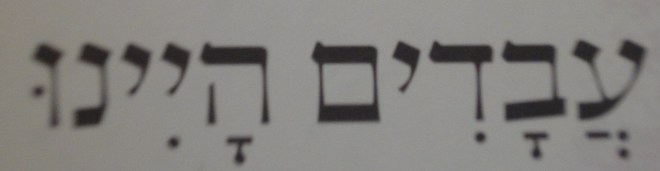
Confusion sometimes arises from the similarity, in English transliteration and in pronunciation, between two prominent words in the haggadah: ‘oved‘ meaning ‘slave’ and ‘oved‘ in the phrase “Arami oved avi,” from Deuteronomy 26:5. The previous post provided a little background on “‘oved‘ with an aleph.” And here, as promised, are a few examples of the word ‘avadim‘ as in “avadim hayinu [we were slaves].”

oved‘ with an ayin: Exodus

Words from the root עבד (oved — ayin-bet-dalet) appear frequently in the Torah and later books of the Tanakh, with many instances in the Exodus story.

For example, Pharaoh is told “let My people go, that they may serve Me” in Exodus 7:16, 8:1, 10:3,…:

שַׁלַּח עַמִּי,
וְיַעַבְדֻנִי.
“…let My people go, that they may serve Me.”
— Exodus 10:3

Pharaoh responds several times, telling Moses “Go ye, serve the LORD…” with some restrictions added:

לְכוּ
עִבְדוּ
אֶת-יְהוָה
רַק צֹאנְכֶם וּבְקַרְכֶם, יֻצָּג: גַּם-טַפְּכֶם, יֵלֵךְ עִמָּכֶם–
Go ye, serve the LORD;
only let your flocks and your herds be stayed; let your little ones also go with you.’
— Exodus 10:24

Later, reference is made again and again to the Israelites leaving “Egypt and the house of bondage.” (Exodus 10:3, 10:14, 20:2,…)

וַיֹּאמֶר מֹשֶׁה אֶל-הָעָם, זָכוֹר אֶת-הַיּוֹם הַזֶּה אֲשֶׁר
יְצָאתֶם מִמִּצְרַיִם
עֲבָדִים מִבֵּית
And Moses said unto the people:
‘Remember this day,
in which ye came out from Egypt,
out of the house of bondage;
— Exodus 13:3

When we recite Hallel at Passover and on other festival days, we reflect on our status as servant now only to God:

אָנָּה יְהוָה,
עַבְדֶּךָ: כִּי-אֲנִי
בֶּן-אֲמָתֶךָ אֲנִי-עַבְדְּךָ,
פִּתַּחְתָּ, לְמוֹסֵרָי.
Now, ABUNDANT ONE,
I am your servant.
I, your servant, child of your servant,
I whose fetters you have opened up.
— Psalm 116:16, Kol Haneshamah
in this prayerbook, NAMES in all caps substitute for YHVH

I beseech Thee, O LORD,
for I am Thy servant;
I am Thy servant,
the son of Thy handmaid; Thou hast loosed my bands.
— Psalm 116:16 JPS 1917

More Bondage and Servants

Forms of ‘oved‘ with an ayin, meaning servant or bondman, appear at many points in the Tanakh. Here are pre-Exodus examples:

In Genesis, we are told that Canaan will be cursed, becoming “servant of servants” or “lowest of slaves” — עֶבֶד עֲבָדִים (Gen 9:25)

When Judah and his brothers are in Egypt during the drought in Canaan and are caught in an apparent theft, Judah says to Joseph: “…we are your bondmen” —
הִנֶּנּוּ עֲבָדִים (Gen 44:16)

Post-Exodus, the people are meant to serve God alone. Should economic circumstances place one Israelite in bond to another, that must be a temporary status: “And if he be not redeemed by any of these means [just outline above], then he shall go out in the year of jubilee, he, and his children with him.” (Lev. 25:54)

כִּי-לִי בְנֵי-יִשְׂרָאֵל,
עֲבָדִים–עֲבָדַי הֵם,
אֲשֶׁר-הוֹצֵאתִי אוֹתָם מֵאֶרֶץ מִצְרָיִם: אֲנִי, יְהוָה אֱלֹהֵיכֶם.
For unto Me the children of Israel are
servants; they are My servants
whom I brought forth out of the land of Egypt: I am the LORD your God.
— Leviticus 25:55

When Nebuchadrezzar, king of Babylon, threatens Jerusalem, the prophet Jeremiah attributes the disaster to the people’s reneging on this command: “but afterwards they turned, and caused the servants and the handmaids, whom they had let go free [at the jubilee], to return, and brought them into subjection for servants and for handmaids” (Jer 34:11).

Later, when the exiles are allowed to return, Ezra remarks on God’s favor, despite the people’s sins:

כִּי-עֲבָדִים
אֲנַחְנוּ–וּבְעַבְדֻתֵנוּ, לֹא עֲזָבָנוּ אֱלֹהֵינוּ;
For we are bondmen;
yet our God hath not forsaken us in our bondage,
-Ezra 9:9

Avadim

posted on this seventh day of the Omer 5777, with this prayer:
“In remembrance of the Exodus from Egypt, we pray that you release all whose bodies and spirits remain captive and enable us to extend Your outstretched arm in the process of liberation.” (see Ritual Well)

Why is This ‘Oved’ Different from The Other Seder ‘Oved’?

“When do we eat?” is often identified as the fifth question at the Passover seder, after the prescribed four about dipping and reclining, bitter herbs and unleavened bread. Just as often, in my experience, people are asking about two Hebrew words that look identical in English transliteration: ‘oved‘ meaning ‘slave’ and ‘oved‘ in the phrase “Arami oved avi,” from Deuteronomy 26:5.

The Hebrew words for “slave,” “work,” and “worship” or “service” all have the same root. (More on “oved with an ayin” in a future post). But I have never heard anyone question the meaning of “avadim hayinu…” which appears near the start of the Passover telling: “We were slaves, and now we’re free.”

Note the letter ayin at the start of the word “avadim [slaves].”

Avadim.jpg
Avadim hayinu

The Deuteronomy verse, “Arami oved avi…” is another story. The ‘oved‘ with an aleph lends itself to several relatively straightforward translations as well as a traditional homelitical reading based on the biblical character most commonly identified with Aram.

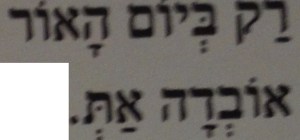
Note the letter “aleph” at the start of “oved [lost, perished, fugitive,…].”

AramiOvedAvi.jpg
Arami oved avi

For discussion of “Who is Arami?” and “What does it mean to be oved?” in the Deuteronomy setting and in the Passover Haggadah, see “Ki Tavo: A Path to Follow.” Here, just to explore Hebrew vocabulary a bit more, is a little background on the word ‘oved‘ (with an aleph) itself.

oved‘ with an aleph

Forms of ‘oved‘ (with an aleph) appear frequently in biblical text. Here are a few instances, along with some translations.

Jeremiah 9:11 —

מִי-הָאִישׁ הֶחָכָם וְיָבֵן אֶת-זֹאת
וַאֲשֶׁר דִּבֶּר פִּי-יְהוָה אֵלָיו וְיַגִּדָהּ;
עַל-מָה
אָבְדָה
הָאָרֶץ, נִצְּתָה כַמִּדְבָּר מִבְּלִי עֹבֵר.
Who is the wise man, that he may understand this?
And who is he to whom the mouth of the LORD hath spoken,
that he may declare it?
Wherefore is the land
perished and laid waste
like a wilderness, so that none passeth through?
— JPS 1917 translation

…Why is the land in ruins
— JPS 1999

Micah 7:2 —

אָבַד
חָסִיד מִן הָאָרֶץ,
וְיָשָׁר בָּאָדָם אָיִן:
The godly man is perished out of the earth,
and the upright among men is no more
— JPS 1917

The pious are vanished from the land
— JPS 1999

Psalms 9:7 —

אָבַד
זִכְרָם הֵמָּה
…their very memorial is perished.
— JPS 1917

…their very names are lost.
— JPS 1999 with note: “meaning of Hebrew uncertain”

Ezekiel 12:22 —

בֶּן-אָדָם, מָה-הַמָּשָׁל הַזֶּה לָכֶם,
עַל-אַדְמַת יִשְׂרָאֵל, לֵאמֹר:
יַאַרְכוּ, הַיָּמִים,
וְאָבַד,
כָּל-חָזוֹן.
‘Son of man, what is that proverb
that ye have in the land of Israel, saying:
The days are prolonged,
and every vision faileth?
— JPS 1917

…every vision comes to naught“?
— JPS 1999

One more point of comparison, just because Temple Micah’s Hebrew poetry group encountered this modern Hebrew instance — over studies during the Shabbat of Passover — and noted how ‘obed‘ with an aleph and ‘obed‘ with an ayin sound alike to most English-speaking, and to some Hebrew-speaking, ears.

Lost

Yehuda Amichai’s “Shir Ha-Chut La-Machut [Poem of the Needle for the Thread]” has not been published in English translation. Our group rendered this line from the poem as “Only in the day, you are lost in the light,” or “Only in the daylight, are you lost.” (We struggled with the expression “b’yom ha-ohr.”)

And, finally, here are several versions of Deuteronomy 26:5 —

וְעָנִיתָ וְאָמַרְתָּ לִפְנֵי יְהוָה אֱלֹהֶיךָ,
אֲרַמִּי אֹבֵד אָבִי,
וַיֵּרֶד מִצְרַיְמָה,
וַיָּגָר שָׁם בִּמְתֵי מְעָט; וַיְהִי-שָׁם,
לְגוֹי גָּדוֹל עָצוּם וָרָב.
And thou shalt speak and say before the LORD thy God:
‘A wandering Aramean was my father,
and he went down into Egypt,
and sojourned there, few in number;
and he became there a nation, great, mighty, and populous.
— JPS 1917

…’My father was a fugitive Aramean…’
— JPS 1999

‘An Aramean Astray my Ancestor”
— Everett Fox translation, 1995

posted on this sixth day of the Omer 5777, with this prayer:
“In remembrance of the Exodus from Egypt, we pray that you release all whose bodies and spirits remain captive and enable us to extend Your outstretched arm in the process of liberation.” (see Ritual Well)

Trouble to See #1: Expelling a Crease or Two

[updated 8/15] At the invitation of Temple Micah‘s Lunch and Learn program (8/10/16), I shared some thoughts about Jews and Racial Justice. I appreciate the opportunity. As promised, I offer the references cited for anyone who wants to explore further: Jews and Racial Justice reference page. I also include below a link to the SongRiseDC rendition of Ella’s Song (from Ella Baker & Sweet Honey and the Rock) that I was unable to share during the talk.

And just to clarify: I share in these “Trouble to See” posts some views which are not my own, for purposes of learning and discussion. But nothing here is the view of Temple Micah.

Skip ahead:
Expelling Creases from the Fold
Trouble to See

Through this talk, I succeeded in annoying a number of people — including myself — for a whole variety of reasons. (I’d like to think that’s some sign of success, given the topic.) At best what I shared can only be the beginning of a long, complicated — and, ultimately, very difficult — conversation.

Trouble to See

We began this afternoon, and I hope we can all continue exploring, with the idea of taking “trouble to see,” based on commentary about Moses at the Burning Bush.  MicahTrouble1


Here’s the commentary —


and the questions I hope we can ask, as we look back on what we think we know about race and racial justice:MicahTrouble2

This is the original post, from 2015, exploring the idea of taking “trouble to see” following the death of Walter Scott.

BACK

Expelling Creases from the Fold

Creases

As part of this exercise in turning the neck, taking “trouble to see” aspects of our past experience in new light, I shared a portion of my memoir/essay, “Skins,” which will appear in the forthcoming Expelling Creases from the Fold, an anthology published by Liberated Muse Arts Group. Thanks to Liberated Muse for allowing me to share this material in advance of its publication.

Here’s a link to the full talk. The reading of “Skins” begins around minute 18:00. (Not the best quality video, sorry. Looking forward to the anthology!!)
BACK

Ella’s Song

Sorry I could not share the SongRise version of “Ella’s Song” during the lunch today. For all in the room today — and anyone else who does not know “Ella’s Song” — as SongRise’s Sarah Beller explains in her introduction: The lyrics are words of Ella Baker, one of the founders of Student Nonviolent Coordinating Committee, and the music was created by Sweet Honey and the Rock.

Last note: the SongRise video cuts off mid-way through their second powerful number, “A Change is Gonna Come.” more on that later…
BACK

Blasphemy of Pharaoh’s Overreach: Theology, Context and the Trouble I’ve Seen

“Claiming the center stage, just like Pharaoh and Caesar did in their time, has always been a blasphemous overreach that actually places oneself on the margins of God’s reign,” thus writes Drew G.I. Hart in Trouble I’ve Seen. 

This new title focuses on “Changing the Way the Church Sees Racism,” but much of what Hart says needs equal attention in the Jewish thought. (Trouble I’ve Seen: Changing the Way the Church Sees Racism. Harrisonberg, VA: Herald Press, 2016.)

Religious Thought and Practice

Hart notes the optional or alternative status of “women’s,” “peace,” or “black” theology:

According to [teacher John Franke] white male theologians have often seen themselves as objective and neutral overseers of Christian tradition. They function as “theological referees” for everyone else, while imagining their position as neutral and unbiased in the center of all the action….Missing is that white men have a social context too.

— p. 163, Trouble I’ve Seen

TroubleA parallel situation still applies all too well in much of the Jewish world. As does his analysis of how well-intentioned attempts at diversity and inclusion often fail to create real change. Many of his recommendations for the Church are ones other faith communities should explore as well:


  1. “Share life together.”
  2.  Practice solidarity. (See, e.g., Be’chol Lashon, Jewish Multi-Racial Network, and Jews of All Hues, as well as links at “Exodus from Racism”)
  3. “See the world from below,” by changing reading habits, for example. (See “Range of Possibilities” for some suggestions.)
  4. “Subvert racial hierarchy in the [religious infrastructure].”
  5. “Soak in scripture and the Spirit for renewed social imagination.” (Explore  “Pharaoh’s Hardened Heart,” e.g. and these resources from Reform Judaism’s Religious Action Center.)
  6. “Seek first the kingdom of God.”
  7. Engage in self-examination.

— from p. 176, Trouble I’ve Seen

Current and Historical Re-Examination

Hart’s exploration of “White Jesus” and related Church history may seem irrelevant to those outside the Christian faith. This is important background for every U.S. citizen, however, and worth review for those as yet unfamiliar.

Moreover, Jewish communities would do well to consider whether our members are aware of essential demographics — such as a recent study showing white men with criminal convictions more likely to get positive job-application responses than black men without a record (see p. 145) — and the individual and cumulative effect of everyday racism experienced by the author of Trouble I’ve Seen.

Most importantly, Jews must join our Christian neighbors in examining how we “resemble this remark”:

Too many in the American Church have perpetuated the myth that this land was build on Christian principle rather than on stolen land and stolen labor.

p.145, Trouble I’ve Seen

Hart’s new volume provides important food for thought as we continue to read Exodus this winter and experience it in the upcoming Passover season.

Hart
Drew G. I. Hart

More about “Anablacktivist” Drew G.I. Hart

Trouble I’ve Seen: Changing the Way the Church Sees Racism. Harrisonberg, VA: Herald Press, 2016.

What are you reading this Exodus season?

Please share your resources and your thinking.

“Wrestling Jerusalem” and Listening thru Oppression

“…but they did not heed because of shortness of spirit-breath” (Exodus)
“It’s complicated…” (“Wrestling Jerusalem”)


Early on in the Exodus story, we learn that the Hebrew slaves in Egypt were unable to absorb Moses’ message of imminent redemption because of “shortness of breath” or “crushed spirit” due to “hard work” or “cruel bondage” (Exodus 6:9; see note below).

At this point, Moses asks God how it is that he, of “blocked speech,” will be able to communicate God’s message to Pharaoh, when even the Israelites won’t listen to him. The story continues with a strong focus on Pharaoh’s inability to hear, alternately attributed to “stubbornness” (e.g., Ex 7:13) and “hardness of heart” (e.g., Ex 8:11). Hebrew below.

Aaron Davidman in Wrestling Jerusalem (Photo: Teddy Wolff)
Aaron Davidman in “Wrestling Jerusalem,” now at DC’s Mosaic Theater (Photo: Teddy Wolff)

So, at the center of the Exodus story is a massive, multi-faceted failure to communicate: a prophet/leader with blocked speech (more literally: “uncircumcised lips”), slaves who cannot breathe well enough to communicate clearly, and a ruler who cannot even hear his own magicians (Ex 8:15) and servants (Ex 10:7). The story reminds us how difficult it is for communication to succeed across communities and through oppression. And the story warns us of the dangers of failing in those communication attempts.

Aaron Davidman‘s one-man play, “Wrestling Jerusalem” — currently [January 2016] at Mosaic Theater Company of DC — embodies at least 17 different voices, from across Israel and Palestine, in monologue and in argument. Each voice provides a very specific perspective, unique to the conflict he is exploring. Throughout the performance, however, echoes of the U.S. conflict come through loud and clear.

Wrestling Jerusalem and the U.S.

In the play, one Palestinian voice explains that the only Israelis he has met are soldiers who often mistreat him and rarely recognize his humanity. How many people of color in the U.S. have a similar experience with white people?

Photo: Teddy Wolff
Photo: Teddy Wolff

Many Black communities in the U.S. view police, not as protectors of peace, but as a “White” power structure occupying and terrorizing their neighborhood. Too many people of color know white people only as government representatives and developers ready to view them as problems to be “fixed.”

“Wrestling” characters, alternately inhabiting Davidman’s body, argue about Hamas: Is it a community organization with a strong feeding program? or an armed group bent on the destruction of Israel? Would donations ear-marked for food programs simply enable violent resistance? With minor changes, these same words have been used to discuss the Black Panther Party or the Nation of Islam: Caring for the ‘hood? Or plotting the downfall of the U.S. power structure?

It’s Complicated
The performance opens with a brilliant “multi-logue” beginning with the pronouncement: “It’s complicated.” Davidman tries to identify the conflict’s start: With the ’67 war? Or 1948 — called either “the Catastophe” or the “War of Independence,” depending on one’s perspective? Maybe with earlier Arab or Jewish violence…or with the British or the Romans? It closes with cries of “If only the world would just leave us alone!” and “If only the world would get involved!”

It’s hard not to hear another set of wrestlers with a parallel litany of “how it started.” Beginning perhaps with Sandra Bland or Trayvon Martin, extending to Emmett Till and Medgar Evers, lives and livelihoods lost in riots of the 20th Century or the 19th, uprisings and mobs of the 18th Century. Then stretching back through U.S. economic dependence on labor of enslaved people and beyond to European views of the “Dark Continent.”

“Help us!” “Leave us alone!”
We might also hear, echoed in the final lines, calls for police to stop “occupying” black neighborhoods and for “Displacement Free” development zones, on the one hand, and on the other, attempts to involve the the U.N. in human rights violations within the United States.

Photo: Teddy Wolff
Photo: Teddy Wolff

The “Aaron” character of “Wrestling Jerusalem” tells us, as he rides the bus through security checkpoints, that he’s been to Israel many times but never before crossed into Ramallah. Likewise, how many residents of north or west Chicago rarely, if ever, cross 75th Street to the South? How many residents of western Washington, DC, seldom cross the Anacostia River? And, of course, vice versa.

Listen!

So many other elements of “Wrestling Jerusalem” — from description of inter- generational trauma to discussion of if/when to take up arms — apply equally to the United States. Davidman’s gift to the conflict around Israel is in embodying and weaving together, with respect, so many voices: Arab and Jew, Israeli and Palestinian, settler and soldier, partier, tourist, and long-time Liberal Israeli rabbi. Each is given the floor and heard in turn. In giving them each something of himself as well as their own unique voices, commonality and difference, Davidman helps us listen across conflict and through oppression.

In a sense, “Wrestling Jerusalem” is an antidote for the Exodus’ failures to communicate. May we listen equally well to the many, often-overlooked perspectives of conflict in the United States.

-1Tickets still available for limited DC run, through January 24.


Thanks to Elliot Eder and participants in Fabrangen West and to the LCVY Hill Torah Discussion Group for Exodus insights that inspired these remarks.

Exodus 6:9
וַיְדַבֵּר מֹשֶׁה כֵּן, אֶל-בְּנֵי יִשְׂרָאֵל; וְלֹא שָׁמְעוּ, אֶל-מֹשֶׁה, מִקֹּצֶר רוּחַ, וּמֵעֲבֹדָה קָשָׁה.
Moses [delivered God’s message of imminent redemption] to the Children of Israel. But they did not heed Moses, because of shortness of breath and hard work [or crushed spirits due to cruel bondage].

מִקֹּצֶר רוּחַ mi-kotzer ruach
ruach = “breath” and “spirit”
mi-kotzer ruach = “shortness of breath” or “crushed spirit”

וּמֵעֲבֹדָה קָשָׁה m’avodah kashah
avodah = “work,” “bondage,” and “worship”
m’avodah kashah = “hard work” or “cruel bondage”

וַיֶּחֱזַק לֵב chazak lev
“stubbornness” (literally: strong of heart; e.g., Ex 7:13)

וְהַכְבֵּד אֶת-לִבּוֹ kh’veid et-libo
“hardness of heart” (literally: heavy of heart; e.g., Ex 8:11)
BACK

In Touch with the Source (Beyond 10)

Three days into the wilderness journey, the promise of freedom seems to fade —

וְלֹא יָכְלוּ לִשְׁתֹּת מַיִם מִמָּרָה
כִּי מָרִים הֵם
they could not drink of the waters of Marah,
for they were bitter [the waters? or the People?]
Exodus 15:23

Despite their recent experiences of leaving bondage and the miraculous, sea-splitting escape from Pharaoh’s army, the Israelites encounter bitterness and are unable to drink.

“Water,” according to Jewish tradition, is linked symbolically with “Torah.” The Israelites’ real problem, therefore, is interpreted as “growing weary” because they “went for three days without Torah.”

The ancient teachers used this story as an explanation for the public Torah reading schedule: Saturdays, Mondays, and Thursdays. In this way, the People “will never go on for three consecutive days without hearing Torah.” In addition, the minimum number of verses for a reading was set at ten, corresponding to the number of people needed to constitute a minyan [public prayer quorum]. (Babylonian Talmud: Baba Kama 82a)

At heart, the message seems to be that we must never drift too long without returning to the Source, however we understand that, and that community is essential in this process.

Nina Simone’s song, “(I Wish I Knew How It Would Feel To Be) Free,” helps me with this “return,” in general, and suggests several lessons for this particular omer journey. There are several wonderful versions, each with its own lessons.

(1) Warning: Most Basic Torah

In her “Live in Montreux 1976” version, Simone pounds out a warning, adding a line not in the usual lyrics:

I wish you could know what it means to be me
If you could see, you’d agree
everybody should be free
’cause if we ain’t we’re murderous
— Live at Montreux 1976, this quote at 2:45ff
(link to clip or whole concert)

The demands here — “see me” and “everybody should be free” — are a call to return to the Source, to the most basic Torah: “I am YHVH thy God, who brought thee out of the land of Egypt, out of the house of bondage.” (Exodus 20:2)

(2) I’d Sing What I Know

This 1968 version, live in Paris —

— stresses “I’d sing what I know.”

This call to learn from — and to share — the direct experiences of people who have suffered oppression is especially apt for this year’s attempt to “Make the Omer Count,” exploring the workings of oppression, and our part in them, with an aim to more effectively move toward liberation for all.

Moreover, Simone urges listeners to participate in a way that echoes for me the rabbis’ embedding of the communal number ten in the Torah reading (above): The artist wants to hear others singing “what I know,” and doesn’t give up when they don’t immediately sing out. At one point she asks band members, “Should I leave ’em alone?” — to which they answer an amused “no!” without missing a beat of their choral response. Still not hearing from enough others, Simone leaves the piano and adds additional verbal and visual cues to facilitate participation.

Finally, I am moved by her addition toward the close of “I’d be a little bit more me.” To me that about sums it up: the journey from Passover to Shavuot is one that is meant to help us each become “a little bit more me,” in our liberation, while striving for a community that honors the need for everyone else to be their own best selves.

SimoneFree

(3) An Anthem Toward…

Several years ago, Elaine Reuben suggested this song as “an appropriate anthem as we count our way toward…” to Fabrangen Havurah‘s Omer Blog). And yes, that’s “toward…” with destination unexpressed, not “forward,” regardless of spellcheck preferences.

The 1967 version, used in the posthumous compilation “The Very Best of Nina Simone” and linked in Fabrangen’s 2010 blog above, is shared without video of the artist. A straight-forward studio version, this rendition serves especially well as “an anthem” in which each of us can join.

This version and Elaine’s “as we count our way toward…” seem apt for this omer journey, with its unknown destination. Of course, we expect to reach 49 and then the holiday of Shavuot. But, our learning about oppression and its workings will be informing where we end up ultimately.

NOTE: In 2013, the Simone estate uploaded an amazing array of resources, including the clip in #2 above, the full concert linked in #1 above, interviews, and more. For more on Nina Simone, visit the website maintained by her estate.

Continue reading In Touch with the Source (Beyond 10)