Lament for Mismatched Glassware

Exploring Babylon Chapter 16.1

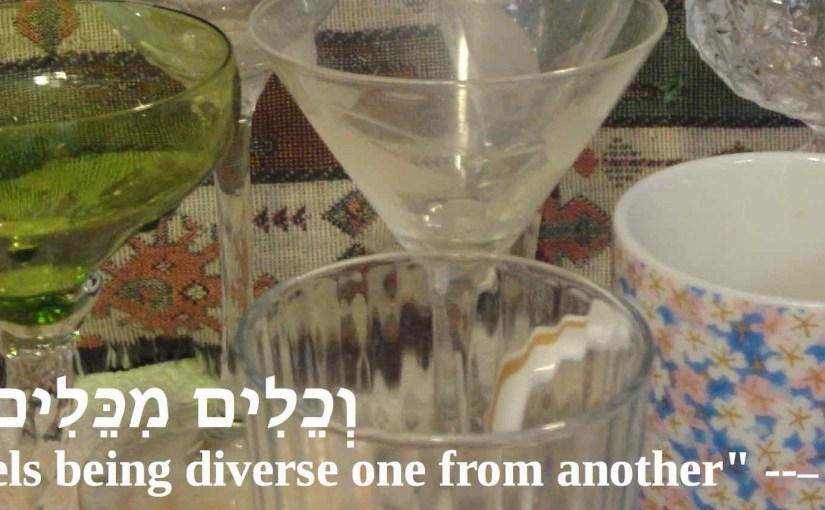
At several points in the Megillah reading, the chant for the Book of Esther shifts to the Lamentations chant. The lament behind some verses seems clear: Mordecai’s introduction as a descendant of Babylonian exiles (2:6) and the decree telling all provinces to destroy the Jews (3:15), for example. It’s less obvious what is lamentable about three words — the whole verse does not change trope, just the three words — describing how banquet guests were served wine:

…וְכֵלִים מִכֵּלִים שׁוֹנִים…
“…the vessels being diverse one from another…” OR
“…beakers of varied design…”
— Esther 1:7

An explanation based on Esther Rabbah 2:11 brings us back to Babylon — although the spirit of Purim seems to cry out for a brief detour to consider the heartbreak of mismatched glassware. (See also note on publication schedule.)

Vessels at the Feast

The Megillah describes the decorations in the palace, the ornate couches, and “vessels of gold” used at the king’s seven-day feast. The text then adds: “Also Vashti the queen made a feast for the women in the royal house which belonged to king Ahasuerus” (Esther 1:8).

There is no mention of the vessels’ origin, beyond the enigmatic “shonim” [“different” or “diverse”]. (Many other explanations have been offered, over the centuries, to explain how the vessels were “different” — a topic, perhaps, for another day.) But Esther Rabbah says the vessels are “different” from ordinary ones in that those used at this feast are the same ones that Nebuchadnezzar took from the Temple in Jerusalem. The passing along of the Temple vessels is also linked in midrash to Queen Vashti.

The Megillah includes nothing about Queen Vashti’s background, although midrash has much to say about her. In terms of lineage, she is described midrashically as Babylonian royalty. She is sometimes identified as Nebuchadnezzar’s daughter (B. Megillah 10b). In one account, she is married to Ahashverus, who was her father’s steward (Esther Rabbah 3:14). Alternatively, she was the daughter of Belshazzar, and Darius married her to his son, Ahashverus, after her father was killed (Esther Rabbah 3:5). The latter story also provides a direct link between Vashti and the vessels in her palace, on the one hand, and, on the other, Belshazzar and the vessels at the “writing on the wall” feast (Daniel 5).

Daniel 5 opens with Belshazzar calling for “the golden and silver vessels which Nebuchadnezzar his father had taken out of the temple which was in Jerusalem.” It is clear, from the text (and midrash) that the party is meant to show contempt for Hebrews and all they hold sacred. The Megillah, in contrast, describes the feasting at the palace of Ahashverus in more neutral terms, while more negative connotations have been added by layers of midrash.

Offspring of Babylon

A strong thread in the negative midrash related to the Megillah stems from identification of Vashti as the “offspring” of Babylon:

וְקַמְתִּי עֲלֵיהֶם, נְאֻם יְהוָה צְבָאוֹת; וְהִכְרַתִּי לְבָבֶל שֵׁם וּשְׁאָר, וְנִין וָנֶכֶד–נְאֻם-יְהוָה.
And I will rise up against them, saith the LORD of hosts, and cut off from Babylon name and remnant, and offshoot and offspring, saith the LORD.
— Isaiah 14:22.

R. Jonathan prefaced his discourse on this section (Book of Esther) with the text, And I will rise against them… (Isa 14:22) [which he expounded as follows]: ‘Name’ means script; ‘remnant’ is language; ‘offshoot’ is kingdom, and ‘offspring’ is Vashti.
— B. Megillah 10b

R. Jonathan’s interpretation of the Isaiah verse can also be linked to the decree about households using the husband’s language (Esther 1:22 — midrash citation to come). Meanwhile, however, Vashti’s brief appearance and then exile have a powerful influence on the rest of the story. (See, for just one example, “The Role of Vashti in the Purim Story,” by Deena Rabinovich — PDF here.) At least one midrash suggests that the language decree, a response to suspicion about Vashti, set up opposition to Ahashverus, resulting, ultimately, in preservation of the Jews (again, citation to come). So perhaps Vashti, as offspring of Babylon, comes to tell us that the past is not so easy to eradicate, and that we are strengthened by preserving lessons — and cultural diversity — brought to us by the past.

Lamentable Banquet Service

This is based very loosely on the “Poetry Game,” created by Zahara Hecksher (9/12/64-2/24/18; her memory for a blessing), and offered in her honor and memory.

Vessels
Instructions:

  • Something in your poem occurs in an alley
  • Refer to a problem in a factory
  • Include the phrase “I remember ____” in your poem

Resulting poem: “Lament for Mismatched Glassware”

Goblets special ordered.
The king wants his display.
“It is time for us to host
A palace feast awash with wine
fine vessels for a toast.”

The queen cannot shake misgivings.
“I remember,” she explains,
“that writing on the wall.
A lavish party, I suspect,
may not end well at all.”

As the date grows near
workshop staff reports the order gone awry.
It appears that no two goblets match.
And not just one odd barrel,
batch after hodgepodge batch.

Palace staff is in the alley
unpacking mismatched wares.
Amid his duties the steward fears.
Royal wrath is a grave concern
as are faux-pas-related tears.

Royal banquet time is nigh.
Guests arriving at the gates.
Will history this night malign?
In trepidation the palace serves
with beakers of varied design.


BACK


Note to subscribers and other followers of “Exploring Babylon” —
Apologies for the hiatus born of flu and weeks of scrambling to catch up with all that was left undone.
BACK

The Treasure and the Favor

Exploring Babylon Chapter 15.2

Just as the stories of Exile and Return include people of quite different mindsets, Exodus peoples are not monolithic, Rabbi Gerry Serotta told me recently. He suggests that #ExploringBabylon could profitably consider some differences among Egyptians in the Exodus tale and look at related texts, in this portion and earlier, about Egyptians becoming “favorably disposed” toward the Israelites.

Difference

Rabbi Serotta points to three groups of Egyptians:

  • those who left with the Israelites — וְגַם-עֵרֶב רַב — “and also the erev-rav [often “mixed multitudes”; Alter uses “motley throng”]” (Ex 12:38);
  • those who did not join the Israelites but gave gold and silver and “raiment/cloaks” (Ex 12:35; see also “The Powers and the Wealth“); and
  • Pharaoh (and, perhaps, other unrepentant oppressors).

 
He adds that it’s good practice to look for the variety of people and perspectives in biblical narrative because “variety is God’s plan.” We see this in the story of Bavel (Genesis Chapter 11) and in many later teachings about the value of galut [exile] and dispersion.

God’s preference for variety is a hard concept to hold in the midst of a tale with the themes “You are MY people and I am YOUR God” and “Let My people go that they may serve ME.” But it can be found in the Exodus tale and in centuries of Jewish teaching centered around it. Seeking out and naming variety within biblical stories helps us avoid pigeonholing people and stereotyping groups in the text, in history, and in contemporary life. Exploring and amplifying difference-celebrating strands of Jewish teaching, from ancient times to the present, provides a foundation for inter-group understanding and cooperation.

…It is no accident that Rabbi Serotta, who has dedicated his career to interfaith, religious freedom, and peace and justice work, is drawn to teachings on diversity and galut [exile]. He offers additional ideas for #ExploringBabylon that will take some time to research; this week, we gratefully continue to pursue his suggestion to “follow the treasure,” so to speak, which appears in this week’s torah portion (Bo: Exodus 10:1-13:16), and its implications….

Boundaries

As discussed in the last episode, ancient commentaries on the gold and silver — mentioned in Ex 3:21-22, 11:2-3, and 12:35-36 (see below) — included the ideas of back wages/reparations and prior ownership of the wealth given to the fleeing Israelites. One important extension to the latter theme focuses on the prominence of women in this exchange to suggest that women used jewels and other portable wealth to bribe neighbors to overlook, or perhaps hide, their infant boys when Pharaoh decreed they be tossed into the river (exact citation temporarily AWOL, sorry).

Robert Alter notes, in his 2004 Five Books of Moses (see Source Materials), that “neighbor” and “sojourner” in 3:22 are feminine nouns, adding:

[The verse] reflects a frequent social phenomenon–also registered in the rabbinic literature of Late Antiquity–in which women constitute the porous boundary between adjacent ethnic communities: borrowers of the proverbial cup of sugar, sharers of gossip and women’s lore.

Alter goes on to insist, however, that exegesis which sees Egyptian women as lodgers in Israelite houses doesn’t match the plague narrative. (He then describes the overall tale as one of “Israelite triumphalism.” More on this below.)

Benno Jacob (1862-1945) also explores boundary crossing and long-term relationships which he sees as hidden in plain sight in Exodus:

The Israelites had settled as herdsmen, a necessary but disdained occupation in Egypt. The details of our story suggest that they were scattered throughout Egypt, which must have led to many personal friendships; only a systematically encouraged hate propaganda was able to change this.
Jacob, The Second Book of the Bible p.343


Protest and Change

Jacob extensively discusses the wealth exchange in Parashat Bo. He uses linguistic and narrative analysis to support his view that God wanted the Israelites and Egyptians to part on good terms and had repeatedly told Moses that was to be the end result. He argues that the Egyptians had already, before Pesach night, come around to seeking compassion and justice for the Israelites, and the farewell gifts are part of the evidence of a change in position:

The Egyptians’ gifts to the Israelites were a clear public protest against the policies of the royal tyrant. They demonstrated a renewal of public conscience…a moral change; the receptive heart of the Egyptian people was now contrasted to the hard heart of Pharaoh.
— Jacob, p.343

He goes further, insisting that this must be a mutual change of heart, from peoples on both sides of the conflict. Jacob links the opening phrase of Ex 11:2 to the similar expression Joseph used in requesting burial for his father (Gen 50:4) and suggests that this link means God was trying to trigger positive feelings:

[God] knew that some Egyptians recalled Joseph, others would have been impressed by the miracles they had witnessed or now had a high a regard for Moses, so they would seek a friendly farewell….

God’s command Moses [Ex 11:2] simultaneously threatened Pharaoh and searched for peace between the two peoples. These peaceful relations were God’s principal concern during Israel’s last hours in Egypt. This was the true meaning of the farewell gifts which the Israelites sought and the Egyptians willingly gave.
— Jacob, p. 344 (emphasis in original)

Rabbi Shai Held, of Mechon Hadar, includes a poignant addendum on this teaching in “Receiving Gifts (and Learning to Love?): The “Stripping” of the Egyptians.” Held quotes Jacob calling this episode “the most elevated and spiritual reconciliation among people; it was full of wisdom and love of fellow man” (p.339 in the above cited Jacob commentary). He then confesses skepticism as to whether Jacob’s story jives with the plain sense of the text but concludes:

One senses in Jacob’s words the insights of a brilliant exegete but also the pain of a rabbi and teacher in a Germany consumed by hate**….In a world suffused with bigotry and hostility, a world in which people of faith often marshal sacred texts to legitimate acts of cruelty and to extol hatred as a virtue, there is great power in reading Jacob’s words and being reminded: At the heart of the religious enterprise is the attempt to soften, and open, one’s heart, to God and to one-another. If even the Egyptians and the Israelites can be (successfully!) called to love one-another, then perhaps, even in the darkest of times, slim glimmers of hope are available to us.

**Held includes a footnote citing personal communication with R. Walter Jacob (Benno’s son) to confirm that his father was working on the Exodus commentary between 1934 and 1939, while still in Germany.

Two Final Comments

Just so we don’t lose sight of the triumphalist nature of the Exodus story in its basic literary form, here are a few more comments from just one scholar:

Denizens of simple farms and the relatively crude towns of Judea would have known about imperial Egypt’s fabulous luxuries, its exquisite jewelry, and the affluent among them would have enjoyed imported Egyptian linens and papyrus. It is easy to imagine how this tale of despoiling or stripping bare Egypt would have given pleasure to its early audiences.
— Alter, on Ex 3:22

Alter adds that the three “sister-wife stories” of Genesis — Abraham and Sarah in Egypt (12:1-10), Abraham and Sarah in Gerar (Gen 20:1-18), and Isaac and Rebecca in Gerar (26:1-16) — “adumbrate the Exodus narrative,” by portraying the couple as arriving with little and leaving with much. Despoiling, he argues, is “an essential part of the story of liberation from bondage in the early national traditions.”

And, finally, also from Benno Jacob:

The Israelites received gifts from their neighbors when they left the Babylonian Exile in a manner parallel to our narrative; these consisted of gold, silver, etc. Some were in response to the royal mandate and were intended for the rebuiling of the Temple while others were freely given (Ezek 1: 4,6)
— Jacob, p.341


TEXTS

And I will give this people favour in the sight of the Egyptians. And it shall come to pass, that, when ye go, ye shall not go empty;
וְנָתַתִּי אֶת-חֵן הָעָם-הַזֶּה, בְּעֵינֵי מִצְרָיִם; וְהָיָה כִּי תֵלֵכוּן, לֹא תֵלְכוּ רֵיקָם.
but every woman shall ask of her neighbour, and of her that sojourns in her house, jewels of silver, and jewels of gold, and raiment; and you shall put them upon your sons, and upon your daughters; and ye shall spoil the Egyptians.’
וְשָׁאֲלָה אִשָּׁה מִשְּׁכֶנְתָּהּ וּמִגָּרַת בֵּיתָהּ, כְּלֵי-כֶסֶף וּכְלֵי זָהָב וּשְׂמָלֹת; וְשַׂמְתֶּם, עַל-בְּנֵיכֶם וְעַל-בְּנֹתֵיכֶם, וְנִצַּלְתֶּם, אֶת-מִצְרָיִם.
–Exodus 3:21-22

Speak now in the ears of the people, and let them ask every man of his neighbour, and every woman of her neighbour, jewels of silver, and jewels of gold.’
דַּבֶּר-נָא, בְּאָזְנֵי הָעָם; וְיִשְׁאֲלוּ אִישׁ מֵאֵת רֵעֵהוּ, וְאִשָּׁה מֵאֵת רְעוּתָהּ, כְּלֵי-כֶסֶף, וּכְלֵי זָהָב.
And the LORD gave the people favour in the sight of the Egyptians. Moreover the man Moses was very great in the land of Egypt, in the sight of Pharaoh’s servants, and in the sight of the people.
וַיִּתֵּן יְהוָה אֶת-חֵן הָעָם, בְּעֵינֵי מִצְרָיִם; גַּם הָאִישׁ מֹשֶׁה, גָּדוֹל מְאֹד בְּאֶרֶץ מִצְרַיִם, בְּעֵינֵי עַבְדֵי-פַרְעֹה, וּבְעֵינֵי הָעָם.
–Exodus 11:2-3

Exodus 12:35-36 was copied in “The Powers and the Wealth
BACK

Benno Jacob

The Second Book of the Bible: Exodus, Interpreted by Benno Jacob. Walter Jacob and Yaakov Elman, trans. (Hoboken, NJ: Ktav, 1992).

Benno Jacob was a rabbi and scholar born in Breslau and active in German Jewish life through the 1930s. He spent his last five years in England, where he completed his Exodus commentary in 1940 and continued to revise it until his death, at age 83, in 1945. See short biography (by his son, Walter Jacob) in the Exodus commentary.

We learn know this biography that Jacob was still in Germany when most synagogues were burned; he watched the German Jewish community to which he’d dedicated his life destroyed; he witnessed the deportation (and eventual return) of his son, R. Ernst Jacob, to Dachau; and he lost nearly everything in moving to England in his late seventies.

Jacobs also produced a commentary on Genesis, which is, as I understand it, not fully available to English readers. Nechama Leibowitz, in her New Studies series, often quotes Benno Jacob, based on unpublished manuscripts. Her chapter on the wealth exchange in Bo makes use of Jacob’s 1924 article, “Gott und Pharao.”
BACK

Babylon and Rachel’s Offering

Exploring Babylon Chapter 8.2

The last episode of #ExploringBabylon focused on the biblical Rachel and her connection to “back home” for the family of Abraham and Sarah, as described in Vayetze (last week’s Torah portion, Gen 28:10-32:3); Rachel’s death and burial on the road, as related in Vayishlach (this week’s portion, Gen 32:4-36:43), was also raised (See “The Babylon Road.”) There is so much more to explore on the road to Ephrath (Gen 35:16-21, Jer 31:14-16). This post begins with one contemporary commentary on one ancient midrash.

Rachel, “Arch-Lamenter”

While the Jacob/Israel clan is still traveling — away from “back home” for Rachel and Leah, and toward the new home for the extended family — the time for Rachel to give birth arrives. Rachel labors with her second child and dies just as her son is born and named: first by his mother, Ben-oni [son of my pain, son of my strength]; and then by his father, Benjamin [son of right, or south, side].

Rachel thus gives birth to the only child of Jacob/tribe of Israel born in “the Land.” But she doesn’t live to participate in the life of the land. Jacob buries Rachel on the side of the road, rather than in the family burial property which is not too far away (Gen 35:16-20). As noted in Chapter 8.1, this burial spot is interpreted as prescient on Jacob’s part, in terms of later exile of his descendants. And the death and burial leave Rachel in a particularly evocative position.

Bodies Performing in the Ruins: The Lamenting Mother in Ancient Hebrew Texts,” by Galit Hasan-Rokem, describes one midrash which links Rachel’s separation from her child in death with Israel’s separation from future children in exile. Hasan-Rokem summarizes one of the long proems opening Lamentations Rabbah (5th Century CE). In it Moses shows the patriarchs the death and destruction in the aftermath of the Babylonian attack on Jerusalem.

“After the patriarchs and Moses have failed to move the heart of the angry father God,” she says, “a remarkable scene is acted out.” Hasan-Rokem then quotes Lam. Rabbah (I am cutting her quoted text into paragraphs for easier reading):

At that moment Rachel leapt before the Holy One, blessed be He, and said:
“Lord of the universe, you know that Jacob your servant loved me exceedingly, and toiled for my father on my behalf for seven years. And at the end of seven years, when the time of my marriage arrived, my father advised that my sister should replace me, and I suffered greatly because his counsel became known to me. And I informed my husband and I gave him a sign so that he might distinguish between my sister and me, and my father would be unable to replace me.

“Later, I repented and suppressed my desire, and took pity on my sister so that she would not be shamed. In the evening, they substituted my sister for me with my husband, and I gave my sister all the signs that I had agreed on with my husband, so that he would believe that she was Rachel. More than that, I went under the bed upon which he lay with my sister, and when he spoke to her and she remained silent, I gave all the answers so that he would not recognize my sister’s voice.”

Up to this point, the narrative follows the tale in the Babylonian Talmud Baba Batra 123a, explicating the enigmatic line, “And it came to pass in the morning, behold! it was Leah”  (Gen 29:25). Then comes Rachel’s contribution to the pleading before God, followed by God’s response:

“I was gracious, I was not jealous, and spared her shame and dishonour. If I, only flesh and blood, dust and ashes, was not jealous of my rival and spared her shame and dishonour, why should you, the everlasting and compassionate King, be jealous of idolatry, which is insubstantial, and exile my children who were slain by the sword, and let their enemies do with them what they wish?”

Forthwith, the mercy of the Holy One, blessed be He, was stirred, and He said: “For your sake, Rachel, I will restore Israel to their place. And so it was written:

Thus said the Lord:
A voice was heard in Ramah
lamentation and bitter weeping,
Rachel weeping for her children,
refusing to be comforted for her children,
because they are no more
(Jeremiah 31:14).

And it is written:

Thus says the LORD:
Refrain your voice from weeping,
And your eyes from tears,
For your work shall be rewarded, says the LORD,
And they shall come back from the land of the enemy
(Jeremiah 31:15).

And it is written:

There is hope in your future, says the LORD,
That your children shall come back to their own border
(Jeremiah 31:16)

–Lam. Rabbah proem 24, quoted in Hasan-Rokem
For another translation, and much more about Rachel in midrash, see Jewish Women’s Archive


Partner in Redemption

Hasan-Rokem comments that Rachel is offering as token “not her premature death…but rather her life, the enduring of the burning passion of the added seven years of longing between her and Jacob” (p.57). The burning passion is significant, in this context, as an illustration of

the transformation of stored-up erotic energy into the power that can produce a lament so effective it will move even the angry and despotic Divine Majesty….Rachel emerges almost as a weeping goddess, and certainly as a partner to God in the act of redemption.
— “Bodies Performing in the Ruins,” p.57

The author’s thesis in this paper involves the “Babylonian legacy of lamenting gods and especially goddesses,” which will have to be a topic for another day. But her description of Rachel offering “not her premature death…but rather her life” can also point us to the significance of another aspect of this midrash.

Rachel tells God, “I was gracious, I was not jealous, and spared [my sister’s] shame and dishonour,” arguing that, if she, with her limited human resources, managed to behave without jealousy, God should davka be able to overlook idolatry. How many lessons are here for people struggling to function with integrity and flexibility in a diverse, often contradictory, world? This model is at least as important, I think, as Rachel’s lament in moving God and serving as partner in redemption.


Galit Hasan-Rokem. “Bodies Performing in Ruins: The Lamenting Mother in Ancient Hebrew Texts.”
IN Perspectives on Jewish Texts and Contexts, edited by Vivian Liska.
Volume 2: Lament in Jewish Thought: Philosophical, Theological, and Literary Perspectives
Ilit Ferber and Paula Schwebel eds. (Berlin: de Gruyter, 2014)
This article is available through Academia (dot) edu.
This article offers a number of insights relevant to #ExploringBabylon, which will have to await another day.
BACK

The Babylon Road

Exploring Babylon Chapter 8.1

The biblical Rachel, the last matriarch to join and add to the clan that becomes Israel, is tied to the east in several ways — all leading, ultimately, to Babylon.

Children of Two Lands

Rachel is introduced just after Jacob arrives in the “land of the Easterners [אַרְצָה בְנֵי-קֶדֶם]” (Genesis 29:1, last week’s Torah portion: Vayetze, Gen 28:10-32:3).

The construct “בְנֵי-קֶדֶם, bnei-kedem” — sometimes translated as “people (or children) of the east,” sometimes, “Kedemites” — does not appear anywhere else in the Torah, although it shows up ten times later in the Tanakh (Concordance Even-Shoshan). Many Torah translations leave the expression without comment (cf. Alter, Fox, URJ, Women of Reform Judaism, Gefen Onkelos); the Stone Chumash simply points out that Ur Kasdim and Haran, places associated with Abraham’s family, are east from Canaan.

Some commentators note that eastward is the direction Abraham sent the children of Ketura, whom he married after Sarah’s death (Gen 25:6). The word “kedem” itself means “past,” as well as “east.”

Previous #ExploringBabylon chapters discussed two themes, repeated through much of Genesis:

  • Ur Kasdim and Haran as “Back Home” for the family of Terah;
  • the descendants of Sarah and Abraham as perpetually “from there.”

Both themes appear in Jacob’s story, and both appear, in two quite different ways, in the stories of Leah and Rachel.

Two Sisters

Jacob is urged, separately by Rebecca and Isaac, to leave Canaan, with both parents saying that he should seek out Rebecca’s brother and find a wife from the uncle’s household (“back home”). Isaac echoes Abraham’s earlier words, insisting his son should find a wife “from there [מִשָּׁם].”

In their instructions to Jacob, Rebecca calls her old home “Haran,” while Isaac calls the place “Paddan-Aram.” Jacob goes to Paddan-Aram (Gen 28:5), going out from Beer-Sheva toward Haran (Gen 28:10). Where he arrives, however, is “artzah bnei-kedem.”

Jacob’s grandparents and parents retained a sense of “from there,” while leaving “back home” behind: Sarah and Abraham left there, as did Rebecca. But Jacob’s trajectory is different: He will live decades among the people of kedem. So, even though the plain meaning of arriving “artzah bnei-kedem” is reaching the “east country” or “land of the Easterners” (as JPS has it above), Jacob has also, in a sense, traveled toward his family’s past. And Rachel’s introduction links her to this land in a way that Leah’s does not.

Jacob arrives in the land of the Easterners, where he sees a well and flocks of sheep and then meets locals who tell him his cousin Rachel is on the way. Rachel, whose name means “ewe,” is intricately woven into this landscape and the household of Laban, where she is seen and heard taking an active role.

Leah, in contrast, is not introduced until 29:16 and then only as Laban’s older daughter with tender, or weak, eyes; she is not linked to the land in any way and does not interact with Laban, except as the passive object of his machinations.

Two Stories

The sisters jointly declare themselves “as outsiders” [כִּי מְכָרָנוּ] in Laban’s household, when Jacob proposes leaving (Gen 31:14-16). The Torah: A Woman’s Commentary adds:

By acknowledging their outsider status in the household, Leah and Rachel prepare themselves to journey to an unknown land. They distinguish themselves from their father, citing the egregious manner in which he married them off and then denied them their due.
— Rachel Havrelock’s commentary to Vayetze

But this doesn’t pan out in the same way for both sisters.

Eventually, although we learn nothing about the later stage of her life, Leah does settle with Jacob and the extended family in Canaan; she is buried at Machpelah with Sarah and Abraham, Rebecca and Isaac, and, finally, Jacob (Gen 49:31). We also learn that Dinah, “the daughter whom Leah had borne to Jacob, went out to visit the daughters of the land” (Gen 34:1); this troubling episode is beyond the scope of this project, but it does seem relevant that Leah and Dinah are thus linked, not to the old land but to the new.

Rachel, in contrast, seems to have stronger relationships to the old land and to the old family. She steals the terafim (הַתְּרָפִים [idols, household gods]) from her father’s house (Gen 31:34), which many commentators link to inheritance or clan leadership — although there is great variety in interpreting the meaning of her act. Moreover, when Laban comes in search of his property, Leah is again a cipher in his presence, but Rachel is seen and heard responding to her father.

However the theft is interpreted, Rachel’s act exhibits strong opinions about her native culture and her place in it. She does not simply move on. And she doesn’t simply move into the new land, either, as her story unfolds in this week’s Torah portion (Vayishlach, Gen 32:4-36:43).

Two Bookends

We’ll explore Rachel’s appearance in the Book of Jeremiah more thoroughly later, but it seems important to mention here the second bookend for her story: We saw above how the landscape appeared prior to Rachel’s gradually coming into view as part of it (Genesis Chapter 29). In Jeremiah 31:15, her cry is heard “wailing, bitter weeping,” before we are told that it is Rachel weeping.

Rachel is tied strongly to the land of her birth; she doesn’t leave it easily or have an opportunity to live in the new land, even as she gives birth to the only child of Jacob, tribe of Israel, born there.

And Rachel died, and was buried on the road to Ephrath (Gen 35:19). Why did Jacob see fit to bury Rachel on the road to Ephrath [and not in the cave of Machpelah*]? Because our father Jacob foresaw that they who were to be exiled would pass by way of Ephrath. Therefore he buried her there, so that she might beseech mercy for them. Referring to this, Scripture says, “A voice is heard in Ramah, lamentation, and bitter weeping. Rachel is weeping for her children” (Jer. 31:15).
— Sefer Ha-Aggadah 50:87, based on Genesis Rabbah 82:10

*Footnote provided by Sefer Ha-Aggadah: Ramah, near where Jacob buried Rachel, lay north of Jerusalem in the path of the exiles driven toward Babylon. Hebron is south of Jerusalem, and the patriarchs and matriarchs buried there in the cave of Machpelah were out of the way of the exiles going northeast to Babylon.

In this way — and in others we’ll explore soon — the bookends of Rachel’s life and death link her to the Babylon of the past and future and to the precarious nature of Israel’s future on the land.

Babylon and the Writing on the Wall

Exploring Babylon: Chapter 5.1

The song, “Mene, Mene, Tekel” (Harold Rome, 1939) takes its name and chorus from the original, now proverbial, “writing on the wall” (Daniel 5:25):

MENE MENE TEKEL UPHARSIN
מְנֵא מְנֵא, תְּקֵל וּפַרְסִין

Rome’s satirical translation of the “writing on the wall” seems as appropriate to 2017 as to 1939, and it’s quite faithful to the biblical text:

King, stop your frolicking, stop your flaunting
you’ve been weighed and you’re found wanting
all your days are numbered days
the Lord don’t like dictators or dictators ways
— H. Rome “Mene, Mene, Tekel”
(Joe Glazer’s version; full lyrics, original and adapted)

This song also leads to further questions about how we understand and interact with sacred text, particularly at times of crisis. And it will give us a slightly different perspective for #ExploringBabylon.

Music of Protest and Power

When new, the song was banned from the radio and protested by both the Daily Worker and the Catholic Archdiocese of New York, among others. It was a later addition to the already controversial musical revue, Pins and Needles, November 1937 to June 1940. The satirical revue ran for 1108 shows, a record for Broadway shows at the time, and was performed throughout most of its run by amateurs from the International Ladies’ Garment Workers’ Union.

Labor and other social justice issues were frequent topics for Rome (1908 – 1993). For more, see 1993 NY Times obituary and the 2014 biography (Lyrical Satirical Harold Rome: A biography of the composer-lyricist. Tighe E Zimmers).

Joe Glazer (1918-2006), known as “Labor’s Troubadour,” often performed “Mene, Mene, Tekel” along with other organizing and protest songs (2006 NY Times obituary). Glazer settled in Silver Spring, MD and lent his voice — including renditions of this song — to early Jews United for Justice Labor Seders.

In a 1981 live performance, Glazer introduced the song’s historical and biblical background:

I want to close with one of the great song’s by Harold Rome. He wrote it at the height of Hilter’s move through Europe, Africa…he was gonna invade England. He was taking over everything, it looked pretty, pretty dark.

Old Harold Rome he took out the Bible, and he checked the Book of Daniel. He saw that old Belshazzar — he was riding high one day, and he got his comeuppance, because he saw the handwriting on the wall. It said: “MENE MENE TEKEL UPHARSIN,” in old Aramaic. “You have been weighed in the balances and you have been found wanting.”

He just took that story and he wrote it up. And that’s what helped to bring old Hitler down, I’ll tell you that.
— from “The Jewish Immigrant Experience in America”
Collector Records, Smithsonian Folkways

Smithsonian Folkways shares Glazer’s introduction and song here–

Rome’s 1962 Anniversary recording, lyrics (Rome and Glazer versions), and more posted here.

Guests were Shagging

Most of Glazer’s alterations to Rome’s lyrics are stylistic, including rhythm and story-telling preferences, and some changes to dialect. One of the biggest changes is the use of “the joint was jumping” in place of Rome’s “guests were shagging.” And this raises some interesting questions about study and use of the bible.

In the US in the 1930s, “shagging” was a relatively new term for a form of jazz dance. Swing dancers, especially in the South, still use the term, although the style has changed over the decades.

Someone more familiar with the history of British slang would know if “shag” was used in the 1930s for sexual intercourse — and if such usage was commonly known in the US; this would create a double-entendre. But it seems likely that the primary meaning in “Mene, Mene, Tekel” was that the banquet included spirited dancing, maybe something like this (from “A Day at the Races”) —

— or maybe this instruction video from Arthur Murray.

By the latter part of the 20th Century, the dance meaning was less generally current, and the Britishism had gained popularity in the US. So saying the “guests were shagging” at that point, when the song was in Glazer’s repertoire, could just sound crude.

This tiny example of how a change in language usage — even among primary speakers of the language alive to recall some of the shifting — is offered as a reminder of just how complex a project it is to interpret an ancient text that has traveled continents and cultures.

It can also point to a bit of what (mostly Christian) bible scholars call “reception history,” that is, how sacred text is understood and used in different generations. More on the general concept in the future.

Guests were Shagging?

Whatever Rome originally intended by “shagging” — an eager student of Broadway and dance could no doubt uncover this, if it’s not already known — sexuality and partner dancing are always closely entwined. Moreover, we are told in the Book of Daniel that Belshazzar is feasting with his “consorts and concubines” — “court and concubines” in the song lyrics (both versions). In addition, sexual license is an aspect of the ill-repute Babylon developed through the centuries (partly via Christian Scripture). More on this later, too.

In this respect, it’s unclear how much “sex” is included in any description of dancing at Belshazzar’s party. But the descriptions of partying in “Mene, Mene, Tekel” don’t sound like a condemnation of sexy jazz dancing, or of anyone but the king.

A musically-oriented interpreter with an ear to Europe in 1939 knows that the Reich was banning jazz as “degenerate music,” for its Jewish and Black associations. (See US Holocuast Memorial Museum just to start.) In that context, what does it mean that “guests were shagging, horns were blowin'” during Belshazzar’s banquet?

We have a hint in the song’s conclusion:

Now, the king of Babylon was slain
But the children of the Lord remain
All his idols turned to rust
crumbled are his kingdom and his power to dust

It’s not the dancers and horn players who turn to dust but the king and his power. More on all this as we continue #ExploringBabylon.

NOTES

Note 1: Daniel and the Writing
The Book of Daniel comes to us partially Hebrew and partially, including Chapter Five, in Aramaic. These four words on the wall, and Daniel’s interpretation of those mysterious words, is the heart of this chapter’s story. So, the words are generally left untranslated and rendered (IN ALL CAPS, e.g) so as to stand out.

It’s pronounced something like “menny, menny, teckle, oo-farseen.”

And this is the writing that was inscribed: MENE MENE, TEKEL UPHARSIN.
This is the interpretation of the thing: MENE, God hath numbered thy kingdom, and brought it to an end.
TEKEL, Thou art weighed in the balances, and art found wanting.
PERES, thy kingdom is divided, and given to the Medes and Persians.’
Then commanded Belshazzar, and they clothed Daniel with purple, and put a chain of gold about his neck, and made proclamation concerning him, that he should rule as one of three in the kingdom.
In that night Belshazzar the Chaldean king was slain.
— Daniel 5:25-30 (Old JPS) Mechon-Mamre

TOP

Babylon: Assimilation and Separation

Exploring Babylon: Chapter 4.2

While sojourning in Gerar (Gen 20), Abraham assumes there is “no fear of God in the place.” That’s what he tells King Abimelech, anyway:

וַיֹּאמֶר, אַבְרָהָם, כִּי אָמַרְתִּי רַק אֵין-יִרְאַת אֱלֹהִים, בַּמָּקוֹם הַזֶּה;
And Abraham said: ‘Because I thought: Surely the fear of God is not in this place;…
— Gen 20:11

Believing the worst of Gerar, Abraham had introduced Sarah as his sister. (The perceived benefit of this move is the subject of much commentary but beside the point at the moment.) Abimelech, based on Abraham’s information, had taken Sarah into his home as wife. But God warned Abimelech of the situation in a dream. And once Abimelech sorted things out, “all the wombs of his household,” which had closed in consequence of Abraham’s trick, healed.

“To his shame,” writes Rainer Albertz, “Abraham had to learn from Abimelech that a ‘Gentile nation’ could also be righteous” (Gen 20:4). Albertz suggests that entire narrative of Genesis 20 is meant to warn against “religious arrogance” and remind readers that, even in a foreign land, “there is also morality and piety” (Israel in Exile, p.265).

Reading the story of Gerar as a morality tale about the dangers of “religious prejudices,” helps make sense of an otherwise disturbing and puzzling text. It seems a powerful lesson any generation could use.

Whether Jews in Babylonian Captivity actually gleaned this lesson from existing Torah text — or from a “Patriarchal History” crafted during exile — is another question.

Lessons for Exiled People

Very old interpretations of Genesis 20 blame Abraham for thinking ill of Gerar. But Jewish scholarship actually dating midrashim about the dangers of religious prejudice to the Babylonian Captivity — again, that’s another question. (Comments, sources most welcome.)

Albertz goes even further than seeking interpretations of the text dating to the Captivity, though: He assigns Genesis 20 to an “exilic Patriarchal History.” He similarly assigns Genesis 21 and 22 to this document, arguing that these tales respond to the needs of a people in exile in these ways:

  • they affirm the value of other nations (e.g., Ishmael’s descendants);
  • the promote non-assimilation (Ishmael is cast out); and
  • they teach “trust in God even when God seemed to be…the most profound threat to Israel” (the Akedah). — Israel in Exile, p.264ff

The kind of scholarship in which Albertz and other, mostly Christian, scholars are engaged, is illuminating for #ExploringBabylon. But the documentary methodology itself is, at least at present, outside the main work of this project. Look for more from those who write about the Exile’s influence on Tanakh — and on contemporary lessons for communities in geographic flux — as this project progresses.

In a related avenue of study, Rev. Hugh R. Page, Jr. of Notre Dame examines ancient Hebrew poetry and its place in the Tanakh specifically from an Africana perspective. Ancient Hebrew poetry, he writes:

represents the earliest recorded musings of our biblical forebears on God, the universe, community, nature, humanity, and life’s ultimate meaning. Moreover, it offers a selective view of an Israelite ethos, born in crisis, that is dynamic, creative, pluriform, polyphonic, and transgressive. This is a community whose early challenges were not unlike those encountered by many Africana peoples today, particularly those dealing with the effects of social displacement and marginalization.
— Page, Israel’s Poetry of Resistance: Africana Perspectives on Early Hebrew Verse, p.ix (full citation and more)

Babylon: Back Home

Updated with additional Moon-cult link and previously missing footnotes.

Exploring Babylon: Chapter 3:2

The Torah doesn’t tell us much about the background of Abraham and Sarah, except that they leave it. We learn later, though, that their family maintains ties with the folk “back home.” And that on-going relationship has a lot to do, both logistically and thematically, with the larger theme of Israel’s relationship to Babylon.

Two of the few details we get about Abraham and Sarah involve departures:

  • Together with Abraham’s father, Terah, and “them,” Abraham and Sarah “departed from Ur of the Chaldees, to go into the land of Canaan; and they came unto Haran, and dwelt there” (Gen 11:31).
  • At Haran, God tells Abraham to go forth; he goes, with Sarah and his family group: “…they departed to go to the land of Canaan, and they came to the land of Canaan” (Gen 12:1, 4).

The departure of Gen 12:1 — “from your land, from your kindred, and from your father’s house” — is often read as thorough and decisive. Later covenantal language, which includes a name change for Abraham and Sarah (from the original Abram and Sarai) and the ritual of circumcision to separate those in- from those outside (Gen 17), suggests that a serious break with the past is intended. Later, however, Abraham sends to his people back home to find a wife for his son Isaac (Gen 24), and Jacob spends two decades in the old country, marrying two women from his grandparents’ kindred (Gen 29ff).

Over the millenia, a variety of teachings have been gleaned from connections of the Patriarchs and Matriarchs with folks “back home.” There is much food for thought and study there in #ExploringBabylon. Here, to begin, are two points of note.

Babylonian Time Travel

From the land of Palestine in the First Century CE, Rabbi Yohanan ben Zakkai taught:

R. Yohanan ben Zakkai used to say: Why should Israel have been exiled to Babylon more than to any of the other lands? Because Abraham’s family came from there. By what parable may the matter be explained? By the one of a woman who was unfaithful to her husband. Where is he likely to send her? Back to the house of her father.
— Bialik & Ravnitsky, The Book of Legends: Sefer Ha-Aggadah 149-150:18 (full citation)
[based on Tosefta Baba Kama 7:3]

R. Yohanan’s teaching merges the Babylon of Captivity, which was roughly 700 years before his time, with the “back home” of Abraham, which the rabbis of the Talmud placed at some 1500 years earlier. Without more context, it’s hard to tell what else the teaching meant to say about Abraham’s place of origin, but it does seem to confirm the idea of an on-going relationship between Israel and “back home.” Perhaps it’s a largely negative one, but there is some kind of relationship.

Two hundred years later, the older teaching is amended:

R. Hanina said: The Holy One exiled them to Babylonia because the language is akin to the language of the Torah. R. Yohanan said: Because He thus sent Israel back to their mother’s house. As when a man grows angry at his wife, where does he send her? Back to her mother’s house. Ulla said [God sent them to Babylonia] so that they might eat dates and occupy themselves with Torah.
The Book of Legends: Sefer Ha-Aggadah 380:25
[based on B. Pes 87b-88a]

Ulla, who traveled between the Talmud academies of Palestine and those of Babylonia, adds a third time period to the merged Babylon concept: It’s Abraham’s original home, it’s the place of Captivity, and it’s a contemporary place where the speaker has witnessed Jews thriving in body and soul. R. Yohanan’s teaching is still there, but it’s book-ended with entirely positive comments about Babylon as the time travel expands.

In addition to merging time periods, both teachings rely on some merging of geographical locations.

Mesopotamia

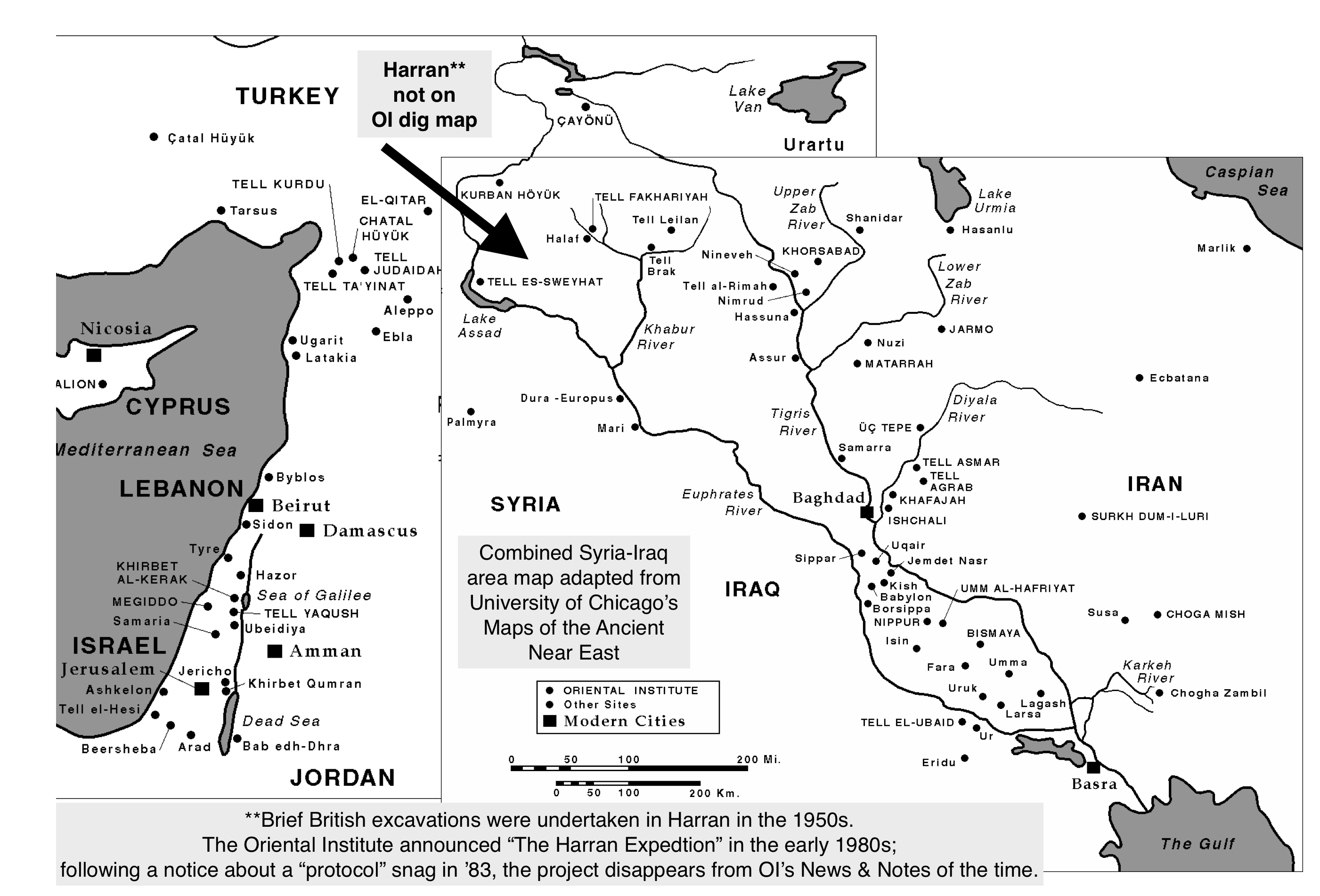
In Genesis (cited above), the places specifically linked to Abraham and Sarah are called Ur Kasdim [אוּר כַּשְׂדִּים] and Haran [חָרָן]. Scholars — of history, archaeology, and bible studies — today identify these biblical locations with the historical cities of Ur, west of the Euphrates River in the southernmost area of Mesopotamia, and Harran, between the Euphrates and Tigris rivers in the northernmost section of Mesopotamia.

Babylon, which Genesis never identifies directly with Terah or descendants, is also between the rivers, south of Harran and north of Ur. In Jewish discourse, however, “Babylon” sometimes means the city, but can also mean the wider Babylonia or whole region of Mesopotamia.

Iraq_Syria_CombinedMap
more info: https://oi.uchicago.edu/research/computer-laboratory/oriental-institute-map-series

As #ExploringBabylon continues, we’ll return to the relationship of Israel to Mesopotamia — in geography, history, and imagination. One of the key elements in that relationship involves the “old” religion. And this topic is linked to the two towns associated with Terah and family.

The Torah text itself does not explain why Terah left Ur or why Abraham is told to leave Haran; nor does the Torah give any reason for God’s choice to engage with Abraham. Commentary generally equate the journey with distancing from older practices and beliefs, particularly in the towns of Ur and Haran. Midrash often fills the white space with stories about Abraham (and, sometimes, Sarah, to whom he was already wed) taking steps toward monotheism before God said “go forth,” while other family members faltered. For example:

Influenced by Abram and his circle, Terah and other members of the family also felt an inner urge — yet not sufficiently strong or clear — in the spiritual direction toward which Abram was set with all his heart and soul. But they did not succeed in overcoming completely the attraction of idol worship and were unable to abandon the world of paganism; they did, in truth, set out on the journey, but stopped in the middle of the away.

Throughout his life, [Terah] did not find the strength to continue his journey and reach the goal that he originally had in mind under his son’s influence. Although he had made an effort to get away from the centre of the moon-cult in Ur of the Chaldees, yet when he came to another city dedicated to this worship — to Haran — he did not succeed in freeing himself from the spell of idolatry, and stayed there.
— Umberto Cassuto, A Commentary on the Book of Genesis Part Two: From Noah to Abraham (Jerusalem: The Magnes Press, 1964; Hebrew, first published 1949), p.281, 283

For more on the moon-cult of Sin, an archaeology background page.


“And Them”

Rabbi and biblical scholar Umberto Cassuto (1883-1951) was eager to provide alternative readings to those promulgated under the Documentary Hypothesis in the mid-20th Century. As part of that effort, he goes to great pains to elaborate on the phrase “[וַיֵּצְאוּ אִתָּם] they went out, with them” (Gen 11:31) in relation to Terah and his traveling party. He also looks at inconsistent references to Abraham’s “country” and “kindred.” (See From Noah to Abraham (full citation).)

While Cassuto is arguing against assigning various passages to the different Documents (not a central concern of this blog), his detailed analysis adds texture to the picture of “back home” for Abraham and Sarah. And that is useful for #Exploring Babylon.

Home and Also Home
Casutto points out that “birth-place” did not mean the same thing for a nomadic people that it means to more settled folk. After further discussion of the references to Abraham’s “country and kindred,” he concludes:

Thus there is no contradiction at all between the passages that indicate Ur of the Chaldees as the original home of Abram and those that afterwards refer to the land of Haran as his native land.
— Cassuto, p.274

This declaration speaks charmingly to all of us who distinguish between “original hometown,” on the one hand, and “longtime home,” on the other. Neither is less “native.” But he goes on to use his analysis to bring some further depth to the landscape Genesis 11ff.

Cassuto suggests that perhaps Terah’s family had originated in Haran and traveled to Ur at some point:

Accordingly, the migration to Haran mentioned in v.31 [11:31] really marks the return of the family to its original home. The fact that Ur and Haran were the chief centres of the cult of the moon-god Sin, and consequently were linked together by firm and permanent ties, serves to explain the movements from one to the other.
— Cassuto, p.275

BACK

Babylon: Babel’s (Distant) Background

Exploring Babylon: Chapter 3.1

The Hebrew “Bavel” is translated into English as “Babel” in Genesis and as “Babylon” when it appears elsewhere in the Tanakh. Bavel as Babel shows up in a total of two verses in the entire Torah text: Gen 10:10, Nimrod’s legacy — “the beginning of his kingdom was Babel, and Erech, and Accad, and Calneh, in the land of Shinar,” and Gen 11:9, the close of what is usually called “The Tower of Babel” story. Bavel, now Babylon, is not mentioned again until 2 Kings 17:30, during the exile of the northern kingdoms.

After that, the Concordance (Even-Shoshan 1998) lists 281 additional appearances Bavel in the prophets and two in Psalm 137. Down the road, we’ll explore Babylon references in the later Tanakh. For now, let’s return to the Genesis.

Babel and Babylon

Jewish commentary on Gen 11:1-9 often treats the Bavel of Genesis as a place apart from history and geography. The focus is on the Babel tale’s placement in the Torah: after the Flood — when Noah’s descendants were told to “be fruitful and multiply and fill the earth” (Gen 9:1) — and before Terah, Abraham, Sarah, and Lot leave Ur (Gen 11:31). Babylon is far in the background, often unremarked.

For example, Rabba Sara Hurwitz, of Yeshivat Maharat, recently shared a lovely, powerful dvar torah for the Torah portion Noach (Gen 6:9-11:32):

And God models how to exist in a world of diversity. In verse 7, when God goes down to mete out their punishment, God says: “Come let US go down.”

Rashi, addressing the question of who God is talking to, suggests that God “took counsel with the Angels, with his judicial court.” Surely God knows how to mete out judgment and punishment, as he has already done unilaterally in the Torah without discussing it with the Angels? Perhaps, God turns to them to asses their thoughts on the sin of the people, to hear their opinion, to debate the pros and cons of scattering the people all over the world. By addressing the Angels, God models how to collaborate with others. Diverse ideas, when debated in a respectful manner, can lead to growth, greater productivity, and ultimately harmony.

…The challenge with diversity is to reject the tendency toward segregating, and running away from conflict. For out of conflict, when we are willing to confront one another with healthy debate, tolerance is born…
— Hurwitz, ָ”Harmony, not Conformity

Hurwitz’s dvar torah is about Babel, not Babylon. She mentions no historical city or empire. Plenty of homelies, in- and outside the Orthodox world, identify Babel with Babylon and incorporate views of the latter; idol-worship, smugness of place, and failure to follow God’s commandments are common themes linking Babel and Babylon. However large a role Babylon plays in any given dvar torah, the overarching point is to help us better understand the Torah, ourselves, and our obligations as Jews — not to tease out insights on life in ancient Babylon.

Still, Jewish bible study has long examined the relationship of the historical, geographical Babylon to the Babel of Genesis 11. For thousands of years, that discussion has returned again and again to concepts of unity and difference, centralizing and dispersing. And for thousand of years, intentionally or not, those discussions have incorporated political ideas about these themes.

Because Babylon, in its many guises, is never far away from Jewish consciousness. Remember: We’ve already found Babylon in the primordial stuff of Creation and in the formation of the first earthling….

It’s Complicated

Erin Runions analyses Babylon as a complex, often contradictory, theme in U.S. culture and politics. From a non-Jewish academic perspective, she writes about the Tower:

The Tower of Babel appears in political and religious discourse when people want to think about what holds the United States together in the face of its racial and cultural diversity. Because the Babelian creation of diverse languages is typically read as both God’s will and at the same time a punishment, the story lends itself well to representing a range of attitudes about difference. A confusing ambivalence about unity and about too much diversity emerges. Via the Babel story, Babylon is sometimes used to promote tolerance toward sexual and ethnic difference, insofar as U.S. Americans see themselves as benevolent toward difference. At other times it is used to stigmatize and attack difference as embodying a problematic unity without moral distinctions.
The Babylon Complex: Theopolitical Fantasies of War, Sex, and Sovereignty (NY: Fordham University Press, 2014), p. 22-23

Runions calls Babylon “a surprisingly multivalent symbol” in U.S. culture and politics and then dedicates 300 pages to unpacking its complexities. Much of The Babylon Complex is outside the scope of this blog’s project. But Runions’s work illuminates how the surrounding culture understands and uses the concept of Babylon — and those insights are crucial, however tangential.

We’ll explore The Babylon Complex further another day. For the moment, let’s return to Rabba Hurwitz’s image of God modeling “how to collaborate with others” and add a postscript.

Different Folks

This past week, Playing for Change re-shared this video — one of my favorites among an enormous menu of great, community-building music. Sly Stewart’s great lines —

You love me
you hate me
You know me and then
Still can’t figure out the bag I’m in

seem so appropriate to this stage of #ExploringBabylon and Hurwitz’s charge to us.

Plus: Who doesn’t need hundreds of children singing and dancing to Sly and the Family Stone’s “Everyday People”?!

More here for those interested, about TurnAround Arts and Playing for Change.

Amichai’s Love and the Entwives

A highway detours in order to give two lovers some privacy in their “bit of eternity,” in the opening stanza of Yehuda Amichai’s “Pinecones in the Tree Above.” Several stanzas later, “she is the walled public garden of the city, and he, the road which moves away from her” (Abramson, p.101 — see notes below).

YA 46
from “Pinecones on the Tree Above” in Collected Poems

Like Pine Cones, Ents and Entwives

The “Pine Cones” series is the second set of love poems [after “Six Poems for Tamar”] published in a collection called “Now and in Other Days” (1955). The garden/road stanza is, as Abramson notes, one of eight short portraits of the same lovers: “like two associations in one mind: as he is referred to, so is she; they are like two lightbulbs in a lamp each one alone too dark but together lighted they are a festival of light….They are like two stones at the bottom of a hill, secluded and alone…”

Each stanza consists of rhymed couplets, which, Abramson continues: “affirm the isolated perfection of love; yet even at their most serene the lovers are separate entities, two lightbulbs, two stones, two numbers. The poems offer an apparent affirmation of love, yet separateness and isolation are implicit in them.” (Abramson, see below)

Considering this stanza, readers find many contrasts, some of them Freudian, between the movement-oriented man and the enclosure-focused woman. For me, the contrast Amichai draws is reminiscent of Tolkein’s wandering Ents and their inability to connect with the more settled Entwives (The Lord of the Rings — full citation below)

Ents are Middle Earth’s very old, male, tree-like creatures who have somehow “lost” their female counterparts, the Entwives. They’re not dead, just missing and missed, Treebeard (AKA Fangorn) tells the hobbits:

…the Ents gave their love to things that they met in the world, and the Entwives gave their thought to other things, for the Ents loved the great trees, and the wild woods, and the slopes of the high hills…But the Entwives gave their minds to the lesser trees, and to the meads in the sunshine beyond the feet of the forests…Entwives desired order, and plenty, and peace (by which they meant that things should remain where they had set them). So the Entwives made gardens to live in. But we Ents went on wandering, and we only came to the gardens now and again.
The Two Towers

“They walked together…”

Treebeard’s description of the old days for Ents and Entwives sounds a little like Jeremiah’s prophetic vision of God and Israel, together in the desert just after leaving Egypt:

When the world was young, and the woods were wide and wild, the Ents and the Entwives – and there were Entmaidens then: ah! the loveliness of Fimbrethil, of Wandlimb the lightfooted, in the days of our youth! – they walked together and they housed together.
The Two Towers

The devotion of your youth, Your love as a bride— How you followed Me in the wilderness, In a land not sown.
— Jer. 2:2

The “Pine Cones” lovers reflect the togetherness of the above metaphors — when the lovers appear like two stones, e.g., together resting at the bottom of a hill, watching seasons pass. But they do not find Amichai’s concept of “true love,” according to Abramson: “Ahavah be-emet [true love], the coupling of both spirit and flesh, is still undiscovered and it is only for a brief moment that the bulbs achieve a “festival of light,” unbounded unity in each other…”

And that undiscovered territory, she argues, has additional implications:

The notion of separateness offered by the couplets in “Pine Cones,” implying that the lovers have failed to achieve perfect unity, indicates their separation also from God.
— Glenda Abramson. The Writing of Yehuda Amichai: A Thematic Approach.
Albany: SUNY Press, 1989, p.101

“Our hearts did not go on growing in the same way,” Treebeard says of Ents and Entwives. The prophets of Israel, Jeremiah included, tell us that reconciliation between God and the People is still possible, although disappointment and anger have reigned for centuries. And what of Amichai’s lovers? Our study group still has four stanzas of “Pine Cones” to translate and discuss, but I do see that the last word of the poem is הפרידה [separation]. Stay tuned.

Notes:

Abramson, Glenda. The Writing of Yehuda Amichai: A Thematic Approach. Albany: SUNY Press, 1989.

Amichai, Yehuda. Collected Poems [5 vols.]. Jerusalem: Schocken, 2002-2004 [Shirei Yehuda Amichai]. “Pinecones on the Tree Above” i

Harshav, Benjamin & Barbara. Yehuda Amichai: A Life of Poetry 1948-1994. NY: Harper Collins, 1995. NOTE: the “highway” stanza is included in the Harshavs’ selected translations; the garden/road stanza is omitted.
TOP

Tolkein, J.R.R. The Two Towers (Book 2 of 3, The Lord of the Rings). London: George Allen and Unwin, 1954.

For more on Ents —

  • Tolkein, Christopher. Treason of Isengard: The History of The Lord of the Rings, Part Two (The History of Middle-Earth, Vol. 7). Boston: Houghton Mifflin, 1989.
  • Not All Who Wander Are Lost (Middle Earth blog), particularly “What Happened to the Entwives

BACK

Distance, part 2

The distance between people and God, and if/how that distance may be bridged, is a major question in theology, philosophy, and the arts, including contemporary Hebrew poetry. The previous post looked at related ways that “touch” [Hebrew: נָגַע] occurs both in Maimonides’ Guide for the Perplexed and in some verses from Yehuda Amichai. The distance between people and God is explored in a different way in the poetry of Leah Goldberg, according to Rabbi Dalia Marx in “Israeli ‘Secular’ Poets Encounter God.”

Goldberg’s God

Marx’s essay explores three Israeli poets, all considered “secular” rather than “religious,” in order to show that “religiosity and engagement with God are not limited to classical forms of prayer and to ‘religious’ circles.” In addition to Goldberg, poets discussed are Yona Wallach (1944-1985) and Orit Gidali (b. 1974).

Marx analyzes several Goldberg poems, including the series “From the Songs of Zion.” This four-poem series, Marx tells us, looks at the question raised in Psalm 137: How can we sing God’s song in a strange land? It concludes with “Journeying Birds” (translated here by Marx):

That spring morning
heaven grew wings.
Wandering westward,
the living heavens recited
T’fillat Haderekh: [22]
“Our God,
bring us in peace
beyond the ocean
beyond the abyss,
and return us in fall
to this tiny land
for she has heard our songs.” [23]
— Leah Goldberg IN Marx, pp.188-189

The essay continues:

Unlike Goldberg’s other poems discussed here, “Journeying Birds” reflects no distance from God — who appears like the God of tradition and who is addressed in a heartfelt prayer for a safe journey. Yet the prayer emanates from the mouth of birds, not the poet’s. What is impossible for her, who does not possess the language of prayer, can be uttered freely and naturally by the birds.

This is not a typical poem for Goldberg in the sense that she uses a familiar liturgical phrase, T’fillat Haderekh, even drawing upon its contents, which, traditionally, asks God “to bring us to our destination for life…and peace…and to return us to our homes in peace.” Like traditional Jewish prayer too, the birds speak in the first person plural [24]. Goldberg, by contrast, could only address “my God,” not the “traditional God” of common Jewish prayer [25].

…Goldberg often writes about birds, who symbolize, for her, joy and freedom. [26]. In this very native and local poem she allows birds to address the ineffable with a joyful prayer that she cannot make herself.
— Marx, “Israeli ‘Secular’ Poets Encounter God,”
IN Encountering God, p.189

The comment above about Goldberg’s use of “my God” refers to two poems also discussed in Marx’s essay: “I Saw My God at the Cafe” and “The Poems of the End of the Journey, 3.” The former does not address God, but describes “my God” in the third person. The latter begins, “Teach me, my God…,” and remains singular and personal throughout:

Teach me, my God, to bless and to pray
Over the secret of the withered leaf, on the glow of ripe fruit…
…Lest my day become for me simply habit.
— Goldberg, from “The Poems of the End of the Journey”
Poems II. Tel Aviv: Hakibbutz Hame’uchad, 1986

NOTE: See Marx’s essay for her translations and discussion of these poems. The full three-part “Poems of the Journey’s End,” translated by Rachel Tzvia Back, appears as a Haaretz poem of the week. (Requires a little patience with ads, but the poem will show up, free of charge).

Tradition and Alienation

In “Poems of the Journeys End,” Goldberg “negotiates with the living God from whom she feels alienated,” Marx tells us: “Traditional prayers are a manifestation of faith; this one is a supplication for faith to arise” (Encountering God, p. 188).

Perhaps it’s a question of chicken and egg, in terms of who picks up a siddur in the first place. But traditional prayers, in contrast to Marx’s declaration, are filled with words and imagery meant to spark a prayerful attitude…a sense of faith, one might say, which the siddur does not take for granted. (Imagining that we are imitating choruses of angels, joining our voices with “all living things who praise,” outright begging God to “open our lips.”)

Moreover, far from being new or unique in Goldberg’s poem(s), a feeling of distance or alienation from God is a major theme in the Book of Psalms. The Jerusalem Commentary on Psalms, e.g., includes a category called “descriptions of the spiritual distress of the psalmist, who feels himself far away from God” (p.xxiii).

It seems hard to believe, in fact, that Goldberg’s “Poems of the Journeys End” is not in active in dialogue with these themes in the psalms:

And he shall be like a tree planted by streams of water,
that brings forth its fruit in its season, and whose leaf does not wither;
and all that it produces prospers.
— Psalm 1:3

So teach us to number our days, that we may get us a heart of wisdom.
— Psalm 90:12

But, somehow, her poetry seems to be read as oddly disconnected from the tradition that helped forge it:

As the orison of an ever-receding horizon, Lea Goldberg’s poems blur the line between the secular and religious divide. They reach for a “contiguity” (Dan Miron’s term) between tradition and a breach with that tradition, awakening anew the religious power of the Hebrew language. And so, this volume of poetry speaks uniquely to this generation of Jewish readers. It should be kept by one’s bedside, read as meditations, “blessings” or “hymns of praise” each morning and night, just as God renews Creation each day (Psalms 104), in the glory of dappled-things, a “withered leaf” or “ripe fruit”, reviving “all things counter, original, spare, and strange” (Gerard Manley Hopkins, “Pied Beauty”), so that your words do not blur in vulgar gibberish, so that your days not turn mundane.
— Rachel Adelman, 2005 review of a Goldberg volume

Hers? Mine? Ours?

Psalms are an odd hybrid of poetry and prayer. It’s not clear where they would fall when Marx declares, in “Israeli ‘Secular’ Poets Encounter God,” that prayer and poetry share an affinity but differ in essentials. But it seems odd that Marx makes so much of Goldberg’s shift from first-person singular to plural in the three poems discussed, without even mentioning that the psalms also include first-person singular and plural language, for both narrator and address to God.

Marx concludes her essay by reiterating the hope, expressed by poet Avot Yeshurun, that “Hebrew literature should renew prayer.” And she does make her point that ‘secular’ poets participate in a “vivacious religious sentiment…far richer and more bountiful than initially expected” (Encountering God, pp.196-197). But her decision to contrast poetry with “traditional prayer,” without mentioning psalms serves to dissociate Goldberg’s work from its background.

Psalms have, it seems, been considered somewhat old-fashioned for millenia —

When the sages in the Second Temple period composed the prayers and blessings that all Jews are obligated to recite, they created new texts rather than selecting chapters from Psalms….The main reason for this tendency seems to have been that the psalms were written in an ancient poetic style not easily understood in the Second Temple period. The rabbis used a style similar to the spoken language of their day, so that ordinary Jews could understand them.
Jerusalem Commentary on the Psalms, p. xliii

— but also demand their own renewal: “Sing unto the LORD a new song” (Psalm 149:1).

Goldberg’s “withered leaf” and desire to avoid the mundane are a fine example of renewing an old theme — except when authors, like Adelman, fail to mention the theme being renewed.

NOTES

“Israeli Secular Poets Encounter God” by Rabbi Dalia Marx
IN Encountering God: El Rachum V’chanun: God Merciful and Gracious. Lawrence A. Hoffman, editor. Woodstock, NY: Jewish Lights, 2016
Full paper also posted on Academia
TOP

Marx’s end-notes:

22. T’fillat Haderekh (literally, “the Road Prayer”) is the title of the traditional prayer for beginning a journey.

23. Leah Goldberg, Milim Achronot (Last Words) (Tel Aviv, 1957) reprinted in Poems II, 221 (my translation, DM).
BACK

24. Talmud, Berakhot 29b

25. For another exception, see Amir, “Prophecy and Halachah,” 52-53.
[Yehoyado Amir, “Prophecy and Halachah: Toward Non-Orthodox Religious Praxis in (Eretz) Israel. Tikvah Working Paper 06/12 (New York: NYU School of Law, 2012)]

26. Lieblich, Learning about Lea, 237
[Amia Lieblich, Learning about Lea (London: Athena Press, 2003)]
BACK