Distance, part 2

The distance between people and God, and if/how that distance may be bridged, is a major question in theology, philosophy, and the arts, including contemporary Hebrew poetry. The previous post looked at related ways that “touch” [Hebrew: נָגַע] occurs both in Maimonides’ Guide for the Perplexed and in some verses from Yehuda Amichai. The distance between people and God is explored in a different way in the poetry of Leah Goldberg, according to Rabbi Dalia Marx in “Israeli ‘Secular’ Poets Encounter God.”

Goldberg’s God

Marx’s essay explores three Israeli poets, all considered “secular” rather than “religious,” in order to show that “religiosity and engagement with God are not limited to classical forms of prayer and to ‘religious’ circles.” In addition to Goldberg, poets discussed are Yona Wallach (1944-1985) and Orit Gidali (b. 1974).

Marx analyzes several Goldberg poems, including the series “From the Songs of Zion.” This four-poem series, Marx tells us, looks at the question raised in Psalm 137: How can we sing God’s song in a strange land? It concludes with “Journeying Birds” (translated here by Marx):

That spring morning
heaven grew wings.
Wandering westward,
the living heavens recited
T’fillat Haderekh: [22]
“Our God,
bring us in peace
beyond the ocean
beyond the abyss,
and return us in fall
to this tiny land
for she has heard our songs.” [23]
— Leah Goldberg IN Marx, pp.188-189

The essay continues:

Unlike Goldberg’s other poems discussed here, “Journeying Birds” reflects no distance from God — who appears like the God of tradition and who is addressed in a heartfelt prayer for a safe journey. Yet the prayer emanates from the mouth of birds, not the poet’s. What is impossible for her, who does not possess the language of prayer, can be uttered freely and naturally by the birds.

This is not a typical poem for Goldberg in the sense that she uses a familiar liturgical phrase, T’fillat Haderekh, even drawing upon its contents, which, traditionally, asks God “to bring us to our destination for life…and peace…and to return us to our homes in peace.” Like traditional Jewish prayer too, the birds speak in the first person plural [24]. Goldberg, by contrast, could only address “my God,” not the “traditional God” of common Jewish prayer [25].

…Goldberg often writes about birds, who symbolize, for her, joy and freedom. [26]. In this very native and local poem she allows birds to address the ineffable with a joyful prayer that she cannot make herself.
— Marx, “Israeli ‘Secular’ Poets Encounter God,”
IN Encountering God, p.189

The comment above about Goldberg’s use of “my God” refers to two poems also discussed in Marx’s essay: “I Saw My God at the Cafe” and “The Poems of the End of the Journey, 3.” The former does not address God, but describes “my God” in the third person. The latter begins, “Teach me, my God…,” and remains singular and personal throughout:

Teach me, my God, to bless and to pray
Over the secret of the withered leaf, on the glow of ripe fruit…
…Lest my day become for me simply habit.
— Goldberg, from “The Poems of the End of the Journey”
Poems II. Tel Aviv: Hakibbutz Hame’uchad, 1986

NOTE: See Marx’s essay for her translations and discussion of these poems. The full three-part “Poems of the Journey’s End,” translated by Rachel Tzvia Back, appears as a Haaretz poem of the week. (Requires a little patience with ads, but the poem will show up, free of charge).

Tradition and Alienation

In “Poems of the Journeys End,” Goldberg “negotiates with the living God from whom she feels alienated,” Marx tells us: “Traditional prayers are a manifestation of faith; this one is a supplication for faith to arise” (Encountering God, p. 188).

Perhaps it’s a question of chicken and egg, in terms of who picks up a siddur in the first place. But traditional prayers, in contrast to Marx’s declaration, are filled with words and imagery meant to spark a prayerful attitude…a sense of faith, one might say, which the siddur does not take for granted. (Imagining that we are imitating choruses of angels, joining our voices with “all living things who praise,” outright begging God to “open our lips.”)

Moreover, far from being new or unique in Goldberg’s poem(s), a feeling of distance or alienation from God is a major theme in the Book of Psalms. The Jerusalem Commentary on Psalms, e.g., includes a category called “descriptions of the spiritual distress of the psalmist, who feels himself far away from God” (p.xxiii).

It seems hard to believe, in fact, that Goldberg’s “Poems of the Journeys End” is not in active in dialogue with these themes in the psalms:

And he shall be like a tree planted by streams of water,
that brings forth its fruit in its season, and whose leaf does not wither;
and all that it produces prospers.
— Psalm 1:3

So teach us to number our days, that we may get us a heart of wisdom.
— Psalm 90:12

But, somehow, her poetry seems to be read as oddly disconnected from the tradition that helped forge it:

As the orison of an ever-receding horizon, Lea Goldberg’s poems blur the line between the secular and religious divide. They reach for a “contiguity” (Dan Miron’s term) between tradition and a breach with that tradition, awakening anew the religious power of the Hebrew language. And so, this volume of poetry speaks uniquely to this generation of Jewish readers. It should be kept by one’s bedside, read as meditations, “blessings” or “hymns of praise” each morning and night, just as God renews Creation each day (Psalms 104), in the glory of dappled-things, a “withered leaf” or “ripe fruit”, reviving “all things counter, original, spare, and strange” (Gerard Manley Hopkins, “Pied Beauty”), so that your words do not blur in vulgar gibberish, so that your days not turn mundane.
— Rachel Adelman, 2005 review of a Goldberg volume

Hers? Mine? Ours?

Psalms are an odd hybrid of poetry and prayer. It’s not clear where they would fall when Marx declares, in “Israeli ‘Secular’ Poets Encounter God,” that prayer and poetry share an affinity but differ in essentials. But it seems odd that Marx makes so much of Goldberg’s shift from first-person singular to plural in the three poems discussed, without even mentioning that the psalms also include first-person singular and plural language, for both narrator and address to God.

Marx concludes her essay by reiterating the hope, expressed by poet Avot Yeshurun, that “Hebrew literature should renew prayer.” And she does make her point that ‘secular’ poets participate in a “vivacious religious sentiment…far richer and more bountiful than initially expected” (Encountering God, pp.196-197). But her decision to contrast poetry with “traditional prayer,” without mentioning psalms serves to dissociate Goldberg’s work from its background.

Psalms have, it seems, been considered somewhat old-fashioned for millenia —

When the sages in the Second Temple period composed the prayers and blessings that all Jews are obligated to recite, they created new texts rather than selecting chapters from Psalms….The main reason for this tendency seems to have been that the psalms were written in an ancient poetic style not easily understood in the Second Temple period. The rabbis used a style similar to the spoken language of their day, so that ordinary Jews could understand them.
Jerusalem Commentary on the Psalms, p. xliii

— but also demand their own renewal: “Sing unto the LORD a new song” (Psalm 149:1).

Goldberg’s “withered leaf” and desire to avoid the mundane are a fine example of renewing an old theme — except when authors, like Adelman, fail to mention the theme being renewed.

NOTES

“Israeli Secular Poets Encounter God” by Rabbi Dalia Marx
IN Encountering God: El Rachum V’chanun: God Merciful and Gracious. Lawrence A. Hoffman, editor. Woodstock, NY: Jewish Lights, 2016
Full paper also posted on Academia
TOP

Marx’s end-notes:

22. T’fillat Haderekh (literally, “the Road Prayer”) is the title of the traditional prayer for beginning a journey.

23. Leah Goldberg, Milim Achronot (Last Words) (Tel Aviv, 1957) reprinted in Poems II, 221 (my translation, DM).
BACK

24. Talmud, Berakhot 29b

25. For another exception, see Amir, “Prophecy and Halachah,” 52-53.
[Yehoyado Amir, “Prophecy and Halachah: Toward Non-Orthodox Religious Praxis in (Eretz) Israel. Tikvah Working Paper 06/12 (New York: NYU School of Law, 2012)]

26. Lieblich, Learning about Lea, 237
[Amia Lieblich, Learning about Lea (London: Athena Press, 2003)]
BACK

Covenant and Liturgy

A pair of questions disturbed journalist Sebastian Junger as a young suburban Boston resident, living “in a time and a place where nothing dangerous ever happened,” he tells us in  Tribe: On Homecoming and Belonging:

How do you become an adult in a society that doesn’t ask for sacrifice? How do you become a man in a world that doesn’t require courage?
— Tribe, p.xiv

I found these oft-quoted lines baffling, and I was not alone in this reaction:

I am tempted to remind Junger that sacrifice and courage are necessary in many fields of life, from parenting to volunteering in refugee camps. He could also join a solidarity movement. That is what he claims he is seeking, after all.
Joanna Bourke in The Guardian

His analysis of life in Boston and its suburbs, for example, totally overlooks the sacrifices made by teachers, nurses, or those fighting for social justice, workers’ rights, against racism or other social ills in his own or other communities as well as the dangers experienced by African Americans or the poor in nearby Somerville or Boston itself.
Suzanne Gordon in Washington Monthly

But Rabbi Danny Zemel, in his Rosh Hashanah sermon at Temple Micah (DC), explained that he finds these questions “paramount,” understanding them somewhat differently in Jewish terms:

How do we become counter cultural? How do we become breakers of idols?”

Zemel points out that “[the Jewish] covenant commands us to love the stranger because we were strangers in the land of Egypt,” and argues that the synagogue should be a “place where we can learn and absorb” a “counter-cultural” message in a world that can seem to applaud self-interest over group interest. He asks:

How do we learn this call – actually more than just learn it, but feel it in our being? How does it become “us?”

How does it become “us”?

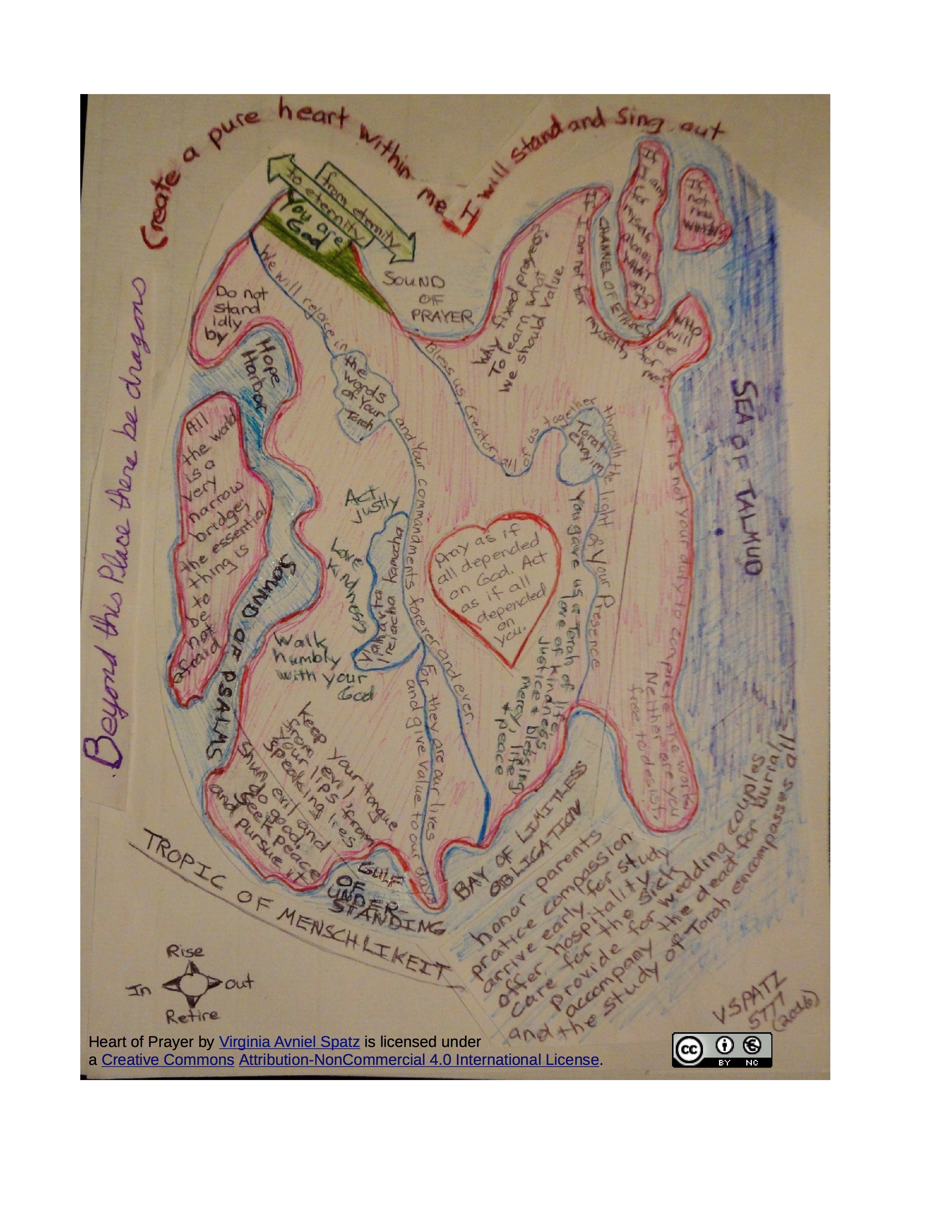
For me, one clear answer is the liturgy, which I tried to express in the “heart map” below. Another is ensuring that we recognize, and regularly celebrate, the many opportunities to prove one’s worth to the community highlighted by Bourke and Gordon above. I remain confused by Junger’s youthful state of mind and join critics of Tribe who find that his “danger” focus led him to glorify war and miss abundant examples of courage.

As it happens, this year’s National Blog Posting Month theme is “Type your heart out.” Look for more daily posts on courage, heart, Judaism, and covenant as November unfolds.

heart

NOTES:
Tribe: On Homecoming and Belonging NY. Sebastian Junger. Hatchette Book Group, 2016

Heart map inspired by Personal Geographies: Explorations in Mixed-Media Mapmaking by Jill K. Berry.

Prayer Warm-up: From Self to Community

Part of the early morning warm-up for prayers — along with awareness of our blessings and awakening body, soul, and mind — is moving from what Mishkan T’filah [Reform prayerbook] calls “self-fulfillment” to “social imperatives of community.” And that means beginning to move through the individual joys and concerns that we brought with us to a communal awareness — of each other and the world beyond these walls.

…To me it’s a little ironic that Mishkan T’filah editors discuss this in the introduction but don’t include my favorite way to accomplish this — the psalms — in the prayerbook proper….

Psalm 30 in particular, on the handout (Psalms Handout; see below), is a great vehicle for moving through our personal laments and dancing, shaken-ness and solidity, as we become aware of participating in thousands of years and millions upon millions of voices crying out and healing, praising without ceasing.

In this season of Elul, Psalm 27 is also recited, asking God to help us feel the divine presence as we seek to return to ourselves, as individuals and as a People in the new year.

And, finally, I repeat a teaching I learned earlier this summer about the nearness of all we need — like the water right in front of the deer in Psalm 42 — and how it is, even still, for us to experience what sustains us. We do, after all, have to become vulnerable, if only for moment.

Note: Please note that Rabbi Dr. Tzvi Hersh Weinreb’s first name contains a typo on this handout, PsalmsAugust22. My apologies.

See also, “Morning: Blessing, with Echo of Gunshots.”

Yet More on Psalm 27 (3 of 4)

The close of Psalm 27 —

קַוֵּה, אֶל-יְהוָה: חֲזַק, וְיַאֲמֵץ לִבֶּךָ; וְקַוֵּה, אֶל-יְהוָה.

Hope in the LORD; strengthen yourself, let your heart take courage, and hope in the Lord [Psalm 27:14]

— is often cited as a motivational aphorism, particularly for the penitential season. This is its role in this meditation for Elul, for example.

Psalms 27:14 is employed in the Babylonian Talmud as a proof-text for appropriate attitude in prayer. The passage includes a discussion on prayer and hope, including — like the question Langston Hughes asks in “Harlem” — what happens to hope deferred.

Psalms 27:14 stands out in that it uses the second person (command) form, while the previous 13 verses are in the first person: “God is My light…whom should I fear?” etc. This raises the question: Whose heart is to hope?
Continue reading Yet More on Psalm 27 (3 of 4)

Exploring Psalm 27 — (1 of 4)

For a little over 200 years, Psalm 27 has been associated with the season of repentance: Some have the custom of reciting this psalm during Days of Awe (10 days), some for the whole month of Elul as well (40 days), and some beginning on Rosh Hodesh Elul and continuing through Hoshana Rabba (51 days). There are several explanations for this association. Most focus on the psalm’s themes; also noted: the expression “were it not” — לוּלֵא — in verse 13 spells Elul — אלול — backward.

Many siddurim include the full psalm somewhere in Psukei D’zimrah (verses of song, in the morning service). Mishkan T’filah includes the single verse, 27:4, for which there are a number of popular tunes (p.662 in “songs and hymns”).
Continue reading Exploring Psalm 27 — (1 of 4)

Psalm 30: Words, Chant, Song

some resources for exploring Psalm 30

Word-based Commentary

So far the most thorough and useful commentary I’ve found on-line is still Schechter’s “A New Psalm”. [UPDATE 2017: Sadly, this on-line resource appears to be gone; Segal’s A New Psalm: The Psalms as Literature is now published by Geffen Books.] If anyone has a resource to suggest, please share.

A number of commentaries focus on the word “dilitani” — you have drawn me up — in the second verse: it reflects the Bible’s frequent use of wells/water imagery. But the language here connotes a pail pulled up from a well, which has to go down in order to rise in a useful way. And, as R. Benjamin Segal in the Schechter commentary notes, deep contrasts run throughout the psalm.

Joel Hoffman, in My People’s Prayer Book, notes that English has no direct way to translate the famous phrase:
בָּעֶרֶב יָלִין בֶּכִי וְלַבֹּקֶר רִנָּה
b’erev yalin bekhi v’laboker rinah

He suggests “tears abide” or “weeping spends the night” for “yalin bekhi.”
Continue reading Psalm 30: Words, Chant, Song

Robe, River, and Bond in Morning Prayer

Wrapping

The early morning section of a Jewish prayer book focuses — with some variety in content and order (see below) — on wraps:

  • God is robed in majesty (Psalms 104:1-2).
  • Jews are wrapped in fringes (blessing for wearing a tallit [prayer shawl]).
  • Humans take refuge in the shadow of divine wings (Psalms 36:8-11).

The focus then shifts — with the verse, “For with You is the fountain of life. In Your light do we see light” (36:10) — away from God’s universal (and one-sided) kindness toward a more specific relationship with expectations on both parts: “Continue Your lovingkindness to those that know You and Your righteousness to the upright in heart” (36:11). This is followed by verses from Hosea (2:21-22) promising betrothal “in righteousness,” “in justice,” “in lovingkindness and in compassion,” and “in faithfulness.” (More below on these verses, tefillin, and the upcoming World Wide Wrap.)
Continue reading Robe, River, and Bond in Morning Prayer

Further Awakenings in the Siddur

The Soul, Slow Waking, and a Little Grammar

Beyond the first two lines of the earliest morning prayers — it takes some of us a long time to make those first few steps — Jewish morning blessings continue to focus on awakening, with attention to body, soul, and Torah/mind. Here are some notes on “the soul” as well as a tune for slow wakers, as well as notes on Hebrew grammar related to this variant of the waking prayer.

Elsewhere on this blog, is a post, prepared for Tu B’svhat last year, and focusing on one of the daily blessings: Strength to the Weary. There are more posts relevant to the early morning prayers, which can be found, I hope, through the search function. Other resources and ideas are always welcome, although this blog cites as general references only egalitarian sources.

NOTE: Temple Micah‘s siddur study group will explore, over the next few months, Birkhot Hashachar [Morning Blessings] and Psukei D’zimrah [Verses of Song]. Discussions will begin in, and center around, the prayer texts themselves. All are welcome. (More details, schedule and a handout to frame group-led discussions is available on the siddur study group page.)

Please note that the Source Materials page offers citations and more details about many books and other resources cited here.


Continue reading Further Awakenings in the Siddur

Notes on Psalm 27

Two Sources for Basic Commentary
Rabbi Benjamin Segal offers an analysis of Psalm 27 in its biblical-literary context and discusses the unity of psalm, behind its apparently disparate set of emotions. The very readable series from Schechter Institute in Philadelphia also includes complete text of each psalm in English and Hebrew. This commentary includes a note on the use of Psalm 27 in Elul and the Days of Awe. [UPDATE 2017: Sadly, this on-line resource appears to be gone; Segal’s A New Psalm: The Psalms as Literature is now published by Geffen Books.]

Machzor Lev Shalem offers explanatory notes as well as a few thoughts on Psalm 27 in the penitential season. Unfortunately, the Rabbinical Assembly’s link to this material, previously offered here, is no longer public. Instead, a few notes are shared in More Exploring Psalm 27 (2 of 4). (Here is the machzor’s own website.) The Kol Nidrei sample pages include Zelda’s poem on “that strange night,” inspiration for this essay during Elul 5772.

Continue reading Notes on Psalm 27

Beyond Body and Soul: Expanding Morning Prayers

I have heard it said, frequently from the bima of Temple Micah (Washington, DC), that a proliferation of words doesn’t always aid prayer. Rabbi Danny Zemel has often said that his own preference would be to choose just a few words on which to focus at any prayer service. I understand this perspective and do sometimes find a day’s worth of prayer in just a few words…

Ribon kol hamaasim [Source of all Creation]
Adon kol han’shamot [Sovereign of all souls]…
Mishkan T’filah (Shabbat Morning I), p.196

…to take just one example.

But I confess that I love words. Lots and lots of them. I am particularly fond of the psalms and of the “Nishmat” prayers which immediately precede the official call to worship on Shabbat and Festival mornings. I miss them when they’re not around.

Nishmat” does appear in Mishkan T’filah, but Temple Micah often skips this. Psalms are generally pretty scarce in the “new” (2007) prayerbook’s morning service, and we usually sing only Psalm 150. So, I carry an extra siddur and quietly add my favorite psalms, as well as the opening and closing prayers for Psukei d’Zimrah [songs of praise, i.e., “Baruch She’amar” through “Nishmat“].

For the most part, I just hope this is not too distracting to others, and I try to keep my finger on the “right” page in case a visitor needs orientation. However, there are times when this practice creates some interesting juxtapositions, one of which I share here.
Continue reading Beyond Body and Soul: Expanding Morning Prayers