Covenant and Liturgy

A pair of questions disturbed journalist Sebastian Junger as a young suburban Boston resident, living “in a time and a place where nothing dangerous ever happened,” he tells us in  Tribe: On Homecoming and Belonging:

How do you become an adult in a society that doesn’t ask for sacrifice? How do you become a man in a world that doesn’t require courage?
— Tribe, p.xiv

I found these oft-quoted lines baffling, and I was not alone in this reaction:

I am tempted to remind Junger that sacrifice and courage are necessary in many fields of life, from parenting to volunteering in refugee camps. He could also join a solidarity movement. That is what he claims he is seeking, after all.
Joanna Bourke in The Guardian

His analysis of life in Boston and its suburbs, for example, totally overlooks the sacrifices made by teachers, nurses, or those fighting for social justice, workers’ rights, against racism or other social ills in his own or other communities as well as the dangers experienced by African Americans or the poor in nearby Somerville or Boston itself.
Suzanne Gordon in Washington Monthly

But Rabbi Danny Zemel, in his Rosh Hashanah sermon at Temple Micah (DC), explained that he finds these questions “paramount,” understanding them somewhat differently in Jewish terms:

How do we become counter cultural? How do we become breakers of idols?”

Zemel points out that “[the Jewish] covenant commands us to love the stranger because we were strangers in the land of Egypt,” and argues that the synagogue should be a “place where we can learn and absorb” a “counter-cultural” message in a world that can seem to applaud self-interest over group interest. He asks:

How do we learn this call – actually more than just learn it, but feel it in our being? How does it become “us?”

How does it become “us”?

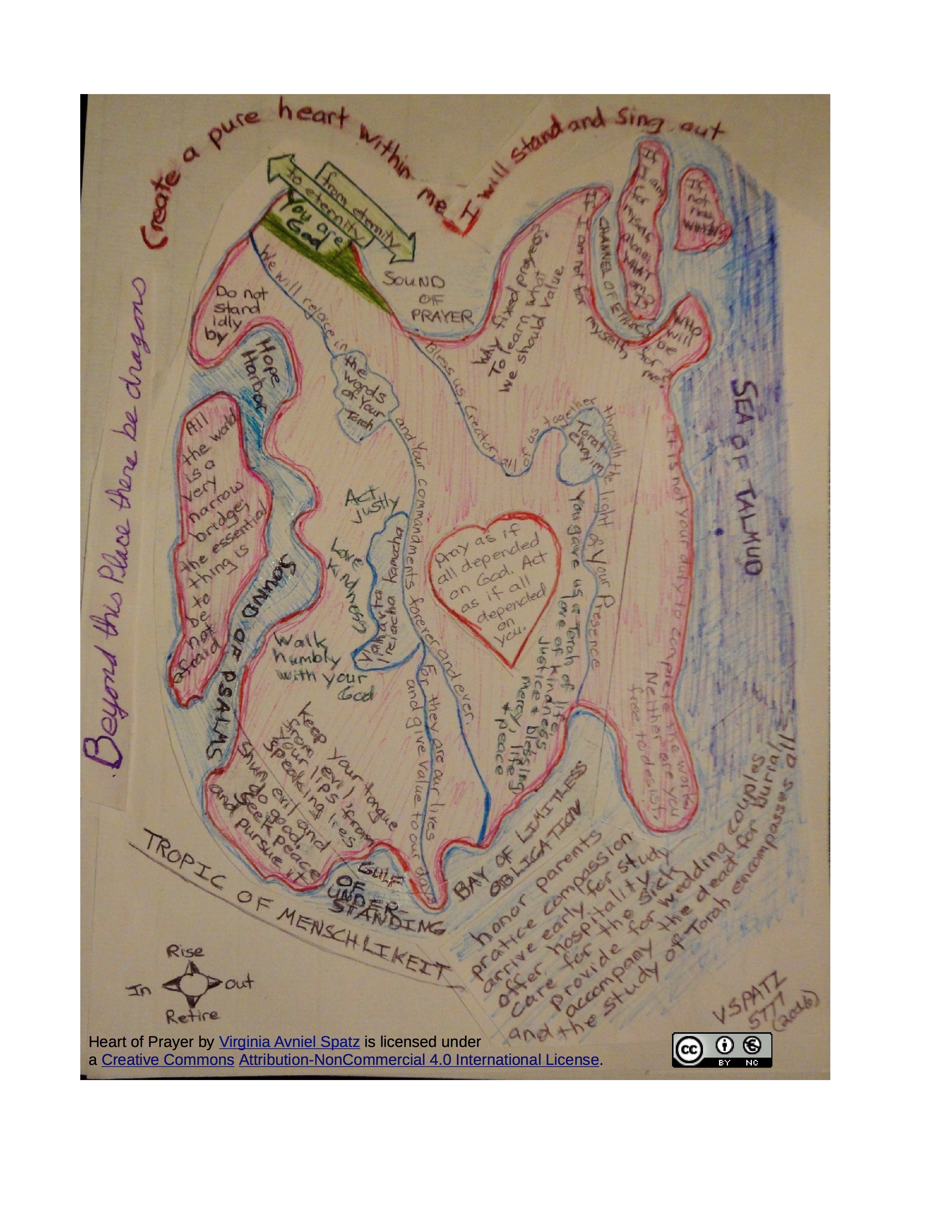
For me, one clear answer is the liturgy, which I tried to express in the “heart map” below. Another is ensuring that we recognize, and regularly celebrate, the many opportunities to prove one’s worth to the community highlighted by Bourke and Gordon above. I remain confused by Junger’s youthful state of mind and join critics of Tribe who find that his “danger” focus led him to glorify war and miss abundant examples of courage.

As it happens, this year’s National Blog Posting Month theme is “Type your heart out.” Look for more daily posts on courage, heart, Judaism, and covenant as November unfolds.

heart

NOTES:
Tribe: On Homecoming and Belonging NY. Sebastian Junger. Hatchette Book Group, 2016

Heart map inspired by Personal Geographies: Explorations in Mixed-Media Mapmaking by Jill K. Berry.

Confronting Jackals of Injustice

“Who will confront the wickedness of all the raw racial hatred marinating in this free land?” asked Rev. T. Anthony Spearman during the North Carolina Council of Churches recent “Seminar on Race, Power, and Privilege.” The powerful sermon begins with a text from 2 Samuel 21: When her sons and five other men are subject to an extrajudicial execution and left without burial, Rizpah mounts a single-handed protest. She maintains a vigil for six months — “risking her own safety and sanity,” as Rev. Spearman describes it — until King David is finally moved to order proper burial for all seven men.

“Back around 9th Century BCE, [Rizpah] would have been my choice for mother of the year,” Rev. Spearman declares. “In all of antiquity there may of a certainty be none as devoted, radical or courageous.” He elaborates:

In her world, she had no authority. Hers was a voiceless life. She was devoid of power…a victim of what seems to be this nation’s cherished legacy, the hierarchy of human values that are known as …classicism, sexism, and racism.

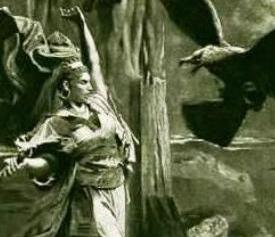
detail of 1875 painting by George Becker. See, e.g., Heroines of the Bible in Art (1900)
George Becker, 1875 (Detail). See, e.g., Heroines of the Bible in Art (C. E. Clement, Boston, 1900)

Allan Aubrey Boesak says this mother does what she does — risks, resists, and reconciles an entire nation — all by her lonesome and silent self. She demonstrates how to truly beat a sword into a plowshare by doing justly, loving mercy and walking justly with her God.

…[Rizpah’s witness] is not dissimilar to that of Sybrina Fulton, Lesley [McSpadden] Brown, Samaria Rice..

From the beginning of the harvest til the rain fell down, her motherly heart was broken but her devotion was fully intact. For about six months R risks her safety and sanity to drive away the vultures of viciousness, the vultures of vulgarity, the vultures of victimization…. the jackals of injustice…

…although in anguish for the dead, her actions were on behalf of the living…only two of the young men were her sons, she fought on behalf of them all.
— from T. Anthony Spearman’s April 23 sermon (full sermon below)

Rev. Spearman notes that Rizpah’s story is not currently in Christianity’s common lectionary — it is also missing from annual Jewish reading cycles — and suggests its inclusion so that more people would be prompted to follow her example. Meanwhile, Rev. Spearman calls us:

Our times are in search of those with spirit of Rizpah, those who will rise up and do justice, love mercy and walk humbly with their God, those who will stand against the ones who keep making and upholding unjust laws.

Is there anyone willing to bend the moral arc just a little bit more?
Anyone willing to repent for the deaths of so many of our sons and our daughters?
Who will shoo the vultures away from the corpse of Michael Brown and Freddie Gray?
Who will discourage the jackals from ravaging the transgender body of Zella Ziona?
…demanding the repeal of House Bill 2?
Who will rise up and…confront the wickedness of all the raw racial hatred marinating in this land?

It’s time for us to confront racism. It’s time for us to confront privilege, it’s time for us to confront power.
— Spearman (full sermon in video below)                                                              NC Council of Churches’ Critical Issues Seminar: Race, Power, and Privilege

Six Months is a Long Vigil

Six months is a long time for the sort of vigil Rizpah kept: “Can you just imagine the gruesome scene with those seven blood-covered bodies…,” Rev. Spearman asks, offering graphic details and concluding with “and the noble Rizpah protecting them from the scavengers waiting to gorge themselves on those corpses.”

buttonSix months is also a long time for the sort of vigil Beverly Smith has been keeping: Alonzo Fiero (Zo) Smith, age 27, died in custody of DC special police officers (SPO), November 1, 2015, in confusing circumstances that included no criminal charges; his death was ruled a homicide with compression of the torso (SPO knelt on his back, for one example) a contributing factor. For six months, Ms. Smith has been demanding accountability for what happened to her son. And, just like Rizpah, and the mothers of many other victims of police brutality, Ms. Smith is demanding justice for others as well as her own child. She waits still.

On May 1, the sixth-month anniversary of Zo’s homicide, District residents joined Ms. Smith in a march and rally honoring his memory and demanding, in his name, community control of police. (Read about Zo’s case and his mother’s campaign in East of the River and the Washington Informer; learn about the Justice 4 Zo community)

And, of course, many parents and concerned community members — including some whom Rev. Spearman included in his sermon — have been keeping similar vigil in one way or another for much longer. (See, e.g., Listening to Voices of Grief and Struggle.) Many of those involved in these struggles have joined together in groups like Mothers Against Police Brutality and Coalition of Concerned Mothers.

Where Were Rizpah’s Neighbors?

Rev. Spearman and Allan Aubrey Boesak, whom he cites, note that Rizpah accomplished what she did “all by her lonesome and silent self.” This rightly characterizes the bible story and highlights the power of one individual to make a difference. But it leaves open the question of what Rizpah’s neighbors were doing — or not doing — for the months she kept her vigil alone:

Did neighbors just shake their heads at Rizpah while going about their own business? Were most people too caught up in demands of their own lives to involve themselves? Or, perhaps, fearing to speak out against King David? Or, just maybe, were some of Rizpah’s fellow citizens working elsewhere, in whatever ways were available to them, in support of her protest? Did groups organize solidarity actions that didn’t make it into Second Samuel?

Rizpah’s example of solo action is inspiring and important. And I would hope that each of us answers, “I will,” when faced with Rev. Spearman’s query: “Who will rise up and…confront the wickedness of all the raw racial hatred marinating in this land?” But I also pray that none of us is left, like Rizpah, to face those “vultures of viciousness” or “jackals of injustice” alone.

LongworthRev. Spearman is incoming president of the NC Council of Churches and senior pastor of St. Philip African Methodist Episcopal Zion Church in Greensboro. He is active in the Forward Together Movement/Moral Mondays.

I had the honor of meeting and protesting with Rev. Spearman as part of a Black Lives Matter Die-In at the U.S. House of Representatives in early 2015.

BACK

Prayer Warm-up: From Self to Community

Part of the early morning warm-up for prayers — along with awareness of our blessings and awakening body, soul, and mind — is moving from what Mishkan T’filah [Reform prayerbook] calls “self-fulfillment” to “social imperatives of community.” And that means beginning to move through the individual joys and concerns that we brought with us to a communal awareness — of each other and the world beyond these walls.

…To me it’s a little ironic that Mishkan T’filah editors discuss this in the introduction but don’t include my favorite way to accomplish this — the psalms — in the prayerbook proper….

Psalm 30 in particular, on the handout (Psalms Handout; see below), is a great vehicle for moving through our personal laments and dancing, shaken-ness and solidity, as we become aware of participating in thousands of years and millions upon millions of voices crying out and healing, praising without ceasing.

In this season of Elul, Psalm 27 is also recited, asking God to help us feel the divine presence as we seek to return to ourselves, as individuals and as a People in the new year.

And, finally, I repeat a teaching I learned earlier this summer about the nearness of all we need — like the water right in front of the deer in Psalm 42 — and how it is, even still, for us to experience what sustains us. We do, after all, have to become vulnerable, if only for moment.

Note: Please note that Rabbi Dr. Tzvi Hersh Weinreb’s first name contains a typo on this handout, PsalmsAugust22. My apologies.

See also, “Morning: Blessing, with Echo of Gunshots.”

Surrounded by Big Things: Jonah, Harvey, and Yom Kippur

One of the things we might notice about Jonah is that he’s a little hard to follow: one minute, minding his own business, in his own land, and next thing he’s on the way to Joppa, on the ship, in the hold, tossed out into the sea, in the fish’s belly; then in Nineveh; and finally sitting outside the city arguing with God about a gourd. In honor of Jonah and his varied travels, these remarks go a number of different places, and, in an even deeper homage to Jonah, I can’t really promise that we’ll understand the point in the end. But I do hope it will be an interesting ride.
Continue reading Surrounded by Big Things: Jonah, Harvey, and Yom Kippur

Maybe: Janis Joplin, the Chantels, and Jonah

“Maybe” is not always comfortable in a world that values black and white, in or out, yes or no. But the Book of Jonah, recited on Yom Kippur afternoon, suggests that coming to terms with “maybe” is a key lesson of these days between “it is written” and “it is sealed.” And two musical approaches to “Maybe” help illuminate Jonah’s struggles with concept.
Continue reading Maybe: Janis Joplin, the Chantels, and Jonah

Opening and the Ark

What does it mean to open the Ark?

In my experience the Torah service exhibits more diversity than any other part of a Jewish service. Reading length varies across denominations. General approach ranges from informal circles embracing Torah to formal, long-standing choreography. And the Torah service is one spot where women’s absence on the bima, in congregations without egalitarian practice, is the most obvious. Moreover, it is one of the few moments where division of Jews into Kohen, Levite, and Yisrael is still obvious in Orthodox and Conservative congregations (where a kohen [priest] is called to the first aliyah [“going up” Torah honor] and a Levite to the second).

How much is shared across this variety? And what do the variations mean? — Are they matters of custom, preference, and leadership style, or theology? Which one(s) work for you and why?

The Torah service is not the only point when the Ark is open. But the beginning of the Torah service presents a prominent opportunity to contemplate what it means to us, individually and communally, to open the Ark… to approach Torah and have Torah brought into our midst.

Here is a prayer of my own, based on words commonly recited as the Ark is opened. Below that are links to the prayers that inspired mine — B’rich Shmei and Anim Zmirot — and more thoughts on opening the Ark.

What is your prayer for approaching the Torah?
To what are you opening?

Entering the Torah Service
Here in this Torah Service we travel the wilderness in the company of the Ark, stand again at Sinai, and re-enact the process of transmission and interpretation as multiple individuals rise to bring the Torah from script to voice. Time collapses. We join the ageless chorus reciting verses that challenge and comfort, awe and enrage, perplex and command. We feel the presence of Jews who have experienced much, in endurance and in celebration, preserving these words. We feel the call of future Jews depending on us to grasp this Tree of Life and hold it for them.

At this expansive point we pray that our hearts open to the essence of Torah and ask for the gift of God’s good light to guide us through our daily lives.

In this precious, liminal moment, fear and need merge with strength and hope. May we all, particularly those observing lifecycle events at the Torah, emerge from this service with a renewed sense of blessings. Let the divine flow of communication represented here bring to us, and to all whom we touch, peace, mercy, sustenance, and gratitude. Thank you for this good teaching. Amen
–Virginia Spatz

More on Opening the Ark

My prayer, above, is based in part on language and themes found in several prayers, including B’rich sh’mei [blessed is the Name], recited at the start of the Torah service.


בריך שמה דמרא עלמא
Blessed is the name of the ruler of the universe

(from Zohar, parashat vayakhel)

The Zohar says, “Rabbi Shimon said: When the scroll of Torah is removed from the ark to be read to the congregation, the heavenly gates of mercy are opened and love is aroused in the world above. Here a person adds….”B’rich sh’mei d’marei alma…. [Blessed is the name of the ruler of the universe!…]”

Blessed is the name of the Master of the universe. Blessed is your crown and your place [v’atrach] May You love your people Israel forever. Reveal the salvation of your right hand to your people in your sanctuary. Lead us to discover the goodness of your light, and accept our prayer in mercy. May it be your will to prolong our lives in happiness.

I am the servant of the Holy One, whom I revere and whose Torah I revere at all times. Not on mortals do I relay, nor upon angels [or “messengers”] do I depend, but on the God of the universe, the God of truth whose Torah is truth, whose prophets are truth, and who abounds in deeds of goodness and truth. In God do I put my trust; unto God’s holy, precious being do I utter praise. Open my heart to Your Torah. Answer my prayers and the prayers of all Your people Israel for goodness, for life, and for peace. Amen.
–See My People’s Prayer Book


BACK


אַנְעִים זְמִירוֹת וְשִׁירִים אֶאֱרֹג כִּי אֵלֶיךָ נַפְשִׁי תַּעֲרֹג
Soothing songs and poems I weave because my soul longs for You.

I was also inspired by a woman’s kavvanah [intention] associated with Anim Zemirot. This hymn is recited when the Ark is open, sometimes early morning, sometimes in concluding prayers; sometimes on Shabbat, often on Festivals. It is not included in the Shabbat Mishkan T’filah, but it does appear in the Weekday/Festival edition. Here’s a link to the full text of Anim Zemirot, sometimes called “Shir HaKavod [Song of Glory],” as well as several recordings.

Here is the women’s meditation from Aliza Lavie’s collection:.


Master of the universe. Just as the Holy Ark is opened here, so may a window be opened in heaven: the gates of mercy. May my prayer be accepted among the other pure prayers that are surely accepted before You, and may it be a crown for Your head….Remember me, my husband, my beloved children, and dear ones, at the time that is called a time of favor and a time of success, so that our lives may be called lives of joy, lives of sustenance, lives of blessing, lives of peace, lives of mercy, and of Your good teachings. Bless us with the three keys that have never been handed over to any emissary, but come about only through Your own blessing. With this I conclude; hurry to my aid, God of my deliverance.

…Protect us all from that which my heart fears, and spare me, my husband, and my children from mortal charity. Hear my prayer [name of worshipper], daughter of [mothers name], as You heard the righteous Hannah and the other righteous women. Amen. Selah
A Jewish Woman’s Prayer Book. Aliza Lavie NY: Spiegel & Grau, 2008


BACK

More Thoughts on Opening the Ark

A few more thoughts, from two different prayer books, on opening the Ark and taking out the Torah…

We approach the Torah slowly. First we open the ark so that the Torah is visible. We look at the Torah but refrain from touching. Next, the Torah is removed from the ark and held by the service leader. Later the Torah is carried through the congregation, and everyone can touch the Torah. This demonstrates that the Torah is not the property of those leading the services; the Torah belongs to the Jewish community. Finally, the coverings of the Torah scroll are removed, allowing us a privileged intimacy with the words we hear.
– Dan Ehrenkrantz, Kol Haneshamah [Reconstructionist] siddur

The verses we sing when we take the Torah scroll from the Ark and when we return it recall the Israelites’ journey through the wilderness, when they carried the Ark with them….We are a people defined by history. We carry our past with us. We relive it in ritual and prayer. We are not lonely individuals, disconnected with past and present. We are characters in the world’s oldest continuous story, charged with writing its next chapter and handing it on to those who come after us.
–Jonathan Sacks in Koren Sacks [Orthodox] Siddur, p.xxxiv-xxxv

BACK

Key Footnote

I asked local scholar Norman Shore for help with understanding the “three keys.” Here are the sources he provided, shared with gratitude.

R. Johanan said: Three keys the Holy One blessed be He has retained in His own hands and not entrusted to the hand of any messenger, namely, the Key of Rain, the Key of Childbirth, and the Key of the Revival of the Dead. The Key of Rain, for It is written, ‘The Lord will open unto thee His good treasure, the heaven to give the rain of thy land in its season,’ (Deut 28:12) The Key of Childbirth, for it is written, ‘And God remembered Rachel, and God hearkened to her, and opened her womb.'(Gen 30:22) The Key of the Revival of the Dead, for it is written, ‘And ye shall know that I am the Lord, when I have opened your graves.’ (Ezek 37:13). In Palestine they said: Also the Key of Sustenance, for it is said, Thou openest thy hand etc. (Ps 145:16) Why does not R. Johanan include also this [key]? — Because in his view sustenance is [included in] Rain.
— Babylonian Talmud, Taanit 2a-2b

And it came to pass after a while, that the brook dried up, because there had been no rain in the land (1 Kings 17:7). Now, when [God] saw that the world was distressed [because of the drought], it is written, ‘And the word of the Lord came unto him (Elijah), saying, Arise, get thee to Zarephath’ (ibid 8ff). And it is further written, ‘And it came to pass after these things, that the son of the woman, the mistress of the house, fell sick’ (ibid 17). Elijah prayed that the keys of resurrection might be given him, but was answered, “Three keys have not been entrusted to an agent: of birth, rain, and resurrection. Shall it be said, ‘Two are in the hands of the disciple[1] and [only] one in the hand of the Master?’ Bring [Me] the other and take this one, as it is written, ‘Go, shew thyself unto Ahab; and I will send rain upon the earth’ (ibid 18:1).”[2]
–Babylonian Talmud, Sanhedrin 113

Footnotes, like text, from Soncinco, public domain edition:
1) Since the key of rain was already in Elijah’s possession, and now he was asking for the key of resurrection too.

2) I but not Thou. The whole passage is adduced to shew how God, having given the key of rain to Elijah, obtained its return, and that the illness of the widow’s son was for that purpose.

RETURN from Footnote

God’s Favor, God’s Prayer

Berakhot 7a discusses the topic of God’s prayer:

R. Johanan says in the name of R. Jose: How do we know that the Holy One, blessed be He, says prayers? Because it says: Even them will I bring to My holy mountain and make them joyful in My house of prayer (Isaiah 56:7; more below). It is not said, ‘their prayer’, but ‘My prayer’ [תְּפִלָּתִי]; hence [you learn] that the Holy One, blessed be He, says prayers.

What does He pray? — R. Zutra b. Tobi said in the name of Rab: ‘May it be My will that My mercy may suppress My anger, and that My mercy may prevail over My [other] attributes, so that I may deal with My children in the attribute of mercy and, on their behalf, stop short of the limit of strict justice.’…

Isaiah 56:7
וַהֲבִיאוֹתִים אֶל-הַר קָדְשִׁי, וְשִׂמַּחְתִּים בְּבֵית תְּפִלָּתִי–עוֹלֹתֵיהֶם וְזִבְחֵיהֶם לְרָצוֹן, עַל-מִזְבְּחִי: כִּי בֵיתִי, בֵּית-תְּפִלָּה יִקָּרֵא לְכָל-הָעַמִּים
Even them will I bring to My holy mountain, and make them joyful in My house of prayer; their burnt-offerings and their sacrifices shall be acceptable upon Mine altar; for My house shall be called a house of prayer for all peoples.
–“Old” JPS translation (borrowed from Mechon-Mamre)

Continue reading God’s Favor, God’s Prayer

Throne, Heel, and Holidays

And whenever God sits upon His Throne of Glory He immediately thinks of the blue thread of the fringes worn by Israel, and bestows upon them blessings.
— footnote in Soncino edition, Chullin 89a

Does the color sapphire [sapir] somehow remind God of tekhelet [the blue of ritual fringes]? Or are the blues and God’s thoughts linked some other way? Are blessings contingent on the fringes? The process or causality described here is obscure to me. But I think the image can still inform this thread exploring tzitzit and “light” (minor) commandments. The key seems to be the importance of connection.
Continue reading Throne, Heel, and Holidays

Time for Silence? Time for Speech?

The Book of Kohelet (Ecclesiastes) offers thirty pairs of phrases elaborating on the theme of a “season set for everything” (Kohelet 3:1-8):

1) To every thing there is a season,
and a time to every purpose under the heaven:
2) A time to be born, and a time to die;
A time to plant, and a time to pluck up that which is planted;
3) A time to kill, and a time to heal;
A time to break down, and a time to build up
4) A time to weep, and a time to laugh;
A time to mourn, and time to dance;
5) A time to cast away stones, and a time to gather stones together;
A time to embrace, and a time to refrain from embracing;
6) A time to seek, and a time to lose;
a time to keep, and a time to cast away;
7) A time to rend, and a time to sew;
A time to keep silence, and a time to speak;
8) A time to love, and a time to hate;
A time for war, and a time for peace.
— Kohelet 3:1-8 (“Old” JPS at mechon-mamre

Continue reading Time for Silence? Time for Speech?

Not Quite Pi

Among Temple fixtures is a “molten sea,” a metal, fountain-type structure (1 Kings 7). It is described as 10 cubits across and 30 cubits “to compass it round about.”

The Babylonia Talmud uses this text to argue a general conclusion that circumference is three times dimeter (Eruvin 14a). This has long been discussed as an inexact approximation of pi.

Steven Dutch, a natural and applied sciences professor at the University of Wisconsin-Green Bay, explores this concept in some depth. See “Pi in the Bible?”
Continue reading Not Quite Pi